Artificial tsunami dam war bombs
May 16, 1943:
The First Artificial Tsunami in History
February 3, 2005
In 1943, the British had the idea of launching attacks on several German dams in the Ruhr area on the same night. It was an engineer, Barnes Wallace, who had this idea. The dams in question were concrete monsters. Wallace knew that the largest bombs that the bombers of that time could carry, which weighed three tons, would have had no more effect on these structures than pinpricks. At that time I was a child. I spent the war years in the seaside resort of La Baule. Many times we saw waves of bombers converging toward the huge concrete shelter that the Germans had built at Saint-Nazaire to house their submarines. I believe the ceilings were more than ten meters thick. Result: nothing. Wallace then had the crazy idea of attacking these dams with cylindrical three-ton bombs.
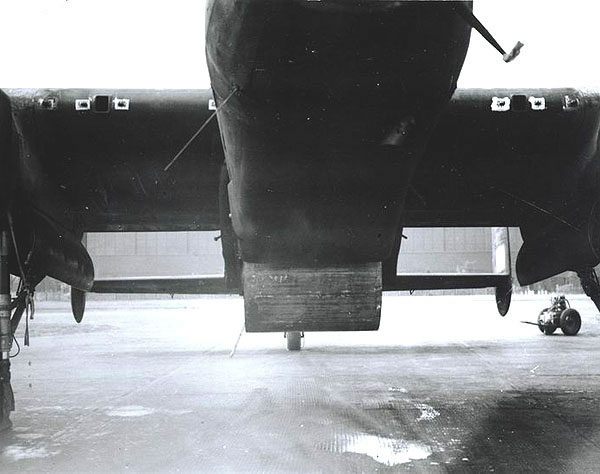
**Four-engine Lancaster bomber, seen from the front, with its three-ton cylindrical bomb. **
The idea was to approach the German dams-arches by flying very low over the lake, at twenty meters, and then to drop the bombs at a precise distance. The Möhne Dam had two towers that can be clearly seen in the following images, showing the breach obtained. The bomber was therefore equipped with a sight consisting of a simple plywood assembly. Looking through a plate found, he had to wait until the towers aligned with two marks, and when that happened, he only had to press the release button. For altitude control, lights were fixed at the ends of the bombers' wings. When the light spots they formed on the surface of the lake, the navigator, who observed them from his forward position, knew that the altitude was correct and transmitted this information to the pilot. The latter had only two things to do: aim at the space located halfway between the two towers and follow the navigator's altitude instructions.
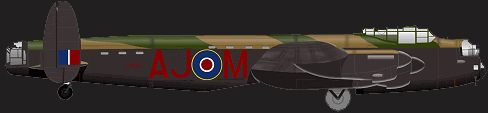
**Lancaster bomber equipped with its three-ton cylindrical bomb. **
It was absolutely necessary that the bomb not bounce when it hit the liquid surface on which it had to bounce several times. To do this, before release, it was spun rapidly using an electric motor and therefore gyroscopically stabilized.
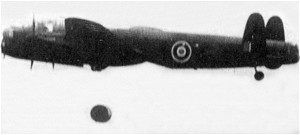
Release of a cylindrical bomb
The bombs had to make a precise number of bounces to finally hit the base of the dam at water level. Due to a miscalculation of the distance, one of the bombs missed its target, passing over it and exploding in the valley below. A damping system had been designed so that the bombs would not explode on impact (the speed of the bomber at the time of release was four hundred kilometers per hour, precisely). Stopped by the impact against the dam, the bombs then sank and were triggered by a pressure sensor.
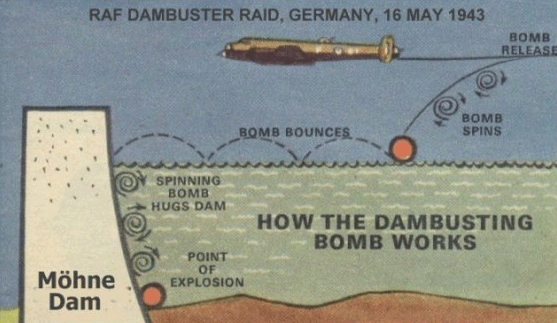
**Diagram of the attack by the "Dambusters", the dam breakers. **
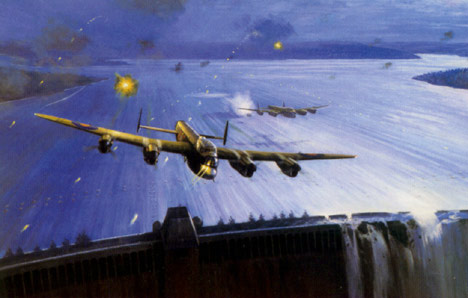
Lancaster bombers flying over the water reservoir of the Möhne Dam
Three bombs hit the Möhne Dam. None of them alone caused the structure to collapse. After completing their mission, the crews were perplexed and remained circling nearby. But a few minutes after the attack, the central part of the dam suddenly burst due to the cracks. The following photos show the breach thus created, measuring two hundred meters wide and thirty meters high, releasing one hundred and thirty million tons of water.
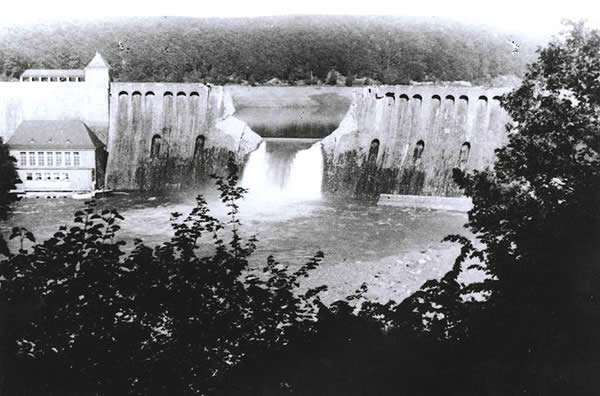
**The Möhne Dam after the attack. **
This was the first artificial tsunami in human history. Indeed, behind this breach there was a considerable mass of water. What spread was in all respects comparable to the tsunami phenomenon (or the mascaret, which corresponds to the image below). It was not a wave that spread through the valley, but a liquid front that advanced, preceded by a seven-meter-high wall, and which, that night, swept everything in its path, killing one thousand two hundred people.
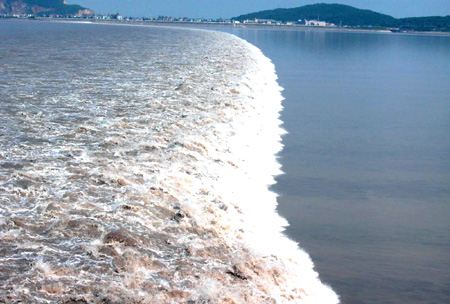
**Image of the propagation of a tsunami-like phenomenon (here a powerful mascaret on a river in China). **
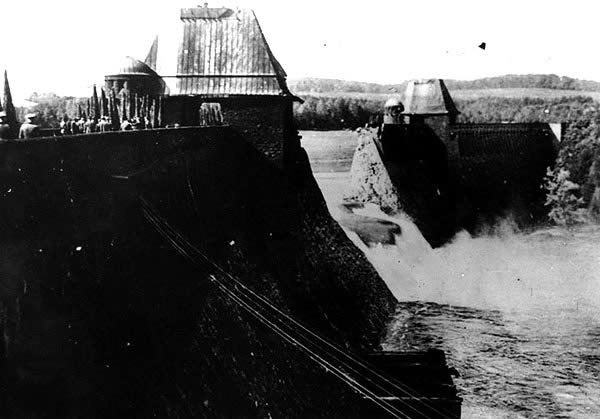
**The same, viewed from the side, showing the towers used for distance marking. **
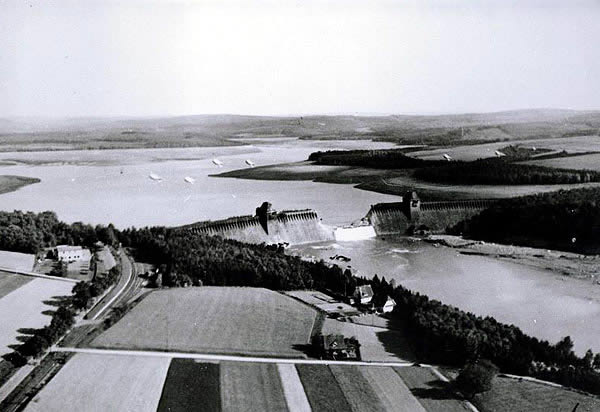
**Finally, a general view. Nothing remains of the installations located below, swept away by a seven-meter-high wave. **
If the charges had been exploded against the outer wall of the dam, the effect would have been negligible, because the energy would have been dissipated in the air, which is compressible. But water is an incompressible medium. When the bombs exploded against the inner wall of the dam, underwater, the water behaved like a reflector. The seismic shock communicated to the concrete proved sufficient to cause decisive cracks. But we must keep in mind that it was not the bombs that broke the dam, but the pressure of the water. The charges only played a role of trigger.
The seismic weapon
This weapon can be used in two ways. During a land operation, the charge must be buried at a great depth to prevent the energy from being dissipated towards the surface (it has been suggested that the number of earthquakes has significantly increased on the planet since the implementation of numerous underground nuclear tests). The implementation is infinitely easier during underwater experiments. It is sufficient, indeed, to place unlimited "thermonuclear" charges along a fault line on the seabed.
The most powerful thermonuclear weapons were tested by the Russians in 1961 on the island of Novaya Zemlya, in the north of the USSR territory. They were designed to be carried by "Bear" bombers (the Russian equivalent of the B-52). Therefore, their weight was limited to 12 tons. Dimensions: 2 meters in diameter and 8 meters long. The first of these two bombs was designed by Andrei Sakharov in a special experimental center called "The Installation." A few months later, he was surprised to discover that the Soviet military lobby had made a copy of his bomb in another center, which he was unaware of. He recounts this in his memoirs. It was after these two last experiences that he decided to refuse to continue working not for the defense of his country, but what he now considered an enterprise "run by mentally ill people." The two bombs, dropped from long-range bombers, each developed a power of 58 megatons. While the mushroom cloud of the Hiroshima bomb rose into the stratosphere, the fallout from the Russian bombs reached 200 kilometers in altitude, exiting the Earth's atmosphere, whose thickness is estimated at 80 kilometers. These weapons, of the FFF (fission-fusion-fission) type, had been "bridled," a part...