Tsunami, earthquake, nuclear explosions, geology
Article published in issue 914 of the magazine Science et Vie (November 1993)
**Below is a reproduction of the article published in the magazine, 11 years before the Indonesian tsunami, as communicated by one of our readers: **
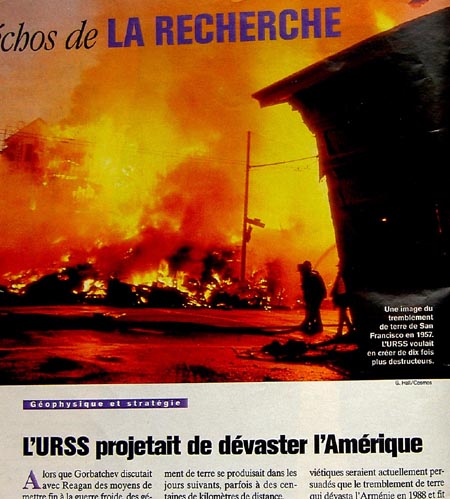
The USSR planned to devastate America
While Gorbachev was discussing with Reagan ways to end the Cold War, Soviet generals were studying ways to devastate America with earthquakes and tsunamis (tidal waves). This is what we have just learned from Oleg Kalougine, one of the KGB generals.
The devastation of the United States and Canada would have been achieved through "seismic bombs", in other words, nuclear bombs that would have been exploded underground. As early as the 1960s, Soviet seismologists had noticed that each time they conducted an underground explosion, an earthquake occurred in the following days. Sometimes at hundreds of kilometers away.
Thus, Alexeï Nikolaïev from the Moscow Institute of Geology reports that a bomb exploded near Semipalatinsk, in Kazakhstan, triggered earthquakes in Tajikistan, Uzbekistan and even Iran.
At first, people doubted a link between the underground nuclear explosions and the subsequent earthquakes, but finally the evidence was there. Nikolaïev and his team demonstrated that even low intensity explosions triggered earthquakes up to 1,600 km from the epicenter. Some Soviet scientists would currently be convinced that the earthquake that devastated Armenia in 1988, killing 45,000 people, was caused by a nuclear explosion 3,500 km away, at Novaya Zemlya.
Therefore, the Soviets exploded 32 underground bombs around their territory, to study the effects. In the early 1980s, civilian geologists designed a project to create very powerful bombs, capable of exerting strong pushes on tectonic plates.
The earthquakes never followed the explosions closely, but occurred several days later, which could allow the Soviets to claim innocence in the case of devastating earthquakes and tsunamis: it would not have been them, but fate.
Nikolaïev however acknowledges that it would have been difficult to specifically direct the effects against a given target. If California is particularly vulnerable, because the San Andreas fault coincides with the eastern edge of the Pacific plate, tectonic plates are in fact not well suited for such billiard-like games. Ikram Kerimov, deputy director of the Institute of Geology of Azerbaijan, estimates that much more research would have been needed before succeeding in reaching America, which is more than 8,000 km from the eastern coast of Siberia. Incidentally, we note that by playing such tectonic billiards, the Soviets could have devastated Japan as well, and if they had managed to move the Pacific plate, nothing says that the shock would not have been reflected on the Cocos and Nazca plates, devastating the western coast of South America - Peru, Bolivia, Chile, etc.
Former head of counterintelligence, now a reformist politician, Kalougine says he discovered the plans when he was tasked, in 1988, with overseeing the secret research of the Academy of Sciences.
Such revelations will certainly encourage some countries to check whether underground nuclear explosions (all of which are recorded by seismic detection) have not preceded earthquakes in their countries. We are thinking here of the one that occurred in Australia, yet one of the most stable continents, in 1990 (5.5 on the Richter scale, 11 dead, 120 injured), not to mention the one that devastated Tajikistan the same year.
Our comment:
The article could do without it. It should be noted that the famous San Andreas fault is not a subduction zone, but corresponds to the friction between two plates. Because of the excessive "dry friction", this sliding cannot occur occasionally, at the price of a very devastating earthquake in this region. A good image of what this sudden sliding of two plates against each other can be is a "snap of the fingers, between the thumb and the index finger".
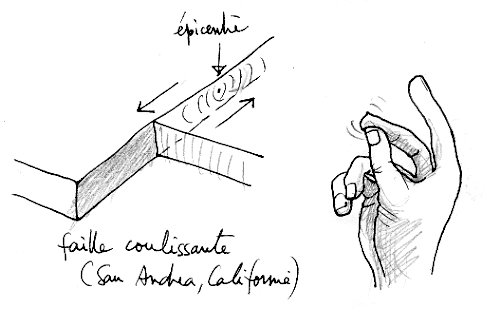
If an earthquake of this kind were to occur in San Francisco, similar to the one that devastated the city a century ago, there would be an epicenter, a point where the two plates would begin to slide. Then the movement would spread rapidly over more than a thousand kilometers. The intensity of the earthquake increases with the length of the fault involved. A similar phenomenon occurring inland would not generate a tsunami. The Science et Vie article indicates that the Russians had considered, well before the 1990s, that underground nuclear explosions could be used as triggers for earthquakes. They indicate that, according to them, the triggering of the natural phenomenon might not be immediate. It is hard to see how the Russians could have managed to attack a country like the United States by conducting nuclear explosions in their own territory, more than 8,000 km away. It is also hard to see how they could have operated by placing a device near the American west coast without revealing their act. It should be remembered that fictional films (like Superman) have already taken up this theme of triggering an earthquake near San Francisco with a nuclear device. But the concepts are clearly mentioned, eleven years before the Indonesian tsunami.
Recently, I saw an episode of the American series Stargate, where the heroes of the series saved the planet, threatened by the arrival of a huge meteorite. Throughout the plot, it was learned that it had not arrived by chance but had been positioned by the long-time enemies of the Americans, the Gohahould, who had even gone so far as to build this meteorite around a particular substance "that could not be found in our galaxy", such that if the space rangers had wanted to explode this asteroid, the effects would have been even worse. Then appears a new element of the plot, involving the use of a parallel universe to ours. "Mac Gyver" and his team manage to transfer the ship and the asteroid "into hyperspace", which causes these two objects to "pass through the Earth without damage" by reappearing on the other side. It is quite "identical".
Back to Guide Back to Home Page
**Number of visits to this page since February 9, 2005: ** ---