The Space Cow Boys Gather
June 22, 2008 –
Updated June 24, 2008
I haven’t had time in recent days to put together an information page.
Wikipedia: You remember that an internet user once sent a very polite and diplomatic message to the president of Wikipedia-France (38 years old, homemaker, municipal council member in a village of a few hundred inhabitants).
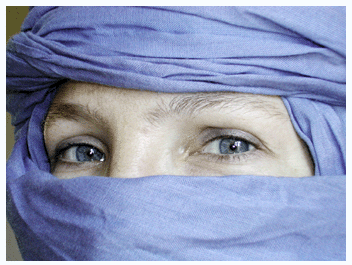
The "pseudo" president of Wikipedia France, version "Anthere"
(source: Wikipedia, Anthere's user page)
http://en.wikipedia.org/wiki/User:Anthere/me
The same person, described as a "star" by one of her fans
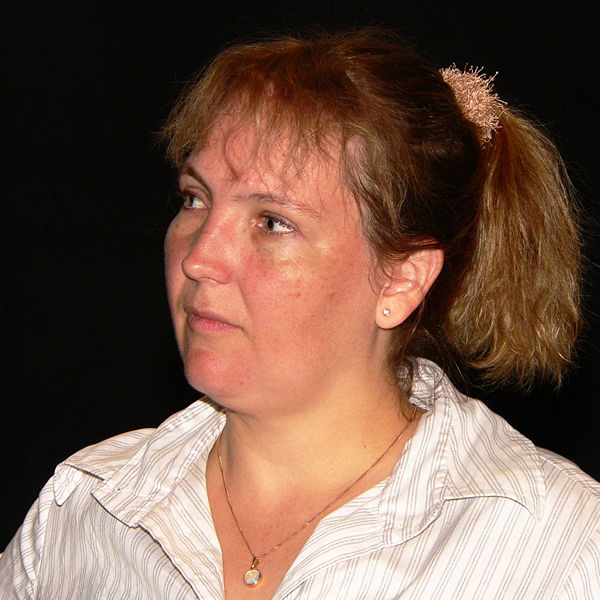
The president of Wikipedia-France, Florence Devouard, 38, alias "Anthere" (bottom removed)
(source: Anthere's user page, Wikipedia site)
Some believed this woman had any real authority to restore order in this structure, now a de facto institution completely under the control of administrators who no longer even bother to list anything about themselves on their personal pages. No age, no skills, nothing. It's just a group of guys who operate by co-optation and recruit their own kind.
We don’t really know what this president does, since she seems to preside over nothing at all. Public relations, maybe?
Some mocked me for not knowing that one could freely access their IRC (chat network among administrators). Readers shocked us by revealing the abysmal level of administrator discussions, always hidden behind anonymity, in which the president herself participated, using the same tone.
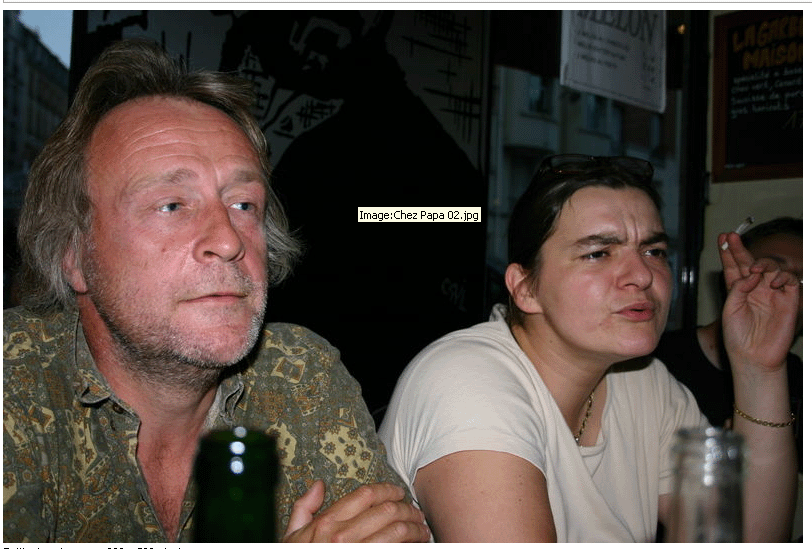
Alvaro and Notafish, specimens of Wikipedia administrators
(source: Wikipedia, photo "at dad's")
The conclusion is simple: this fantastic idea, of obvious utility, has fallen into the hands of people whose majority are individuals whose level of culture, elegance, and maturity readers will appreciate. Readers who follow these "fascinating chats" are encouraged to keep sending us excerpts, especially those involving the president under the pseudonym "ANTHERE."
The power of Wikipedia is that of this horde of masked characters; and the president responded that she herself could do nothing, and that the only recourse was to appeal to arbitration committees, themselves composed of... administrators.
INFO-KAFKA
Thus, Wikipedia’s status remains entirely unclear. Who owns it? Is it democratic or non-democratic? Who controls this factory of nonsense? Is there any structure capable of controlling it? Given its scale, this site has become a kind of reference for teachers. Can they recommend its content to young people under their care? Is this site an objective reflection of the evolution of science and contemporary knowledge? You know that discussions on this topic are already in full swing.
In this regard, I issue a call for testimony from people who, having wished to post public interest content on Wikipedia, were blocked from editing by unidentified administrators. What scientists, intellectuals, would be discouraged from contributing to this project, fearing confrontation with ignorant teenagers hiding behind their pseudonyms?
This is absolutely not a personal vendetta by Jean-Pierre Petit against Wikipedia, following my lifetime ban in October 2006 by a handful of idiots whom I care nothing about. The real question is: can this structure be cleansed, even, let's say, saved? One internet user specifically asked the president:
"Administrators should at least list the extent of their knowledge and skills on their personal pages."
Immediate refusal.
She compared this group of administrators to the referees in scientific journals who control the content of published articles. In fact, we know that among these administrators there are... and added:
- If your article was rejected, would you consider demanding to know the identities of those who rejected it?
A small detail: those referees are supposed to be scientists. At Wikipedia, the expert is... anyone, chosen and co-opted by other "anyones."
So, as Raymond Devos would say, it's only natural that it becomes... anything.
I’ll add that the system of anonymous referees, which spread after the war, has become a plague, a brake on scientific progress. This is the opinion of unquestionable figures such as Professor Jean-Marie Souriau, one of the greatest living mathematicians. Today, physics is sinking into an unprecedented crisis (see my presentation of Smolin’s book, "Nothing Is Wrong in Physics!", 2007). The fraud of superstrings is beginning to spread, despite the support of various science media and sites like Futura-Science, which, after the "M-theory," now extols the virtues of an "F-theory" (M for "mother," F for "father").
It has become... scientific nonsense.
There are journals like "Classical and Quantum Gravity" that aim to establish themselves as "authorities in the field." We forget that quantum gravity, it doesn’t exist, since no one has yet succeeded in quantifying gravity or the graviton. We should rather speak of a "project of a journal." This won’t stop referees from rejecting articles with:
Sorry, we don't publish speculative works
So, dear madam, the example you rely on to justify maintaining your secret society doesn’t hold. Within Wikipedia, administrators worry that they perceive an attack aimed at destroying this project, and they want to "defend" it. Not destroy it, but cleanse it. This must be done, urgently, because the drift is only worsening each day.
The page "The Drift of the French Wikipedia," which I will update with what readers have sent me, and which is... top-notch.
Knowing that a French scientist served as a referee for journals like Nature or Physical Review, I vainly tried to attend a seminar with this person. What better expertise could one hope for than that emerging from a public confrontation, even face-to-face in his office (which I offered)?
Not a smart move, the artist. Publicly dismantling my work might damage his reputation among colleagues.
He’s not the first to hide under his desk.
Let’s leave this subject, which I’ll return to.
Right now, we’re busy setting up the first low-density MHD experiments. Jacques Legalland, our MacGyver-like electronics expert, has finished assembling the high-voltage power supply (5 kV, 200 mA) we needed. Charles is handling the test bench. Specialized equipment orders have been placed. I drove down from Paris in my car the 45 cm internal diameter, 45 cm tall, English-made pyrex vacuum bell, and the Edwards pump bought in 2007. The American-made magnetometer has arrived. Price: 200 euros! Instrumentation prices have plummeted dramatically. We also have our vacuum yellow thermistor.
I hope we’ll have our results ready for Vilnius, September 2008.
Before leaving, I recorded 2.5 hours of videos in French and English, which Denis Roussel is editing with his usual talent, mixing archival footage with clips from the Pertuis conference. It’s better to let him handle it to get a professional-quality edit, like the first video, which has been viewed by 17,000 internet users. Roussel just messaged me that he’ll soon have video #2 ready to go live.
I’ll have to make one about ITER to explain to taxpayers how they’re being fooled.
We’ve received the freezer for plant samples that might have been taken from a presumed UFO landing site, using techniques similar to those employed by Professor Michel Bounias in 1981 during the Trans-en-Provence case.
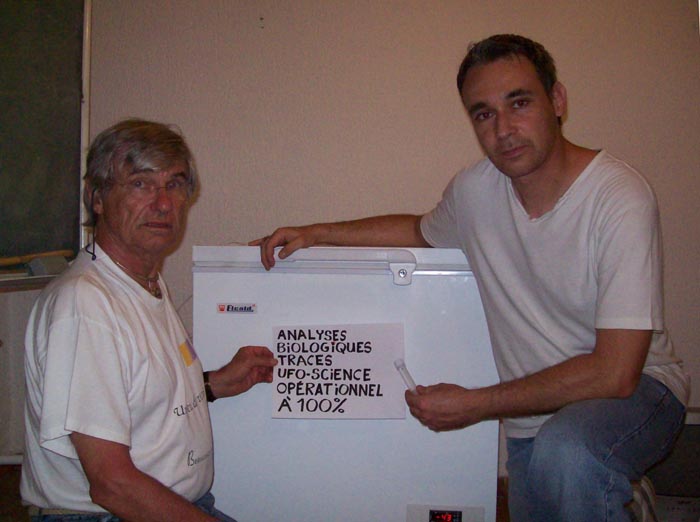
J.P. Petit and Jérôme Frasson with the lab freezer (1,500 euros), in place
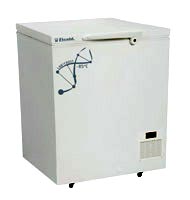
The same, quickly spotted and quickly bought, from the catalog.
Meanwhile, the Geipan continues to fumble around with UFOlogists during TV shows on major networks.
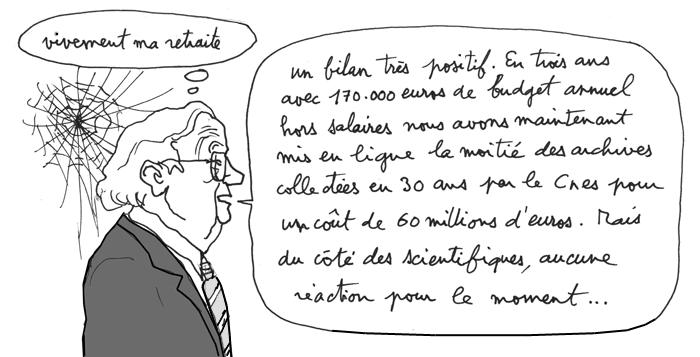
Did you know that Gepan-Sepra-Geipan cost French taxpayers over 6 million euros in thirty years? (At its peak, Gepan had ten employees, and currently the Geipan’s annual budget is 170,000 euros per year, while having published only 40% of the gendarmerie paperwork.) The outcome amounts to just a few pages of analysis by Bounias on the Trans-en-Provence case (a move that cost him his career, then his life), plus 100,000 pages of gendarmerie reports, devoid of any scientific or technical value.
Frasson with special gloves for handling low-temperature samples
So we are now
operationally ready for biological trace analysis.
But we couldn’t intervene in the crop circle that appeared near Metz in early June 2008, because we weren’t notified in time. In passing, we advise readers who might visit a crop circle to try a very simple test:
-
First, obtain Petri dishes (transparent plastic containers, 10 cm in diameter, 2 cm thick).
-
Place soil samples taken from inside and outside the circle (soil without visible plant life) into these dishes.
-
Place two slices, for example, of eggplant on the surface of these dishes.
-
Let them develop.
If the microbial fauna has been affected by the phenomenon (something that "pranksters" using boards and string at night couldn’t achieve), and if this destroyed the microbial fauna, the eggplant slice will remain either intact or only slightly altered. Conversely, outside the circle, the abundant microbial life in the soil will cause rapid decomposition of the control slice.
You might then suspect microwave action, as you’d get the same result by exposing a soil sample to your microwave oven. Guaranteed and spectacular result.
Such a test seems problematic when conducted weeks after the event, given the rapid recovery of microbial life. But for those on site, the experiment would be worth trying. Do it—just in case.
If we do nothing, we’ll never know more.
A reader, Hervé Lamarre, sent us photos of wheat stalks linked to the crop circle that appeared near Metz in early June 2007:
Photo of wheat stalks, case of the crop circle appearing in early June 2008 near Metz, inside and outside the circle
Photos by Hervé Lamarre
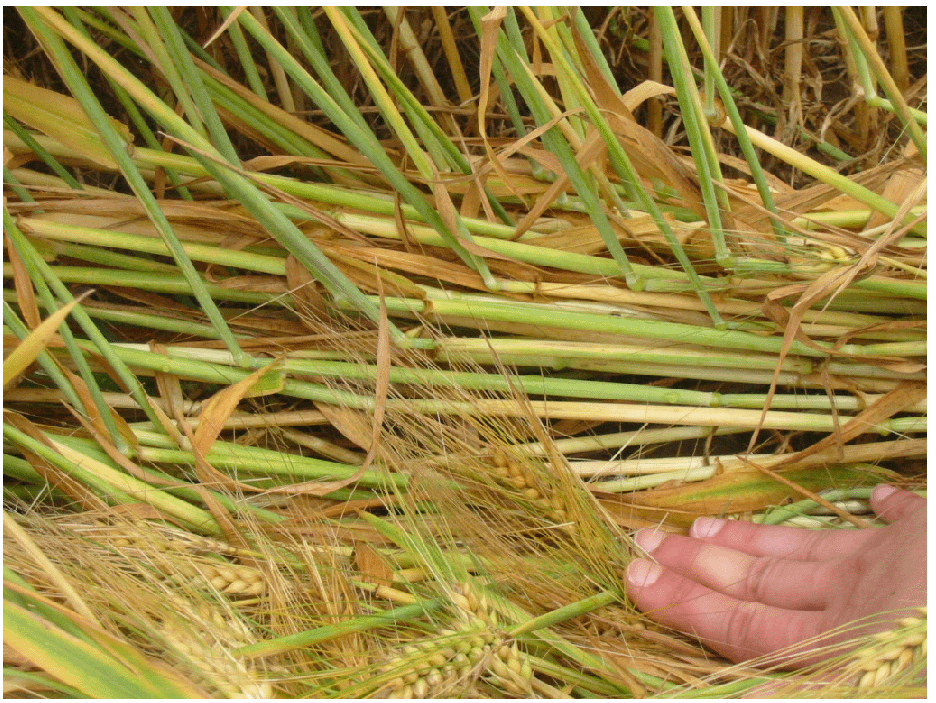
Detail of "bent" wheat, photo by Hervé Lamarre
The UFOlogist Thierry Pinvidic (author of "Ummo, the Extraterrestrials from the Cold") has consistently and with abundant resources shown, on behalf of Geipan, that crop circles are simple hand-made hoaxes. I wonder how he manages to achieve these regular wheat bends. He must have a trick I’m missing.
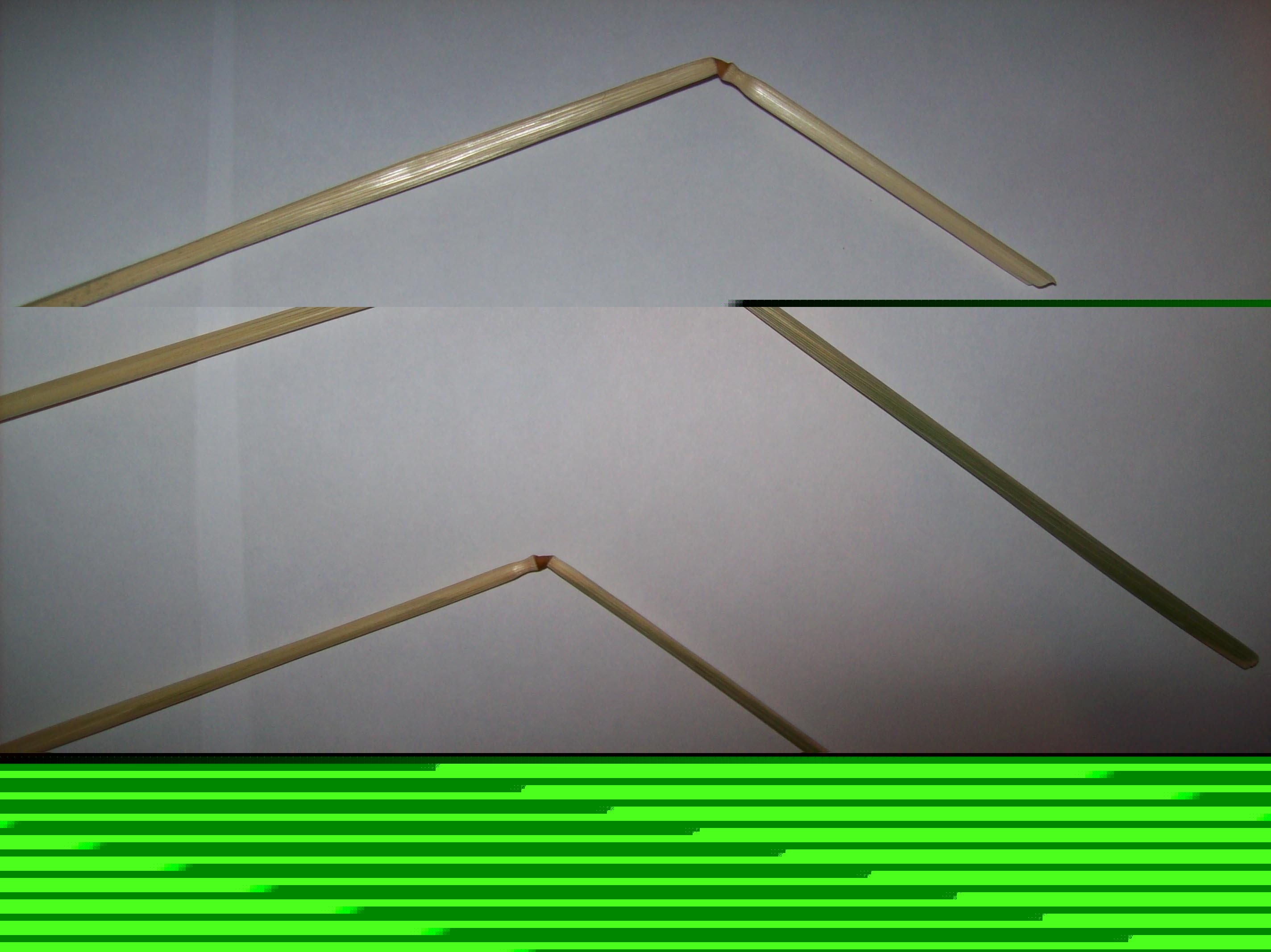
Grass stems placed in a microwave oven by Frasson and weighted down. Bend at the "knot" level.
The whole thing stiffens when drying
(we didn’t have wheat stems at hand)
Patenet has returned to the (big) media with a UFOlogist whose head must be swelling visibly.
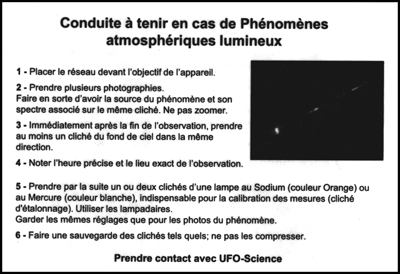
Still no mention of the "bonnettes à réseau" technique, even though the maximum number of people should have this accessory within reach, in their wallet or glove compartment.
On the CNES website, Patenet has launched an appeal to UFOlogists to become "Level 1 Responders" (IPN). Questions:
- Are you an adult, do you have a compass, a tape measure, a tape recorder, a camera?
But setting up a biological trace analysis unit for 5,000 euros in 9 square meters—we’ve done it. Out of reach for someone with a 170,000 euro annual budget (excluding salaries). Patenet "travels with his equipment": a theodolite. When I think about what we’re building on the MHD side, it leaves one dreamy. Who will dare mention the 6 million euros spent by CNES over 31 years for nothing, except the development of an "extremely precise methodology"? We’ve really been taken for fools, and it’s not very satisfying to stop there. Will Sillard find Patenet, very close to retirement, a "high-level collaborator"? And since this recruitment would be automatically internal to CNES, it would automatically be:
-
An old veteran near retirement, who knows nothing about the UFO issue (which is Patenet’s profile)
-
A young inexperienced person who wants to have fun and appear in the media
-
A... Vélasco
But a truly brilliant person at CNES would immediately ruin their career. That won’t stop the major media from continuing to serve them their soup diligently. It’s been going on for 30 years now.
Watch this video on the acroglyphs in Australia. In the circle: more compact soil, disappearance of microbial life, and... sound! To tackle the acroglyphs problem, soil specialists are needed. Since no one at INRA (National Institute of Agronomy) will move, we’ll have to do the job ourselves within ufo-science. This isn’t a new issue. At CNES, no one has moved in 30 years. Total lack of imagination, even with 170,000 euros annual budget (excluding salaries).
http://www.dailymotion.com/video/x5jitc_bruit-etrange-au-centre-des-agrogly_news
Yesterday, June 21, I completed a 4.5-hour, 400-kilometer flight in a glider with Jacques Legalland, from Vinon to Pic de Bures, flying over the ridge from Séderon to Sisteron, the route we used for our delta cross-country flights with Michel Katzman, and the mountain of Chabre near Laragne, where I’ve also flown many times. At Pic de Bures, we spiraled with a delta pilot, a species on the verge of extinction, in favor of the paraglider. Along the way, a detail was clarified by a specialist instructor. In paragliding, schools offer advanced training sessions in aerobatics. One figure involves executing tight turns while enduring "g-forces." Enduring accelerations is part of aerobatic maneuvers. But the particularity of the paraglider, whether in tight turns or "infinite tumbling" (a sequence of forward loops), is that these accelerations
are sustained long enough for the body to no longer counteract the migration of blood mass away from the brain.
The paraglider, whose brain becomes inadequately perfused, loses all perception of their situation and... dies.
But "the show must go on," as they say.
In a random note, early June, a partner of one of our team members woke up one morning with a strange mark, after a bizarre dream. I had experienced the same mark twenty-five years ago, and later my Japanese translator Nakajima. No, it’s not the mark of a bra clasp. But we don’t have time to dwell on such details. Let the UFOlogists handle it.

In a random note, received from a reader:
UNITED KINGDOM: A police helicopter confronted an "unusual flying object"
Source of the information:
(Belga) A Welsh police helicopter encountered an "unusual flying object" early June near Cardiff (south Wales), prompting an investigation.
"The South Wales Police confirms that its aerial support unit sighted an unusual flying object. This was reported to the competent authorities for their investigation," said a police spokesperson, avoiding the term UFO ("unidentified flying object"). The helicopter, carrying three people, was waiting to land at the military base of St Athan near Cardiff when the incident occurred, the spokesperson added, specifying that the encounter took place at 12:40 (13:40 CET) on June 8. The tabloid The Sun reported Friday that police had chased an unidentified flying object (UFO) that had "attacked" the helicopter, pursuing it for several dozen kilometers above the Bristol Channel separating south Wales from southwest England. "The pilot made a sharp turn to avoid being hit, then launched into a high-speed chase. But he had to abandon the pursuit because the helicopter’s fuel tank was almost empty—and the UFO escaped," the newspaper wrote. According to the UK’s most-read daily, the crew described an object "shaped like a flying saucer with blinking lights all around." However, police denied any pursuit and stated the helicopter crew was never in danger. (CYA)
See also:
http://afp.google.com/article/ALeqM5iYf83nn8HRQm6w6vWVjxgHuqGjYg
June 24, 2008: An UFO was seen near Toulouse. Photograph, still without bonnettes! When will a major media outlet finally echo the efforts of ufo-science to popularize this simple and inexpensive technique? Has Patenet understood the benefit that could be gained from such a document? Nothing is certain, since his position is "all gendarmerie brigades have been equipped with this device and it did nothing. So it does nothing (....)."
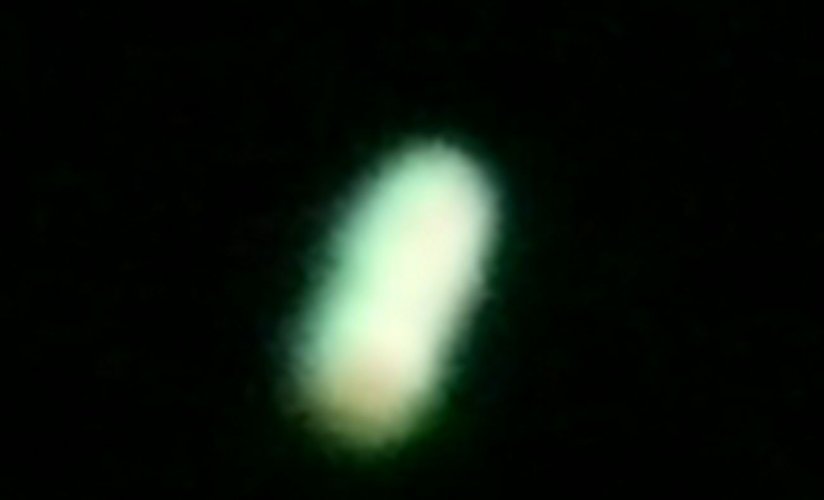
The UFO photographed in Toulouse in June 2008
I’m trying to catch up on the backlog of emails received. I’ve received confirmation of acceptance to present a 30-minute talk at the PIRT (Physical Interpretation of Relativity Theory) conference in Cambridge, UK, in September 2008. I’ll present my recent work in cosmology and astrophysics.

Dear Dr. Petit,
I am pleased to inform you that your paper has been included in the programme of lectures for the conference PHYSICAL INTERPRETATIONS OF RELATIVITY THEORY, 12–15 September at Imperial College, London. It has been allotted 30 minutes for presentation and discussion.
I attach the conference information document and the registration form.
I look forward to meeting you in London,
yours sincerely,
M. C. Duffy J
I had previously written to a man I met at the French Ministry of Research in Paris, an aide to Valérie Pécresse, asking if the ministry could subsidize my participation in the international MHD conference in Vilnius at the end of September, where I have three accepted presentations that will be published, plus a 30-minute speech. The total registration fees and publication costs for these conferences (excluding travel and accommodation, which I will pay myself) amount to 1,500 euros. This earnest young man replied:
- I will forward your request to the relevant people and hope they won’t delay contacting you.
There was no follow-up. The guy did his best, but the Ministry of Research is a dead end. And who is Valérie Pécresse? What is she? Another "policy"? I just remembered I had a letter from the director of the fusion department at the Kurchatov Institute in Moscow. We had the letter but... no recipient!! The letter simply stated that developing research on Z-pinches (one of the key topics of the Vilnius conference) was important. Sending it to a CEA official? Impossible. Z-pinches are outsider competitors of the ITER and Megajoule programs. I told Pécresse’s aide: "If your boss agrees to receive this letter, let us know. I’ll forward it to my academician in Moscow, who will send it with the lab’s letterhead, impressive titles, and a long list of medals."
Nothing. No response. Pécresse probably didn’t want to offend the two powerful lobbies of ITER and Megajoule. Another possibility: she didn’t understand, or both. I’m dropping it.
This isn’t physics, it’s no longer science—it’s politics...
I won’t waste time making a second request. Friends will come to these two conferences to film my interventions, and upon return we’ll make videos with commentary, which will be posted on Dailymotion or YouTube. They will carry the ufo-science mark, since the association will cover the registration and publication fees. Generally speaking, and we’ll see later how the project develops, we no longer expect anything from the "institutions," with whom we’d only waste our time. But when we have results in various fields, and have access to our own media—Dailymotion and YouTube, now in high definition—we’ll say... what we have to say.
Some guys sent me photos of their wall confinement experiment they performed in "high density" (everything is relative, meaning under one-tenth of atmospheric pressure with a 14,000-volt source). So, discharge regime in the form of arcs. Couldn’t find the images in my email avalanche. Will resend images with precise experimental conditions. From memory, one image showed successful wall confinement with curved arcs pressed against the wall. But without being able to retrieve the files, I can only mention it and ask the guys to resend.
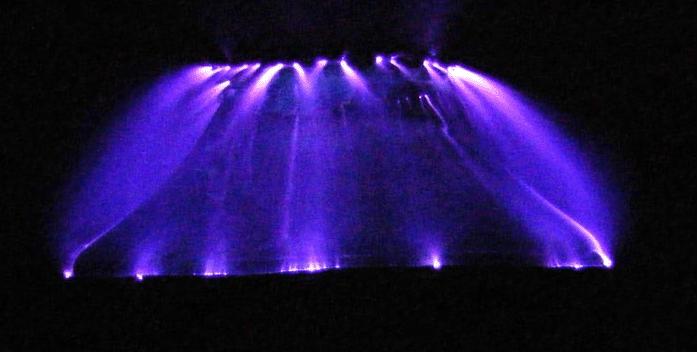
Unless I’m mistaken, this is the image of the discharge without confinement, with spots showing arc starts turning into diffuse discharge.
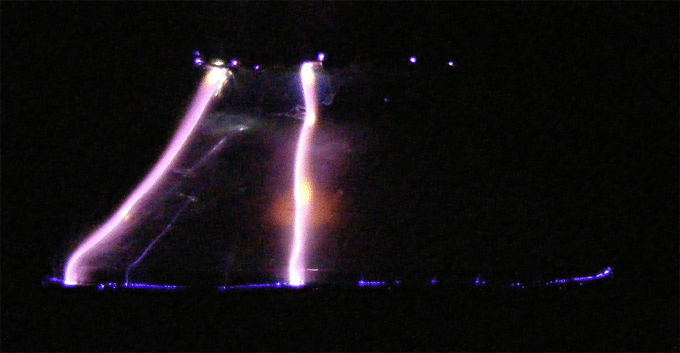
The same object with magnetic confinement effect on the arcs (judging from this photo: pressed against the concave wall)
Still in a random note, Geffray is finishing correcting the book, soon to be at the printer, printed in 1,000 copies to start. Here’s the cover, a computer-generated image by Jean-Stéphane Beetschen, based on an old experiment photo. But we didn’t want to risk copyright issues or citation of "the guy who holds the rights." When we have new photos of experiments, we’ll install a beautiful new cover image with its "HF arcs."
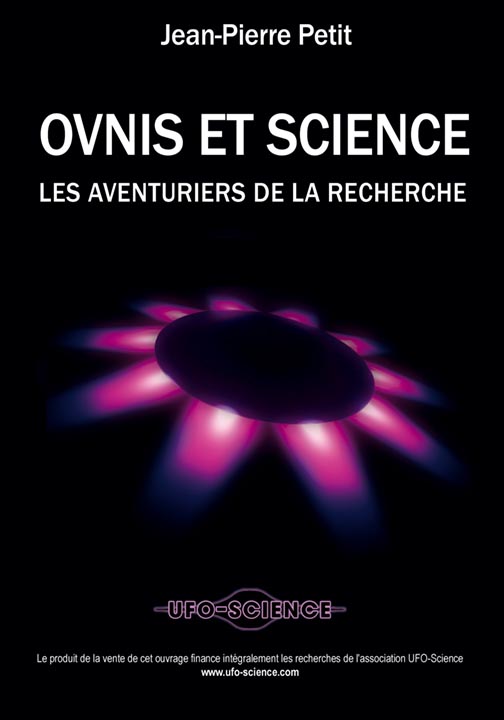
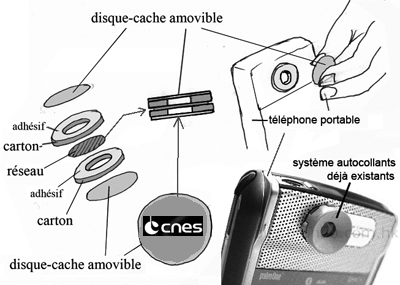
The first 1,000 buyers will receive the book with a diffraction grating and a plastic instruction card.
19.50 euros, payable to ufo-science and sent to UFO-science 83 rue d’Italie, 75013 Paris. Shipping included.
Add extra shipping cost for international orders, except for Belgium, where we can ship from Brussels.
This is the black-and-white image. Couldn’t find the color version. But here’s the front and back of this "flyer."
Before linking to reader reactions about this lamentable Wikipedia affair, the news of the day:
One of the "space cowboys" of MHD, our old friend Pierre Issartier, the MacGyver of shock tube electronics from the 1960s, passed away Friday. I was notified too late to attend the funeral. I’ve reconnected with the others, and the team of space cowboys grows stronger. "Mond" is 75, but apparently hasn’t lost a bit of his legendary engineer’s imagination for "finding solutions." He’s even up to date on all cutting-edge techniques. He built all the shock tubes at the Institute of Fluid Mechanics in Marseille and an ultra-fast camera since the early 1960s. He’s on board with the project. So we’ll prepare a meeting at my place with the few survivors of this adventure, who can be counted on one hand, but all are "real characters" and true magicians of technology. With Mond handling the mechanical side and Legalland the electronics and measurements, we’re super-equipped. We have cutting-edge scientific knowledge,
which no one else in France possesses.
At least not the flashy team of "cold plasmas" funded by the DGA, the army (the DGA and forty labs). We have the technical expertise. Equipment is starting to arrive. Mond had a second vacuum pump. We have spacious premises and even accommodation capacity. We’ll aim simultaneously at both hot and cold pulse wind tunnels. As Mond said:
- At our age, we can’t afford to delay.
I agree with him. It’ll be too late for the dinosaurs of science and technology in France and Navarre. CNES, CNRS, ONERA, etc.—too late for engineering schools. Anyway, Supaéro and other aeronautics engineering schools are full of teachers who are either former DGA staff or people "on leave from the DGA." As for me, I simply don’t want to hear about the army anymore. They’ve done enough nonsense in thirty years.
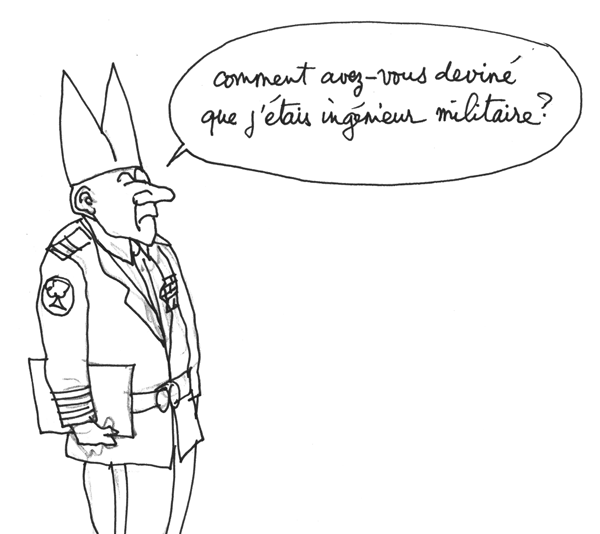
A group of small military engineers dream of turning a Z-machine into a microwave weapon. You know what you can do with such a weapon: permanently blind thousands of people in a fraction of a second. That’s the kind of gadget the Americans tested during the capture of Baghdad airport.
I won’t dispense my knowledge in the form of DEA-level lectures. We’ll set up our own machining workshop in the large lab. The Ministry of Research can go to hell.
Suddenly, I explode. These people, these ministry rats, are really fools, money-wasters. CNRS is full of petty minds, mafia-like groups, with the mentality of small bureaucrats. Ministries are filled with incompetent people, "politicians," "mission handlers." Latest farce: IHEST, the Institute of Advanced Scientific and Technical Studies, a new nonsense where "auditors" pontificate and produce "audits."
Money? We’ll find it. It’ll be the book, books, or donations, or both, or equipment sales. After the French edition, I’ll prepare an international edition, first translated into English, immediately and freely by a bilingual friend. I’m counting on a budget of 40,000 euros per year. Achievable with an army of retirees at work and lodging at a low cost. The essentials are already in place. In these "private property" premises, we are impregnable. There are two teams:
Those under forty and those over seventy. A thirty-year gap in between. That’s how it is.
Today, it’s no longer necessary to wait for a problematic media echo. What a magnificent change. When journalists fail to do their job of information and investigation, we must do it for them. It’s a matter of available time. The video online (viewed by 17,000 people) is just a tiny glimpse of our firepower in this domain. We have the "pros of editing," we have magicians of computer-generated imagery. We know how to speak, write, explain. We have many people with many things to say, and we have top-level scientists. On the other side, Jacques Patenet the soporific, Pierre Lagrange, a jack-of-all-trades sociologist, the man for all tasks, Jean-Claude Ribes, a seller of giant cylindrical space stations, Claude Poher and his universes.
Maybe one day we’ll find a way to host PhD students (for example, with... CNES grants). But among the young, there are also individuals who already have their slippers on. Students, yes, but only Jérôme Frasson types—guys who must run, not kids to drag along. If we ever host young people, they’ll be "finders," not "researchers." There are plenty of researchers at CNRS, plenty in universities. Sometimes I get emails from young people writing, "I’m interested in this, that." It’s not enough.
"Finders," young people with the passion for research in their blood, are rare gems.
The wildest ideas circulate. After supersonic wind tunnels, why not a focused experiment to attempt boron-hydrogen fusion, neutronless, in a backyard, just a few cables away from the ITER site—wouldn’t that look impressive? It’s... non-impossible. Be wary of those over seventy. They fear nothing anymore, are unstoppable, and nothing stops them.
The wild beasts are unleashed.
Apart from that, I’m finalizing the explanation of the Pioneer probes’ slowdown, next paper.
Link to reader emails about Wikipedia