UFO-Science Presentation
May 6, 2010
Introduction
The UFO phenomenon has manifested itself on Earth for more than half a century. Before presenting a condensed overview of the activities of our UFO-Science group, we would like to begin by recalling various aspects of the phenomenon and its impact on our society.
It must be said that the impact has been almost null, at least in the social circles accessible to us. As for the benefits that the military forces of more developed countries have derived from it, that is another story. But let us delve deeper into the question of impact. It is surprising that a phenomenon supported by a hundred thousand observations, many of which possess considerable credibility, has not produced any reaction in the political, scientific, military (at least to the extent we know so far), religious, and philosophical spheres.
Such a pervasive phenomenon has become a folkloric issue worldwide. The vast majority of the international scientific community, across all disciplines, strongly denies the reality of the phenomenon in a highly irrational manner. A typical position can be summarized in the following sentence:
- Why do you want me to be interested in a phenomenon that has no foundation?
The lack of serious scientific studies conducted by competent scientists leaves the subject in the hands of speculators whose only available material is limited to a few witnesses, photographs, or videos, all of which are subject to doubt.
In 1977, France created a service that has had several names over the last thirty years: GEPAN (Groupe d’Etudes des Phénomènes Aérospatiaux Non Identifiés), SEPRA (Service d'Expertise des Phénomènes de Rentrées Atmosphériques), and finally, in 2005, GEIPAN (Groupe d'Etude et d'Information sur les Phénomènes Aérospatiaux Non identifiés). This service continues to limit its actions to witness accounts and ground surveys, stating that scientific studies are not part of its mission (after… 33 years!). Neither the military, comparable to the American National Guard, nor the service itself (currently limited to two people: an engineer and a secretary) has, or has ever had, the minimal scientific expertise to address these questions, and nothing suggests that things will evolve differently in the future.
Why have things evolved this way?
The answer is simple. Behind the UFO phenomenon lies the hypothesis, a very disturbing one, of the incursion of visitors from systems other than our own. For decades, scientists have expressed a geocentric skepticism, preferring instead the hypothesis according to which life could not appear and organize in any place different from Earth. Many astronomers even doubt the existence of planetary systems different from ours.
But recent observations have revealed the existence of so-called exoplanets, whose number exceeds four hundred to date (May 2010). These observations correspond to relatively nearby systems, and even the most reluctant astronomers and astrophysicists are coming to admit that the universe must contain a fantastic number—defying imagination—of planets capable of hosting life.
Observations suggest that the known universe contains a hundred billion galaxies, each composed of hundreds of billions of stars, in which there would be at least a million planets exhibiting organized life.
This unavoidable and progressive certainty has evident religious consequences for all monotheistic religious beliefs that claim to be universal. Even if some scientists, such as Stephen Hawking, to quote only him, end up concluding that organized life necessarily exists in the universe apart from Earth, they moderate their enthusiasm and add “that such life could most probably exist in a very primitive stage,” which is fantastically absurd.
More than ever, the idea that Earth could be visited by extraterrestrials represents an absolute taboo. In the scientific realm, the UFO issue is forbidden. On October 16th and 17th, 2010, we intend to participate in an international symposium whose topic is “Astronomy-Space-UFOs.” It would thus be logical to expect the participation of astronomers. The organizer has contacted professionals in that field, awaiting their contributions. But they have replied:
- Okay, but only if you remove any reference to UFOs.
One could not better express the taboo that strikes this subject, after more than half a century. This is explained by the extremely destabilizing character of the idea of alien visits, which would imply immense scientific and technical superiority. This simple idea breaks our fundamental geo-centrism and deeply questions our current scientific knowledge (according to which such voyages would be physically impossible) and our religious beliefs.
Every form of thought is nothing more than an organized system of beliefs. From this point of view, science is structured as a religion. The word religion comes from the Latin word religare, which means to bind together. Societies are based on a common vision of things, whether they are religions, science, or belief in the virtues of some social, political, and economic system. To question it is like removing the foundations that hold up the entire edifice.
Unconsciously, human beings are perfectly aware of the danger related to contact, as it would be the most shocking event in human history. In the course of history, very different civilizations have found themselves brutally in contact, like the pre-Columbian populations with the Spanish conquistadors. Entire social systems have crumbled. We have an equivalent phenomenon almost daily today, as for example with the inhabitants of the Amazon basin, and the corresponding word is ethnocide.
A contact between the inhabitants of Earth and beings from another planet inherently encloses a risk of ethnocide. It is because our religious, scientific, political, and military systems unconsciously perceive the magnitude of that risk that these social groups exhibit denial mechanisms having the character of a psycho-socio-immunological reaction. This should not surprise anyone; on the contrary, it is highly predictable.
The problem is that this rejection mechanism is widespread among science professionals, the only ones who could carry out fruitful research on the subject. In its absence, the mere collection of simple testimonies or the accumulation of photographs and films, as has been done by the French service for 33 years, is a perfectly vain and sterile attitude.
Scientific Approaches to the UFO Phenomenon
- Optical Data
The phenomenon has many faces. The most common is its nocturnal manifestation in the form of lights whose characteristics exclude:
- A natural phenomenon
- Objects or light sources corresponding to Earth technologies
A very logical and simple way of investigating such signals consists in creating a spectral image of the source with the aid of a diffraction grating.

Diffraction grating placed in front of the lens of a digital device
These gratings are plastic films with fine stripes (commonly 500 per millimeter). When purchased in large quantities, they cost only a few cents. The problem is that they should be widely distributed so that any observer in any circumstance is capable of facing the phenomenon.
The UFO-Science association has been offering these diffraction gratings. People who contact us and send a symbolic contribution to facilitate shipping can receive the item. In two years, 3,000 gratings have been distributed by the association in 17 countries.

Visitors to the UFO-Science association website
The implementation is very simple. Observers can place the grating in front of the lens of their camera or in front of their video cam. The image of the source is then transformed into a succession of colored spots constituting a spectrum, as shown in the following image.
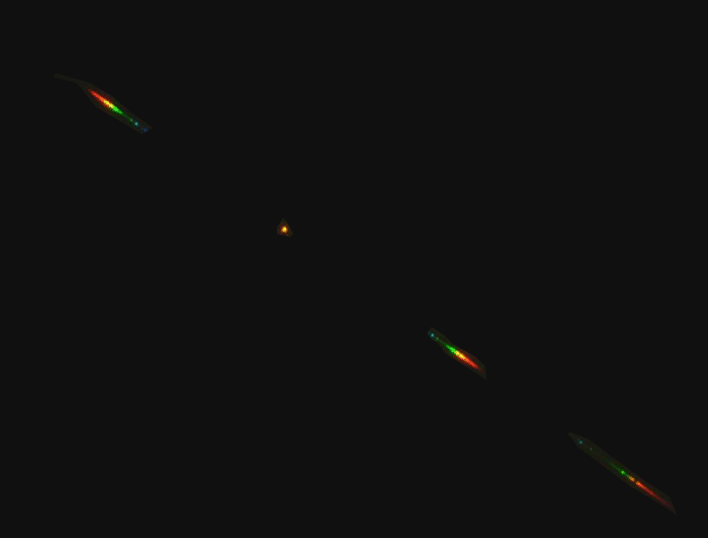
Point light source transformed into a spectrum by a diffraction grating
At UFO-Science, we have considered the possibility of integrating the grating with a self-adhesive cap, similar to those that the Japanese attach to their cameras in order to manipulate images.

Diffraction grating adapted to the lens of a cell phone with the aid of a self-adhesive cap (UFO-Science)
Professionals in optics and spectroscopy can analyze the spectra. At UFO-Science, we have the people with the expertise. Spectral analysis, when revealing substances not present in the atmosphere, would allow excluding, on the basis of the observation in question, any attribution of the phenomenon to a natural meteorological cause.
When people are witnesses of the UFO phenomenon, the light source can be, when photographed, mixed with other sources that perturb the spectral analysis (like the light of reflectors). When confronted with the phenomenon, the observer would be tempted to zoom. But if he/she does not have a tripod, the chances are high that he/she would lose the object. It is difficult to imagine that someday a witness will have a digital camera, a diffraction grating, and a tripod.
Another approach consists in automating the search for UFO spectra. At UFO-Science, we have developed a system named UFOcatch.
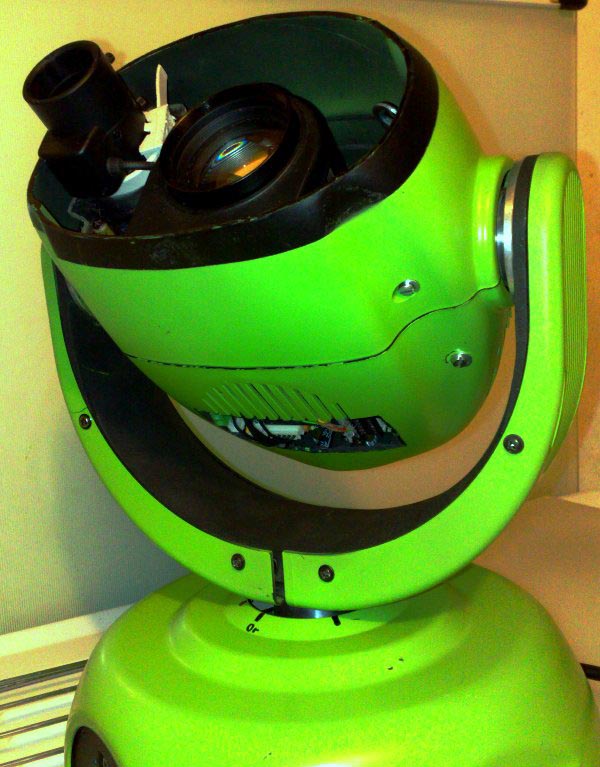
The UFO-catch system: the searching mount
It is made of two elements.
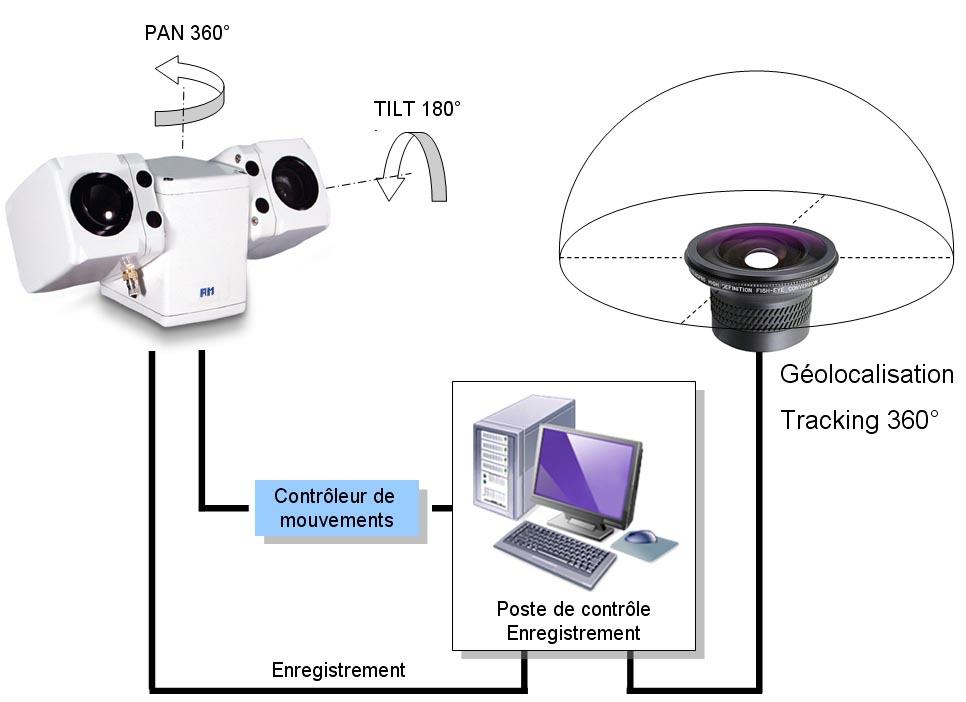
UFO-catch diagram
A system with a fisheye lens allows a complete survey of the sky. The images are sent to a computer memory. The system takes an image every tenth of a second. Pairs of successive images are sent to memory and compared pixel by pixel. It is thus possible to detect any moving source (security cameras are also based on this principle). A filtering system intervenes and can be parameterized at will to eliminate, for example, sources like shooting stars or airplane lights, etc.
When the computer system estimates, based on its parameterization, that the source deserves to be followed, a motorized “mount” freezes the optical system on this single source. An automatic zoom is then operated. This first optical system records an optical image of the source while a second one operates the spectrum registration. The latter is automatically analyzed and compared with a spectrum database.
If two UFO-catch detection stations are operated together, separated by a certain distance from one another, the system allows a complete survey of the object’s trajectory in 3D and a velocity estimate. If the source comes into contact with the ground, the recording indicates the point of contact.
Let us also note that this tracking system would offer a great deal of services to astronomers in their search for meteorites.
The UFO-Science association cannot alone operate a system with a large number of UFO-catch detection stations. It thus searches for industrial partners, other associates, or philanthropies in order to develop such a network.
- Biological Data
In 1981, Professor Michel Bounias, a biologist from the Institut National d’Agronomie d’Avignon, was requested to carry out the analysis of the traces of a UFO landing in order to corroborate the observation made by a witness, together with a mechanical footprint that remained on the ground. The method employed consisted of a dosage of the pigmentary constitution of plants by means of thin-layer chromatography.
This method is relatively simple and easy to replicate.

Localization and collection of samples

Attire for taking away samples and storage at low temperature in dry ice. The temperature to which the samples are maintained is visible on the container

Complete equipment for taking away vegetal samples

Intervention team carrying samples

Samples are stored at low temperature in dry ice
Here is the dosage of pigments by thin-layer chromatography:

Weighing of the vegetable sample

Grinding

Bio-molecules are extracted by centrifugation

Bio-molecules are deposited on the silica gel of the plate, ready to be immersed

Bio-molecules get separated in the solvent by capillarity when carried to different velocities

Resulting chromatography

Resulting analysis of the chromatographic plate, after scanning and treatment by a densitometry software
By comparing the results with the densitometry profile of the plant sample (its chromatographic “signature”), it is possible to discover eventual alterations, quantify them, and correlate the phenomenon with the distance to the epicenter of the phenomenon.
This was already done by Professor Michel Bounias, deceased in 2003, when investigating the traces of the well-known case of Trans en Provence (France) in 1981, which revealed a correlation alteration for pigment vs. distance of 0.98.

Professor Michel Bounias in 1984.

Results of biological analysis of a UFO landing trace by Prof. Michel Bounias, 1981
The reconstruction of this technique was done during 2008 within the framework of the activities of the UFO-Science association, but it was soon realized that in the case of a new landing it would be impossible to keep working an analysis infrastructure with its own funds. This being the case, it is evident that the analysis of ground traces must be a part of the study of the UFO phenomenon, with biological analysis constituting a step in a rather broad panoply of examinations and tests.
On the Observed Trajectories
If UFOs are really material objects, when examining witnesses’ testimonials or radar records, it is frequent to observe supersonic and even hypersonic velocities, and this raises immediately a paradox, since those displacements take place, with rare exceptions, without any noise. According to the laws of classic fluid mechanics, an object moving in a gas at a supersonic velocity creates a system of shockwaves together with very loud sound signals (the supersonic “bang”). Thus the observation of UFOs raises immediately the following question:
- Is it possible to move an object in air at a supersonic speed without creating a bang or shockwaves (and their associated wake turbulence)?
In 1976, two members of the association (J.P. Petit and M. Viton) showed with hydraulic experiments that when a Laplace force field enters the scene, it is possible to annihilate wake turbulence downstream of a cylindrical object.

Cylindrical MHD accelerator. Suction upstream, wake turbulence removal downstream
Since that time, the first theoretical works, based on a reformulation of the theory of characteristics (“Mach waves”) in the presence of a Laplace force field, showed that in effect this field could prevent these waves from being formed. Those who know fluid mechanics are aware that in a supersonic regime, a flow can be associated with a system of Mach waves that carry pressure perturbations. It is the crossing of the waves that creates the shockwaves.

Calculation of the distribution of “characteristics” (Mach waves) in a supersonic regime around a lenticular profile. Their accumulation indicates places of shockwave generation.
Hereafter is a schematic representation of the (two-dimensional) air flow around a lenticular profile, and the emergence of two shockwave systems: at the frontal edge and in the rear edge of the profile. Between these waves are the (characteristic) Mach waves.

2D-supersonic flow around a lenticular profile, together with its two shock wave systems. Between these plane waves, planes represent the first family of Mach waves.
At the beginning of the eighties, a doctoral student of Jean-Pierre Petit showed that under the action of an appropriate Laplace force field, the parallelism of the characteristics could be preserved, thus implying the absence of shock waves.

Figure taken from the doctoral thesis of Bertrand Lebrun. A Laplace force field J x B prevents characteristics from crossing. The flow comes from the left. See reference 55.
This is an important scientific result that arises from the simple consideration of the UFO phenomenon from a scientific point of view and which leads to a novel and third fluid mechanics. One had:
- Subsonic fluid mechanics
- Supersonic fluid mechanics, with shockwaves
The problems emerged from the UFO observation have created an entirely new research field:
- “MHD controlled” fluid mechanics, in which shockwaves are eliminated, the MHD opposing their formation.
It is absolutely amazing that such research, without known precedents, published in refereed journals (see below) and presented in international specialized workshops (Moscow 1983, Tsukuba 1987, Beijing 1991), far from being encouraged and acclaimed, instead of being facilitated and sponsored, was on the contrary opposed and even completely stopped in France at the end of the eighties. It was not necessarily the consequence, at least in France, of the action of an army anxious to develop that technology in secrecy with the aim of obtaining a hypersonic cruise missile (which hasn’t been done), but the desire of keeping “things under control.”
We’ll finish this brief notice by adding that the “MHD discoid aerodynes” problematic is still alive and productive, and has presented recent communications in two international scientific workshops (2008 and 2009) as well as three papers in a top-level refereed journal. These problems have led to true discoveries in non-equilibrium plasma physics (magnetic wall confinement technique by inversion of the magnetic gradient field).

Wall confinement due to magnetic gradient inversion. See reference 61 (Int. AIAA meeting, Bremen, 2009)
These researches, which lie at the top of the specialty (MHD and non-equilibrium plasma physics), will be continued with scandalously ridiculous funding.
The Problem of Interstellar Travel
The hypothesis of extraterrestrial incursions poses immediately the thorny question of how to travel the considerable distances that separate us from the nearest stars, distances that are ten thousand times greater than the size of our solar system.
Instead of contradicting the consequences of Special Relativity with its fundamental limitation of velocities with respect to light velocity, consequences that correspond to a geometrical requirement (in classic SR trying to go faster than light is equivalent to trying to descend more deeply in a sphere than… its center), it is worth considering the principles of SR in a wider context.
The UFO-Science researchers have reprised and extended the works of Andrei Sakharov. A considerable amount of work has been done in the last 35 years, together with scientific publications in top-level journals and presentations in international workshops. The whole has been called the “twin-universe theory” by taking again the term introduced by the Soviet academician. Today it has been reformulated under the name of “bi-metric,” which is a universe where, in order to go from a point A to a point B, there can exist two ways corresponding to opposite times. Here once again the UFO phenomenon imposes itself with a powerful and stimulating scientific mood as a source of new ideas in a time when astrophysics and cosmology undergo a serious crisis and do not accept to exploit for their own benefit this paradigmatic knowledge.
The Exploitation of Documents of Non-Identified Origin
To be complete, another source of information in the form of letters signed by persons who claimed to be extraterrestrials should be quoted, the so-called Ummo affair. It is a very controversial and polemical issue, and many people intend to deny the scientific quality of the scientific knowledge contained in those letters. We will not develop that further here and mention only that in those texts appeared for the first time, in 1967, the idea that the velocity of light may have varied during cosmic evolution, an idea that was reprised and developed by Jean-Pierre Petit in 1988-1989, see (8), (9), (10), (11), (14), (15).
Conclusion
The above evocations show that the scientific world should bring interest into the UFO dossier, and that the scientific clues contained therein are numerous, real, and revolutionary for the fields of fluid mechanics, cosmology, and mathematical physics. Continuing on these grounds is the aim of the UFO-Science association. Time has come to get this dossier out from the ghetto of parasciences and from the folklore and put it among the great scientific problems of our time.
References
(1) J.P. Petit (1972). "Applications of the kinetic theory of gases to plasma physics and galactic dynamics". Doctor of Engineering thesis, Aix-Marseille University, France.(1)
(2) J.P. Petit (16–20 September, 1974). "Proceedings" in International meeting on spiral galaxies dynamics. Institut des Hautes Études Scientifiques (IHES), Bures-sur-Yvette, France.
(3) J.P. Petit: "Is supersonic flight possible?" Eighth Inter. Conf. on MHD Electr. Power Generation. Moscow 1983.
(4) J.P. Petit & B. Lebrun: "Shock wave cancellation in a gas by Lorentz force action". Ninth Inter. Conf. On MHD Electr. Power Generation. Tsukuba, Japan, 1986
(5) B. Lebrun & J.P. Petit: "Shock wave annihilation by MHD action in supersonic flows. Quasi-one dimensional steady analysis and thermal blockage". European Journal of Mechanics; B/Fluids, 8, n°2, pp.163-178, 1989
(6) B. Lebrun & J.P. Petit: "Shock wave annihilation by MHD action in supersonic flows. Two-dimensional steady non-isentropic analysis. Anti-shock criterion, and shock tube simulations for isentropic flows". European Journal of Mechanics, B/Fluids, 8, pp.307-326, 1989
(7) B. Lebrun: "Approche théorique de la suppression des ondes de choc se formant autour d'un obstacle effilé placé dans un écoulement d'argon ionisé. Thèse d'Energétique n° 233. Université de Poitiers, France, 1990.
(8) B. Lebrun & J.P. Petit: "Theoretical analysis of shock wave annihilation by Lorentz force field". International MHD symposium, Beijing 1990.
(9) Convertisseurs MHD d'un genre nouveau (Comptes Rendus de l'Académie des Sciences de Paris, 15 Septembre 1975, t. 281, pp. 157-159) translated as New MHD converters.
(10) Convertisseurs MHD d'un genre nouveau. Appareil à induction avec Maurice Viton (Comptes Rendus de l'Académie des Sciences de Paris, 28 Février 1977, t. 284, pp. 167-179) translated as New MHD converters: induction machines.
(11) Univers énantiomorphes à temps propres opposés (Enantiomorphic universe with opposite time arrows). Comptes rendus de l'Académie des Sciences de Paris, 23 Mai 1977, Série A., t. 263, pp. 1315-1318)
(12) Univers en interaction avec leur image dans le miroir du temps (Comptes Rendus de l'Académie des Sciences de Paris, 6 Juin 1977, Série A., t. 284, pp. 1413-1416) translated as Universes interacting with their opposite time arrow.
(13) A.D. Sakharov (1982). "Collected Scientific Works" (tr. D. Ter Haar, D. V. Chudnovsky et al.). Marcel Dekker, NY. ISBN 0824717147.
(14) A.D. Sakharov (1984). "Œuvres scientifiques" (in French, tr. L. Michel, L.A. Rioual). Anthropos (Economica), Paris. ISBN 2715710909.
(15) A.D. Sakharov (1967). "CP violation and baryonic asymmetry of the Universe". ZhETF Pis'ma 5 (Tr. JETP Lett. 5, 24–27) (5): 32–35.
(16) A.D. Sakharov (1970). "A multisheet Cosmological model". preprint. Moscow, Russia: Institute of Applied Mathematics.
(17) A.D. Sakharov (1972). "Topological structure of elementary particles and CPT asymmetry". Problems in theoretical physics, dedicated to the memory of I.E. Tamm. Nauka, Moscow, Russia.
(18) A.D. Sakharov (1980). "Cosmological model of the Universe with a time vector inversion". ZhETF (Tr. JETP 52, 349-351) (79): 689–693.
(19) Hydraulic simulation of shock wave annihilation & Annihilation of the Velikhov instability by magnetic confinement, Spiral electric currents with high apparent Hall parameter confinement (8ème Congrès International de MHD, Moscou 1983).
(20) J.P. Petit (1988). An interpretation of cosmological model with variable light velocity. Modern Physics Letters A, 3 (16): 1527.
(21) J.P. Petit: An interpretation of cosmological model with variable light velocity: the interpretation of red shifts (Modern Physics Letters A. Vol 3, N°18, Décembre 1988, pp 1733-1744).
(22) J.P. Petit: Gauge cosmological model with variable light velocity. III: Comparison with QSO observational data (Modern Physics Letters A. Vol 4, N°23, Décembre 1989, pp 2201-2210).
(23) Shock wave cancellation by Lorentz Force field with B. Lebrun (10ème Congrès International de MHD, Pékin 1991).
(24) MHD shock wave cancellation (Congrès International de MHD, Research of Nuclear Energy (CEA), Cadarache, 1992)
(25) J.P. Petit (July 1994). The missing mass problem. Il Nuovo Cimento B, 109: 697–710
(26) J.P. Petit (1995). Twin Universes Cosmology. Astrophysics and Space Science (226): 273–307.
(27) P. Midy; J.P. Petit (June 1989). Scale invariant cosmology. The International Journal of Modern Physics D, 8: 271–280.
(28): J.P. Petit, F. Henry-Couannier; G. d'Agostini, (2005). I- Matter, antimatter and geometry. II- The twin universe model: a solution to the problem of negative energy particles. III- The twin universe model plus electric charges and matter-antimatter symmetry. Preprint. arXiv:0712.0067
(29): J.P. Petit; P. Midy, F. Landsheet (June 2001). Twin matter against dark matter in International Meeting on Astrophysics and Cosmology. "Where is the matter?", Marseille, France.
(30): J.P. Petit; G. d'Agostini (August 2007). Bigravity as an interpretation of the cosmic acceleration. Colloque International sur les Techniques Variationnelles CITV, tr. International Meeting on Variational Techniques. arXiv:0712.0067
(31): J.P. Petit; G. d'Agostini (August 2007). Bigravity: a bimetric model of the Universe. Exact nonlinear solutions. Positive and negative gravitational lensings. Colloque International sur les Techniques Variationnelles CITV, tr. International Meeting on Variational Techniques. arXiv:0801.1477
(32): J.P. Petit; G. d'Agostini (August 2007). Bigravity: a bimetric model of the Universe with variable constants, including VSL (variable speed of light). Colloque International sur les Techniques Variationnelles CITV, tr. International Meeting on Variational Techniques. arXiv:0803.1362
(33): J.P. Petit; G. d'Agostini (August 2007). "Bigravity: Bimetric model of the universe. Very large structure". Colloque International sur les Techniques Variationnelles CITV, tr. International Meeting on Variational Techniques.
(34): J.P. Petit; G. d'Agostini (August 2007). "Bigravity: Bimetric model of the universe. Joint gravitational instabilities". Colloque International sur les Techniques Variationnelles CITV, tr. International Meeting on Variational Techniques.
(35): J.P. Petit; G. d'Agostini (August 2007). "Bigravity: spiral structure". Colloque International sur les Techniques Variationnelles CITV, tr. International Meeting on Variational Techniques.
(36): J.P. Petit; G. d'Agostini (12-15 September 2008). Bigravity Variable Constants Model (A bimetric model of the Universe. Interpretation of the cosmic acceleration. In early time a symmetry breaking goes with a variable speed of light era, explaining the homogeneity of the early Universe. The c(R) law is derived from a generalized gauge process evolution). 11th international conference on Physical Interpretations of Relativity Theory (PIRT XI), Imperial College, London.
(37): - Five-dimensional bigravity. New topological description of the Universe. J.P. Petit & G. D'Agostini. Reference arXiv: http://arxiv.org/abs/0805.1423 9 May 2008 (mathematical Physics)
(38) J.P. Petit; J. Valensi, J.P. Caressa (24–30 July 1968). "Theoretical and experimental study in shock tube of non-equilibrium phenomena in a closed-cycle MHD generator" in International Symposium on MHD Electrical Power Generation. International Atomic Energy Agency, Warsaw, Poland. Proceedings 2: 745–750.
(39): J.P. Petit; J. Valensi, J.P. Caressa (24–30 July 1968). "Electrical characteristics of a converter using as a conversion fluid a binary mix of rare gases with non-equilibrium ionization" in International Symposium on MHD Electrical Power Generation. International Atomic Energy Agency, Warsaw, Poland. Proceedings 3.
(40): J.P. Petit; J. Valensi, D. Dufresne, J.P. Caressa (January 27, 1969). "Caractéristiques d'un générateur linéaire de Faraday utilisant un mélange binaire de gaz rares, avec ionisation hors d'équilibre" (tr. Characteristics of a Faraday linear generator using a binary mix of rare gases, with non-equilibrium ionization). CRAS 268 (A): 245–247. Paris: French Academy of Sciences.
(41) J. Valensi; J.P. Petit (15 mars 1969). Etude théorique et expérimentale des phénomènes accompagnant la mise hors d'équilibre dans un générateur à cycle fermé (tr. "Theoretical and experimental study of phenomena accompanying the non-equilibrium stage in a closed-cycle generator"), Compte rendu 66-00-115, Institut de Mécanique des fluides, Université d'Aix-Marseille, France.
(42): J.P. Petit; J. Valensi (April 14, 1969). "Performances théoriques d'un générateur de type Faraday avec ionisation hors d'équilibre" (tr. "Theoretical performances of a Faraday generator with non-equilibrium ionization"). CRAS 268 (A): 245–247. Paris: French Academy of Sciences.
(43): J.P. Petit (April 14, 1969). "Instabilité de régime dans un générateur de Hall avec ionisation hors d'équilibre" (tr. "Running instability in a Hall generator with non-equilibrium ionization"). CRAS 268: 906–909
(44): J.P. Petit; J. Valensi, D. Dufresne, J.P. Caressa (January 27, 1969). "Caractéristiques électriques d'un générateur linéaire de Faraday utilisant un mélange binaire de gaz rares, avec ionisation hors d'équilibre" (tr. "Electrical characteristics of a linear generator using a binary mix of rare gases, with non-equilibrium ionization"). CRAS 268: 245–247
(45): J.P. Petit; J. Valensi (September 1, 1969). "Growth rate of electrothermal instability and critical Hall parameter in closed-cycle MHD generators when the electron mobility is variable". CRAS 269: 365–367. Paris: French Academy of Sciences.
(46): B. Forestier; B. Fontaine, P. Bournot, P. Parraud (July 20, 1970). "Study of the variations in the aerodynamic flow parameters of ionized argon subjected to Laplacian accelerating forces". CRAS 271: 198–201. Paris: French Academy of Sciences.
(47): J.P. Petit (March 10, 1972). "Applications de la théorie cinétique des gaz à la physique des plasmas et à la dynamique des galaxies" (tr. "Applications of the kinetic theory of gases to plasma physics and galactic dynamics"). Doctor of Science thesis, CNRS#6717, University of Provence, Aix-Marseille, France.
(48): J.P. Petit; M. Larini (May 1974). "Transport phenomena in a nonequilibrium, partially ionized gas in a magnetic field". Journal of Engineering, Physics and Thermophysics 26 (5): 641–652.
(49): J.P. Petit; J.S. Darrozes (April 1975). "Une nouvelle formulation des équations du mouvement d'un gaz ionisé dans un régime dominé par les collisions" (tr. "New formulation of the equations of motion of an ionized gas in collision dominated regime"), Journal de Mécanique 14 (4): 745–759, France.
(50): J.P. Petit (September 15, 1975). "Convertisseurs MHD d'un genre nouveau" (tr. "New MHD converters"). CRAS 281 (11): 157–160. Paris: French Academy of Sciences.
(51): J.P. Petit; M. Viton (February 28, 1977). "Convertisseurs MHD d'un genre nouveau. Appareils à induction" (tr. New MHD converters: induction machines"). CRAS 284: 167–179. Paris: French Academy of Sciences.
15 J.P. Petit (1979). "Prospects on magnetohydrodynamics". Technical Report CNRS on behalf of CNES.
16 J.P. Petit; M. Billiotte, M. Viton, (October 6, 1980). "Accélérateur à courants spiraux" (tr. "Magnetohydrodynamics: Spiral-current accelerators"). CRAS 291 (5): 129–131. Paris: French Academy of Sciences.
(52): J.P. Petit; M. Billiotte (May 4, 1981). "Méthode pour supprimer l'instabilité de Velikhov" (tr. "Method for eliminating the Velikhov instability"). CRAS 292 (II): 1115–1118. Paris: French Academy of Sciences.
(53): J.P. Petit (September 1983). "Cancellation of the Velikhov instability by magnetic confinement" in 8th International Conference on MHD Electrical Power Generation. Proceedings, Moscow, Russia.
(55): J.P. Petit (September 1983). "Spiral electric currents with high apparent Hall parameter confinement" in 8th International Conference on MHD Electrical Power Generation. Proceedings, Moscow, Russia.
(54): B. Lebrun [dir. J.P. Petit] (1987). "Approche théorique de la suppression des ondes de choc se formant autour d'un obstacle effilé placé dans un écoulement supersonique d'argon ionisé à l'aide de forces de Laplace" (tr. "Theoretical study of shock wave annihilation around a flat wing in hot supersonic argon flow with Lorentz forces". Engineer-Doctor thesis, Aix-Marseille University; & Journal of Mechanics, France.
(55): J.P. Petit; B. Lebrun (1989). "Shock wave annihilation by MHD action in supersonic flow. Quasi one dimensional steady analysis and thermal blockage". European Journal of Mechanics B/Fluids 8 (2): 163–178.
(56): J.P. Petit; B. Lebrun (1989). "Shock wave annihilation by MHD action in supersonic flows. Two-dimensional steady non-isentropic analysis. Anti-shock criterion, and shock tube simulations for isentropic flows". European Journal of Mechanics B/Fluids 8 (4): 307–326.
(57): J.P. Petit; B. Lebrun (October 1992). "Theoretical analysis of shock wave annihilation with MHD force field" in 11th International Conference on MHD Electrical Power Generation. Beijing, China. Proceedings III, Part.9- Fluid dynamics, art.4: 748–753.
(58): J.P. Petit; J. Geffray (22-26 September 2008). "MHD flow-control for hypersonic flight" in 2nd Euro-Asian Pulsed Power Conference (EAPPC2008), Vilnius, Lithuania; and in Acta Physica Polonica A 115 (6): 1149–11513 (June 2009).
(59): J.P. Petit; J. Geffray (22-26 September 2008). "Wall confinement technique by magnetic gradient inversion. Accelerators combining induction effect and pulsed ionization. Applications." in 2nd Euro-Asian Pulsed Power Conference (EAPPC2008), Vilnius, Lithuania; and in Acta Physica Polonica A 115 (6): 1162–1163 (June 2009).
(60): J.P. Petit; J. Geffray (22-26 September 2008). "Non equilibrium plasma instabilities" in 2nd Euro-Asian Pulsed Power Conference (EAPPC2008), Vilnius, Lithuania; and in Acta Physica Polonica A 115 (6): 1170–1173 (June 2009).
(6): J.P. Petit; J. Geffray, F. David (19-22 October 2009). "MHD Hypersonic Flow Control for Aerospace Applications", AIAA-2009-7348, in 16th AIAA/DLR/DGLR International Space Planes and Hypersonic Systems and Technologies Conference (HyTASP), Bremen, Germany.
Back to homepage