Following a fatal paragliding accident
Paragliding: The Dangers of the "Kite" Effect
January 8, 2008
Paragliding involves a wing that only maintains its shape through aerodynamic forces. In August 2007, the young son of a reader of my website died on his fourth flight. His instructor had him performing "tangential tests," and he ended up inside his wing, dying after a 500-meter fall.
The first question I asked the mother was, "What time was it when the accident occurred?" Her answer: 12:30 PM, and it was mid-August.
I believe flying beginners during the middle of the day in clear weather presents significant risks, unless the sky was so overcast as to eliminate all lift. But that wasn't the case: look at the photos taken during the young Ludwig's last takeoff:
Ludwig's Final Takeoff
Further on, I explain how a wing, under very high angle of attack, experiences an aerodynamic force that, instead of being directed backward relative to the profile, becomes its "normal aerodynamic drag"—in these particular conditions, it is directed... forward!
It is thanks to this that the paraglider can bring his wing above him before immediately beginning the run that ensures his takeoff. In the photo above, the pilot has just pulled his wing off the ground by tugging on the risers. The airflow then strikes the profile at an angle (relative to the profile) close to 90°. What will this wing do? It will rapidly rise and position itself directly above the pilot, precisely because the aerodynamic force pulls it forward (relative to its profile). Once it reaches the pilot’s vertical, this movement stops. It stabilizes above him instead of continuing its rotation. Simply because the wing’s profile is now struck at a smaller angle, and the aerodynamic force has changed direction. It ceases to pull the profile forward.
Here, the wing quickly positioned itself above the pilot. He then began his run down the slope, facing into the wind, which would bring him to takeoff.
The uninitiated might think: "It’s a beautiful day, it’s so calm." On the ground, yes. But the pilot knows that as soon as you move away from the terrain, everything changes. At 12:30 PM, the sun heats the valley. Hot air rises in bursts, known as "thermals," which you absolutely cannot feel on the ground. It is by exploiting these thermals that an experienced pilot can gain altitude and cover distance. The instructor who wrote to me knows this perfectly well.
Certainly, there are temperature inversion configurations where the valley floor recovers cold air descending from mountain peaks, accumulating in the valley and creating a more stable condition. This needs to be verified. This is called a temperature inversion. But meteorologists deal with complex, localized phenomena.
The only conditions under which we can be certain a beginner won’t encounter a thermal burst are early morning flights, when the sun is not yet active.
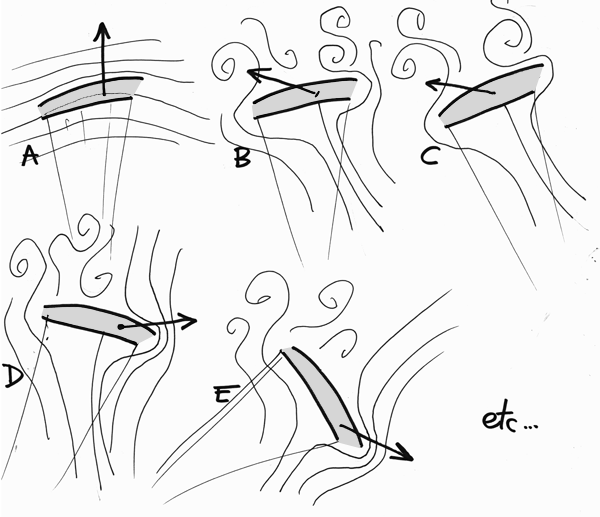
I’ve flown many times in these beautiful blue skies. With a delta wing, such thermals are not a concern. You feel them like a sailor feels gusts. Warm air rises unevenly. Within the mass of air beneath your eyes, there are unpredictable, invisible shear zones where vertical air speeds differ. Given the time, clear sky, season, and sunlight, it’s impossible for it to be otherwise. In a delta, this might lift one wing by a meter. Precisely, when you brush against a column of hot air, that’s where the lifting wing is, and that’s the direction you should turn to "catch" it. But for a paraglider, it’s an entirely different story. Such a disturbance can simply fold the wing. I’ve seen, in the southern Alps during midday, a paraglider fold up like a common handkerchief in a clear blue sky, far from any terrain. The pilot was flying straight, making no maneuvers. He was lucky to avoid a 50-meter fall before his wing re-opened. A strong thermal can cause a stall. If a beginner encountered such a situation, they might also perform maneuvers at the wrong time.
A beginner on their fourth flight should not be exposed to such problems. They must fly in air free of lift and turbulence. Therefore, early morning.
Over thirty years ago, my friend Michel Katzman, who died in 1989 after a "holey strut" broke mid-flight—a 20-gram object—organized the first delta wing training course in the Queyras, precisely at Col Agniel. I must have an old photo lying around that I’ll find. We had Manta wings, real ironing boards, gliding horizontally at 2.5 m/s. One evening we faced the valley. The air was fantastically calm. It must have been 5 or 6 PM. My friend and I said:
- We’re going to have a great flight. It’s going to be fantastic, calm and all.
I’ve never been so shaken in my life.
We were unaware of the phenomenon of restitution. We were flying fairly close to the ground, above a forest, if I recall correctly. The scenery, I don’t remember it well, but the jolts, I’ll never forget. Good heavens, I was eager for the flight to end. During the day, the sun heats the ground differently depending on its nature. Above warm areas, updrafts occur. But when sunlight ceases, the ground cools at different rates, depending on its nature and vegetation, and then releases the heat it absorbed. A typical example is restitution above a lake, like Lake Annecy (the photo in my biography refers to a tandem flight over this lake). During the day, the sun heats rocky slopes. Warm air rises along the slopes leading to the Forclaz pass, where a launch site has now been built with beams and planks, resembling a diving board. In the evening, these slopes stop "giving." As the lake water releases its accumulated heat, you can venture far from the shore above the lake into an ascending air mass. But restitution isn’t always so peaceful, though it often is. This is to say that one shouldn’t trust appearances in aero-meteorology.
Here is the weather bulletin sent by the national meteorological service, corresponding to the time of the accident:
The wing used by this beginner pilot (4th flight) was a NOVA AXON 22. I see it listed as a cross-country wing. Was this a wing suitable for a beginner? For such a wing, what is the pilot weight range? I asked my readers, who responded quickly. Here are its specifications:
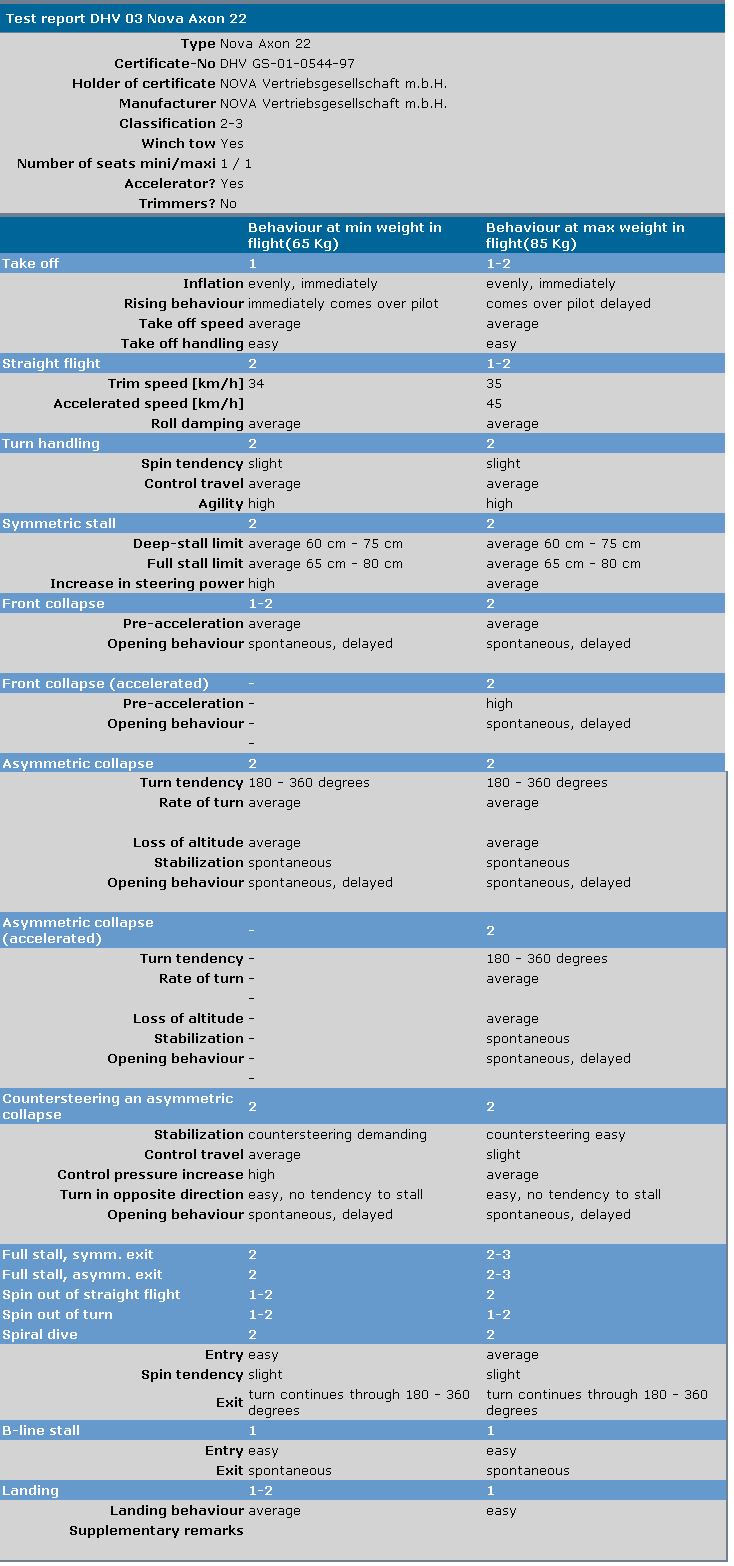
Here are the test results for this wing (source http://www.para2000.org/wings/nova/axon-22-tests.html)
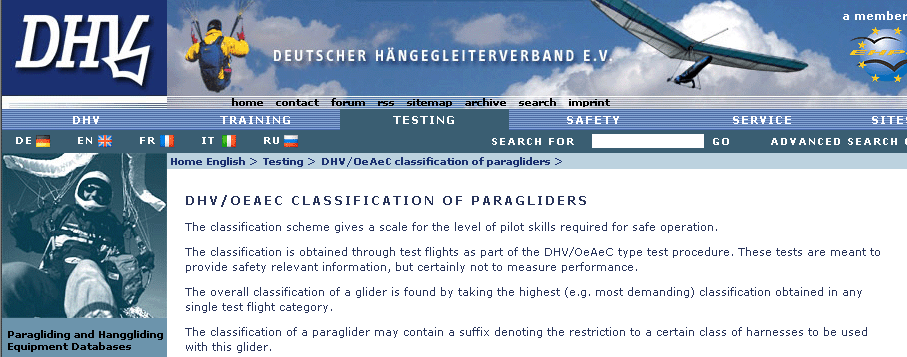
A reader, Luc Ferry, directed us to this site: http://www.dhv.de/typo/DHV_OeAeC_classifica.831.0.html
Which clarifies what these classifications 1-2-3 mean.
Here’s what we find:
The most important part of this report is this:
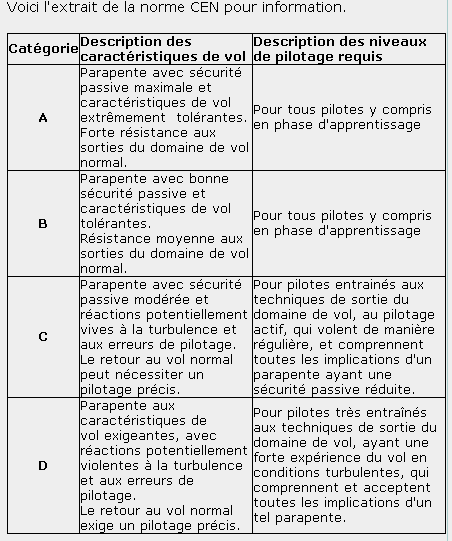
- Classification 2-3
Referring to the meaning of classifications on the DHV organization’s website (which issues certifications for free-flight equipment), this means:
"Paragliders with very demanding flying characteristics and potentially violent reactions to turbulence and pilot errors. Recommended for experienced and regularly flying pilots."
"Paragliders requiring high pilot skill, with potentially violent reactions to turbulence and pilot errors. Recommended for experienced, regularly flying pilots."
According to this, it is clearly not a beginner’s equipment.
January 11, 2008
: Message from Guillaume Doisy
Hello,
If the wing involved in the incident is indeed a DHV 2-3, then it had no business in the hands of a beginner. The DHV certification system is different from CEN, but a DHV 2-3 wing corresponds to a CEN C or even CEN D wing.
A beginner should learn to fly on a DHV 1 wing (or CEN A).
January 11, 2008
: Message from Guillaume Doisy
Hello,
If the wing involved in the incident is indeed a DHV 2-3, then it had no business in the hands of a beginner. The DHV certification system is different from CEN, but a DHV 2-3 wing corresponds to a CEN C or even CEN D wing.
A beginner should learn to fly on a DHV 1 wing (or CEN A).
After checking with the boy’s mother, the wing in question, which is sealed (so its traceability will be fully established), has not been manufactured since 1996. It’s over ten years old. Paragliders are less prone to fatigue than delta wings. But over time, the flexible wings of ultralight aircraft deform. This reduces their performance. A slightly deformed delta wing, if suitable for beginners, is not inherently dangerous, provided it doesn’t tear in flight, as happened in Laragne at the Otto Lilienthal school with a Cosmos ULM. The pilot and passenger died, and the reserve parachute, not maintained, failed to deploy. But the "Air Gendarmes," before I resumed this investigation from scratch, were content to take photos of the bodies. The Civil Aviation delegate, sent to the site, was just as incompetent in this field as the gendarmes and eager to conclude, "accident, cause undetermined." I still remember the girl of that woman wandering around the center while we tried to contact her father and grandparents. In this case, the cause was flying on an outdated machine, which I could tear by hand.
Returning to the NOVA AXON 22 wing issue: it has been established that it was unsuitable for a beginner. The fact that it’s over ten years old makes it dangerous regardless. Paraglider flight qualities change significantly due to aging-related deformations. But schools buy used wings from pilots and resell them as "training wings." In this specific case, the primary responsibility lies with the school, more than with the instructor. All this will be clarified and become part of the legal dossier. The family has declared their readiness to do everything possible to uncover the truth. We will assist them. Regarding a pending lawsuit, the defense might argue that there are no precise guidelines for introducing this sport. We will verify this, and it’s likely. A friend told me there is no specific paragliding federation, but the sport is jointly managed by delta and parachuting federations (...). If anyone has information to share, please don’t hesitate.
January 11, 2008. Message from Mathieu Daly, trainee paragliding instructor in the Pyrenees, reproduced with his permission:
Hello Mr. PETIT, I’m writing to respond to your article on paragliding stall.
Generally speaking, you’re right: the strong dive (nose-down movement) of a paraglider during retraction comes from aerodynamics (lift center at the leading edge during high angles of attack). This characteristic is actually very useful during the inflation phase, since the wing "wants" to rise as soon as the leading edge is shaped in relative wind.
I was a bit puzzled by your cryptic description of the accident… But the information you’ve just provided about the equipment frightens me!
No, a cross-type wing (DHV 2-3: roughly equivalent to French certification in the Performance/Competition category) should never be above a beginner pilot! Never! Not even a wing over ten years old!
According to the table you presented, the PTV (total flying weight: aircraft mass + pilot) of this wing is 65 to 85 kg. The wing weighs 6 kg, the harness and other equipment about 10 kg (roughly!), so the acceptable pilot mass (dressed) is therefore 50 to 70 kg.
We don’t know the aero-meteorological conditions of the day, so I won’t comment on that.
Nevertheless, one thought irresistibly comes to mind: in a consumer act, who is more responsible—the buyer or the seller?
Let me explain: a paragliding training structure using equipment over ten years old and completely unsuitable can only survive by cutting stage prices… thus attracting a clientele whose main criterion for choice is clearly price!
Is it reasonable to skimp on safety for a few euros? No! If all paragliding school clients thought this way, the "bad apples" in this small world would have ceased causing harm long ago.
Furthermore, in our consumer-driven and irresponsible society, the public increasingly thinks in terms of guaranteed results: I pay, so I want to fly, without much concern for my safety since I’ve paid (the instructor will know what to do...)! In that case, the least one can do is to turn to a structure accredited by the FFVL (certainly more expensive but bound by a federal charter defining equipment and its usage context).
But the reality is simple: the instructor is not beside the student to act or react on their behalf: the student IS the pilot-in-command, and it is their actions (directed from the ground via radio) that will bring them (safely or not) back to the ground. This is true in the vast majority of paragliding training structures. It seems, however, that many schools are shifting toward a different training model, focused on tandem flight discovery, which could prevent such tragedies. But let’s not dream: this type of course is necessarily more expensive than a conventional one....
Well, I hope this letter hasn’t been too long or tedious to read!
Kind regards, Mathieu DALY
January 11, 2008. Message from Mathieu Daly, trainee paragliding instructor in the Pyrenees, reproduced with his permission:
Hello Mr. PETIT, I’m writing to respond to your article on paragliding stall.
Generally speaking, you’re right: the strong dive (nose-down movement) of a paraglider during retraction comes from aerodynamics (lift center at the leading edge during high angles of attack). This characteristic is actually very useful during the inflation phase, since the wing "wants" to rise as soon as the leading edge is shaped in relative wind.
I was a bit puzzled by your cryptic description of the accident… But the information you’ve just provided about the equipment frightens me!
No, a cross-type wing (DHV 2-3: roughly equivalent to French certification in the Performance/Competition category) should never be above a beginner pilot! Never! Not even a wing over ten years old!
According to the table you presented, the PTV (total flying weight: aircraft mass + pilot) of this wing is 65 to 85 kg. The wing weighs 6 kg, the harness and other equipment about 10 kg (roughly!), so the acceptable pilot mass (dressed) is therefore 50 to 70 kg.
We don’t know the aero-meteorological conditions of the day, so I won’t comment on that.
Nevertheless, one thought irresistibly comes to mind: in a consumer act, who is more responsible—the buyer or the seller?
Let me explain: a paragliding training structure using equipment over ten years old and completely unsuitable can only survive by cutting stage prices… thus attracting a clientele whose main criterion for choice is clearly price!
Is it reasonable to skimp on safety for a few euros? No! If all paragliding school clients thought this way, the "bad apples" in this small world would have ceased causing harm long ago.
Furthermore, in our consumer-driven and irresponsible society, the public increasingly thinks in terms of guaranteed results: I pay, so I want to fly, without much concern for my safety since I’ve paid (the instructor will know what to do...)! In that case, the least one can do is to turn to a structure accredited by the FFVL (certainly more expensive but bound by a federal charter defining equipment and its usage context).
But the reality is simple: the instructor is not beside the student to act or react on their behalf: the student IS the pilot-in-command, and it is their actions (directed from the ground via radio) that will bring them (safely or not) back to the ground. This is true in the vast majority of paragliding training structures. It seems, however, that many schools are shifting toward a different training model, focused on tandem flight discovery, which could prevent such tragedies. But let’s not dream: this type of course is necessarily more expensive than a conventional one....
Well, I hope this letter hasn’t been too long or tedious to read!
Kind regards, Mathieu DALY
A second investigation of a similar nature is underway, concerning a 2008 May ULM accident on a Cosmos pendular where a young girl died during a trial flight. If parents or relatives of ultralight accident victims come forward, we can examine their files.
The problem is that victims’ relatives, when confronted with tragedy, are too overwhelmed by grief to react immediately. I experienced this when my son died. It was only later, during a very painful investigation, that I realized witnesses had lied (even about their number) to conceal a failure to assist someone in danger.
In ultralight accidents, reports are made by gendarmes, completely incompetent. Nonsense is told to relatives and families, who anyway know nothing about these sports and can’t ask the right questions. As for evidence, it quickly becomes inaccessible, simply disappearing. Beyond that, there’s what the father of a victim called omertà, the law of silence. Don’t break the business. The innocent practitioners are also afraid their favorite sport might be "policed," and they want to continue enjoying their splendid freedom, which sometimes hides risks they’re unaware of, even unconsciously. Some parents are tempted to retreat inward, thinking, "It won’t bring him (or her) back to life." In our current approach, we think about future fatal accidents or those leaving victims permanently disabled due to incompetence and irresponsibility.
In this fatal accident case, the instructor, in an email she sent me, attempts to shift all responsibility onto the victim. She protests indignantly against what she considers unfounded insinuations. Yet, what happens when you investigate the wing used, with references provided by the young man’s mother? You quickly find it wasn’t a beginner’s model.
Send all messages to:

For information, the federation has established a classification of different types of paragliders. Airplanes and gliders are machines offering active safety, meaning that at sufficient altitude they automatically return to normal flight conditions with controls neutral. This is a non-negotiable condition for their certification. Note the expression "out of normal flight domain," which deserves clarification. This is a property of paragliders: they are sensitive to aero-meteorological conditions or pilot errors, during which the wing deforms and the pilot must act to restore normal shape. This kind of problem doesn’t exist in delta wings, where the fabric is fixed to a tube assembly.
This "departure from normal flight domain" is linked to how the paraglider has evolved over time. Parachute wings (those used for freefall) have relatively low aspect ratios, making it extremely rare for turbulence to render them inoperative or cause, for example, one riser to pass over the wing, requiring pilot action to restore order (in fact, if this happened, the maneuver would be problematic, and the parachutist would prefer to jettison the wing and switch to their reserve). I don’t even know if this has ever happened due to turbulence after opening.
Since wing performance is directly linked to aspect ratio (albatrosses fly better than pigeons), we’ve increased paraglider performance by increasing aspect ratio, thereby also increasing their vulnerability to turbulence. Thus, we’ve obtained machines capable of "folding in flight" (unless used in hyper-calm conditions, where ascents are absent). When this happens, returning to normal configuration results in altitude loss of about 50 meters. I know experienced pilots who were seriously injured due to wing folds near the ground (both legs broken or pelvic fracture). Turbulence occurs at all altitudes. Further down, you’ll find the testimony of Mr. Alain G., who dislocated his shoulder due to an asymmetric stall during landing, caused by a gust of wind.
Unless flying in air completely free of turbulence (thus free of ascents), paragliding therefore presents an inevitable intrinsic danger. Personally, I’ve preferred to stay in the realm of free flight where this risk is considerably reduced. You can be jolted, you might risk a dynamic stall if you approach too slowly. But a delta wing doesn’t fold in flight. That said, paragliding has the enormous advantage of being foldable into a bag, thus easily transportable. It can be stored in a bedroom or closet. A practitioner can, after flying tens of kilometers from their vehicle during a cross-country flight, return by hitchhiking, bus, train, or anything. Free flight requires an entire recovery and transportation system at the end of a "cross" and generally. This is why free flight or delta wing is almost disappearing today, in favor of paragliding.
No paragliding practitioner can tell you this risk of in-flight folding doesn’t exist in air full of ascents, thus turbulent. All practitioners have experienced such events and actually consider them "normal." And if you add: "What happens when this occurs near the ground?" the answer will be:
- Yes, that’s the risk of this sport...
I have experience as a delta pilot since 1974 and as a parachutist (200 jumps), first in "hemispherical" parachutes, then using canister parachutes, the forerunners of paragliders. When I switched from hemispherical to canister parachutes, I was surprised by their behavior during stalls. I’ll detail this later.
The hemispherical parachute has long since disappeared. By nature, it descended almost vertically. You could deform the structure by pulling on the risers. There were four. Pulling the two front ones allowed slight forward movement. Pulling the two rear ones caused backward movement, etc.
A very primitive mode of control, linked to a fineness far below one. Enough to avoid an obstacle or try