ULM Accident Wing Chronos 14
Text updated on July 12, 2007
If you are flying a Cosmos ULM with a Chronos 14 wing, read this file and check your machine.
I had to wait years before being able to share my testimony about a very serious accident that victimized my friend Robert Dalmau and his passenger-client, Alsio Origlio, leaving both of them permanently disabled. Dalmau can no longer walk, he drags himself. The neurological injuries he suffered have made his life a real hell of suffering. I don't know what happened to his passenger, whose identity and physical damage I don't know. This accident occurred in France, at the Gap Tallard airfield on May 26, 1997.
Dalmau considered himself as a sort of official pilot for the Cosmos company, a pioneer in pendular ULMs. I see on checking the website that this company is the first in the world in terms of selling pendulars. These wings have the following appearance:
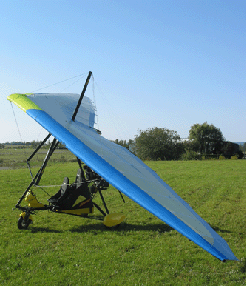
Pendular ULM
This is not a photo of the Cosmos wing on which Dalmau and his passenger were involved in an accident, but the appearance is very similar.
**The incriminated Cosmos pendular was equipped with a Chronos 14 wing, mounted on a Cosmo "bidulum" cart. **
I recently verified, in July 2007, that there were still Cosmos pendulars equipped with Chronos 14 wings in clubs (at the Nivelles ULM airclub, Belgium). I just spoke to Robert on the phone, who thinks that there are still machines with this configuration still in service.
Therefore, I strongly urge all owners of carts equipped with Chronos wings to perform this check urgently!
Here are the facts.
I had known Dalmau for many years, since the mid-1970s. He was one of the pioneers of pendular ULMs and one of the promoters of flying on this type of aircraft. He had an impressive number of flight hours. Sometimes I rented his machine to go for a flight now and then, from the airfield where he was based, in the south of France. The pendular of that time was very fun. Without any fuselage, it gave the impression of being the "bicycle of the air". You could see the void under his feet.
One day in 1997 I came to the Tallard airfield with two friends who wanted to take their air baptism on this aircraft. When we arrived, Robert Dalmau had just landed after a flight with a client. A skilled pilot, he had felt "that the machine was pulling to the left". He decided to lower the wing and inspect it. I helped him perform the operation. When we saw the leading edge - crossbar joint, I was shocked. At the time I was making extremely precise sketches, which were used by the aeronautical expert in the trial that Dalmau brought against the Cosmos company. It was precisely because these drawings were essential pieces of the trial that I could not mention them for years, during the entire duration of the trial, under penalty of making these legal documents invalid. I have not yet been able to find these drawings in my CD archives. I just spoke to Dalmau on the phone, who told me that he was going to retrieve them from his lawyer, Mr. Magret, in Bordeaux, and that he would send them to me. As soon as I have these drawings I will scan them and include them on the site.
Therefore, this is only a first schematic presentation.
A pendular wing is attached to a frame made of light alloy tubes. See the top view diagram. This frame has two leading edge - crossbar joints (floating). In the assembly that Dalmau and I examined, the two tubes were fastened by a single threaded rod along its entire length and bolted. At both ends, cables could be attached, forming the upper and lower stays. As can be seen, the lower stays are attached to the horizontal bar of the "trapeze". These two stays are subjected to very high tension. Therefore, the bolt passing through the two tubes is subjected to both tensile and bending forces.
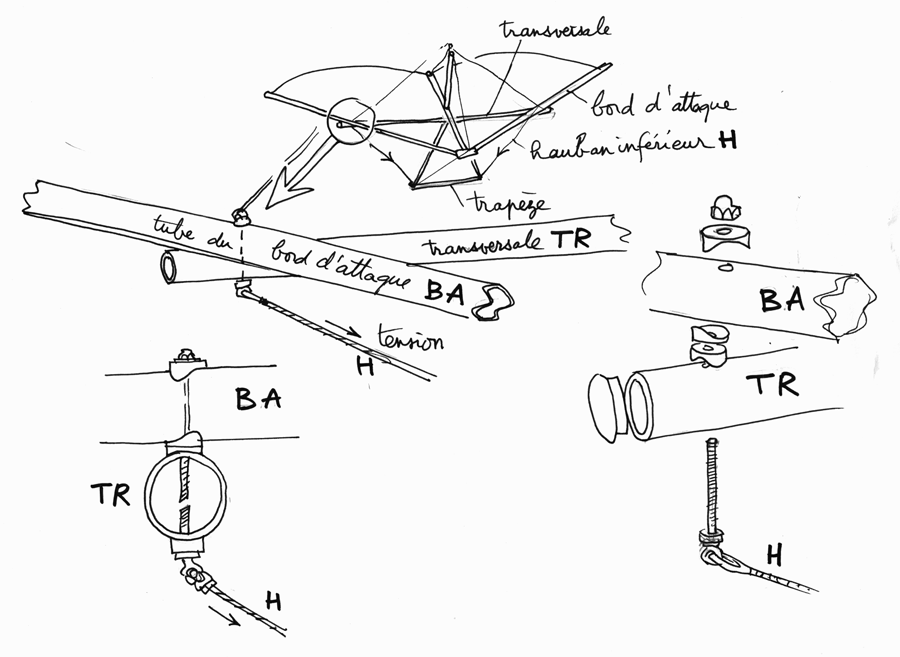
**Diagram of the leading edge - crossbar assembly **
In the assembly of this Chronos 14 wing that equipped this Cosmos "bidulum" machine, we can see how the lower stay H causes bending on the threaded rod that passes through the two tubes. Between the tubes, there are plastic coupling pieces. But inside the tubes, there is no bushing! A bushing would have prevented the rod from bending.
Such an assembly is completely absurd.
As can be seen in the drawing on the left, the successive efforts on this assembly had caused the threaded rod to break in the middle of the tube forming the leading edge. A threaded rod is not the best device for alternating bending efforts. In fact, it is the worst one imaginable, since the threads represent as many crack initiation points.
But fortunately, the system remained in place due to the strong lateral tension. See the drawing on the left.
In fact, the clinical assembly was even worse. When I have the original drawing, the reader will be able to see it. I don't want to reproduce something imprecise from memory. There was another flat piece, 5 mm thick, which was cracked over 5 cm. Only 1 cm of metal remained. The conclusion was that Dalmau and his companion were very lucky that day. If he had not performed this inspection, the two young women who came with me for their air baptism would have probably been victims of a serious accident, along with Dalmau, the pilot.
I personally wrote three letters.
-
One to the manufacturer.
-
The second to the president of the ULM federation
-
The third to the magazine "Vol Moteur", in the form of an informative article that I wanted to see published in its columns.
No response.
Some time later I found out that Dalmau had been seriously injured, on a Cosmos machine with a Chronos 14 wing.
Sometimes people "don't listen to warnings". A few months after I found out that these wings were also poorly constructed, Robert bought ... another one, used.
*- The wing looked healthy, he told me. *
These were his own words. It had 200 flight hours. Robert did not perform the inspection on this one that we had done together. The breakage occurred during takeoff, when he was flying with a client. This time the threaded rod was ejected, along with the lower stay cable. The leading edge did not break, but the cable got caught in the propeller. As it wrapped around the axis, it exerted a strong pull on the trapeze, which Dalmau could not control. The machine went into a dive and hit the ground.
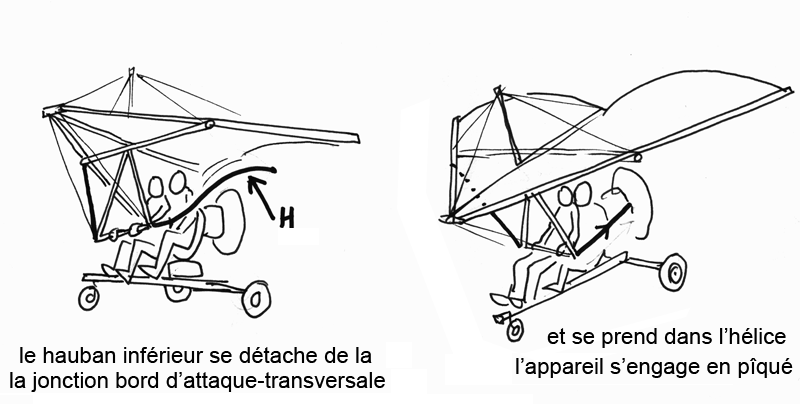
**The accident on Cosmos, Chronos 14 wing, May 1997. Pilot: Robert Dalmau. Passenger Alsio Origlio. Link: Tallard airfield, France **
After this accident, the Cosmos company did not issue any warning note to buyers of this type of machine (according to Robert Dalmau)
That's it... the facts.
This case has a third part. After this serious accident and while the trial was already underway, I was flying a delta da...