How the birds turned
How the birds turned
(and the free wings)
...Airplanes and gliders have vertical stabilizers, birds do not. So, how do they turn?
...Some years ago, an American scientist, a paleontologist, built a flying model of a pterodactyl, in an attempt to evaluate the animal's ability to stay in updrafts. It is known that the head of these creatures was extended by a bony crest, flat.
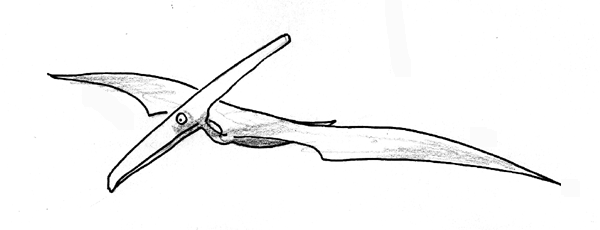
Our man deduced that this must have served as a vertical stabilizer and made it movable, to control his model via a remote control. But in doing so, he forgot that bats are very agile in flight and perfectly capable of making tight turns, even though they don't have a bony crest, just two membranous wings. So, where was the trick?
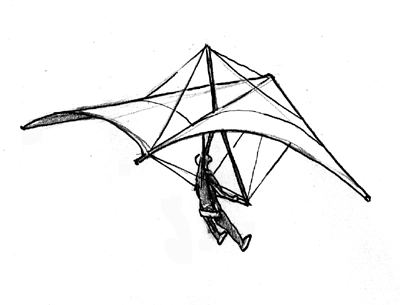
...When men flew attached to the first Rogallo wings, the control was entirely done by moving the center of gravity. By pulling or pushing the trapeze control bar, the pitch control was ensured. There, no problem. The first Mantas had "fixed crossbars". To turn, the center of gravity had to be shifted. The turns were always done in a slide, with a significant increase in the descent rate (from 2.5 meters per second in stabilized horizontal flight to 3.5 m/s in a turn, even a slight one).
**
The first "Manta". Flying in a standing position.
**
**...**A pioneer, whose name I can't recall, had the idea of separating the crossbar from the keel. A link (see drawing) allowed some lateral movement.
**
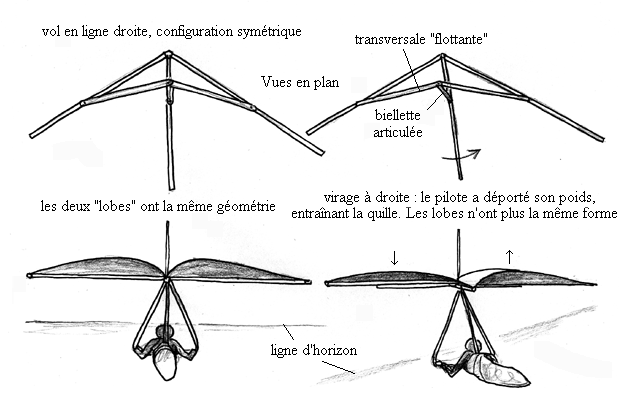
** ...The result: an extraordinary gain in maneuverability, was immediate. When the pilot shifted his weight to the side, pulling the keel, which was attached to the trapeze, with him, he deformed the wing. The drawings show this effect in a very exaggerated way. But it's easy to imagine the result. By flattening one of the "lobes" by a centimeter, while the other indented by the same amount, it was as if the two wings had had ailerons running along the entire trailing edge. The handling comfort changed completely and safety increased.
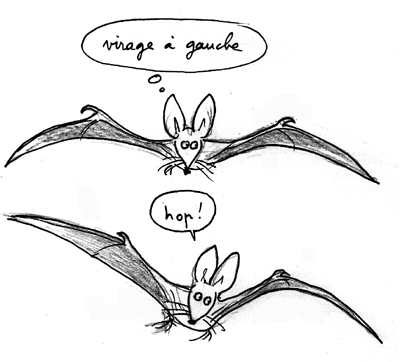
...Going back to the bat, which also has flexible wings, with free trailing edges, simply attached to the arm and one of the animal's hypertrophied fingers. What does it do when it wants to turn? It simply extends one of its wings while slightly folding the other. Same effects on the trailing edges. No need for a vertical stabilizer.
...Birds turn in a similar way. Those whose wings have strong elongations, like albatrosses, use "inverse effects". The feathers are connected to muscles. Thus, the entire wing of the bird is of variable geometry and forms a very complex system. These are "multi-surface" wings that allow air to flow from the underside to the upper side, which causes a "boundary layer blowing" and allows flying at high angles.
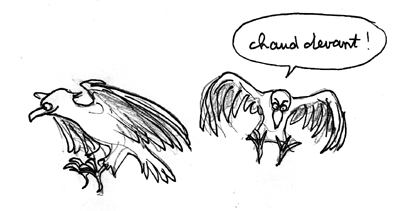
...When a paraglider lands, it deploys what it calls its "aerobrakes", which are also "lift destroyers". Birds partially fold their wings. You have probably seen a raptor approaching, its two wings half-folded.
**
**
**...**In short, we haven't invented much. Deltas already existed in the time of the dinosaurs. They were called pterodactyls.
Click on the "Previous Page" box