Is paragliding a dangerous sport?
**Text updated on July 12, 2007 **
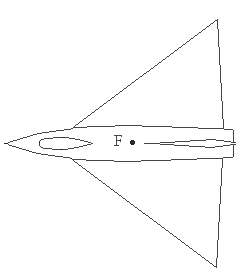
...The "delta wings" have a particularity: their center of lift is at 40% of the "chord", as shown in the drawing above. They fly and glide very well, with their famous "S" shaped profile.
**
The "delta plane".
**
...What connection do these rigidly constructed delta wings have with the "delta" of the "libertarians"? At first, these two wings have little in common. The first free flight delta wings were "single surface": two Dacron triangles stretched over three light alloy tubes.
**
The "Rogallo" wing.
**
...This wing was invented by Rogallo, a NASA engineer. The initial motivation had nothing to do with a sport activity. The military were not satisfied with the accuracy of their intercontinental missiles at the end of their ballistic flight. Therefore, Rogallo was asked if he could not imagine a kind of wing allowing the military payload (an atomic bomb) to be delivered, being more or less controllable during this part of the mission. The Rogallo wing was supposed to deploy from the rocket body when the speed had sufficiently decreased, at the end of the flight, by means of a deployable parachute. But with time, missiles became more accurate. They preferred to pilot them during the re-entry phase and not at such a low speed that the enemy could hit them with simple slingshots. The Rogallo patent therefore fell into the public domain. As with all great ideas, it was very simple. In the USA, free flight was born, some daring people having the idea of attaching themselves, like hams, under these tube, canvas and cable assemblies. The control seemed extremely simple. To dive, one moved their body forward, to climb, backward, using a "trapeze" connected to the wing by cables. By moving their weight to the right or left, one achieved what was called turns. Thus were born the first "Manta" wings, manufactured in France from 1973. I personally bought my first "delta plane" Manta in 1974.
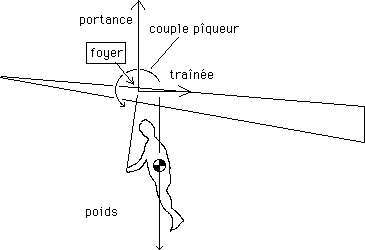
...The first wings were cut in the simplest way possible. When dismantled, they were completely flat, which made the two lobes have a conical shape in flight. The dihedral was pronounced (80°). It was the pilot, flying with his body shifted behind the "center of lift" of the wing (the point of application of the resultant of aerodynamic force and lift), who compensated for the diving moment of the wing with his weight.
**
It is the pilot's weight that compensates the diving moment.
**
...I remember my first flight on this type of device. The son of the famous climber Lachenal had bought one. He worked near Chamonix, at the "Grands Montets". After a few very brief explanations, the client, standing on skis, was attached under the device with a harness and a carabiner, then launched down a steep slope, standing on his skis. He was advised to keep the nose of the machine lowered "until the sail flaps well" (a sailor would use the verb "faseyer"). Then it was enough to push the control bar by ten or fifteen centimeters to immediately be ten meters in the air, for a 150 meter flight.
*- When you are in the air, you touch nothing, it flies by itself and lands the same way. *
...Indeed, landing on skis is not much of a problem and can be done with a very simple rounding. Back in Aix, I immediately ordered a Manta that a carrier delivered to my home, and I continued my training alone on all the ski slopes in the region. When the snow disappeared, I made some takeoffs by fitting baby carriage wheels on an old pair of skis (remember that at the time, no one taught how to use a wing, anywhere). Fortunately, I quickly found other "crazy flyers on their strange machines" who taught me how to take off by running, much less dangerous than this baby carriage wheel affair.
...At the time I was writing articles for Science et Vie. I published an article in 74 on this new sport, which probably contributed to its development. But very quickly, things got worse. Our friend Delacourt died in front of the TV cameras. His machine dived and he could not recover. Immediately I went to Paris to question the manufacturer.
His answer:
*- Lack of piloting, the seller of Manta in France immediately declared. *
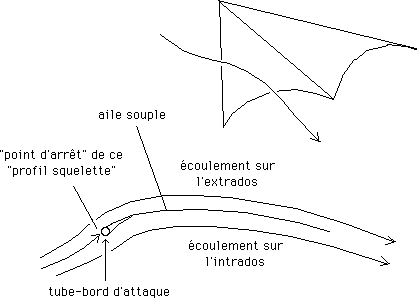
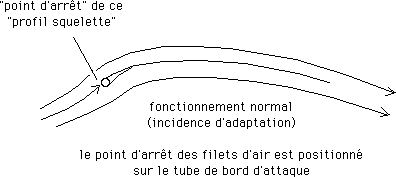
...This was false. The Manta were indeed very dangerous machines. Here's why. As can be seen in a drawing presented above, the Rogallo wing is a "skeleton profile". There is an optimal angle of attack, called "adaptation angle", under which the profile works best. The stagnation point (the point where the airflow splits into two, the upper part flowing over the upper surface and the lower part over the lower surface) is then located on the rigid leading edge tube.
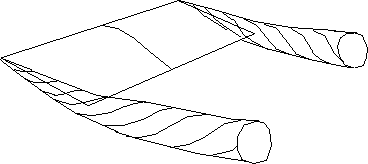
...When an airplane wing is moved through a mass of air, a pressure increase occurs on the lower surface (below) and a pressure decrease on the upper surface (above). The air therefore tends to flow from the lower surface to the upper surface, like this:

and a system of wingtip vortices is formed (these are the ones that trigger the condensation trails created by airplanes flying at high altitude in moist air).
**
Wingtip vortices **
...A remark in passing: this turbulence dissipates energy. It can be reduced by increasing the aspect ratio:
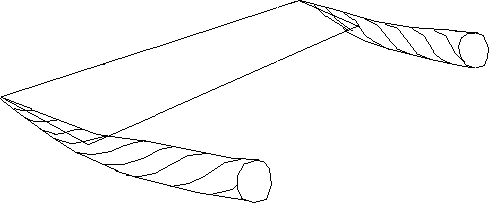
Reduction of the effect of wingtip vortices by increasing the aspect ratio.
**
...This is why albatrosses fly better than pigeons and gliders have very high aspect ratio wings. But then, why do airplanes have delta wings, with very low aspect ratio? Jet fighters are not gliders. Their ability to "cut through the air" is then prioritized. At supersonic speeds, this will require very thin, knife-edged wing profiles. So, either:
*- You choose the straight wing, very thin, like the F-104 fighter *
*- Or you choose the swept wing, which, for a given thickness, reduces the "relative thickness of the profile". *
...The variable geometry wing, despite its mechanical complexity, easy to imagine, combines both qualities. It cuts through the air well at supersonic speeds, wings folded, but remains an acceptable glider at low speed, wings deployed again. Delta wings form a special family because they perform very well at very high angles of attack.
**
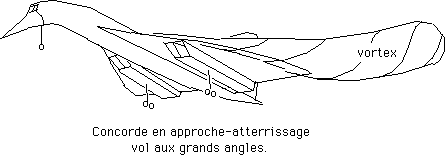
A Concorde approaching final, at high angle of attack.
**
...Two "vortex" are then formed which have a stabilizing effect on the flow. The same is true for Rogallo wings (Manta).
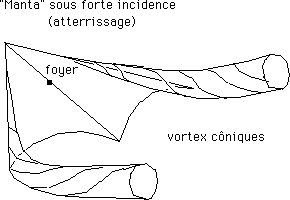
...This ability to maintain significant lift at large angles makes landing the Manta very easy. It was a wing that did not stall, but smoothly transitioned into a "parachute descent". Although it is now a bit difficult to imagine, with these ironing boards at very...