Is paragliding a dangerous sport?
Updated on July 12, 2007
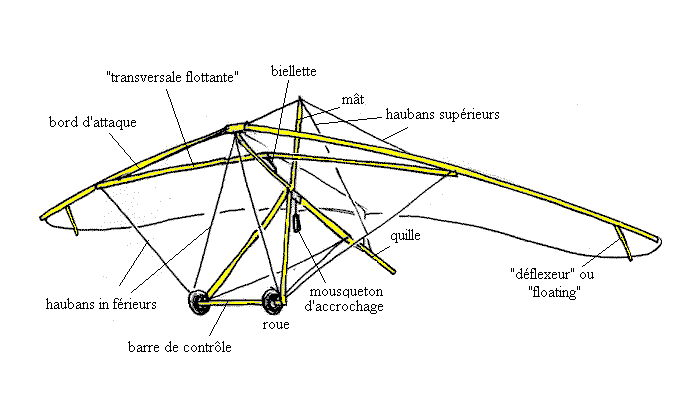
...In the drawing below, the anti-stall, anti-dive device as it currently exists on all modern wings. At the wingtips are "deflectors" or "floatings," planted into the leading edge tube. The ends of the spars are also connected to the top of the mast by stays.
...In this way, the entire shaded portion of the wing contributes to the aircraft's recovery in case of accidental stall.
...Between this current design and the early machines: a path paved with numerous fatalities. In the drawings below, the structure of a modern delta wing:
The wing’s "skeleton": tubes and cables.
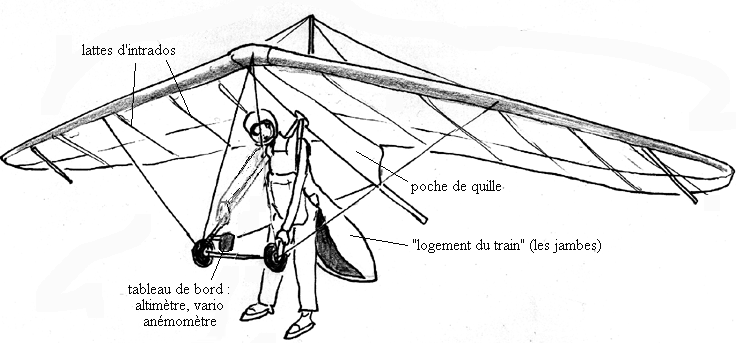
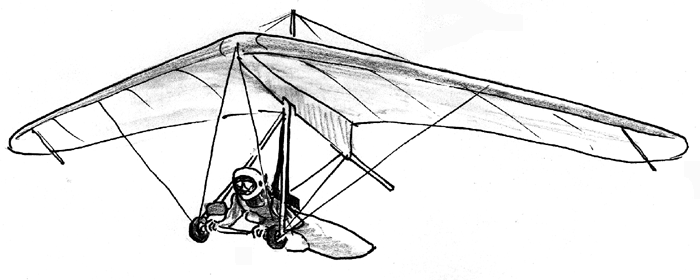
...The harness has changed dramatically. Twenty-six years ago, pilots flew standing upright, suspended in a parachute-style harness. Then came the prone flying position. At takeoff, the pilot would run while holding part of his cocoon harness between his teeth, having to contort himself to fit his legs into it. Then someone had the crazy idea of adding a wasp-like "abdomen" to these harnesses, visible in the drawing above. Immediately after takeoff, the pilot "retracts the landing gear," meaning he slides both legs into this bag and then closes it manually using a zipper. The most amazing part is that this entire process works flawlessly.
...This is what I look like under my Tecma "Cloud" wing after takeoff (my own machine). On my belly, the reserve parachute. A wing on which one can have fun, cover long distances, and face turbulence. A healthy wing, both structurally and in flight performance. Of course, one shouldn’t be reckless—avoid flying under cumulus clouds transforming into towering cumulonimbus or near rugged terrain with rolling features.
...At landing, you pull another zipper and "extend the landing gear." This maneuver never fails to delight me. Who would have thought, twenty-five years ago, that such devices would ever emerge (at a time when I landed on modified skis using baby carriage wheels). Fortunately, that didn’t last long.
The free wing today.
...Can we say all problems in this branch of ultralight aviation have been solved? Let’s say machines have improved considerably. But what’s tragic is that these advances came only after many people died. Why? Because this sport—ultralight aviation—grew like a wild plant. My mind is heavy with tragic memories. One day, a manufacturer introduced a double-surface wing. Performance immediately increased. Today, heavily braced on both the upper and lower surfaces, these Dacron wings resemble airplane wings almost entirely. With high aspect ratios, they have little in common with the Manta wings of the 1970s. Switching to "double surface" improved glide ratio, reduced drag, and lowered sink rate. But with this wing, when entering a turn, the aircraft would suddenly dive.
...Once again, deaths occurred. Only pressure on the manufacturer brought the scandal to an end.
...Did people have to die for the sport to progress again "freely"? No—these materials could have been tested in wind tunnels. At ONERA, engineer Claudius Laburthe had access to the large wind tunnel at Chalais-Meudon, where wings could be tested at full scale. Is that wind tunnel still available? Was it even accessible back then? Couldn’t model tests, possibly remotely controlled, have been conducted?
...It’s expensive, one might object? But how do we value a human life?
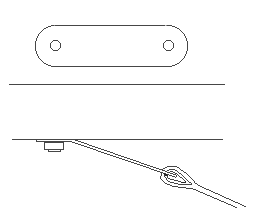
...Ten years ago, my friend Michel Katzman, with whom I had flown for 15 years, died foolishly. He was one of the pioneers of this sport and possessed great experience. A component failed in flight. He was flying a two-seater with a passenger, without a reserve parachute. Here is the broken part, full size:
...The attachment marking here is schematic, but you can see it’s simply a stainless steel "tab with holes" used to secure a lower stay to the tubular structure. This tab broke in flight. Michel and his passenger were trapped inside a coffin of fabric, cables, and broken tubes. During the fall, he cried out—clearly audible from the ground: "Close your eyes, we’re done for!" During that endless descent, Michel must have thought: "I never believed in parachutes. But now, maybe they could save us."
...No such tab had ever broken on any delta wing since their inception. So why did it happen?
Material fatigue.
...All aviation engineers will tell you: in aircraft design, what really matters isn’t static strength but fatigue resistance. You’ve all broken a wire or sheet metal by repeatedly bending and unbending it. The metal "fatigues" and eventually breaks. In this case, we’re forcing things. But any metal part subjected to alternating loads gradually loses its strength. This could be a rotor blade undergoing flexing, the cabin wall of a jet experiencing pressurization and depressurization with every flight. It could be... anything. A tab with holes, for example.
...Let me tell you a story etched in blood in the history of international aviation. After the war, the British launched an aircraft astonishingly ahead of its time: the Comet quadjet. It was the first of its kind. The British had been leaders in jet propulsion just at the end of the war with their "Gloster Meteor." The Comet was sleek, elegant, fast. Then, a few months after dozens of units entered service, a series of inexplicable accidents occurred. Every time, 100 passengers died. The aircraft were grounded, and de Havilland lost all its orders. Numerous teams were laid off.
...One thing was known: all accidents happened after a certain number of flights. There were no black boxes at the time. When accidents occurred, pilots had no chance to send a distress call—almost as if the planes had literally exploded in mid-air. And that’s exactly what happened. To reach this conclusion, engineers sealed a Comet fuselage in a pressure chamber and simulated pressurization-depressurization cycles. After a certain number of cycles, the fuselage failed at a window frame. That number turned out to be close to the number of cycles experienced by the aircraft during the early phase of commercial operation.
...It’s practically impossible to predict fatigue phenomena—the problem is too complex. The only solution is to test materials and complete structures. Specialized test benches subject aircraft landing gear to endless impacts simulating runway landings, wings undergo alternating flexing driven by simple crankshafts that mimic gust loads. These tests can go up to 100 million cycles.
...In reality, material strength decreases from its static value. This decline curve is called the Wöhler curve, if I recall correctly. Some structures, under given stresses, see their strength drop and then stabilize at a constant level. If this level exceeds the normal operational loading, we conclude the structure is "fit for service."
...The aviation industry has established standards and adopted safety factors. Today, when you sit in a commercial airliner, you can be certain all components have been tested under impact, cold, and heat. Safety comes at that price.
...The same applies to small aircraft—two-seaters, four-seaters—not built haphazardly but calculated and tested for fatigue. The same goes for what’s known as "light aviation." Amateur construction thrives but is regulated. Take the example of a well-known small single-seater, the "Cri-Cri," initially powered by two lawnmower engines. At first, one man designed, drew, and built it. But he submitted a calculation dossier reviewed by qualified experts. He tested his aircraft under load and fatigue, following existing standards. The mechanical strength of a wing primarily depends on a "spar." The Cri-Cri’s inventor tested his own spar using an eccentric mounted on an electric motor—100 million cycles. The test was validated. The inventor received approval to market his product. No Cri-Cri wing has ever broken in flight.
...And what about ultralight aviation? Sadly, nothing similar exists (&&& written in 2001. But it’s highly likely the situation hadn’t changed six years later). In this field, we’re still in the era of the Wright brothers, who, as we know, began their lives as bicycle manufacturers. No one had calculated or tested the tab with holes whose failure caused my friend’s death. "It looked thick enough to hold," that was all. We can’t blame the manufacturer: no regulations required such testing, and he simply didn’t understand the meaning of the word "material fatigue."
...Under static load, the part could withstand multiple times the most violent forces. But no one had tested its fatigue resistance, not even considered doing so. Yet it would have been simple. A frame, an eccentric, tensile and bending loads repeated thousands or millions of times—simulating ten or a hundred times the forces the part experiences under the harshest conditions, far beyond the aircraft’s expected lifespan.
...The broken tab was cut from 1.5 mm thick stainless steel sheet. With just 2 mm thickness, it would never have failed. All tab thicknesses were later inspected, and some increased. But this required two deaths—two more.
...I don’t blame the manufacturer, Mallinjoud. Poor man spent countless sleepless nights over this tragedy that cost the life of a man who was also his friend. It’s the system that’s completely broken. No standards, no periodic inspections, no requirement to wear a helmet or carry a reserve parachute. Just pure, splendid freedom.
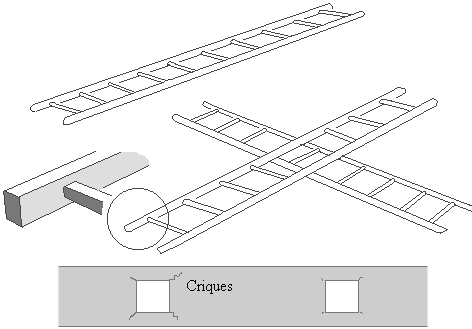
...In terms of construction, ultralight aviation is in total chaos (&&& written in 2001. If things have changed, please let me know). We’ll dedicate a full dossier to this topic. For now, I’ll cite just one recent, highly revealing fact. A few months ago, a friend drew my attention to an idea that seemed appealing for its simplicity. Someone had decided to build ultralights using simple recovered aluminum ladders. He bought an entire batch from a large discount store at low cost. Lightweight, relatively strong. The man chose the "sky’s the limit" formula.
...The structural part of this revolutionary ultralight: three lightweight alloy ladders.
...The same, "dressed up."
...Of course, it flies. With fifty horsepower, you can get any ultralight off the ground. But let’s take a closer look at these famous ladders.
...Any beginner engineer would explain that these square holes, where the ladder struts fit, are ideal locations for crack formation under bending and torsion forces, ultimately leading to in-flight failure. But who supervises the brilliant tests of this "job creator"? (I even heard talk of "subsidies"). Which technical service is authorized, mandated, to investigate such matters? None. In ultralight aviation, anyone can build anything, however they like, and sell it to whoever comes along—whether or not they hold a pilot’s license. Did you know that?