Is paragliding a dangerous sport?
Text updated on July 12, 2007
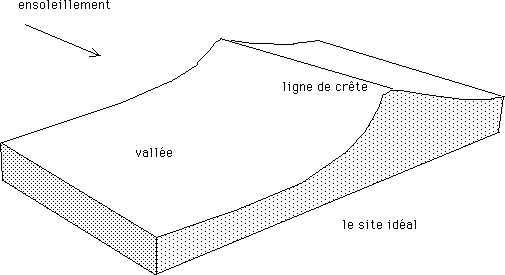
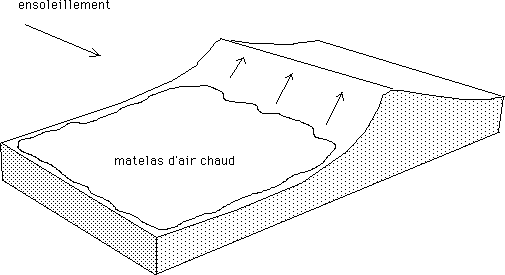
...The cliff, just below the ridge, is almost perpendicular to the light rays. The heated air will create updrafts that will tend to pull this warm air mass towards the slopes.
...In the middle of the day, the system becomes unstable.
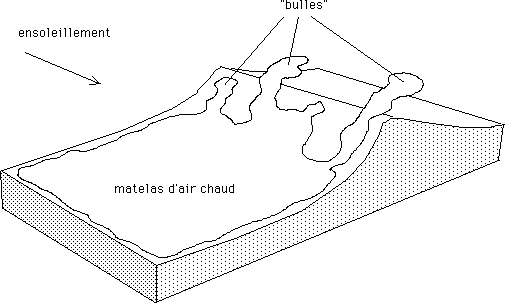
...On a general upward movement, say 1 m/s, due to the general rise of the air mass under the effect of the light wind, are superimposed "bubbles", corresponding to more pronounced updrafts (from two to four m/s).
...Ultra-light aircraft (delta or paragliders) can take advantage of this system to stay in the air for hours, to make back and forth along a ridge, then eventually jump to another "updraft", after a "transition", by crossing as quickly as possible without losing too much altitude an air mass without updraft or slightly descending.
...The upward movement of the air can be more or less regular. It can be large masses where the machines are calmly pulled upwards. But the hazards of meteorology can give rise to more intense boiling, to "shear" regions where ascending and descending currents coexist over distances of a few meters.
...An ultra-light aircraft can then cross a region where very different air currents prevail:
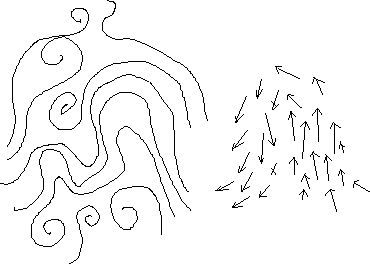
Regions of high turbulence. Shear.
**
...The machine is then shaken. A glider flying at 120 km/h will hardly notice this local turbulence, which it will cross quickly like the wind.
...A delta will see one of its wings lift. The pilot can:
-
Counteract by quickly shifting his body weight in that direction.
-
Pull on his harness to increase his speed and get out of this situation. His speed range is relatively wide: (35 to 70 km/h).
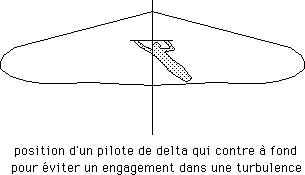
...All machines have their specific limits, their "flight domain". In this respect, ultra-lights can be compared to pleasure boats, particularly to fragile dinghies, which are not designed to face any weather. Let's say the flight domain of the delta is wider than that of the paraglider, and we will see why.
...The paraglider's speed is much lower. The pilot cannot dive, gain speed to get out of a bad situation, which a delta pilot can do. But above all, the paraglider's sail is not designed to withstand any gust. It will deform, fold, temporarily lose its aerodynamic qualities. The pilot will lose altitude.
...The deformation can go as far as closing. For those who have already witnessed such a sad spectacle, the wing then looks like a crumpled handkerchief.
...I witnessed such an event on Sunday, August 30, 1998, at 4 p.m. at the site called "Col Saint Jean", near Seyne les Alpes. The conditions seemed excellent. Light north wind (10 km/h). Activation of a thermodynamic updraft system (see diagram above). Blue sky, no stormy instability.
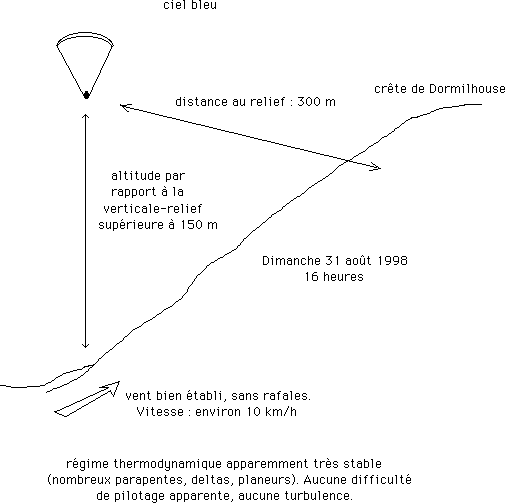
Suddenly the sail closed in a "Z":
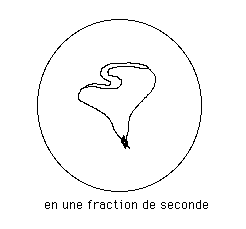
...The man fell about twenty meters, screaming. Then the sail opened again, the incident lasting a total of three seconds.
...This type of incident, according to the practitioners of this sport, is common, with an average altitude loss of 50 meters.
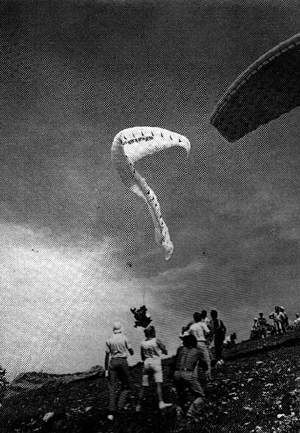
**Flight incident near the terrain. The pilot flying in a seated position
**** his body detaches above the head of the woman in shorts who is in the foreground
Extract from the FFVL manual. **
...This type of shear commonly occurs near the ground or near terrain. In this case, the pilot does not have time to reopen his sail before touching the ground. He can be seriously injured, or even killed.
...The accidents affect the ankles, legs, pelvis, and spine and correspond to vertical falls.
...Delta accidents often correspond to high-speed landings (possibly with a tailwind). The hands, arms, and shoulders are then damaged.
...Recently, the jaw is well protected by the adoption of an "integral" helmet specifically designed for ultra-light aircraft. The harnesses are also almost all equipped with wheels with a diameter of thirty centimeters, which allow for recovering from poorly executed landings.
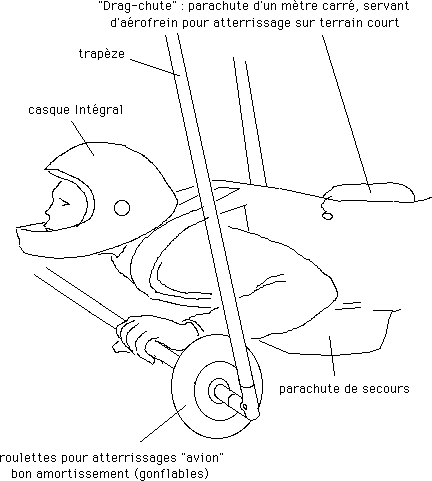
...I don't want to make a controversy, but to report facts. The sails of deltas are attached to a rigid tubular frame. Paragliders are not. We can compare these two sails, one to a Marconi sail of a boat, fixed to its boom, the other to an untangled spinnaker. Everyone knows that a spinnaker can wrap up with the slightest gust of wind. It is much less stable than a sail fixed on a boom. But what is the typical mechanism that causes a paraglider to close?
...We are no longer at the stage of simple box parachutes (which are required not only to allow appreciable gliding flights, but also to be able to open in free fall, which excludes too long extensions). A paraglider is a wing with a very studied profile. A complex system of lines maintains its shape. The leading edge is made of a kind of flexible mesh, through which the air freely enters, ensuring the inflation of the cells. As long as the point of air flow stop is on this mesh, acting as an air inlet, the sail will maintain its shape.
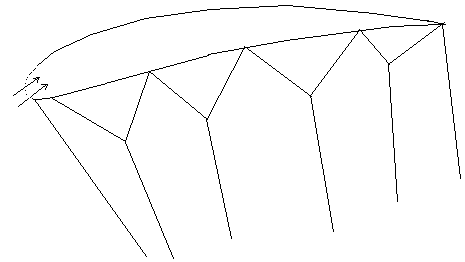
Below, the air circulation in a normal use:
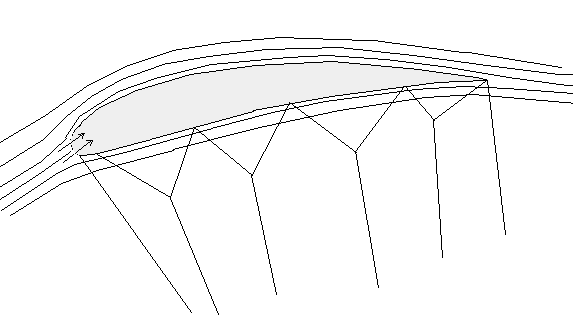
...In gray: air under slight overpressure. But what will happen if a turbulence, a "shear" changes the direction of the "relative wind", like this:
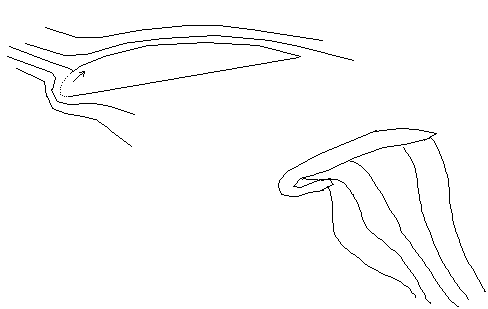
...This part of the wing will fold, as indicated. This will result in an immediate loss of lift and a tendency to autorotate.
...Thus, it is clear that the dangerous configuration for a paraglider is a low angle of attack (as was the case for the "Manta" before). However, high-performance, fast wings have flat profiles and a narrow tolerance for angle of attack.
...When a pilot wants to "cover distance", he will have to go from updraft to updraft. Between two "pumps", he will have to fly as fast as possible to perform his "transition". Some delta wing models are equipped with "overdrives". This is a cord that the pilot can maneuver in flight and which, connected to a pulley system, extends his sail and flattens it. He thus increases his "penetration". Some wings can thus approach a hundred kilometers per hour (maximum speed). For a paraglider, this is excluded. Therefore, to gain performance, manufacturers lose safety.
...The question of paraglider in-flight closure is developed on page 38 and following of the federation manual, chapter 1.28.2, reproduced below:
1.28.2. Closures.
...Closure is the result of a decrease in angle of attack. One can have an idea of what happens by pulling...