COSMO17 Conference, Paris Report
COSMO 17 Conference, Paris, August 2017, summary
September 2, 2017
#_ftnref1****
George Smoot, Nobel Prize 2006
Françoise Combes' lecture on supermassive black holes
Video showing her building a light aircraftAndrew Strominger
**
I’ve just returned from the COSMO 17 conference, held in Paris from August 28 to September 1, 2017, at Paris Diderot University, organized by the APC (Astroparticles and Cosmology) laboratory. I imagine internet users asking: “So, what were the reactions?”
It went just like Frankfurt. I’d even say it was worse.
First, internet users need to understand what attending a conference means—especially when presenting a poster. It’s a standing presentation, nothing like oral presentations in a hall, which are the only ones where people can “react,” or at least wish to react.
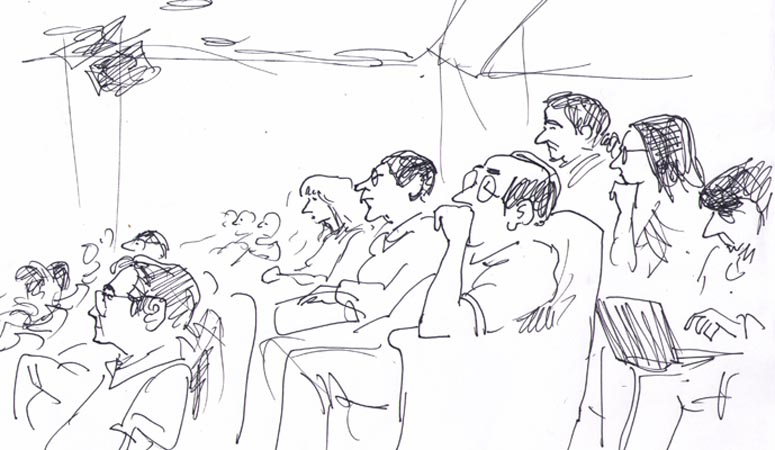
There were 193 registered participants from 24 countries, but it seems Parisian researchers formed a particularly large contingent. People were sitting on the steps of an amphitheater packed to capacity. I’ll discuss these interventions later in detail. But it’s important to describe what international conferences have become today—especially in this field. Speakers deliver presentations lasting 30 to 40 minutes, illustrated with images shown on a screen.
In the hall, half or even two out of three attendees have their smartphones on their laps. What are they doing? When you glance at their screens, it has nothing to do with the talk they’re supposed to be attending. Since internet access is available, they can read emails, send and receive messages during the talks. Personally, I sat next to a young Russian researcher working in Bonn, Germany, who spent the entire session staring at a Cyrillic text on a small tablet, paying zero attention to the presentations. She didn’t hesitate to tell me she was reading a... novel!
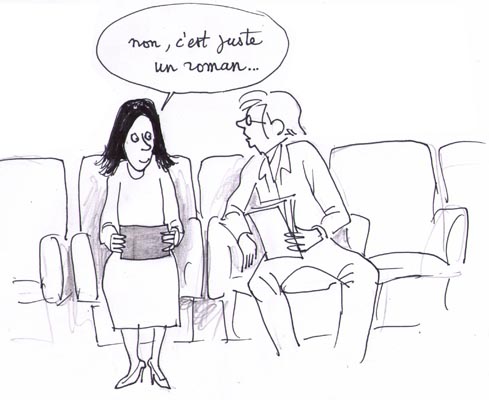
In many sessions, less than half the audience is actually listening. It was the same in Frankfurt. When the talk ends, the chairperson thanks the speaker profusely, and the hall erupts in enthusiastic applause. I’d already noticed this phenomenon in Frankfurt. But when I attended conferences in the past, I’d never seen anything like it. There’s a clear difference between normal applause and what I witnessed. It verges on a standing ovation. As if the audience were apologizing for their lack of attention—or validating content that is, in fact, completely empty, especially in theoretical talks.
So why hold such conferences? For most attendees, it boils down to being able to list participation in an international event in their activity report. Research barons can also meet, present the development of their powerful observational tools—where we’re not talking about tens of millions of dollars, but far more. Yes, observation is going very well. Technical means allow collecting increasingly precise data and making real discoveries, such as the “Great Repeller” in January 2017.
This lack of attention during talks may seem shocking. But in this theoretical field, there’s no unity at all. The specialist on the right hand doesn’t understand what the specialist on the left hand says. We’re just drowning in words.
At this conference, I didn’t see Thibaud Damour, Françoise Combes, Aurélien Barrau, Riazuelo, or even Marc Lachièze-Rey, who is part of the organizing laboratory, APC (Astroparticles and Cosmology).
I counted the participants by country, in descending order:
Japanese: 32 (...) Americans: 31 French: 27 British: 27 Koreans: 12 Germans: 10 Dutch: 9 Spaniards: 8 Canadians: 8 Swiss: 6 Poles: 5 Chileans: 4 Mexicans: 4 Portuguese: 2 Estonians: 2 Brazilians: 2 Finns: 2 Italians: 2 Iranians: 2 Chinese: 1 Indian: 1 Swede: 1 Israeli: 1 UAE: 1 Total: 192 participants from 24 countries! This is the annual international event in cosmology.
Incidentally: no presence of French science journalists. If they report on this event, it will be based on secondhand accounts. I contacted four journalists from Ciel et Espace; none attended.
I presented two posters on the scheduled day, Tuesday. But don’t expect reactions beyond simple curiosity about something so enormous: proposing to replace Einstein’s equation with two coupled field equations. In the second poster, I presented my model—an alternative to the black hole concept—where neutron stars evacuate any excess mass sent by a companion star. I’ll dedicate an entire video to this topic.
I’ll skip discussions with young Canadian, Japanese, etc., researchers—indicating only vague curiosity, nothing more.
Monday:
The session began with a talk on dark energy by Italian researcher Filippo Vernizzi, based at the CEA-Saclay Astrophysics Laboratory. You can easily find his credentials on Google Scholar. He’s the archetype of today’s theoretical physicist: scalar fields, quintessence, quantum gravity, etc. In his talk, centered on dark energy, he mentioned “ghosts,” “massive gravity,” “quintessence,” “k-essence,” and “scalar-tensor theory.” I discovered the term “Symmetron” (...). He concluded: “Something is missing in our schema.” Indeed...
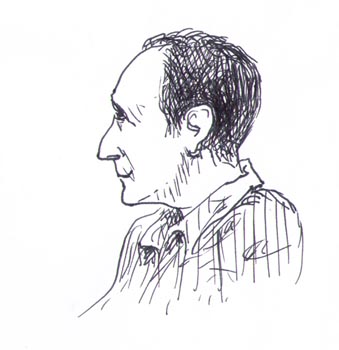
Filippo Vernizzi, dark energy theorist, Department of Astrophysics, CEA-Saclay. I approached him during the coffee break. He faced me with obvious displeasure. After briefly outlining my approach (though he clearly wasn’t listening), I continued by citing something relevant to his field—quantum mechanics:
- Currently, the universe’s acceleration implies that in quantum physics, we must account for states with negative energy. You agree? You stated this during your talk (in front of all attendees, not in a small afternoon session). This cosmic acceleration implies negative pressure, hence negative energy states.
He grimaced. I continued:
Pressure is also energy density per unit volume.
No, no! he protested—pressure is force per unit area. That’s unrelated. Even with negative pressure, energy remains positive (? ...) —I’m sorry, but you’re mistaken. If you want to treat pressure as force per unit area, let’s do it. I know this topic well from my work in kinetic gas theory. Place a wall in this fluid medium. It will experience impacts from incoming particles. These particles transfer to the wall the part of their momentum corresponding to the component of their velocity perpendicular to the wall. You agree?
Yes...
Now, momentum is mV. So a fluid with negative pressure doesn’t push the wall away—it attracts it. Starting from negative pressure implies that these collisions involve particles carrying negative momentum, hence possessing negative mass. Then, since E = mc², the energy of these particles is also negative. You agree?
Yes... yes... don’t get upset. Okay, this energy is negative—you’re right. I’ll take it into account from now on (...).
That’s not all. When you discuss instabilities of these negative energy states, you think in terms of energy emission via positive-energy photons. But particles with negative mass and energy emit negative-energy photons. And your quantum field theory doesn’t handle that.
Yes... yes... very well... I’ll take it into account, promise.
Frustrated, he immediately turned around and walked away.
He clearly mocked me, refusing any discussion. I couldn’t get anything more out of him. Obviously, these people avoid all dialogue.
We returned to the amphitheater. Next talk: Robert Brandberger (McGill University, Canada). His title: “Update on Bouncing and Emergent Cosmologies.” These are current ideas. He presents himself as a “string theorist.” Everything’s there—trendy buzzwords: “universe with a bounce,” “quantum gravity,” “string gas” (...), “Hagedorn temperature” (the temperature beyond which hadrons can no longer exist—estimated at 10³⁰ Kelvin. Some even claim this temperature is “unattainable”). Brandberger presents inflation as the only theory capable of solving the horizon paradox (“there is no alternative to inflation theory”).
After his talk, I raised my hand.
- As an alternative, what do you think of a variable constants model—particularly one with a variable speed of light—as a competitor to inflation theory? I’ve published papers on this since 1988 and 1995, proposing a joint variation of all physical equations...
Brandberger immediately deflected, pointing to a young Canadian researcher who had also worked in this direction.
- You’d be better off discussing this with that researcher rather than with me.
End of discussion. Clearly, Brandberger has fixed ideas. Axions, string gas, quantum gravity—now that’s serious stuff. A variable speed of light? What a silly idea! Let the crackpots debate among themselves. Later, I exchanged words with this young Canadian, otherwise very friendly, who told me:
- I looked at your poster and discussed it with colleagues. It seems interesting. But, regarding a variable speed of light model—you know, I haven’t done much in that area. Nothing like your work in this field.
End of morning session. Next talk: Eric Verlinde on “Emergent Gravity.” This isn’t a review of empirical modifications to gravity, like Israeli physicist Milgrom’s approach, but a highly complex theory where gravity is an emergent property. I quote the key sentence:
"By using entanglement in the code subspace (...) we can reproduce the puzzling behavior of the region of duality" (...) “By using entanglement in the code subspace, we can reproduce the strange behavior observed in the duality region.”
Tuesday: I spoke after the second talk the next day, summarizing the various points of agreement between the current dominant model (LambdaCDM) and observational data such as the CMB. This comprehensive overview was delivered by Silvia Galli from the Paris Astrophysics Institute.
I raised my hand. The microphone was passed to me:
How do you reconcile the Lambda-CDM model with the Great Repeller effect?
The what? .....
The Great Repeller—presented in January 2017 in Nature by Hoffman, Courtois, Tully, and Pomarède—showing that at 600 million light-years away there’s a completely empty region that repels galaxies, including our own, at 631 km/s.
It didn’t register with her. She stared wide-eyed.
Then others in the audience confirmed my statement. There was a palpable moment of discomfort when the IAP researcher said:
- I’m not aware of this...
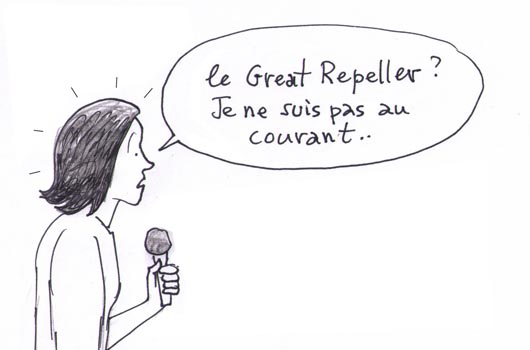
I didn’t expect to cause such embarrassment with this question. We moved on.
During a subsequent talk by Daniel Harlow from MIT, discussing black holes, quantum information, and the holographic principle, I tried to shift attention:
- I’d like to point out that black hole theory is based on a 1916 paper by Karl Schwarzschild. But who knows that Schwarzschild, in early 1916—just before his death in May—published not one, but two papers?
Confusion in the audience.
I continued:
- The content of this second paper, only translated in 1999, is very important. Who here knows that this second paper exists?
Silence...
- So, among the black hole specialists present, who has read Schwarzschild’s first paper from January 1916?
Silence.
This confirms my suspicion. None of the black hole specialists have read Schwarzschild’s, Einstein’s, or Hilbert’s original papers. They’ve operated since the 1950s based solely on secondhand commentary.
I didn’t press further.
Wednesday:
The next day, Hendrick Hildebrandt from the Alfa, Emmy Noether Laboratory in Germany presented techniques for analyzing weak gravitational lensing—where the faint gravitational lensing effect distorts galaxy images. The focus was entirely on the reliability of conclusions drawn from this analysis, given various “biases” (there’s no French equivalent for this term, which must be understood as “error due to an assumption made in data processing.” We speak of “sampling bias,” or biased sampling).
So his concern was about the reliability of these analyses.
I raised my hand:
- In this type of observational data analysis, there’s a fundamental assumption: that the effect is due to positive-mass dark matter. A few years ago, a group of Japanese researchers published a paper in Physical Review D suggesting that if positive mass causes azimuthal distortion, negative mass would cause radial distortion:
Koki Izumi, Chizaki Hagiwara, Koki Nakajima, Takao Kitamura, and Hideki Asada: Gravitational lensing shear by an exotic lens with negative convergence or negative mass. Physical Review D 88, 024049 (2013). Have you considered analyzing your data—on a million galaxies—by attributing distortions not to positive mass, but to negative mass? I think this would require only a minor modification in your processing program.
But radial distortion appears when there’s a void in dark matter, which then behaves like positive mass.
True, but here I’m talking about an authentic concentration of negative mass—similar to what I believe creates the Great Repeller effect.
Clearly, my remark confused him. He didn’t grasp its significance and probably wondered: “Who is this guy? Where does he work? I don’t know him…” I didn’t press further.
It’s very difficult to confront people like this. After his talk, he engaged in an intense conversation with other colleagues—likely involved in similar studies. I’m completely exotic in this context. Negative masses? What a ridiculous idea!
In a later talk, Chira Caprini, a researcher from the local APC (Astroparticle and Cosmology) laboratory at Paris-Diderot University, discussed results from numerical simulations, “hoping to learn more about dark matter physics.”
She added:
- Regarding galaxies, they remain very mysterious objects.
I thought of my own work—initiated in 1972 and now being finalized—on galactic dynamics, based on a joint solution of the Vlasov and Poisson equations.
She delivered her exhaustive presentation.
I raised my hand again: Since Monday, attendees have understood that I don’t believe in the existence of positive-mass dark matter—something no one has ever observed, whether in tunnels, mines, aboard the International Space Station, or in the LHC. Personally, I don’t think we’ll detect these astroparticles because these invisible entities aren’t where you’re looking for them. I believe negative mass, invisible, resides at the centers of large cosmic voids and between galaxies—ensuring their confinement and immediately triggering their formation after the radiation phase. It’s this surrounding negative mass that produces their spiral structure via dynamical friction. I believe that if you introduced data with high-density, self-attractive negative mass—yet mutually repulsive with positive mass—into your simulations, you’d discover many fascinating results. For example, large-scale, lacunar structures similar to those described by Israeli physicist Tsvi Piran in the form of interconnected soap-bubble-like regions.
These statements caused shock and silence. The general reaction must have been: “What’s this guy bothering us with negative masses?” The speaker was visibly uncomfortable, unsure what to do or say. I’d compare it to speaking during a religious service. Imagine, in the West, in a church, suddenly standing up and saying:
- Who tells you that your beliefs correspond to reality? That the events you mention actually occurred?
The shock would be comparable. We’re not in a scientific conference, but—when it comes to purely theoretical aspects—in a series of religious services, displaying beliefs utterly devoid of observational support.
The young woman continued, discussing how simulations show the influence of giant black holes on galactic dynamics.
I raised my hand again: You speak of giant black holes. But what evidence do you have that they are black holes?
Well... we base it on the high speed of stars near the galactic center.
True, which implies a very massive object. But if you place gas with an average density equal to that of water—corresponding to the average density in a star like the Sun—within a sphere the size of Earth’s orbit, you’d get four million solar masses. And where is the spectral signature confirming the black hole’s presence? You know very well that when the Chandra satellite was launched 17 years ago, we expected it to receive a strong burst of X-rays. And... nothing. You also know that in 2012, a cloud of interstellar gas passed nearby—and its behavior was nothing like what it should have been if it had passed near a black hole. Observations completely contradicted predictions based on simulations.
These remarks should have sparked debate. But no. It’s as if science were dead. Only the bright eyes of a few young people suddenly heard another discourse. For most, and especially for their supervisors, I’m just a crackpot disrupting the conference’s smooth flow.
I realized I needed to approach some “big names.” During the coffee break, I approached George Smoot, based at the APC (Astroparticles and Cosmology) laboratory at Paris-Diderot University.
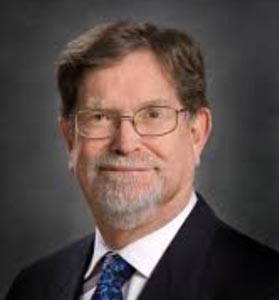
George Smoot, Nobel Prize 2006. He won the Nobel for showing that the cosmic microwave background matches a blackbody radiation spectrum. I positioned myself beside him as he climbed the stairs.
Mr. Smoot, I’d like to present my work to you in a seminar.
It will be difficult, as I’m leaving soon for Hong Kong.
No urgency. We could set a date.
He quickened his pace, annoyed.
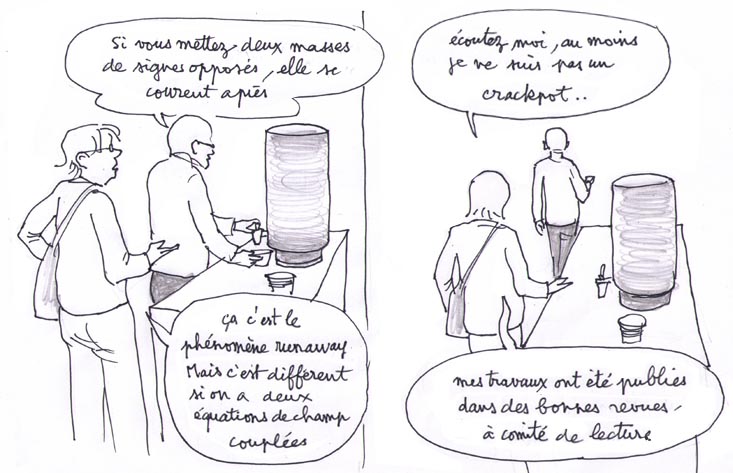
You may have seen my poster. I’ve designed a model where the universe hosts both positive and negative masses—when these masses are brought together, they chase each other, and the kinetic energy of the positive mass grows indefinitely...
That’s the runaway effect, as shown by Bondi in 1957. But in my model, this effect disappears. The interaction laws derived from Newtonian approximation applied to two coupled field equations make negative masses self-attractive, while opposite-sign masses repel each other via anti-Newtonian mechanics.
Smoot poured himself coffee, ostentatiously ignoring me. At no point did he look at me or turn his head. I’ve never seen such rudeness. I finally said:
- You’re treating me as if I were a crackpot (the term Anglo-Saxons use for pseudo-scientists, mythomaniacs living in grandiose, unfounded dreams). I’m a serious person. I’ve published my work in peer-reviewed journals...
But Smoot had already turned his back and walked away. Shocking from a Nobel laureate.
But no doubt he’d been thoroughly warned against me by his French colleagues.
Thursday: I decided to rest. It was very hot in Paris—31 degrees by late afternoon—and I had trouble sleeping. These “interventions in hostile environments” are extremely exhausting. Anyway, the talks that day focused on gravitational wave detection—a topic I hadn’t yet addressed. Still, I went to dinner at “Le Train Bleu,” at Lyon Station, where the traditional gathering of all conference participants takes place.
Incidentally: a meal costing 90 euros—absolutely scandalous. A waiter poured a finger of red wine. There was so little that it seemed meant only for tasting. The cheese plate: laughable. Slices just 2 mm thick. The bread, half-stale and clearly frozen. The hors d’oeuvres and desserts: products straight from a supermarket. Only the decor—the ceiling paintings—remains. This menu at Le Train Bleu, Lyon Station: we’d have eaten better in a snack bar!
I didn’t find the few young people I’d spoken with earlier. I sat down anywhere. I tried to start a conversation with my neighbor on the right, a young American. He’s not a researcher but just a student. I met simple-minded American conservatism. This guy was already “programmed,” very self-assured, completely closed to anything that deviates from what he was taught in school. Our exchange ended quickly.
My neighbor on the left is the head of a high-energy physics lab. I mentioned the failure in the search for supersymmetric particles. But nothing shook his conviction that we must continue all ongoing projects (“we’ll eventually find something”). The same attitude toward Italian physicist Helena Aprile’s work in her Monza tunnel, hunting neutralinos in a ton of krypton (and... nothing!).
At one point he smirked:
- Tell me, if no one paid attention to your theory, maybe it’s because it doesn’t hold water?
I’m convinced he’ll never read my papers.
In Frankfurt, I’d been too timid. It’s not easy to speak up in front of two hundred men, defending theses diametrically opposed to theirs—theses that, worse still, if confirmed, would collapse all their own work.
Frankfurt is Schwarzschild’s hometown. The conference was titled “Schwarzschild Conference,” and a “Schwarzschild Prize” was awarded (“for young hopes in cosmology”). You saw how a senior German researcher admitted he’d never read those foundational papers. In his talk, Maldacena referred to that first paper, published exactly one century ago, as “something that caused confusion. But later, we clarified these matters.”
I’ll show that the opposite is true. There was a misinterpretation of Schwarzschild’s solution by the great mathematician David Hilbert. And everyone followed suit. The first to notice it was Canadian researcher Abrams, who published in the Canadian Journal of Physics an article titled “The Black Hole, the Legacy of Hilbert’s Error.” (A completely overlooked work: Abrams has since died.) Italian physicist Antoci picked up on this and published another article. I tried contacting him, but he didn’t reply.
I believe he understood that questioning today’s cosmological fetish was unwise.
I’ll show (and you’ll understand my explanations!) that the black hole rests on a topological error that has persisted for a century. In Frankfurt, I would have liked to ask everyone present—especially Maldacena—whether they’d read Schwarzschild’s papers. I bet I’d have gotten the same negative response as on Tuesday.
It’s staggering. None of these people who make black holes their daily bread have read Karl Schwarzschild’s foundational paper, published in January 1916, exactly one century ago. True, it wasn’t translated into English until 1975. For 59 years, those who don’t read German had to rely solely on “commentaries on commentaries,” and errors spread—nobody has corrected them. As for the second paper Schwarzschild published, a month before his death in February 1916, it wasn’t translated by Antoci until... 1995!
How does the scientific community perceive me?
The first answer is simple: “It doesn’t perceive me at all.” No one pays attention to someone who’s only been granted a poster—and worse, who talks about negative mass.
What did those who witnessed my repeated outbursts in the hall think? I believe they didn’t understand a word I said. Negative mass? Never heard of it...
No one approached me for more information. By challenging the existence of black holes and even dark matter, and suggesting alternative research paths, I was probably perceived as “a retired researcher, a bit rusty, outside today’s mainstream cosmology,” as one researcher from the Paris Astrophysics Institute, Alain Riazuelo—great designer of black hole images—had written to me.
The general public has a completely false image of the scientific community. They imagine scientists as attentive to new ideas, ready to debate. But they behave like... religious people. For years, new currents have emerged that rest on no observational foundation. The most spectacular is so-called “quantum gravity.” We know gravity has never been successfully quantized. Every attempt to create a graviton hits insurmountable divergence problems. Yet, it feels as if, by endlessly repeating the words “quantum gravity” like a mantra, the thing will eventually materialize.
Just reflect on how black hole theory is sold to you. For thirty years, you’ve been fed the same phrase, endlessly repeated by media that serve this community (they sell what they’re given):
- Although there’s no observational confirmation of black holes, no scientist doubts their existence anymore.
Does such a statement deserve to be called scientific? Will you keep swallowing this without reacting? When we base everything on just one case—the binary system Cygnus X1, detected in 1964—where the companion emitting X-rays is credited with eight solar masses (thus exceeding the critical mass of two and a half solar masses; otherwise it would be a neutron star). For fifty years—a half-century—this is the only “stellar black hole” case. Distance: 6,000 light-years. So obvious uncertainty in distance measurement—and thus uncertainty in estimating the masses of the two objects orbiting a common center of gravity.
Our galaxy has about 200 billion stars. Half are multiple systems, usually binary. There could be between ten and a hundred million “black holes” in our galaxy alone—objects obviously closer to us than Cygnus X1. And we haven’t observed them for fifty years, despite ever-improving observational tools!
At galactic centers: “supermassive black holes.” In ours, an object with a mass equivalent to four million solar masses. Immediately: “It must be a supermassive black hole.” But this object doesn’t behave like a black hole. It emits no X-rays. In 1988, the Chandra satellite was launched, capable of detecting X-ray radiation. Quickly, it was pointed at the galactic center. And... nothing.
- It’s a satiated black hole, we hear.
In 2011, a cloud of interstellar gas headed toward it. Quickly, simulations were run. The gaseous mass would deform, be sucked in.

2013, the thing passes by and... nothing (check it out at 13'47").
Could this be... an anorexic black hole?
You've heard about quasars. Again, it's a black hole that... etc. The model? Watch Françoise Combes' video: when the black hole has eaten enough, it "spits out" matter... The mechanism behind this cosmic hiccup? Unknown, not described.
It's nonsense! This is astrophysics and cosmology today. Empty words, bluff, theories that aren't theories at all. Appeals to authority, mythical visions, and an abundance of computer-generated images. Add in grandiose poetic rants. Is confrontation with observation... really so important? Forward we go, just like with this nonsense about the Multiverse!
Friday; I take a seat in the front row. This time the chairperson tells me there will be a tight schedule and that long questions aren't allowed. A clear attempt to discourage me.
A Korean presents on various candidates for dark matter. All the usual clichés are trotted out.
After the talk, I raise my hand. But the chairperson, just two meters away, turns his head, deliberately ignores me, walks down the corridor, and looks for other questions in the room. Sitting in the front row, my arm remains completely raised.
The tactic is well known. You let two or three speakers speak, then turn to the potential troublemaker and say:
- I'm sorry, but we can't devote more time to this topic.
But he finds only one person asking to speak. He then turns back to me and, to cut off any further comment, I say:
- I just want to ask one question—one only. Everyone in the room heard it. Reluctantly, he finally hands me the microphone.
Then I ask:
- Given this context of dark matter behavior, how do you envision the effect of the Great Repeller?
The Korean stares at me wide-eyed. As a good Asian, he looks utterly distressed. He's losing face. I press on:
- You know, it's the region that appeared last January, when Hoffman, Courtois, Pomarède, and Tully revealed a void 600 million light-years away, where there's nothing, yet it pushes galaxies away.
Again, the Korean has no idea. I don't press further...

In all my interventions, I've tried to maintain a calm tone, to avoid appearing as a madman. It's a difficult exercise in such a context. I forced myself to do it. I was present at this conference thanks to material support from internet users. I had to show how far things had gone.
My wife told me:
- By creating such discomfort, you risk closing the doors of international conferences in this field.
That's very possible. In future conferences, it will undoubtedly unfold the same way. Yet at no point did I act aggressively or insultingly. But all my interventions made an impact. I think the most shocking moment was when an Italian theoretical physicist, an expert in dark energy, told me that negative pressure doesn't go hand in hand with negative energy density. How could he say such a thing? At that point, I made a mortal enemy—one more.
We can only hope that the subsequent Janus videos, subtitled in English, will eventually have an international impact. Not necessarily a positive one, though. Think of what a young Italian researcher said to me in Frankfurt:
- How could you possibly expect people at these conferences to do anything but turn their backs on you? Your work undermines the very foundations their own work rests upon!
The first barrier is skepticism. A few sparks of curiosity have lit up among some young researchers, but that's all. During Thursday's dinner, when I tried talking to a young American researcher sitting to my right, he immediately and obviously dismissed me as a crackpot—even though I immediately cited my 2014 and 2015 work. He was just as closed-minded as the others. What are these "young researchers" really seeking? A fascinating thesis topic? No, a chance at a job or a contract-based position under a powerful boss.
Believing that young researchers will turn toward these ideas is an illusion, I think. They have everything to lose, just like their mentors.
A reader mentioned the name of a 23-year-old woman, Sabrina Pasterski, presented as the next Einstein.

It's true her path is remarkable. Seeing her fly solo at just 16, after having flown at 13–14 years old. Having joined MIT, she quickly showed great aptitude for theoretical physics and soon joined a research team.
Andrew Strominger, aged 61 (relatively young), has won numerous awards for his contributions to... string theory. His young protégée has a website, http://wwwphysicsgirl.com ("the girl who does physics"), which claims she's already been invited everywhere, and the press is writing about her—including in France (Marie-Claire magazine).

People tell me, "Maybe this young woman..." I also have the email address of this young "genius." I'll write to her too.
I'm going to write to Strominger, inviting him to come see me and present my ideas and work. The funds from internet supporters would allow me to cover such a trip. But will he respond?
In any case, today I'm writing to two labs, contacting the seminar organizers.
- To the Laboratory of Astroparticles and Cosmology at Paris-Diderot, where George Smoot and Marc Lachièze-Rey are based; and to the Astrophysics Laboratory at CEA-Saclay, where theoretical physicist Filippo Fabrizzi works. I'm requesting permission to present my work there.
I bet no one will reply. And then I'll document it in the Janus videos, which will remain online indefinitely, listing the names of those involved. Because this systematic avoidance is not normal.
It's a sign that this science is deteriorating further and further.