Report from the international conference COSMO-17
COSMO-17 Conference Report
Paris, France, 28 August – 1 September 2017
2 September 2017
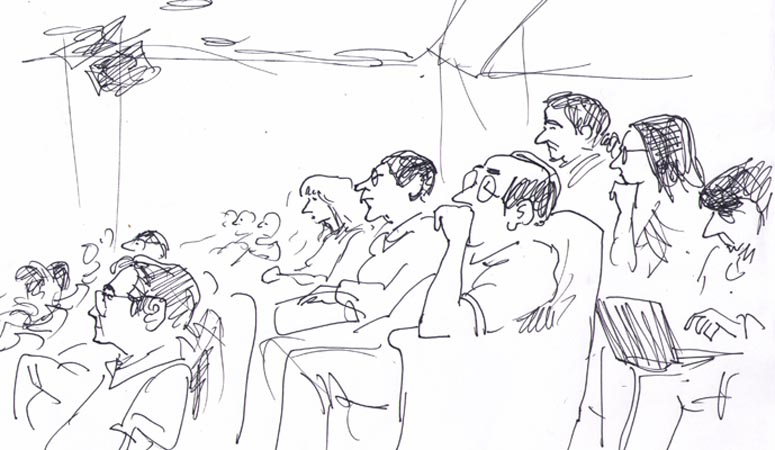
I have just returned from the 21st annual international conference on particle physics and cosmology (COSMO-17), held on the campus of Paris Diderot University in Paris, France, from 28 August to 1 September 2017. The event was organized by the Astroparticles and Cosmology Laboratory (APC). I suppose readers are wondering: “So, how was this conference?”
The reactions were the same as in Frankfurt. I’d even say it was worse.
First of all, internet users should understand what a real participation in an international conference is like when presenting a poster. It’s a reduced presentation. No comparison with oral presentations in a hall, which are the only ones where people can “react,” or simply wish to do so.
There were 193 participants from 24 countries, with a strong presence of Paris-based researchers. One room was completely packed, people were sitting on the steps. I will detail these presentations below. But it’s useful to describe what international symposia have become today, at least in this field. Speakers present their work for 30 to 40 minutes, illustrated by slides projected onto a large screen.
During these presentations, half of the participants—sometimes two out of three—had their laptop on their lap. What are they doing? When you glance at their screens, it has absolutely nothing to do with the presentation they are supposed to be listening to. Since everyone is connected to the internet, you can receive, read, and send emails and text messages during talks. I was sitting next to a young Russian woman working in Bonn, Germany, who spent the entire session staring at a Cyrillic text displayed on a small tablet, paying no attention whatsoever to the presentations. She didn’t hesitate to tell me she was reading… a novel!

In many sessions, I would say less than half of the participants were listening. This phenomenon was identical. When the presentation ended, the chair warmly thanked the speaker, and the room was then flooded with applause. I saw the same thing in Frankfurt. But back then, during the rare times I attended an international conference, I had never seen this. You can clearly distinguish “normal” applause from what I witnessed. It’s almost a standing ovation. As if the audience wanted to apologize for their lack of attention, or validate the content, usually completely empty, especially when it comes to theoretical talks.
So why do these researchers attend such conferences? For the majority of delegates, it boils down to the opportunity to mention their participation in an international event in an activity report. The research barons can also meet, present the development of their powerful observation instruments, costing tens of millions of dollars. Yes, observation is also very much alive. Technical means allow collecting increasingly precise data and making authentic discoveries, such as the Great Repulsor in January 2017.
This lack of attention during talks may seem shocking. But in the theoretical field concerned, there is no unity. The specialist on the right hand doesn’t understand a thing said by the specialist on the left hand. It’s like an overdose of unilateral speeches.
At this international cosmology conference held in France, I didn’t find a single French specialist: not Thibaud Damour, not Françoise Combes, not Aurélien Barrau, not Alain Riazuelo, nor even Marc Lachièze-Rey, who is a member of the laboratory hosting the symposium, APC (Astroparticles and Cosmology Laboratory).
I counted the participants, in descending order:
Japanese: 32 (…)
Americans: 31
French: 27
British: 27
Koreans: 12
Germans: 10
Dutch: 9
Spanish: 8
Canadians: 8
Swiss: 6
Poles: 5
Chileans: 4
Mexicans: 4
Portuguese: 2
Estonians: 2
Brazilians: 2
Finns: 2
Italians: 2
Iranians: 2
Chinese: 1
Indians: 1
Swedes: 1
Israelis: 1
Emiratis: 1
Total: 192 participants from 24 countries! A major annual international event in cosmology.
By the way: not a single French journalist. If they mention it, it will be through second-hand accounts. I contacted four journalists from the magazine Ciel & Espace; none came.
I presented two posters on the scheduled day (Tuesday, 29 August 2017). But I couldn’t expect any reaction other than curiosity (at best) toward something immense: the idea of replacing Einstein’s equation with two coupled field equations. In the second poster, I presented my alternative to the stellar black hole model: the escaping neutron star, which evacuates excess mass accumulated from the stellar wind of a companion star. I will dedicate an entire video to this topic.
I’ll skip over discussions with young Canadian, Japanese, and other researchers… who showed vague curiosity, but unfortunately nothing more.
MONDAY.
I began attending a talk on dark energy, presented by Italian researcher Filippo Vernizzi from the Institute of Theoretical Physics (IPhT) at CEA-Saclay. You can easily find his professional background on Google Scholar. He embodies the archetype of the contemporary theoretical physicist: scalar fields, quintessence, quantum gravity, etc. In his talk on dark energy, he speaks of “ghosts,” “massive gravity,” “quintessence,” “k-essence,” and “scalar-tensor theory.” I discover the word “Symmetron” (…). He concludes: “Something is missing in our framework.” Certainly…
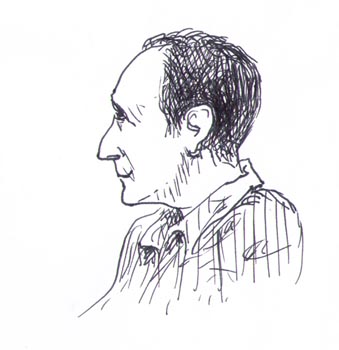
Filippo Vernizzi, dark energy theorist
Department of Astrophysics, CEA-Saclay
I’ll meet him during the coffee break. He faces me with evident displeasure. After briefly outlining my approach (but he’s clearly not listening), I continue by citing something that could impact his field, quantum mechanics:
“Currently, the accelerated expansion of the universe implies, in quantum field theory, states of negative energy. Do you agree? As you stated in your main presentation (before all participants, not in smaller afternoon sessions), this cosmic acceleration implies negative pressure. Therefore, states of negative energy.”
I continue despite his frown:
“A pressure is also energy per unit volume, i.e., an energy density.”
“Impossible!” he protests. “Pressure is force per unit area. It has nothing to do with energy. Even negative pressure implies positive energy.”
“I’m sorry, but that’s a mistake. If you want to approach this pressure issue as force per unit area, let’s go ahead. It’s a subject I master well, since I’ve done a lot of kinetic gas theory. Place a wall in a fluid medium. It experiences collisions with incoming particles. These particles then transfer part of their momentum to the wall, corresponding to the component of their velocity vector V perpendicular to it. Do you agree?”
“Yes…”
“Now, this momentum is mV. So if a fluid in contact with a wall has negative pressure, it doesn’t push the wall—it attracts it. Thus, if we speak of negative pressure, these collisions are due to particles with negative momentum. Since E = mc², the energy of these particles is also negative. Do you agree?”
“Yes, yes—don’t get upset. Okay, this energy is negative, you’re right. I’ll take it into account now.” (…)
“It’s not all. When you talk about instabilities caused by negative energy states, you think of energy emission by positive-energy photons. But particles with negative energy emit negative-energy photons. And this, quantum field theory does not address.”
“Yes… Very well—I’ll take it into account, I promise.”
Annoyed, he immediately turns around and walks away.
He clearly dismissed me, refusing any discussion. I couldn’t get anything more out of him. These people avoid all dialogue.
We return to the hall. Next presentation: Robert Brandenberger, McGill University, Quebec, Canada. Title of his talk: “Update on bouncing and emergent cosmologies.” These are trendy ideas. He presents himself as a “string theorist.” All the keywords are there: the “Big Bounce,” “quantum gravity,” “string gas” (…), “Hagedorn temperature” (beyond which hadrons can no longer exist—estimated at around 1030 K—some even claim this temperature is “unattainable”).
Brandenberger refers to inflation as the only theory capable of solving the horizon paradox. He concludes:
“There is no alternative to the inflation theory.”
At the end of his talk, during the question session, I speak up:
“As an alternative to inflation theory, what do you think of a model with a varying constant, which includes VSL, a variable speed of light, challenging this inflation theory? I published peer-reviewed articles on this topic as early as 1998, and even earlier in 1995, where I propose a joint variation of all physical constants as a gauge process—”
But Brandenberger immediately evades the question, pointing me toward a young Canadian researcher he identifies in the crowd, who has also worked in this direction:
“You’ll be better inspired talking to this researcher than with me.”
End of discussion. In reality, Brandenberger has very rigid ideas. Axions, string gas, quantum gravity… that’s serious. But a variable speed of light? What a crazy idea! Let the madmen argue among themselves.
Later, I exchange with this young Canadian, who is actually a pleasant person, who told me:
“I glanced at your poster and discussed it with colleagues. It seems interesting. But for the variable speed of light model, I haven’t done much, you know. Nothing related to your work in this field.”
Late morning: presentation by Eric Verlinde on “Emergent Gravity.” This is not a review of empirical methods for modifying gravity, as the Israeli Milgrom does with MOND, but a very complex theory that makes gravity an “emergent” property. I quote the key sentence:
“Using entanglement in the subspace of the code (…) we can reproduce the strange behavior of the duality region (…)”
TUESDAY.
I participate after the second presentation of the second day, discussing the various elements of consistency between the current dominant model (ΛCDM model) and observational data such as the CMB. Silvia Galli from the Paris Institute of Astrophysics (IAP) engages in this long investigation.
I raise my hand. I’m given the microphone:
“How do you view the compatibility between the ΛCDM model and the Great Repulsor?”
“… The… What?”
“The Great Repulsor, or Dipole Repulsor, presented in Nature in January 2017 by Hoffman, Courtois, Tully, and Pomarède, where they show a void region 600 light-years across, completely empty, pushing galaxies—including our own at 631 km/s.”
She has no memory of this and remains speechless. Then others in the hall confirm my statements. There’s a moment of great embarrassment when the IAP researcher finally says:
“I’m not aware of it.”
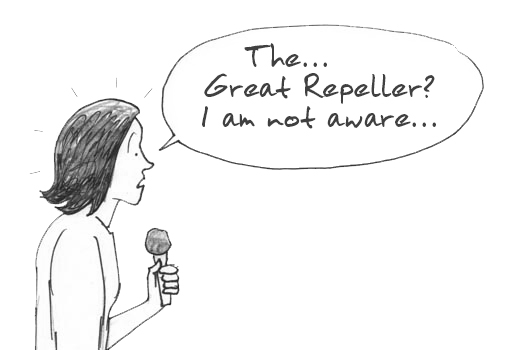
I hadn’t imagined creating such discomfort with this precise question. Let’s move on.
In a later presentation by Daniel Harlow, MIT, on black holes, quantum information, and the “holographic principle,” I try to spark interest in the foundations of the black hole model:
“I would like to emphasize that the black hole theory rests on a 1916 publication by Karl Schwarzschild. But who knows that Schwarzschild, at the beginning of 1916, just before his death in May, published not one, but two articles?”
Confusion in the hall. I continue:
“The content of this second article, translated into English only in 1999, is very important. Who knows that this second article exists?”
Silence… Then I ask:
“So, among the black hole specialists present here, who has read Schwarzschild’s first article, from January 1916?”
Deafening silence.
This confirms what I suspected. No black hole specialist has ever read Schwarzschild’s, Einstein’s, or Hilbert’s original articles. They’ve always worked, since the 1950s, on commentaries after commentaries. I don’t press further.
WEDNESDAY.
Third day. Hendrik Hildebrandt, head of the Emmy Noether research group at the Institute of Astronomy AIfA, University of Bonn, presents techniques of weak lensing, which distort galaxy images. Everything is oriented toward the reliability of conclusions drawn from this analysis, in relation to “bias,” i.e., possible errors due to assumptions made in data processing.
Thus, Hildebrandt’s interest lies in the reliability of these analyses.
I speak up:
“In this type of observational data processing, there is a fundamental assumption: that this effect is due to positive-mass dark matter. A few years ago, a group of Japanese researchers published an article in Physical Review D, referring to the fact that if positive mass generates azimuthal distortion, negative mass would produce radial distortion.”
The document I refer to is:
Izumi, K. et al. (2013). « Gravitational lensing shear by an exotic lens object with negative convergence or negative mass ». Physical Review D. 88 : 024049. doi : 10.1103/PhysRevD.88.024049. arXiv:1305.5037.
I continue:
“Have you considered analyzing your data—concerning a million galaxies—by attributing the distortions not to positive mass, but to negative mass? I think this would require only a small change in your data processing program.”
“We already find radial distortions,” replies Hildebrandt, “when there’s a void in dark matter. Such a void acts as if it had negative mass there.”
“Of course, but here I’m talking about real concentrations of negative mass, similar to those I believe create the Great Repulsor effect.”
Obviously, my remark confuses him. He hasn’t really grasped the extent of my proposal and must be wondering, “Who is this guy? Where does he work? I’ve never seen him, I don’t know him…”
I don’t press further.
It’s very difficult to disturb people like this. After his presentation, Hildebrandt engaged in a long conversation with other colleagues, probably involved in similar studies. Me? I’m… completely exotic in this game. Negative masses? What an idea!
In another presentation by a researcher from the local French laboratory, APC (Astroparticles and Cosmology Laboratory) at Paris Diderot University, Chiara Caprini discusses results from numerical simulations, where “we hope to learn more about dark matter physics.” She adds:
“Regarding galaxies, they remain very mysterious objects.”
At that moment, I think of the work I initiated in 1972 and am currently finalizing on galactic dynamics (yes, I’ve resumed this work 45 years later). A work based on a joint resolution of the Vlasov equation and the Poisson equation.
She gives a fairly exhaustive presentation.
I ask for the microphone again and say:
“Since Monday, people in the hall have understood that I don’t believe in the existence of dark matter in the form of positive-mass particles, which have never been observed—neither in tunnels, mines, aboard the International Space Station, nor at the LHC. Personally, I think these astroparticles will never be detected, because these invisible elements aren’t where you’re looking. I believe that invisible negative mass is located at the center
I will show that it’s exactly the opposite. There has been a misinterpretation of Schwarzschild’s solution by the great mathematician David Hilbert. And everyone followed. The first to notice this was an American, Leonard Abrams, who published an article in the Canadian Journal of Physics:
Abrams, L. S. (1989). "Black Holes: The Legacy of Hilbert's Error". Canadian Journal of Physics 67 (9) : 919–926. doi:10.1139/p89-158. arXiv:gr-qc/0102055.
A work completely ignored (Abrams died in 2001). The Italian physicist Salvatore Antoci picked up this work:
Antoci, S. ; Liebscher, D.-E. (2001). "Reconsidering Schwarzschild’s original solution". Astronomische Nachrichten. 322 (2) : 137–142. arXiv:gr-qc/0102084.
Antoci, S. (2003). "David Hilbert and the origin of the Schwarzschild solution". Meteorological and Geophysical Fluid Dynamics. Bremen: Wilfried Schröder, Science Edition. arXiv:physics/0310104.
I tried to contact him, unfortunately he didn’t reply.
I believe he understood it wasn’t wise to challenge the cult object of current cosmology.
I will show (and you’ll understand my explanations) that the black hole rests on a topological error that has lasted for a century. In Frankfurt, I would have liked to ask all participants if they had read Schwarzschild’s articles, especially Maldacena. I bet I’d have gotten the same negative response as during my oral presentation on Tuesday.
It’s frightening. None of the specialists who make black holes their daily bread have ever read the two foundational articles published in January and February 1916 by Karl Schwarzschild, a century ago. It’s true that his first article (the “external” solution) was only translated into English in 1975. For 59 years, those who don’t read German had to rely on “commentaries after commentaries,” and errors spread, on which practically no one has returned. As for Schwarzschild’s second article (the “internal” solution), published in February 1916, three months before his death, it was only translated by Antoci in… December 1999!
How does the community perceive me?
The first answer is very simple: “It doesn’t perceive me at all.” No one pays attention to someone who gets only a poster presentation, especially one introducing negative mass into cosmology!
As for those who attended my repeated “outbursts” in the amphitheater: what did they think? I suppose they didn’t understand a single word I said. Negative mass between galaxies? Never heard of that…
No one approached to learn more. By questioning the existence of black holes, or even dark matter, and suggesting alternative research paths, I was probably perceived as “a retired researcher, a bit rusty, outside the main currents of current cosmology,” as Alain Riazuelo from the Paris Institute of Astrophysics (IAP), a major designer of black hole CGI, wrote to me.
The general public has a completely false idea of the scientific community. They imagine scientists as attentive scholars open to new ideas, ready for debate. Yet most behave like religious followers. In recent years, new currents have emerged that rest on no observational basis. The most spectacular is “quantum gravity.” You may know that gravity has not yet been quantized. Every attempt to create a graviton hits insurmountable divergence problems. But it gives the impression that, by speaking of “quantum gravity,” by repeating these words like a mantra, the thing will eventually exist.
Just think about how the black hole is announced, how it is literally “sold” to you. For thirty years, you’ve been served the same phrase, endlessly repeated by the media under the influence of this community (they sell what they’re given):
“Although there is no observational confirmation of the existence of black holes, no scientist doubts it today.”
Does such a sentence deserve to be called scientific? Will you continue to swallow this without reacting? While we base everything on a single case—the binary system Cygnus X-1, detected in 1964, where the X-ray-emitting companion is credited with a mass of eight to fifteen solar masses (thus exceeding the critical mass of 2.5 solar masses). For fifty years, for half a century, this has been the only case of a “stellar black hole.” Distance: 6,000 light-years. There is therefore an obvious uncertainty in measuring the distance and in the resulting mass estimate of the two objects orbiting a common center of gravity.
There are two hundred billion stars in our galaxy. Half are multiple systems, generally binary. There would be between ten and a hundred million “black holes” in our galaxy, objects obviously closer to us than Cygnus X-1. And we haven’t observed them for 50 years, while our observational tools improve every year!
At the centers of galaxies: “supermassive black holes.” In ours, an object with a mass equivalent to four million solar masses. Immediately “it’s a supermassive black hole.” But this object does not behave like a black hole. The surrounding gas does not emit X-rays. In 1988, the Chandra satellite was launched, capable of detecting such radiation. It was pointed toward the center of the Milky Way: nothing.
“It’s a full black hole,” we even heard!
In 2011, an interstellar gas flow approached. Simulations were set up to show what would happen: the gaseous mass would deform and be sucked in.
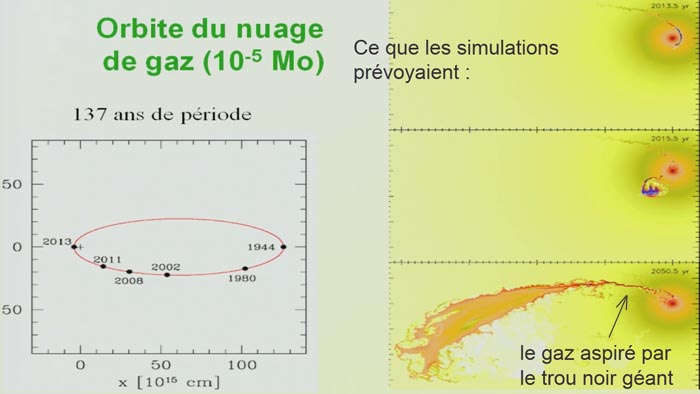
Summer 2013: the matter passed nearby and… nothing. For more on this, see Françoise Combes’s talk on supermassive black holes at 12:33 here (in French).
Could it be… an anorexic black hole?
You’ve heard of quasars. Again, it’s a black hole that… etc. The model? In the same video: when the black hole has eaten enough, it “spits out”… The mechanism behind this cosmic hiccup? Unknown, not described.
It’s insane! This is astrophysics and cosmology today. Words, boasting, theories that don’t exist. Appeals to authority, mythic visions, and computer-generated images. Some even add a grand poetic flourish of ambition. Confrontation with observation? Why, is it so important? Let’s move forward, like with this nonsense of the multiverse!
FRIDAY.
I sat in the front row. This time, the chair warned me about the tight schedule and that long questions would not be allowed. A discouraging speech.
A Korean researcher presented on various candidates for dark matter. All the fairy dust candidates were reviewed.
At the end of the presentation, I raised my hand. But the chair, who was two meters away from me, turned his head, pretending not to see me, and fled down the corridor to find other questioners in the hall. In the front row, I remained with my arm fully raised.
A well-known tactic. Two or three speakers are selected and given the floor, after which the chair returns toward the potential troublemaker saying:
“I’m sorry, but we’ve now exhausted the time.”
But he found only one person who wanted to speak. He then returned to me and, to cut off any remark I might make:
“I want to ask one question. Just one.”
All participants heard. He reluctantly handed me the microphone.
Then I asked:
“In this context of dark matter candidates’ behavior, how do you consider the effect of the Great Repulsor?”
The Korean researcher stared at me with wide, round eyes. He seemed stunned. As an Asian, he was “losing face.” I persisted:
“You know, the Great Repulsor, as shown in January by Hoffman, Courtois, Pomarède and Tully. A void 600 million light-years across, completely empty, yet pushing galaxies.”
Once again, the Korean researcher was unaware. I didn’t press further…
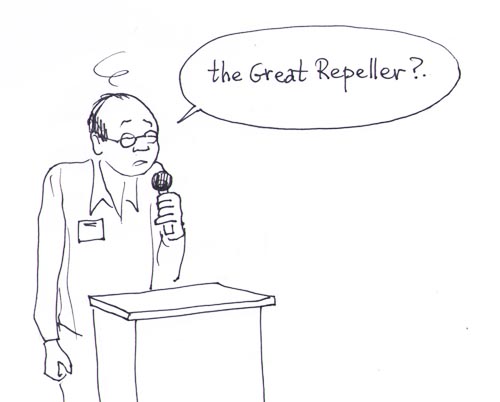
Each time I spoke, I tried to keep a calm tone, so as not to appear an energetic madman. A difficult exercise in such a context. I forced myself to do it. I was present at this conference thanks to financial support from internet users. I therefore had to show just how far things had gone.
My wife told me:
“By creating such embarrassing situations, you risk seeing the doors of international conferences in this field close in front of you.”
Very possible. In the future, it will happen the same way, obviously. Yet I have never been aggressive or insulting. But all my interventions touched a nerve. I think what was most frightening was the Italian theorist, expert in dark energy, who told me that negative pressure does not go hand in hand with negative energy density. How could he say such nonsense? There, I made a mortal enemy, one more.
Fortunately, the next part of the video, subtitled in English, may eventually have an international impact and spark interest among some scientists. Not necessarily positive, though. Think of this remark from that young Italian researcher in Frankfurt, who told me:
“I’ve seen your articles on your Janus cosmological model. I’m watching how you’re received here. How can you expect these people to do anything other than turn their backs on you? What you’re proposing is to destroy the very foundation of their work!”
The first barrier is skepticism. A few sparks of curiosity lit up among the young, but nothing more. During Thursday’s dinner, when I tried to talk to a young American researcher sitting next to me, he obviously considered me a madman, even when I cited my peer-reviewed articles from 2014 and 2015. He was just as stubborn as the others. What are these “young researchers” seeking? A fascinating thesis topic? No. They’re looking for a job opportunity within a research group of similar type, where they can easily co-publish. Or a well-paid contract under a powerful boss.
Believing that young researchers will be interested in new ideas is an illusion, I think. They have everything to lose, just like their mentors.
A reader told me about this 24-year-old woman, Sabrina Pasterski, presented as the future Einstein.
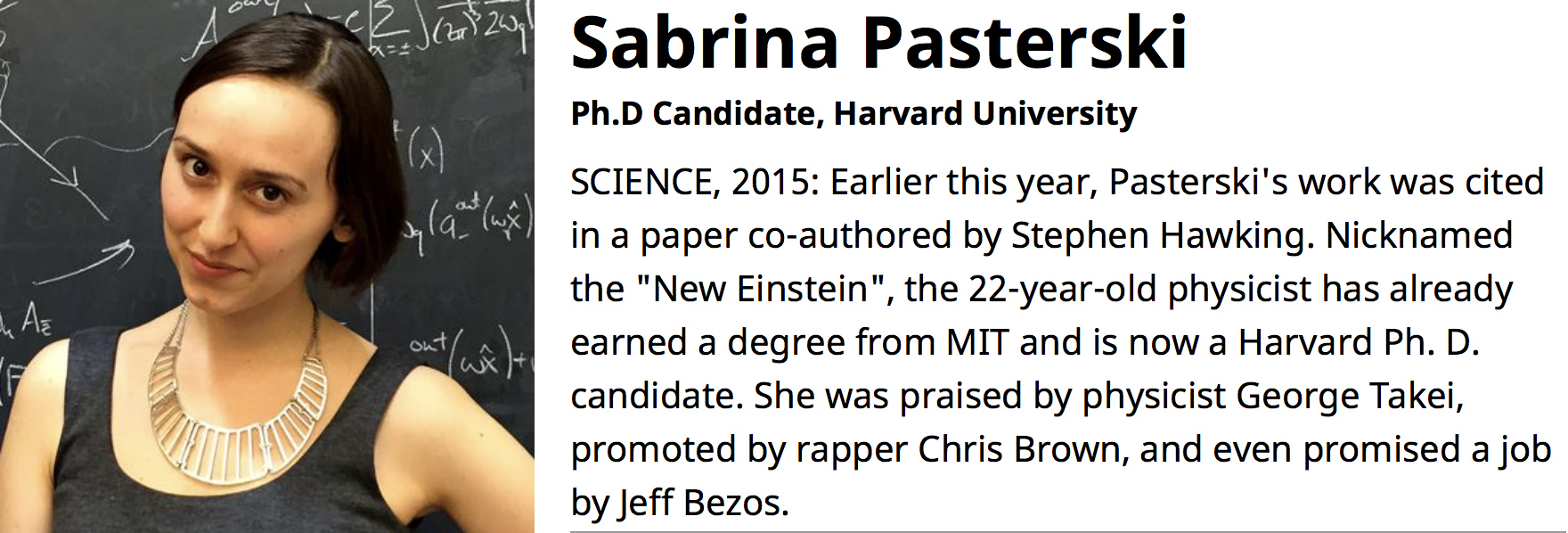
Profile of Sabrina Pasterski on Forbes
It’s true her path is surprising. See the video where she is shown building a light aircraft at age 13–14, which she flew solo at 16. Joined MIT, she immediately showed great aptitude for theoretical physics, then joined the research team of Andrew Strominger.
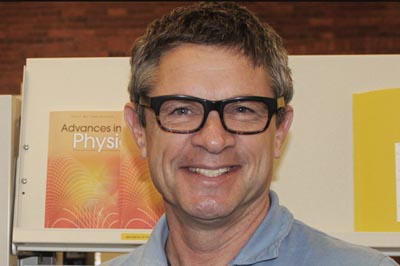
Andrew Strominger
At 61 (and thus relatively young), he has received numerous awards for his contributions to string theory.
His young disciple has a website: physicsgirl.com which states she has already been invited everywhere, and the press talks about her worldwide.
People tell me: “Maybe this girl…?”
I also have the email address of this young “genius.” I’ll write to her too.
I’ll write to Strominger asking him to meet me and present my ideas and work. Internet users’ financial support would allow me to carry out such a mission. But will he respond?
In any case, today I’m sending messages to two laboratories, to the seminar organizers:
– the Astroparticles and Cosmology Laboratory (APC) at Paris Diderot University, where George Smoot and Marc Lachièze-Rey are affiliated.
– the Astrophysics Laboratory at CEA-Saclay, where theoretical physicist Filippo Fabrizzi works.
asking to be allowed to present my work there.
I bet that, once again, no one will reply. And then I’ll mention these behaviors in the Janus videos, which will remain online indefinitely, with the names of the individuals involved. Because such systematic avoidance is abnormal.
It’s a sign that this part of science is becoming increasingly authoritarian.
Previous conference report (KSM 2017)
The Janus cosmological model on YouTube
In many sessions I would say that less than half of attendees do listen. By the way, it was the same. When the presentation ends, the chairman thanks the speaker very much, and the room is then overwhelmed with applause. I witnessed the same phenomenon in Frankfurt. But back in the day, the few times I've been able to attend an international conference, I've never seen this. One can very well distinguish between "normal" applause and what I saw. It is almost a standing ovation. As if the audience wishes to apologize for its lack of attention, or to validate the content, which is usually completely empty, when it comes to theoretical lectures.
So what? Why do these researchers attend such conferences? For the most part of delegates, it can be summed up as the possibility to mention their participation to an international event in an activity report. The barons of research can also meet, present the development of their powerful observational instruments, to the tune of tens millions of dollars. Yes, observation is as fit as a fiddle. Technical means make it possible to collect more and more precise data, to make authentic discoveries, like that of the Great Repeller in January 2017.
This lack of attention, during the presentations, may seem staggering. But in the theoretical field concerned, there is no unity. The specialist of the right hand does not hear anything to what the specialist of the left hand has to say. This is like an overdose of one-way talks.
At this international conference on cosmology held in France, I didn't find any of the French specialists: neither Thibaud Damour, nor Françoise Combes, nor Aurélien Barrau, nor Alain Riazuelo, not even Marc Lachièze-Rey, who is a member of the laboratory hosting the symposium, the APC (Astroparticle and Cosmology Laboratory).
I made the count of participants, in descending order:
Japanese: 32 (…)
American: 31
French: 27
English: 27
Korean: 12
German: 10
Dutch: 9
Spanish: 8
Canadian: 8
Swiss: 6
Polish: 5
Chilean: 4
Mexican: 4
Portuguese: 2
Estonian: 2
Brazilian: 2
Finnish: 2
Italian: 2
Iranian: 2
Chinese: 1
Indian: 1
Swedish: 1
Israeli: 1
Emirati: 1
Total: 192 attendees, from 24 countries! A major annual international milestone in cosmology.
By the way: not even one French journalist. If they echo this event, it will be according to second-hand testimonies. I called upon four journalists from the Ciel & Espace magazine; none came.
I presented two posters on the scheduled day (Tuesday, 29 August 2017). But I should not expect any reaction other than curiosity (at best) with respect to something as enormous: to consider replacing Einstein's equation with two coupled field equations. In the second poster, I presented my alternative to the stellar black hole model: the leaking neutron star, which evacuates any mass in excess that would be accreted from the stellar wind of a companion star. I will dedicate an entire video to this subject.
I pass on discussions with young Canadian, Japanese, and other researchers… who showed a vague curiosity, but alas nothing more.
MONDAY.
I started attending a lecture devoted to dark energy, presented by Italian researcher Filippo Vernizzi, from the Theoretical Physics Institute (IPhT) of CEA-Saclay. You can easily find his professional track record on Google Scholar. He is the archetype of today's theoretical physicist: scalar fields, quintessence, quantum gravity, etc. In his presentation on dark energy, he speaks of "ghosts", "massive gravity", "quintessence", "k-essence", "scalar-tensor theory". I discover the word "Symmetron" (…). He concludes: "Something is missing in our schema". Certainly.....

Filippo Vernizzi, dark energy theorist
Astrophysics department at CEA-Saclay
I go to meet him at the coffee break. He faces me with evident displeasure. After having evoked the main lines of my approach (but he obviously does not listen) I go on to quote what may have an impact on his field, quantum mechanics:
"Currently, the accelerating expansion of the universe implies to assume, in quantum field theory, negative energy states. Do you agree? As you said in your main presentation (in the face of all attendees, not to little groups in smaller rooms during the afternoon), this cosmic acceleration implies a negative pressure. Hence negative energy states."
I continue despite his pout of annoyance:
"A pressure is also an energy per unit volume, i.e. an energy density."
"No way!" He protests. "A pressure is a force per unit area. That has nothing to do with energy. Even a negative pressure implies a positive energy."
"I am sorry but this is a mistake. If you want to address this issue of pressure as a force per unit area, let's go. This is a subject I know very well since I did a lot of kinetic theory of gases. Place a wall in a fluid medium. It undergoes collisions from incident particles. These will then transfer some of their momentum to the wall, corresponding to the component of their velocity vector V perpendicular to it. Do you agree?"
"Yes…"
"Yet this momentum is mV. Therefore if a fluid in contact with a wall has a negative pressure, it does not repel the wall, it attracts it. So if we are talking about a negative pressure, such collisions are due to particles with a negative momentum. Since E = mc² the energy of these particles is also negative. Do you agree?"
"Yes, yes — Don't get upset. OK this energy is negative, you're right. I will now take it into account." (…)
"That is not all. When you talk about instability issues due to negative energy states, you think of an emission of energy using positive energy photons. But negative energy particles emit negative energy photons. And that, the quantum field theory does not handle it."
"Yes… Fine — I will take this into account, I promise."
Annoyed, he immediately turns on his heel and walks straight away.
He obviously played me for a fool, refusing any discussion. I could not get anymore. These people are fleeing from any dialogue.
We return to the auditorium. Next presentation: Robert Brandenberger, McGill University, QC, Canada. Title of his communication: "Update on Bouncing and Emergent Cosmologies". These are the trending ideas. He presents himself as "a string theorist". Every buzzing word happens there: the "Big Bounce", "quantum gravity", the "string gas" (…), the "Hagedorn temperature" (beyond which hadrons can no longer exist – estimated at about 1030 K – one even read that some think such temperature would be "unsurpassable").
Brandenberger refers to inflation as the only theory able to solve the horizon paradox. He concludes:
"There is no alternative to inflation theory."
At the end of his presentation during Q&A, I take the floor:
"As an alternative to inflation theory, what do you think of a variable constant model, which in particular implies VSL, a variable speed of light, which challenges this inflation theory? I published peer-reviewed papers on this subject as from 1998 then 1995, where I propose a joint variation of all physical constants as a gauge process —"
But Brandenberger immediately dodges the issue, redirecting me toward a young Canadian researcher he points to in the crowd, who also would have worked in this direction:
"You'll be better off speaking with this researcher than with me."
End of discussion. Actually Brandenberger has very fixed ideas. Axions, string gas, quantum gravity… that's serious. But a varying speed of light: what an idea! Let the wacky guys discuss among themselves.
I will have an exchange afterward with this young Canadian, who is a kind person by the way, who said to me:
"I had a look at your poster and I talked with colleagues. It seems interesting. But as for that light velocity model, I did not do much, you know. Nothing to do with your work in this area."
Late morning: Eric Verlinde's presentation on "Emergent Gravity". This is not a review of the empirical ways of modifying gravity, as the Israeli Milgrom does with MOND, but of a very complex theory that makes gravitation an "emerging" property. I quote the key phrase:
"By using entanglement in the code subspace (…) we can reproduce the puzzling behavior of the region of duality (…)"
TUESDAY.
I take part after the second presentation of the second day, situating the different elements of concordance between the current dominant model (ΛCDM model) and observational data like the CMB. Silvia Galli, of the Paris Astrophysics Institute (IAP), is engaged in this long survey.
I raise my hand. Someone give me the mic:
"How do you consider the compatibility between the Lambda-CDM model and the Great Repeller?"
"…"
In another presentation by a researcher from the local French laboratory, APC (Astroparticles and Cosmology) at Paris Diderot University, Chiara Caprini presents the results of numerical simulations through which "we hope to learn more about the physics of dark matter." She adds:
"With regard to galaxies, they are still very mysterious objects."
At that moment, I think of the work I initiated in 1972 and am currently finalizing on galactic dynamics (yes, I have resumed this work 45 years later). A work based on a joint resolution of the Vlasov equation and the Poisson equation.
She delivers a fairly exhaustive lecture.
I ask for the microphone again and declare:
"Since Monday, the people present in the audience have understood that I do not believe in the existence of positive-mass dark matter particles, which no one has ever observed, whether in tunnels, mines, aboard the International Space Station, or at the LHC. Personally, I think these astroparticles will never be detected, because these invisible elements are not where you are looking for them. I think negative mass, invisible, is located at the heart of large cosmic voids and between galaxies, where it ensures their confinement and immediately promotes their formation at the end of the radiation-dominated era. It is also this surrounding negative mass that produces their spiral structure through dynamical friction. I think that if you introduce into your simulations other data, with high-density negative mass, self-attracting gravitationally, but interacting with positive mass via mutual repulsion, you would discover many interesting things. For example, large-scale structure, as described by the Israeli Tsvi Pirán, which takes the form of adjacent soap bubbles."
These sentences provoke immediate astonishment, triggering a general silence. They must be thinking: “This guy really irritates everyone with his negative masses!” The presenter is disturbed, doesn't know whom to address or what to say. I would make a comparison with an intervention during a religious service. Imagine yourself, in a Western country, inside a church, taking the floor and suddenly saying to the priest and the faithful:
"How do you know that the foundation of your belief is a reality, that the story you speak of as facts actually unfolded?"
The astonishment would be comparable. We are no longer in a scientific meeting where ideas are debated, but, in purely theoretical cases, in a series of religious services, a staging of beliefs devoid of any observational basis.
The young woman continues and speaks about how simulations show the influence of supermassive black holes on galactic dynamics.
I raise my hand again:
"You speak of giant black holes. But what evidence do you have that they are actually black holes?"
"Euh… We rely on the increase in star velocities near the galactic center."
"Of course, and their motion implies the presence of a very massive object at that location. But if you place, in a sphere with a radius equal to that of Earth's orbit, a gas whose average density is that of water – which corresponds to the average density inside the Sun’s orbit – then you obtain your four million solar masses. As for the supposed black hole, where is the spectral signature confirming its presence? You know that when the Chandra satellite was launched 17 years ago, we expected to receive a powerful burst of X-rays. But we received nothing. You also know that in 2013, an interstellar gas cloud passed nearby and its behavior was in no way what it should have been if it had passed near a black hole. The observation completely contradicts the predictions from the simulations."
Such comments should trigger a debate among the scientists present. But no, nothing. One might think that science is dead. There remains only a gleam in the eyes of a few young people who suddenly hear a different voice. But for most of them, and for their superiors, I am just a Charlie disrupting the smooth running of the symposium.
Thus, I think I must try to attract the attention of the "big names," and during the coffee break, I decide to approach George Smoot, who is currently working at the Astroparticles and Cosmology Laboratory (APC) at Paris Diderot University.
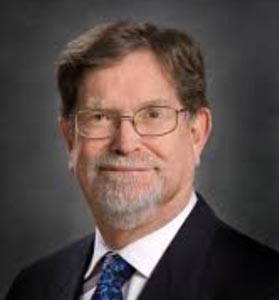
George Smoot, Nobel Prize in Physics 2006
He received the Nobel Prize for demonstrating that the cosmic microwave background (CMB) radiation corresponds to a blackbody radiation. I stand beside him as he climbs the stairs.
"Mr. Smoot, I would like to present my work at a seminar in your laboratory."
"It will be difficult, as I am soon leaving for Hong Kong."
"There is no urgency. We could set a date."
He quickens his pace, annoyed.
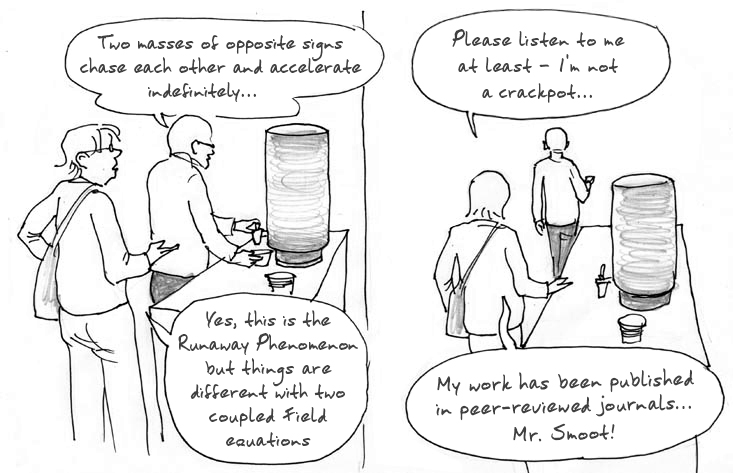
"You may have seen my poster. I have developed a model where the universe is populated by positive and negative masses."
"When such opposite masses meet, they repel each other and the kinetic energy of the positive mass increases indefinitely…"
"Yes, that's the energy run-away effect, demonstrated by Bondi in 1957. But precisely, in my model, this effect disappears. The interaction laws derived from the Newtonian approximation based on two coupled field equations make negative masses self-attracting and opposite-sign masses mutually repel each other according to an anti-Newtonian law."
Smoot pours himself a cup of coffee, clearly not paying the slightest attention to what I am saying. He does not even glance at me, nor turn his head toward me. I have never seen such rudeness in my life. I conclude by saying:
"You treat me like a crackpot. But I am a serious scientist. I have published my work in peer-reviewed journals —"
I haven't finished my sentence when Smoot himself has already turned his back and walked away. Completely stunned by this behavior from a Nobel laureate.
Perhaps he was warned about me by his French colleagues, who do not allow me to present my work in any of their laboratories and do not even reply to my emails.
THURSDAY.
Fourth day. I decide to rest. It is very hot in Paris. 31°C (88°F) in the late afternoon, and I struggle to sleep. These "hostile interventions" are extremely exhausting. Nevertheless, the day's presentations focus on the detection of gravitational waves, a subject I have not yet addressed. Still, I attend the evening event at the restaurant Le Train Bleu, near Lyon Station, where the traditional dinner gathering all participants takes place.
In passing: a meal costing 90 euros absolutely scandalous. A waiter pours a single drop of red wine. There was so little that it seemed like a tasting. The cheese board: laughable, with slices only 2 mm thick. The bread, half-stale, visibly frozen. The appetizers and desserts straight from a supermarket. Only the decoration, the ceiling paintings, remain. The menu at this restaurant Le Train Bleu, Lyon Station: you would have eaten better in a snack bar!
I don't find the few young people I discussed with earlier days, so I randomly sit at a table. I try to start a conversation with my right neighbor, a young American. He is not a researcher but just a student. I am then confronted with a very simplistic conservatism, typically American. This boy is already well "programmed," very self-assured, completely closed to any idea that deviates from what he was taught during his studies. Our exchange is brief.
My left neighbor is the director of a high-energy laboratory. I mention the failure to find supersymmetric particles. But nothing shakes his conviction that all ongoing projects must continue: "We'll eventually find something," he says. The same goes for the work of Italian researcher Elena Aprile, who, in her tunnel beneath Mount Gran Sasso, searches for the neutralino in a ton of liquid xenon (and discovers… nothing!).
At one point, he steps out mockingly:
"Say, if no one paid attention to your theory, maybe it's because it doesn't hold up?"
You can be certain that this person will never read my articles.
In Frankfurt, I had erred through timidity. It is not easy to speak before two hundred people, defending ideas diametrically opposed to theirs. Ideas that, worse still, if confirmed, would collapse their entire body of work.
Frankfurt is Schwarzschild's hometown. The conference was called the "Karl Schwarzschild Meeting," and the "young hopes of cosmology" were awarded a "Schwarzschild Prize." You have seen (here) my report on this conference, where a senior German researcher admitted he had never read those foundational articles. In his presentation, Juan Maldacena referred to that first work, published exactly a century ago, as "something that caused confusion, but which was later clarified."
I will show that the exact opposite is true. There was a misinterpretation of Schwarzschild's solution by the great mathematician David Hilbert. And everyone followed suit. The first to notice this was an American, Leonard Abrams, who published an article in the Canadian Journal of Physics:
Abrams, L. S. (1989). « Black Holes: The Legacy of Hilbert's Error ». Canadian Journal of Physics 67 (9) : 919–926. doi:10.1139/p89-158. arXiv:gr-qc/0102055.
A completely unknown work (Abrams died in 2001). Italian physicist Salvatore Antoci picked up this work:
Antoci, S.; Liebscher, D.-E. (2001). « Reconsidering Schwarzschild’s original solution ». Astronomische Nachrichten. 322 (2) : 137–142. arXiv:gr-qc/0102084.
Antoci, S. (2003). « David Hilbert and the origin of the Schwarzschild solution ». Meteorological and Geophysical Fluid Dynamics. Bremen: Wilfried Schröder, Science Edition. arXiv:physics/0310104.
I tried to contact him, unfortunately he did not reply.
I believe he understood it was unwise to challenge the cult object of modern cosmology.
I will show (and you will understand my explanations) that the black hole rests on a century-old topological error. In Frankfurt, I would have liked to ask all participants whether they had read Schwarzschild's articles, especially Maldacena's. I bet I would have received the same negative response as during my oral presentation on Tuesday.
It is distressing. None of the specialists who make black holes their daily bread have ever read the two foundational articles published in January and February 1916 by Karl Schwarzschild, exactly one century ago. It is true that his first article (the "external" solution) was only translated into English in 1975. For 59 years, those who do not read German were content with "commentaries on commentaries," and errors spread unchecked, with practically no one revisiting them. As for Schwarzschild's second article (the "internal" solution), published in February 1916, three months before his death, it was only translated by Antoci in… December 1999!
How does the community perceive me?
The first answer is very simple: "It doesn't perceive me at all." No one pays attention to a person who only gets a poster presentation and, moreover, introduces negative mass into cosmology!
As for those who attended my "repeated interventions" in the amphitheater: what did they think? I suppose they didn't understand a word of what I said. Negative mass between galaxies? Never heard of such a thing...
No one came to me to learn more. By challenging the existence of black holes, and even that of dark matter, by suggesting alternative research paths, I was probably perceived as "a retired researcher, a bit rusty, out of step with current trends in cosmology," as Alain Riazuelo of the Paris Astrophysics Institute (IAP), a major CGI designer of black holes, wrote to me in an email.
The general public has a completely false idea of the scientific community. People imagine scientists as attentive to new ideas, ready for debate. In reality, most behave like believers. In recent years, new trends have emerged, with no observational basis. The most spectacular is "quantum gravity." You probably know that gravity has not yet been quantized. Every attempt to create a graviton hits insurmountable divergence problems. But it seems that by talking about "quantum gravity," by repeating these words like a mantra, the thing will eventually exist.
Just consider how black holes are presented, how they are literally "sold" to you. For thirty years, you've been served the same phrase, endlessly repeated by media under the influence of this community (they sell what they are given):
"Although there is no observational confirmation of the existence of black holes, no scientist doubts their existence anymore."
Does such a sentence deserve to be called scientific? Will you continue swallowing it without reacting? When everything rests on just one case—the binary system Cygnus X-1, detected in 1964, where the companion object emitting X-rays is credited with a mass between eight and fifteen solar masses (thus exceeding the critical mass of 2.5 solar masses). For fifty years—half a century—this is the only case of a "stellar black hole." Distance: 6,000 light-years. There is therefore an obvious uncertainty in measuring the distance and thus in estimating the masses of the two objects orbiting a common center of gravity.
There are two hundred billion stars in our galaxy. Half are multiple systems, usually binary. There should be between ten and a hundred million "black holes" in our galaxy, objects obviously closer to us than Cygnus X-1. And we haven't observed them for fifty years, despite our observational tools improving year after year!
At galactic centers: "supermassive black holes." In ours, an object with a mass equivalent to four million solar masses. Immediately, "it's a supermassive black hole." But this object does not behave like a black hole. The surrounding gas does not emit X-rays. In 1988, the Chandra satellite was placed in orbit, capable of detecting this radiation. It was pointed toward the center of the Milky Way: nothing.
"It's a saturated black hole," we even heard someone say!
In 2011, an interstellar gas flow headed toward it. Simulations were run to show what would happen: the gaseous mass would distort and be sucked in.

Summer 2013: the matter passed nearby—and nothing happened. For more on this, see Françoise Combes' conference on supermassive black holes at 12:33 (in French).
Could it be… an anorexic black hole?
You've heard of quasars. Again, it's a black hole that… etc. The model? In the same video: when the black hole has eaten enough, it "spits out"… The mechanism of this cosmic hiccup? Unknown, not described.
It's absurd! This is today's astrophysics and cosmology. Words, bluff, theories that aren't real. Arguments from authority, mythic visions, and computer-generated images. Some even add a grand poetic flourish of ambitious aspiration. Confrontation with observation? Why, is that so important? Let's go ahead, like with the absurdity of the multiverse!
FRIDAY.
I sit in the front row. This time, the chairperson warns me that the schedule is tight and long questions won't be allowed. A discouraging speech.
A Korean presents on various candidates for dark matter. The entire spectrum of "fairy dust" is reviewed.
At the end of the presentation, I raise my hand. But the chairperson, who is two meters away from me, turns his head elsewhere, clearly ignoring me, and exits into the corridor to look for other people wishing to ask questions in the room. In the front row, I remain with my arm fully raised.
This strategy is well known. Two or three speakers are selected and given the floor, then the chairperson turns toward the potential troublemaker and says:
"I'm sorry, but we have no more time."
But he finds only one
Original version (English)
Report from the International Conference COSMO-17
Report from the COSMO-17 Conference
Paris, France, August 28 – September 1, 2017
September 2, 2017

I have just returned from the 21st annual international conference on particle physics and cosmology (COSMO-17), held on the campus of Paris Diderot University, Paris, France, from August 28 to September 1, 2017. The event was organized by the Astroparticle and Cosmology Laboratory (APC). I suppose readers are wondering: "So, how was this conference?"
The reactions were the same as in Frankfurt. In fact, it was worse.
First of all, Internet users should understand what a real participation in an international conference is like when one presents a poster. It is a reduced presentation. No comparison with oral presentations in a hall, which are the only ones where people can "react," or simply wish to do so.
There were 193 participants from 24 countries, with a strong presence of Parisian researchers. The hall was packed to capacity, people sitting on the steps. I will detail these interventions below. But it is useful to describe what international symposia have become today, at least in this field. Speakers present their work for 30 to 40 minutes, illustrated by slides projected onto a large screen.
During these presentations, half of the participants—sometimes two out of three—have their laptop on their lap. What are they doing? When you glance at their screens, it has absolutely nothing to do with the presentation they are supposed to be listening to. Since everyone is connected to the Internet, one can receive, read, and send emails and text messages during talks. I sat next to a young Russian woman working in Bonn, Germany, who spent the entire session staring at a Cyrillic text on a small tablet, paying no attention to the presentations. She didn't hesitate to tell me she was reading… a novel!

In many sessions, I would say that less than half of attendees do listen. This phenomenon was identical. When the presentation ends, the chairman thanks the speaker very much, and the room is then overwhelmed with applause. I witnessed the same phenomenon in Frankfurt. But back in the day, the few times I've been able to attend an international conference, I've never seen this. One can very well distinguish between "normal" applause and what I saw. It is almost a standing ovation. As if the audience wishes to apologize for its lack of attention, or to validate the content, which is usually completely empty, when it comes to theoretical lectures.
So what? Why do these researchers attend such conferences? For the most part of delegates, it can be summed up as the possibility to mention their participation to an international event in an activity report. The barons of research can also meet, present the development of their powerful observational instruments, to the tune of tens millions of dollars. Yes, observation is as fit as a fiddle. Technical means make it possible to collect more and more precise data, to make authentic discoveries, like that of the Great Repeller in January 2017.
This lack of attention during presentations may seem shocking. But in the theoretical field concerned, there is no unity. The specialist in the right hand understands nothing of what the specialist in the left hand says. It's like an overdose of one-sided speeches.
At this international cosmology conference held in France, I didn't find a single French expert: not Thibaud Damour, not Françoise Combes, not Aurélien Barrau, not Alain Riazuelo, nor even Marc Lachièze-Rey, who is a member of the laboratory hosting the symposium, the APC (Astroparticles and Cosmology Laboratory).
I counted the participants, in descending order:
Japanese: 32 (…)
Americans: 31
French: 27
British: 27
Koreans: 12
Germans: 10
Dutch: 9
Spaniards: 8
Canadians: 8
Swiss: 6
Poles: 5
Chileans: 4
Mexicans: 4
Portuguese: 2
Estonians: 2
Brazilians: 2
Finns: 2
Italians: 2
Iranians: 2
Chinese: 1
Indians: 1
Swedes: 1
Israelis: 1
Emiratis: 1
Total: 192 participants, from 24 countries! A major annual international event in cosmology.
Incidentally: not a single French journalist. If they report on it, it will be through secondhand accounts. I contacted four journalists from the magazine Ciel & Espace; none came.
I presented two posters on the scheduled day (Tuesday, August 29, 2017). But I couldn't expect any reaction other than curiosity (at best) toward something immense: contemplating replacing Einstein's equation with two coupled field equations. In the second poster, I introduced my alternative to the stellar black hole model: the escaping neutron star, which evacuates excess mass accumulated from a companion star’s stellar wind. I will dedicate an entire video to this topic.
I omit mentioning discussions with young researchers from Canada, Japan, and elsewhere… who showed vague curiosity, but unfortunately nothing more.
MONDAY.
I began attending a lecture on dark energy by Italian researcher Filippo Vernizzi from the Institute of Theoretical Physics (IPhT) at CEA-Saclay. You can easily find his professional background on Google Scholar. He embodies the archetype of today’s theoretical physicist: scalar fields, quintessence, quantum gravity, etc. In his presentation on dark energy, he speaks of "ghosts," "massive gravity," "quintessence," "k-essence," and "scalar-tensor theory." I discover the word "Symmetron" (…). He concludes: “Something is missing in our framework.” Certainly…

Filippo Vernizzi, dark energy theorist
Department of Astrophysics, CEA-Saclay
I’ll meet him during the coffee break. He faces me with evident displeasure. After briefly outlining my approach (though he clearly isn’t listening), I continue by citing something that could impact his field: quantum mechanics.
“Currently, the accelerated expansion of the universe implies, in quantum field theory, states of negative energy. Do you agree? As you stated in your main presentation (before all participants, not in smaller afternoon sessions), this cosmic acceleration implies negative pressure. Therefore, negative energy states.”
I continue despite his frown:
“A pressure is also energy per unit volume, i.e., an energy density.”
“Impossible!” he protests. “Pressure is force per unit area. That has nothing to do with energy. Even negative pressure implies positive energy.”
“I’m sorry, but that’s a mistake. If you want to approach this pressure issue as force per unit area, let’s go ahead. It’s a subject I master well, since I’ve done extensive work in kinetic gas theory. Place a wall in a fluid medium. It experiences collisions with incoming particles. These particles then transfer part of their momentum to the wall, corresponding to the component of their velocity vector V perpendicular to it. Do you agree?”
“Yes…”
“Now, this momentum is mV. So if a fluid in contact with a wall exerts negative pressure, it doesn’t push the wall away—it pulls it in. Thus, if we’re discussing negative pressure, these collisions result from particles with negative momentum. Since E = mc², the energy of these particles is also negative. Do you agree?”
“Yes, yes—don’t get upset. Okay, this energy is negative; you’re right. I’ll take it into account now.” (…)
“It’s not all. When you talk about instabilities caused by negative energy states, you think of energy emission via positive-energy photons. But particles with negative energy emit photons with negative energy. And quantum field theory does not address that.”
“Yes… Very well—I’ll take it into account, I promise.”
Annoyed, he immediately turns and walks away.
He clearly dismissed me, refusing any discussion. I couldn’t get anything more. These people avoid all dialogue.
We return to the hall. Next presentation: Robert Brandenberger, McGill University, Quebec, Canada. Title of his talk: “Update on bouncing and emergent cosmologies.” These are trendy ideas. He presents himself as a “string theorist.” All the keywords are there: the “Big Bounce,” “quantum gravity,” “string gas” (…), “Hagedorn temperature” (beyond which hadrons can no longer exist—estimated at around 10³⁰ K—some even claim this temperature is “unattainable”).
Brandenberger refers to inflation as the only theory capable of solving the horizon paradox. He concludes:
“There is no alternative to inflation theory.”
At the end of his talk, during the Q&A session, I speak up:
“As an alternative to inflation theory, what do you think of a model with variable constants, particularly VSL—variable speed of light—which challenges this inflationary theory? I published peer-reviewed articles on this topic as early as 1998, and even earlier in 1995, proposing a joint variation of all physical constants as a gauge process—”
But Brandenberger immediately evades the question, directing me toward a young Canadian researcher he points out in the crowd, who has also worked in this direction:
“You’ll be better inspired talking to this researcher than with me.”
End of discussion. In reality, Brandenberger has very rigid ideas. Axions, string gas, quantum gravity—these are serious. But variable speed of light? What a ridiculous idea! Let the madmen argue among themselves.
Later, I exchange with this young Canadian, who is actually a pleasant person and told me:
“I glanced at your poster and discussed it with colleagues. It seems interesting. But for the variable speed of light model, I haven’t done much, you know. Nothing related to your work in this area.”
Late morning: presentation by Eric Verlinde on “Emergent Gravity.” This is not a review of empirical methods for modifying gravity, like Israel’s Milgrom with MOND, but a highly complex theory that makes gravity an “emergent” property. I quote the key sentence:
“Using entanglement in the subspace of the code (…) we can reproduce the strange behavior of the duality region (…)”
TUESDAY.
I participate after the second presentation of the second day, situating various elements of agreement between the current dominant model (ΛCDM) and observational data such as the CMB. Silvia Galli from the Paris Institute of Astrophysics (IAP) embarks on this long investigation.
I raise my hand. They give me the microphone:
“How do you view the compatibility between the ΛCDM model and the Great Repulsor?”
“… The… What?”
“The Great Repulsor, or Dipole Repulsor, presented in Nature in January 2017 by Hoffman, Courtois, Tully, and Pomarède, where they show a void 600 million light-years away, completely empty, which repels galaxies—including our own at 631 km/s.”
She has no memory of this and remains speechless. Then others in the room confirm my statement. There’s a moment of great embarrassment when the IAP researcher finally says:
“I’m not aware of it.”

I hadn’t imagined creating such discomfort with this precise question. Let’s move on.
In a later presentation by Daniel Harlow from MIT, on black holes, quantum information, and the “holographic principle,” I try to spark interest in the foundations of the black hole model:
“I’d like to emphasize that black hole theory rests on a 1916 paper by Karl Schwarzschild. But who knows that Schwarzschild, at the beginning of 1916, just before his death in May, published not one, but two articles?”
Confusion in the room. I continue:
“The content of this second article, translated into English only in 1999, is very important. Who knows that this second article exists?”
Silence… Then I ask:
“So, among the black hole specialists present here, who has read Schwarzschild’s first article, from January 1916?”
Dead silence.
This confirms what I suspected. No black hole specialist has ever read Schwarzschild’s original papers, Einstein’s, or Hilbert’s. They’ve always worked, since the 1950s, on commentaries after commentaries. I don’t press further.
WEDNESDAY.
Third day. Hendrik Hildebrandt, head of the Emmy Noether research group at the AIfA Institute of Astronomy at the University of Bonn, presents techniques for weak lensing, which distort galaxy images. Everything is oriented toward the reliability of conclusions drawn from this analysis, particularly regarding “bias”—i.e., possible errors due to assumptions made in data processing.
Thus, Hildebrandt’s focus is on the reliability of these analyses.
I speak up:
“In this type of observational data processing, there is a fundamental assumption: that this effect is due to positive-mass dark matter. A few years ago, a group of Japanese researchers published an article in Physical Review D, noting that if positive mass generates azimuthal distortion, negative mass would produce radial distortion.”
The paper I’m referring to is:
Izumi, K. et al. (2013). “Gravitational lensing shear by an exotic lens object with negative convergence or negative mass.” Physical Review D. 88: 024049. doi:10.1103/PhysRevD.88.024049. arXiv:1305.5037.
I continue:
“Have you considered analyzing your data—on a million galaxies—by attributing the distortions not to positive mass, but to negative mass? I think this would require only a small change in your processing program.”
“We already observe radial distortions,” replies Hildebrandt, “when there’s a dark matter void. Such a void acts as if it had negative mass there.”
“Of course, but here I’m talking about actual concentrations of negative mass, similar to those I believe create the Great Repulsor effect.”
Clearly, my remark confuses him. He doesn’t truly grasp the scope of my proposal and must be wondering, “Who is this guy? Where does he work? I’ve never seen him before—I don’t know him…”
I don’t press further.
It’s very hard to disturb people like this. After his presentation, Hildebrandt engaged in a long conversation with other colleagues, likely involved in similar studies. Me? I’m utterly exotic in this game. Negative masses? What an idea!
In another presentation by a researcher from the local French lab, APC (Astroparticles and Cosmology) at Paris Diderot University, Chiara Caprini discusses results from numerical simulations, where “we hope to learn more about dark matter physics.” She adds:
“Regarding galaxies, they remain very mysterious objects.”
At that moment, I think of the work I initiated in 1972 and am currently finalizing on galactic dynamics (yes, I’ve resumed this work 45 years later). A study based on a joint solution of the Vlasov and Poisson equations.
She delivers a fairly comprehensive presentation.
I request the microphone again and say:
“Since Monday, attendees have understood that I don’t believe in dark matter as positive-mass particles—something no one has ever observed, whether in tunnels, mines, aboard the International Space Station, or at the LHC. Personally, I think these astroparticles will never be detected, because these invisible elements aren’t where you’re looking. I believe invisible negative mass is located at the center...
I’ll show that it’s exactly the opposite. There was a misinterpretation of Schwarzschild’s solution by the great mathematician David Hilbert. And everyone followed suit. The first to notice this was an American, Leonard Abrams, who published an article in the Canadian Journal of Physics:
Abrams, L. S. (1989). "Black Holes: The Legacy of Hilbert's Error". Canadian Journal of Physics 67 (9): 919–926. doi:10.1139/p89-158. arXiv:gr-qc/0102055.
A completely ignored work (Abrams died in 2001). Italian physicist Salvatore Antoci picked up this work:
Antoci, S.; Liebscher, D.-E. (2001). "Reconsidering Schwarzschild’s original solution". Astronomische Nachrichten. 322 (2): 137–142. arXiv:gr-qc/0102084.
Antoci, S. (2003). "David Hilbert and the origin of the Schwarzschild solution". Meteorological and Geophysical Fluid Dynamics. Bremen: Wilfried Schröder, Science Edition. arXiv:physics/0310104.
I tried to contact him, but unfortunately he didn’t reply.
I believe he understood it wasn’t wise to challenge the cult object of modern cosmology.
I’ll show (and you’ll understand my explanations) that the black hole rests on a topological error that has persisted for a century. In Frankfurt, I would have liked to ask all participants if they’d read Schwarzschild’s articles, especially Maldacena. I bet I’d have gotten the same negative response as during my oral intervention on Tuesday.
It’s frightening. None of the specialists who make black holes their daily bread have ever read the two foundational papers published by Karl Schwarzschild in January and February 1916—one hundred years ago. True, his first paper (the “exterior” solution) wasn’t translated into English until 1975. For 59 years, those who don’t read German had to rely solely on “commentaries after commentaries,” and errors spread unchecked—no one has returned to correct them. As for Schwarzschild’s second paper (the “interior” solution), published in February 1916, three months before his death, it wasn’t translated by Antoci until… December 1999!
How does the community perceive me?
The first answer is simple: “They don’t perceive me at all.” No one pays attention to someone who gets only a poster presentation—and worse, introduces negative mass into cosmology!
As for those who attended my repeated outbursts in the amphitheater: what did they think? I suppose they didn’t understand a word I said. Negative mass between galaxies? Never heard of it…
No one approached to learn more. By questioning the existence of black holes, or even dark matter, and suggesting alternative research paths, I was probably perceived as “a retired researcher, slightly rusty, outside the mainstream currents of modern cosmology,” as Alain Riazuelo from the Paris Institute of Astrophysics (IAP), a major designer of black hole CGI, wrote to me.
The general public has a completely false image of the scientific community. They imagine scientists as attentive scholars open to new ideas, ready for debate. But most behave like religious believers. In recent years, new currents have emerged that rest on no observational basis. The most spectacular is “quantum gravity.” You may know that gravity hasn’t yet been quantized. Every attempt to create a graviton hits insurmountable divergence problems. Yet it seems that by merely speaking of “quantum gravity,” repeating these words like a mantra, the thing will eventually come into existence.
Just consider how black holes are announced, how they are literally “sold” to you. For thirty years, you’ve been fed the same phrase, endlessly repeated by media under the influence of this community (they sell what they’re given):
“Although there is no observational confirmation of black holes’ existence, no scientist doubts them today.”
Does such a statement deserve to be called scientific? Will you continue swallowing this without reacting? While we base everything on a single case—the binary system Cygnus X-1, detected in 1964, where the X-ray-emitting companion is credited with a mass of eight to fifteen solar masses (thus exceeding the critical mass of 2.5 solar masses). For fifty years—half a century—this has been the only case of a “stellar black hole.” Distance: 6,000 light-years. There’s therefore an obvious uncertainty in measuring this distance and in estimating the resulting masses of the two objects orbiting a common center of gravity.
There are two hundred billion stars in our galaxy. Half are multiple systems, usually binary. There would be between ten and a hundred million “black holes” in our galaxy—objects obviously closer to us than Cygnus X-1. And we haven’t observed them for fifty years, despite our observational tools improving every year!
At galactic centers: “supermassive black holes.” In ours, an object with a mass equivalent to four million solar masses. Immediately labeled “a supermassive black hole.” But this object doesn’t behave like a black hole. The surrounding gas doesn’t emit X-rays. In 1988, the Chandra satellite was launched, capable of detecting such radiation. It was pointed at the center of the Milky Way: nothing.
“We even heard it’s a “full black hole”!”
In 2011, an interstellar gas flow approached. Simulations were run to show what would happen: the gaseous mass would distort and be sucked in.

Summer 2013: the matter passed nearby—and nothing happened. For more on this, see Françoise Combes’s talk on supermassive black holes at 12:33 here (in French).
Could it be… an anorexic black hole?
You’ve heard of quasars. Again, it’s a black hole that… etc. The model? In the same video: when the black hole has eaten enough, it “spits out”… The mechanism behind this cosmic hiccup? Unknown, not described.
It’s absurd! This is astrophysics and cosmology today. Words, boasting, theories that don’t exist. Appeals to authority, mythical visions, and computer-generated images. Some even add a grand poetic flourish of ambition. Confrontation with observation? Why, is that so important? Let’s move forward, like with this nonsense of the multiverse!
FRIDAY.
I sat in the front row. This time, the chairperson warned me about the tight schedule and said long questions wouldn’t be allowed. A discouraging speech.
A Korean researcher presented various candidates for dark matter. All the fairy dust was reviewed.
At the end of the presentation, I raised my hand. But the chairperson, two meters away from me, turned his head, pretending not to see me, and fled down the corridor to find other questioners in the hall. In the front row, I remained with my arm fully raised.
A well-known tactic. Two or three speakers are selected and given the floor; then the chairperson returns to the potential disruptor saying:
“I’m sorry, but we’ve now exhausted the time.”
But he found only one person wanting to speak. He returned to me and, to cut off any remark I might make:
“I want to ask one question. Just one.”
All attendees heard. He reluctantly handed me the microphone.
So I asked:
“In this context of dark matter candidates’ behavior, how do you view the effect of the Great Repulsor?”
The Korean researcher stared at me with wide, round eyes. He seemed stunned. As an Asian, he was “losing face.” I persisted:
“You know, the Great Repulsor, as shown last January by Hoffman, Courtois, Pomarède, and Tully. A void 600 million light-years away, completely empty, yet it repels galaxies.”
Again, the Korean researcher wasn’t aware. I didn’t press further…

Each time I spoke, I tried to keep a calm tone, so as not to appear an energetic madman. A difficult exercise in such a context. I forced myself to do it. I attended this conference thanks to financial support from internet users. I had to show just how far things had gone.
My wife told me:
“By creating such embarrassing situations, you risk seeing the doors of international conferences in this field close permanently in front of you.”
Very possible. In the future, it will happen the same way, obviously. Yet I’ve never been aggressive or insulting. But every intervention touched a nerve. I think what was most frightening was the Italian theorist specializing in dark energy, who told me negative pressure doesn’t go hand-in-hand with negative energy density. How could he say such nonsense? At that point, I made a mortal enemy—one more.
Fortunately, the next part of the video, subtitled in English, may eventually have an international impact and spark interest among some scientists. Not necessarily positive, though. Think of this remark from a young Italian researcher in Frankfurt, who told me:
“I’ve seen your articles on your Janus cosmological model. I’m watching how you’re received here. How can you expect these people to do anything other than turn their backs on you? What you’re proposing is to destroy the very foundation of their work!”
The first barrier is skepticism. A few sparks of curiosity lit up among the young, but nothing more. During dinner on Thursday night, when I tried to talk to a young American researcher sitting next to me, he obviously considered me insane—even when I cited my peer-reviewed articles from 2014 and 2015. He was as stubborn as the others. What are these “young researchers” really seeking? A fascinating thesis topic? No. They seek a job opportunity within a similar research group where they can easily co-publish. Or a well-paid contract under a powerful boss.
Believing that young researchers will take interest in new ideas is an illusion, I think. They have everything to lose, just like their mentors.
A reader told me about this 24-year-old woman, Sabrina Pasterski, presented as the next Einstein.

Profile of Sabrina Pasterski on Forbes
It’s true her background is impressive. See the video where she’s shown building a light aircraft at age 13–14, which she flew solo at 16. Joined MIT, she immediately showed great aptitude for theoretical physics, then joined Andrew Strominger’s research team.

Andrew Strominger
At 61 (and thus relatively young), he has received numerous awards for his contributions to string theory.
His young disciple has a website: physicsgirl.com, indicating she’s already been invited everywhere, and the press talks about her worldwide.
People say: “Maybe this girl…?”
I also have the email address of this young “genius.” I’ll write to her too.
I’ll write to Strominger asking him to meet me and present my ideas and work. Internet users’ financial support would allow me to carry out such a mission. But will he reply?
In any case, today I’m sending messages to two laboratories, the seminar organizers:
– The Astroparticle and Cosmology Laboratory (APC) at Paris Diderot University, where George Smoot and Marc Lachièze-Rey are affiliated.
– The Astrophysics Laboratory at CEA-Saclay, where theoretical physicist Filippo Fabrizzi works.
asking to be allowed to present my work there.
I bet no one will reply again. Then I’ll mention these behaviors in the Janus videos, which will remain online indefinitely, with the names of those involved. Because such systematic avoidance is abnormal.
It’s a sign that this part of science is increasingly deteriorating.
Previous conference report (KSM 2017)
The Janus cosmological model on YouTube
Original version (English)
Report of the COSMO-17 international conference
Report of the COSMO-17 conference
Paris, France, August 28–September 1, 2017
September 2, 2017

I've just come back from the 21st annual International Conference on Particle Physics and Cosmology (COSMO-17) held at the Paris Diderot University campus in Paris, France, August 28–September 1, 2017. The meeting was hosted by the Astroparticle and Cosmology Laboratory (APC). I imagine readers are asking: "So then, how did it go?"
Reactions were the same as in Frankfurt. I would even dare to say: it was worse.
First of all, Internet users need to know what is really a participation to an international conference when presenting a poster. This is a rump presentation. No comparison to oral presentations, in a room, which are the only ones where people can "react," or simply wish to react.
There were 193 attendees from 24 countries, with a lot of Parisian researchers. An auditorium was packed to standing room only, so people sat on the stairs. I will detail these interventions below. But it is worth describing what international symposia became, at least in this specialty today. Speakers present their work, during 30 to 40 minutes, illustrated with slides on a big screen.
In the rooms during these presentations, half of attendees – sometimes two out of three – have their laptop on their lap. What are they doing? When you take a look at their screen, it has nothing to do with the presentation they are supposed to listen to. As everyone is connected to the Internet, one can receive, read and send emails and text messages during the presentations. I was personally seated next to a young Russian woman who works in Bonn, Germany, who spent all these sessions with her eyes on a Cyrillic text displayed on a small tablet, without paying any attention to the talks. She did not hesitate at all to tell me that she was reading… a novel!

In many sessions I would say that less than half of attendees do listen. By the way it was the same. When the presentation ends, the chairman thanks the speaker very much, and the room is then overwhelmed with applause. I witnessed the same phenomenon in Frankfurt. But back in the day, the few times I've been able to attend an international conference, I've never seen this. One can very well distinguish between "normal" applause and what I saw. It is almost a standing ovation. As if the audience wishes to apologize for its lack of attention, or to validate the content, which is usually completely empty, when it comes to theoretical lectures.
So what? Why do these researchers attend such conferences? For most of the delegates, it can be summed up as the possibility to mention their participation to an international event in an activity report. The research barons can also meet, present the development of their powerful observational instruments, at the cost of tens of millions of dollars. Yes, observation is as fit as a fiddle. Technical means make it possible to collect more and more precise data, to make authentic discoveries, like that of the Great Repeller in January 2017.
This lack of attention, during the presentations, may seem staggering. But in the theoretical field concerned, there is no unity. The specialist of the right hand does not hear anything to what the specialist of the left hand has to say. This is like an overdose of one-way talks.
At this international conference on cosmology held in France, I didn't find any of the French specialists: neither Thibaud Damour, nor Françoise Combes, nor Aurélien Barrau, nor Alain Riazuelo, not even Marc Lachièze-Rey, who is a member of the laboratory hosting the symposium, the APC (Astroparticle and Cosmology Laboratory).
I made the count of participants, in descending order:
Japanese: 32 (…)
American: 31
French: 27
English: 27
Korean: 12
German: 10
Dutch: 9
Spanish: 8
Canadian: 8
Swiss: 6
Polish: 5
Chilean: 4
Mexican: 4
Portugese: 2
Estonian: 2
Brazilian: 2
Finnish: 2
Italian: 2
Iranian: 2
Chinese: 1
Indian: 1
Swedish: 1
Israeli: 1
Emirati: 1
Total: 192 attendees, from 24 countries! A major annual international milestone in cosmology.
By the way: not even one French journalist. If they echo this event, it will be according to second-hand testimonies. I called upon four journalists from the Ciel & Espace magazine; none came.
I presented two posters on the scheduled day (Tuesday, 29 August 2017). But I should not expect any reaction other than curiosity (at best) with respect to something as enormous: to consider replacing Einstein's equation with two coupled field equations. In the second poster, I presented my alternative to the stellar black hole model: the leaking neutron star, which evacuates any mass in excess that would be accreted from the stellar wind of a companion star. I will dedicate an entire video to this subject.
I pass on discussions with young Canadian, Japanese, and other researchers… who showed a vague curiosity, but alas nothing more.
MONDAY.
I started attending a lecture devoted to dark energy, presented by Italian researcher Flippo Vernizzi, from the Theoretical Physics Institute (IPhT) of CEA-Saclay. You can easily find his professional track record on Google Scholar. He is the archetype of today's theoretical physicist: scalar fields, quintessence, quantum gravity, etc. In his presentation on dark energy, he speaks of "ghosts", "massive gravity", "quintessence", "k-essencce", "scalar-tensor theory". I discover the word "Symmetron" (…). He concludes: "Something is missing in our schema". Certainly.....

*Filippo Vernizzi, dark energy theorist
Astrophysics departement at CEA-Saclay *
I go to meet him at the coffee break. He faces me with evident displeasure. After having evoked the main lines of my approach (but he obviously does not listen) I go on to quote what may have an impact on his field, quantum mechanics:
"Currently, the accelerating expansion of the universe implies to assume, in quantum field theory, negative energy states. Do you agree? As you said in your main presentation (in the face of all attendees, not to little groups in smaller rooms during the afternoon), this cosmic acceleration implies a negative pressure. Hence negative energy states."
I continue despite his pout of annoyance:
"A pressure is also an energy per unit volume, i.e. an energy density."
"No way!" He protests. "A pressure is a force per unit area. That has nothing to do with energy. Even a negative pressure implies a positive energy."
"I am sorry but this is a mistake. If you want to address this issue of pressure as a force per unit area, let's go. This is a subject I know very well since I did a lot of kinetic theory of gases. Place a wall in a fluid medium. It undergoes collisions from incident particles. These will then transfer some of their momentum to the wall, corresponding to the component of their velocity vector V perpendicular to it. Do you agree?"
"Yes…"
"Yet this momentum is mV. Therefore if a fluid in contact with a wall has a negative pressure, it does not repel the wall, it attracts it. So if we are talking about a negative pressure, such collisions are due to particles with a negative momentum. Since E = mc² the energy of these particles is also negative. Do you agree?"
"Yes, yes — Don't get upset. OK this energy is negative, you're right. I will now take it into account." (…)
"That is not all. When you talk about instability issues due to negative energy states, you think of an emission of energy using positive energy photons. But negative energy particles emit negative energy photons. And that, the quantum field theory does not handle it."
"Yes… Fine — I will take this into account, I promise."
Annoyed, he immediately turns on his heel and walks straight away.
He obviously played me for a fool, refusing any discussion. I could not get anymore. These people are fleeing from any dialogue.
We return to the auditorium. Next presentation: Robert Brandenberger, McGill University, QC, Canada. Title of his communication: "Update on Bouncing and Emergent Cosmologies". These are the trending ideas. He presents himself as "a string theorist". Every buzzing word happens there: the "Big Bounce", "quantum gravity", the "string gas" (…), the "Hagedorn temperature" (beyond which hadrons can no longer exist – estimated at about 1030 K – one even read that some think such temperature would be "unsurpassable").
Brandenberger refers to inflation as the only theory able to solve the horizon paradox. He concludes:
"There is no alternative to inflation theory."
At the end of his presentation during Q&A, I take the floor:
"As an alternative to inflation theory, what do you think of a variable constant model, which in particular implies VSL, a variable speed of light, which challenges this inflation theory? I published peer-reviewed papers on this subject as from 1998 then 1995, where I propose a joint variation of all physical constants as a gauge process —"
But Brandenberger immediately dodges the issue, redirecting me toward a young Canadian researcher he points to in the crowd, who also would have worked in this direction:
"You'll be better off speaking with this researcher than with me."
End of discussion. Actually Brandenberger has very fixed ideas. Axions, string gas, quantum gravity… that's serious. But a varying speed of light: what an idea! Let the wacky guys discuss among themselves.
I will have an exchange afterward with this young Canadian, who is a kind person by the way, who said to me:
"I had a look at your poster and I talked with colleagues. It seems interesting. But as for that light velocity model, I did not do much, you know. Nothing to do with your work in this area."
Late morning: Eric Verlinde's presentation on "Emergent Gravity". This is not a review of the empirical ways of modifying gravity, as the Israeli Milgrom does with MOND, but of a very complex theory that makes gravitation an "emerging" property. I quote the key phrase:
"By using entanglement in the code subspace (…) we can reproduce the puzzling behavior of the region of duality (…)"
TUESDAY.
I take part after the second presentation of the second day, situating the different elements of concordance between the current dominant model (ΛCDM model) and observational data like the CMB. Silvia Galli, of the Paris Astrophysics Institute (IAP), is engaged in this long survey.
I raise my hand. Someone give me the mic:
"How do you consider the compatibility between the Lambda-CDM model and the Great Repeller?"
"… The… What?"
"The Great Repeller, or Dipole Repeller, presented in Nature in January 2017 by Hoffman, Courtois, Tully and Pomarède, where they show a void region 600 lightyears away, totally emply, that repels galaxies, including ours at 631 km/s."
She has no recollection of such a thing and stands there goggling. Then others in the room confirm my sayings. There is a big moment of embarrassment when the IAP researcher finally says:
"I am not aware."

I did not think I would have created such awkwardness with this specific question. Let's skip over that.
In a subsequent presentation by Daniel Harlow, MIT, which deals with black holes, quantum information and the "holographic principle," I try to derive interest in the foundations of the black hole model:
"I would like to point out that the black hole theory is based on a publication made by Karl Schwarzschild in 1916. But who knows that Schwarzschild at the beginning of 1916, just before his death in May, published not one paper, but two?"
Incomprehension in the room. I go on:
"The content of this second article, which was only translated in English in 1999, is very important. Who knows that this second paper exists?"
Silence… So I ask:
"Then, among black hole specialists here, who has read Schwarzschild's first paper, that of January 1916?"
Deafening silence.
This confirms what I supposed. None of black hole specialists read the original papers from Schwarzschild, Einstein, Hilbert. They have always worked, since the fifties, based on comments after commentaries. I do not insist.
WEDNESDAY.
The third day, Hendrik Hildebrandt, head of the Emmy Noether research group at the astronomy institute AIfA of the University of Bonn, presents the techniques of weak lensing, which distorts the images of galaxies. Everything is geared towards the reliability of the conclusions drawn from this analysis, with respect to "bias" i.e. possible errors due to a hypothesis posed for data processing.
So Hildebrandt's interest concerns the reliability of these analyzes.
I speak:
"In this type of processing of observational data, there is a basis hypothesis, that this effect is due to dark matter of positive mass. A few years ago, a group of Japanese researchers published a paper in Physical Review D referring to the fact that if a positive mass generates an azimuthal distortion, a negative mass will create a radial distortion."
The document I referred to is:
Izumi, K. et al. (2013). "Gravitational lensing shear by an exotic lens object with negative convergence or negative mass". Physical Review D. 88: 024049. doi:10.1103/PhysRevD.88.024049. arXiv:1305.5037.
I continue:
"Have you thought about trying to analyze your data, about a million galaxies, by imputing the distortions, not to a positive mass, but a negative mass? I think this would require only a small change in your processing program."
"We already find radial distortions," Hildebrand answers, "when there is a gap in dark matter. Such a gap acts like if it was negative mass there."
"Of course, but here I am talking about genuine negative mass concentrations, similar to that which creates, I think, the effect of the Great Repeller."
Obviously, my remark disconcerts him. He did not really understand the scope of my proposal and must ask himself "Who is this guy?" Where does he work? I never saw him before, do not know him…"
I do not insist.
It's very difficult to harass people like that. After his presentation, Hildebrandt entered into great conversation with other colleagues, probably involved in similar studies. I am… completely exotic in this game. Negative masses? What an idea – !
In another presentation by a researcher from the local French lab, the APC (Astroparticles and Cosmology laboratory) of the Paris Diderot University, Chiara Caprini discusses the results of numerical simulations through which "we hope to learn more about the physics of dark matter". She adds:
"About galaxies, they are still very mysterious objects."
At this moment I am thinking about the work I initiated in 1972, and which I am currently finalizing, on galactic dynamics (yes, I have resumed this work 45 years after). A work based on a joint resolution of the Vlasov equation and Poisson's equation.
She delivers a quite exhaustive talk.
I ask again for the microphone and say:
"Since Monday, people in the audience understood that I do not believe in the existence of a dark matter as positive mass particles, that no one observes, whether it is in tunnels, mines, on board of the International Space Station, or in the LHC. I personally think that these astroparticles will never be detected, because these invisible elements are not where you are looking for them. I believe that negative mass, invisible, lies at the center of the great cosmic voids and between galaxies, of which it ensures their confinement and immediately favors their formation at the end of the radiation-dominated era. It is also this surrounding negative mass which produces their spiral structure, by dynamic friction. I think that if you introduce other data into your simulations, with a negative mass of high density, gravitationally self-attractive, but which interacts with positive mass according to mutual repulsion, you will find many interesting things. The large-scale structure, for example, as described by Israeli Tsvi Pirán, taking the shape of adjoining soap bubbles."
Sentences that immediately create a stupor, triggers a general silence. They must think "this guy really pisses everybody off with his negative masses!" The presenter is bothered, no longer knows who to turn to, what to say. I would make a comparison with an intervention in a religious service. Imagine yourself, in an occidental country, inside a church, taking the floor and suddenly saying to the priest and the faithful:
"How do you know that the base of your belief is a reality, that the story you are talking about as facts actually happened?"
Stupefaction would be comparable. We are not anymore in a scientific meeting where ideas are debated but, in the case of purely theoretical parts, in a series of religious services, a display of beliefs free from the slightest observational support.
The young woman continues and talks about how simulations show the influence of supermassive black holes on galactic dynamics.
I raise my hand again:
"You are talking of giant black holes. But what proof do you have they are indeed black holes?"
"Errr — One relies on increasing star velocities near the galactic center."
"Of course, and their motion implies the presence of an object of very large mass there. But if you put, in a sphere having the radius of Earth's orbit, a gas with an average density that would be that of water – which corresponds to the average density inside the Sun – then you find your four million solar masses. As for the supposed black hole, where is the spectral signature that confirms its presence? You know that when the Chandra satellite was launched 17 years ago, we expected to receive a powerful flush of X-rays. But we got nothing. You also know that in 2013, a bunch of interstellar gas passed by and that his behavior was not at all what he should have had if it passed near a black hole. The observation totally contradicted the predictions based on the simulations."
Such comments should trigger a debate among scientists present there. But no, nothing. It is to believe that Science is dead. There is only a sparkling look in the eyes of a few young people who suddenly hear a different speech. But for most of them, and for their bosses, I am only a Charlie who disrupts the smooth running of the symposium.
Thus I think I must try to hook up "big shots" and at the coffee break I decide to approach , who currently works at the Astroparticles and Cosmology Laboratory of the Paris Diderot University.

*George Smoot, Nobel Prize in Physics 2006 *
This one had the Nobel Prize for showing that the CMB radiation corresponds to a black-body radiation. I stand at his side as he goes up the stairs.
"Mister Smoot, I would like to present my work at a seminar in you lab."
"This will be difficult as I am about to leave for Hong Kong soon."
"There is no urgency. We could save the date."
He lengthens his stride, annoyed.
"You may have glimpsed my poster. I developped a model where the universe is populated by positive masses and negative masses."
"When such opposite masses encounter, they chase one after the other and the kinetic energy of the positive mass grows indefinitely…"
"Yes, this is the runaway effect as shown by Bondi in 1957. But precisely, in my model this effect disappears. The interaction laws resulting from the Newtonian approximation with two coupled field equations cause the negative masses to become self-attracting and the masses of opposite signs mutually repel according to anti-Newton."
Smoot poured himself a cup of coffee, ostensibly not paying the least attention to my purpose. He did not give me a look at any time, did not turn his head towards me. I have never seen such rudeness in my whole life. I ended by saying to him:
"You are treating me as if I were a crackpot. But I'm a serious guy. I published my work in peer-reviewed journals —"
I haven't finished my sentence yet Smoot has already turned his back on me and is walking away. Totally shocking from this Nobel Prize.
Maybe he was briefed against me by his French colleagues, who do not allow me to present my work in any of their labs and don't even answer my emails.

THURSDAY.
Fourth day. I decide to rest. Temperature is very hot in Paris. 31 °C (88 °F) at the end of the day, and I have trouble sleeping. These "hostile interventions" are very trying. Whatever, presentations of that day deal with detection of gravitational waves, a subject I have not yet addressed. I still go to the evening event at the restaurant "Le Train Bleu", near Gare de Lyon, where the traditional diner is held, bringing together all the attendees.
By the way: a 90-euro meal absolutely scandalous. A minion pours a finger of red wine. There were so little that one would have thought it was to taste. The cheese plate: laughable with slices 2 mm thick. The bread, semi-stale, visibly frozen. Appetizers and desserts coming directly from a supermarket. It remains the decoration, the paintings on the ceiling. The menu of this restaurant Le Train Bleu, Gare de Lyon: we would have eaten better in a snack!
I do not find the few young people I discussed with the preceding days, so I sit randomly at a table. I try to engage a bit of conversation with my right-hand neighbor, a young American. He is not a researcher but a simple student. I am then confronted with the most simplistic conservatism, typically American. This boy is already well "formatted", very sure of himself, totally impervious to anything that could deviate from what he was inculcated in his studies. Our exchange is short.
My left-hand neighbor is the director of a high-energy lab. I evoke the failure of the quest for superparticles. But nothing shakes his conviction that we must pursue all the projects in progress: "We will eventually find something" he says. The same applies to the work of the Italian Elena Aprile who, in her tunnel underground the Gran Sasso mountain, hunts for the neutralino within a ton of liquid xenon (and discovers… nothing!).
At one moment he is coming out, mockingly:
"Say, if no one has paid attention to your theory, it may be because it does not stand up?"
You can be convinced this one will not read my papers.
At Frankfurt I had sinned by timidity. It is not convenient to speak before two hundred men and women, supporting ideas diametrically opposite to theirs. Ideas which, even worse if they were confirmed, would collapse all their own work.
Frankfurt is Schwarzschild's birthplace. The conference was called the "Karl Schwarzschild Meeting" and "the young hopes of cosmology" were awarded a "Schwarzschild prize". You saw (here, my report of that conference) that a senior German researcher had confessed to me that he had never read these founding papers. In his presentation, Juan Maldacena referred to this first work, which was published exactly a century ago as "something that had created confusion, but afterward these things were cleared up."
I will show that it is exactly the opposite. There was a misinterpretation of the Schwarzschild solution by the great mathematician David Hilbert. And everyone has followed suit. The first one who noticed this was an American, Leonard Abrams, who published an article in the Canadian Journal of Physics:
Abrams, L. S. (1989). "Black Holes: The Legacy of Hilbert's Error". Canadian Journal of Physics 67 (9): 919–926. doi:10.1139/p89-158. arXiv:gr-qc/0102055.
A totally unrecognized work (Abrams died in 2001). Italian physicist Salvatore Antoci took this work over:
Antoci, S.; Liebscher, D.-E. (2001). "Reconsidering Schwarzschild’s original solution". Astronomische Nachrichten. **322 **(2): 137–142. arXiv:gr-qc/0102084.
Antoci, S. (2003). "David Hilbert and the origin of the Schwarzschild solution". Meteorological and Geophysical Fluid Dynamics. Bremen: Wilfried Schröder, Science Edition. arXiv:physics/0310104.
I tried to get in touch with him, alas he did not reply.
I believe he understood that it was not good to question the fetish object of today's cosmology.
I will show (and you will understand my explanations) that the black hole is based on a topological error that has lasted for a century. At Frankfurt, I would have liked to ask all attendees if they had read Schwarzschild's papers, especially Maldacena. I bet I would have received the same negative answer, as I did in my oral intervention on Tuesday.
This is appalling. None of the specialists who make the black hole their daily bread ever read the two founding papers, published in January and February 1916 by Karl Schwarzschild, a century ago. It is true that his first article (the "exterior" solution) was translated in English only in 1975. For 59 years those who do not read German have contented themselves with "comments after comments", and mistakes have spread, on which practically nobody has returned. As for Schwarzschild's second paper (the "interior" solution) published in February 1916, three months before his death, it has been translated by Antoci only in… December 1999!
How does the milieu perceive me?
The first answer is very simple: "it does not perceive me at all". One does not pay attention to a guy who only gets a poster presentation, which in addition introduces negative mass in cosmology!
About those who witnessed my reiterated "outings" in the auditorium: what did they think? I suppose they did not understand a word of what I said. Negative mass between galaxies? Never heard of such a thing…
None came to me to find out more. In contesting the existence of black holes, and even that of dark matter, suggesting other paths of research, I was no doubt perceived as "a retired, rather rusty researcher, outside the great currents of today's cosmology", as Alain Riazuelo of the Paris Astrophysics Institute (IAP), great CGI designer of black holes, wrote me.
The general public has a totally false idea of the scientific community. People imagine scientists as scholars attentive to new ideas, ready to debate. Whereas most of them behave like religious people. In recent years, new currents have emerged which are not based on any observational basis. The most spectacular is "quantum gravity". You may know that gravitation has not yet been quantified. Any attempt to create a graviton runs into problems of insuperable divergence. But one gets the impression that by talking about "quantum gravity", to repeat these words as an incantation, the thing will eventually exist.
You just have to think about how the black hole is advertised, how it is litterally "being sold" to you. For the past thirty years, you have been served the same phrase, repeated endlessly by the media under the heel of this milieu (they sell what they are given):
"Although there is no observational confirmation of the existence of black holes, no scientist any longer doubts their existence."
Does such a phrase deserve to be called scientific? Will you continue to swallow that without reacting? Whereas we base all on a single case, that of the binary system Cygnus X-1, detected in 1964, where the companion that emits X-rays is credited with a mass of eight to fifteen solar masses (thus greater than the critical mass of 2.5 solar masses). For 50 years, half a century, it is the only case of a "stellar black hole". Distance: 6,000 lightyears. So there is obvious uncertainty about the distance measurement and the resulting evaluation of the mass of the two objects gravitating around a common center of gravity.
There are two hundred billion stars in our galaxy. Half are multiple systems, usually binaries. There would be between ten and one hundred million "black holes" in our galaxy, obviously objects that would be closer to us than Cygnus X-1. And we did not observe them for 50 years, while our observation means are refined year after year!
In the center of galaxies: "giant black holes". In ours, an object whose mass is equivalent to four millions solar masses. Immediately "it's a supermassive black hole". But this object does not behave like a black hole. The gas arround does not emit X-rays. In 1988, the Chandra satellite is placed in orbit, able to detect such radiation. It is pointed toward the center of the Milky Way: nothing.
"It is a replete black hole" we have even heard!
A flow of interstellar gas goes towards it in 2011. Simulations are set up to show what will happen: the gaseous mass will deform and be aspirated.

Summer 2013: the stuff goes nearby and… nothing. For that matter, see Françoise Combes' conference on giant black holes at 12:33 (in French).
Would it be… an anorexic black hole?
You heard of quasars. Here again it is a black hole that… etc. The model? In the same video: when the black hole has eaten enough, it "spits"… The mechanism of this cosmic hiccup? Unknown, not described.
This is insane! It is astrophysics and cosmology today. Words, bluff, theories that are not. Arguments of authority, mythical visions and computer-generated imagery. Some even add a great flight of lyricism of poetic ambition. Confrontation with observation? Why, is it so important? Let's go ahead, as with this multiverse twaddle!
FRIDAY.
I sat down in the front row. This time the chairman warns me about the tight schedule and that long questions will not be allowed. A dissuasive speech.
A Korean makes a presentation about the different candidates for dark matter. The whole pixie dust range is reviewed.
At the end of the presentation I raise my hand. But the chairman, who is two meters away from me, turns his head away, ostensibly ignoring me, and runs into the corridor to look for other questioners in the room. In the first row, I remain the arm completely raised.
That kind of strategy is well known. Two or three speakers are selected and are given the floor, after which the chairman turns back to the potential disturber, saying:
"I am sorry, but we have now run out of time."
But he finds only one person who asks to speak. He then returns to me and to cut short any remarks I say to him:
"I want to ask one question. Only one."
All attendees in the room heard. He reluctantly gives the microphone to me.
So I ask:
"In this context of the behavior of dark matter candidates, how do you consider the effect of the Great Repeller?"
The Korean guy stares at me with great big round eyes. He looks shattered. As an Asian he is "loosing face". I insist:
"You know, the Great Repeller, as shown last January by Hoffman, Courtois, Pomarède and Tully. A void 600 million lightyears away, where there is nothing, yet which repels galaxies."
Here we go again. The Korean is not aware. I do not insist ….

Each time I spoke, I tried to keep a posed tone, to avoid appearing as an energetic nutcase. A difficult exercise in such a context. I forced myself to do it. I was present at this conference thanks to the financial help of internet users. So I had to show how far things had gone.
My wife said to me:
"Having created such embarrassing situations, what you risk is to see the doors of international conferences in this specialty closing in front of you."
Highly possible. In future conferences this shall happen the same way, obviously. Yet at no time I was aggressive, or insulting. But all my speeches hit a nerve. I think the most frightening thing was the Italian theoretician, a dark energy specialist, who told me that negative pressure did not go hand in hand with a negative energy density. How could he say such bullshit? There I made myself a mortal enemy, one more.
Hopefully, the continuation of the , subtitled in English, will eventually have an international impact and trigger interest among some scientists. Not necessarily positive, by the way. Think of this remark of this young Italian researcher in Frankfurt, who had said to me:
"I saw your papers about your Janus cosmological model. I am looking at how you are welcomed here. How can you expect these people to do anything but turn their back on you? What you are proposing is to destroy the very basis of their work!"
The first barrier is scepticism. Some glimmers of curiosity were lit up among young people, but nothing more. During the dinner, Thursday evening, when I tried to speak with a young American researcher on my right at the table, he obviously considered me as a wacky man, even when I quoted my 2014 and 2015 peer-reviewed papers. He was as thick as the others. What do these "young researchers" look for? An exciting thesis topic? No. They are searching for a position perspective within a group of researchers of the same kind, where they can easily copublish. Or a well-paid contract under the leadership of a powerful boss.
To believe that young researchers will turn to these novel ideas is an illusion, I think. They have everything to lose, like their bosses.
A reader told me about this 24-year old young woman, Sabrina Pasterski, presented as the future Einstein.

Sabrina Pasterski's profile on Forbes
It is true that her history is remarkable. See the video of her building a light aircraft at age 13–14, which she will fly solo at 16. Having joined MIT, she immediately showed exceptional talent in theoretical physics and later joined the research team of Andrew Strominger.

Andrew Strominger
At 61 (and thus relatively young), he has received numerous awards for his contributions to string theory.
Her young disciple has a website: physicsgirl.com, which notes that she has already been invited everywhere, and the press is writing about her worldwide.
I'm told: "Maybe that girl…?"
I also have the email address of this young "genius." I'll write to him as well.
I am going to write to Strominger, asking him to meet with me and present my ideas and work. Financial support from internet users would enable me to carry out such a mission. But will he respond?
Anyway, today I'm sending messages to two laboratories, contacting the seminar organizers:
– The Astroparticles and Cosmology (APC) laboratory at Paris Diderot University, where George Smoot and Marc Lachièze-Rey are based.
– The Astrophysics Laboratory at CEA-Saclay, where theoretical physicist Filippo Fabrizzi works.
asking permission to present my work there.
I bet that, once again, nobody will answer me. And then I'll mention these behaviors in the Janus videos, which will remain online indefinitely, listing the names of those involved. Because such systematic avoidance is abnormal.
It's a sign that this part of science is deteriorating further and further.
Report from the previous conference (KSM 2017)The Janus Cosmological Model on YouTube