Report from the 3rd Karl Schwarzschild Meeting
Report from the 3rd Karl Schwarzschild Meeting
FIAS, Frankfurt, Germany
July 24–28, 2017
August 2, 2017
"On the gravitational field of a material point according to Einstein's theory"
https://arxiv.org/abs/physics/9905030 arXiv:physics/9905030
"On the gravitational field of an incompressible fluid sphere according to Einstein's theory"
arXiv:physics/9912033
"Foundations of Physics (Second Communication)"
"The Foundations of Physics (Second Communication)"
Juan Maldacena symposium brochure
JANUS 6 (at 14:04)
full playlist here
Using the metric in the form given by Schwarzschild as a solution to the field equations, expressed in coordinates (t, r, θ, φ), one might initially wrongly think that the throat sphere is reduced to a single point, similar to the tip of a cone: the point r = 0. But this would amount to assigning a "dimensional value" to this quantity, which is nothing more than a "spatial coordinate." A spatial coordinate in differential geometry is simply a number used to locate certain points. The only actual distances—lengths that have meaning—are those calculated using the metric. These lengths, denoted by the letter s, are invariant regardless of the coordinate system chosen (when you consider two identical paths described by different coordinate systems).
The spherical symmetry of the solution allows us to fix three of the four coordinates (t, r, φ) and perform a 2π rotation along the θ coordinate. In the Hilbert representation, the throat sphere corresponds to R = α. If t = constant, φ = constant, and this rotation is performed along θ, the result is 2πα, the circumference of a great circle on the throat sphere.
Let us repeat this operation in my own representation (t, r, θ, φ). The throat sphere then corresponds to ρ = 0. Rotating along the θ coordinate again yields the value 2πα.
What is more surprising is that, when choosing the Schwarzschild representation where the throat sphere corresponds to r = 0, we still obtain this length 2πα! This is very disturbing, because "circling around the point r = 0" yields a non-zero length! This is because r… is not a point! This is a confusing aspect of differential geometry and of representing objects through their metric.
This thought experiment should help you understand that you must no longer consider r as a "dimensional length." It is precisely because everyone imagines r as a "radial distance" that confusion arises.
In reality, even the word "dimension" causes confusion. Instead of saying "we will locate points in this geometric object using a set of dimensions," we should say:
— We will locate points in this geometric object using spatial coordinates:
(x₀, x₁, x₂, x₃)
But even the letter x could be misleading. To completely eliminate the erroneous idea that r is a variable radial distance leading to a central point, the spatial coordinate should be defined by a neutral Greek letter, such as β or ζ:
(ζ₀, ζ₁, ζ₂, ζ₃)
Returning to this general concept of metric: in mathematics and geometry, what is it?
The Earth is not flat. It is spherical. This poses a problem for cartographers. If we look at continents on a globe, everything is fine. But how to map a curved world onto flat sheets of paper, onto flat surfaces? Several maps are created and compiled into an atlas. Adjacent maps can be connected by adjusting the correspondence between their meridians and parallels.
More generally, it is possible to map any surface using such a technique. For example, an automobile body. Each flat element in this atlas corresponds to a local metric description. Mathematicians and geometers have extended this concept by considering atlases composed of non-Euclidean elements. Imagine a world where paper does not exist and people use surfaces shaped like dried leaves, molded into spherical sections that can be stacked, forming a strange curved atlas. Everything could be mapped this way, step by step (including a plane!).
Such a technique imposes no constraints regarding the topology of the object being mapped.
Choosing to shape the object described by the Schwarzschild metric using "polar coordinates" implicitly assumes a strong hypothesis about its topology.
In what follows, the idea is that the metric solution contains its own topology, and we have no choice. We completely abandon the classical approach of maps forming an atlas, imagining instead that the object is described solely by its metric, expressed in a set of "adapted" coordinates—that is, consistent with the topology implicitly linked to its metric solution. The guiding principle being:
– The unit length s must be real everywhere.
– And its consequence: the metric signature is invariant.
Based on these comments and suggestions, we can then question the classical black hole model, burdened by its multiple pathologies. Isn't this a consequence of the way Hilbert interpreted this geometry? Carrying the chimera of the "interior of the black hole," accessible via "the analytic continuation of Kruskal," which Maldacena said in his lecture "allows extending the solution to all of spacetime"? The fact is that black hole researchers have a preconceived idea about the topology of the object they study. How?
Topologically, consider a 2D surface. Draw a closed curve, then try to shrink its perimeter to zero. There are two scenarios:
– Either this perimeter can be reduced to zero.
– Or a minimum limit is reached.
This can be illustrated in the following diagram:
If a 2D inhabitant of this surface asked us:
— What lies at the center of the circle?
We could only reply that their question makes no sense, because these circles have no center.
If we move to a 3D world, such contractibility would appear as the possibility of deforming a sphere by reducing its surface area to zero:
If this operation succeeds, then the sphere has an "interior" and a "center."
But a 3D space is not necessarily contractible. If it is not, then in certain regions (the surface having the topology of a 2-sphere), foliating this space with nearby concentric spheres (like peeling a potato) will reach a minimal surface. After that, if we attempt to continue the foliation, the surface will increase again, because the minimal surface we just crossed was actually a throat sphere.
It is no longer possible to draw this in 3D, but referring back to the previous 2D figure, we see that on the right side, the minimum value is a throat circle (in red). All of this can be extended to a 3D hypersurface and to a hypersurface with any number of dimensions.
By praising Joseph Kruskal "who allowed us to extend the solution to all of spacetime," Maldacena does not realize (as thousands before him have not realized) that he is unconsciously making an assumption about the topology of the 4D hypersurface he speaks of: "spacetime."
Yet this attempt ends with a change in the metric signature, accompanied by the transformation of the unit length into a purely imaginary quantity. This simply expresses the "answer" provided by the formalism:
— Attention! You are outside the hypersurface!
In reality, he wants to explore a portion of spacetime that does not even exist, just as a geometer constructing an analytic continuation to study the properties of the tangent plane to a torus… near its axis, like a mad mechanic in Alice's Wonderland trying to glue a piece onto the inner tube of a tire in the region near the wheel's axis… If I am right, so much paper, ink, and brainpower (including quantum brainpower) consumed over decades to describe an object that does not exist, and all that it implies—such as the properties of a "central singularity"! One might wonder why all this has gone completely unnoticed for a full century. Perhaps science historians can provide the answer. Let us say that thanks to Hilbert's fantasy of imaginary time, he transmitted the idea of a spatial signature (– + + +), which perhaps means that no one after him has been concerned about the fact that the square of the unit length changes sign. But it is false to claim that this is merely a matter of "convention."
However, Schwarzschild (and Einstein) opted for a temporal signature (+ – – –), as can be seen in Schwarzschild's paper:
In contrast, by fixing the signs of the terms referring to angles, Hilbert implicitly locks the signature into (– + + +):
Physicists, students, and engineers wishing to explore these questions may download below the English translations of the various articles cited on this page, including the historical papers originally published in German a thousand years ago. They have probably never been read by our modern "black hole men," who seem to have lost all contact with reality, constructing astrophysics without observation, derived from mathematics without rigor.
• Historical Papers:
Schwarzschild, K. (January 13, 1916).
Sitzungsber. Preuss. Akad. Wiss. Berlin (Phys.-Math.) 1916, 189–196, translated into English under the title:
Antoci, S.; Loinger, A. (May 12, 1999). "On the Gravitational Field of a Point Mass According to Einstein's Theory."
Schwarzschild, K. (February 24, 1916).
Sitzungsber. Preuss. Akad. Wiss. Berlin (Phys.-Math.) 1916, 424–434, translated into English under the title:
Antoci, S. (May 12, 1999). "On the Gravitational Field of an Incompressible Fluid Sphere According to Einstein's Theory."
Frank, Ph. (1916) in Jahrbuch über die Fortschritte der Mathematik.
46: 1296.
Translated into English under the title:
Antoci, S. (2003). "Appendix A: Frank's Review of Schwarzschild's 'Massenpunkt' Paper" in "David Hilbert and the Origin of the Schwarzschild Solution."
Meteorological and Geophysical Fluid Dynamics. Bremen: Wilfried Schröder, Science Edition.
Droste, J. (1917).
Proceedings of the Koninklijke Nederlandse Akademie Van Wetenschappen, Series A.
19 (I): 197–215. (Communicated by Prof. H. A. Lorentz at the KNAW meeting, May 27, 1916).
Reprinted (2002) in General Relativity and Gravitation.
34 (9): 1545–1563. doi:10.1023/A:102074732.
Weyl, H. (1917).
Annalen der Physik.
54 (18): 117–145. doi:10.1002/andp.19173591804.
Translated into English under the title:
Neugebauer, G.; Petroff, D. (March 2012).
General Relativity and Gravitation.
44 (3): 779–810. doi:10.1007/s10714-011-1310-7.
Hilbert, D. (December 23, 1916).
Nachrichten von der Gesellschaft der Wissenschaften zu Göttingen, (Math.-Phys.). 53–76.
Translated into English under the title:
Renn, J. (2007).
The Genesis of General Relativity, Vol. 4: Gravitation in the Twilight of Classical Physics: The Promise of Mathematics. Springer. 1017–1038.
• Further Reading:
Abrams, L. S. (November 1979). "Alternative Spacetime for a Point Mass."
Physical Review D.
20 (10): 2474–2479. doi:10.1103/PhysRevD.20.2474.
- correction:
Abrams, L. S. (April 1980). "Erratum: Alternative Spacetime for a Point Mass."
Physical Review D.
21 (8): 2438. doi:10.1103/PhysRevD.21.2438.
Antoci, S.; Liebscher, D.-E. (2001). "Rethinking the Original Schwarzschild Solution."
Astronomische Nachrichten.
322 (2): 137–142.
Antoci, S. (2003). "David Hilbert and the Origin of the Schwarzschild Solution."
Meteorological and Geophysical Fluid Dynamics. Bremen: Wilfried Schröder, Science Edition.
Petit, J.-P.; d’Agostini, G. (March 21, 2015).
Modern Physics Letters A.
30 (9): 1550051. doi:10.1142/S0217732315500510.
Petit, J.-P. (2017).
(YouTube playlist, subtitled in English).
See also this.
I have just returned from the 3rd Karl Schwarzschild Meeting on gravitational physics and gauge/gravity correspondence, held in Frankfurt, Germany, at the prestigious FIAS (Frankfurt Institute for Advanced Studies).
I was very hesitant about the content of my poster and finally decided to present my system of two coupled field equations, the core of the Janus Cosmological Model.
A text that did not fit well within the central theme of the conference, focused on "black hole physics." It was a topic I wanted to address later, but an article I published in 2015 in Modern Physics Letters A:
Petit, J.-P.; d'Agostini, G. (21 March 2015).
.
Modern Physics Letters A.
30 (9): 1550051. doi: 10.1142/S0217732315500510.
was the closest thing I had ever published with peer review. Since there was a table next to my poster, I wrote the main points of this article:
This attracted a lot of attention. Participants took photos and a crowd gathered. A senior researcher, aged 60, immediately expressed his skepticism about the idea that all the singular aspects of the metric solution found by Schwarzschild in 1916 (which supports the black hole theory) could be eliminated by a simple change of variable. As he did not have a badge, unlike the others, I assumed he must be a member of FIAS, the Frankfurt Institute for Advanced Studies, organizer of this conference. Here is this change of variable:
A critic at last! To clarify, I quickly wrote all the details of the calculation on a sheet of paper that I gave to my expert. He took the paper, moved away a bit, sat on a chair, and immersed himself in the equations for a quarter of an hour.
Everyone was waiting for his verdict. He finally returned my article with a nod of approval. A deep surprise was visible on his face. I think he must have said:
"I have never seen anything like this before. Obviously, this Frenchman made a mistake somewhere that I haven't noticed yet. I will find it later." I tried to get him involved in this problem, which raises the question of the interpretation of Karl Schwarzschild's 1916 result (the conference was called precisely the "Karl Schwarzschild Meeting"!). I asked him if he had read the original paper published in the Proceedings of the Prussian Academy of Sciences, detailing what is now called the "external Schwarzschild solution":
Schwarzschild, K. (13 January 1916).
.
Sitzungsber. Preuss. Akad. Wiss. Berlin (Phys.-Math.) 1916 . 189–196 translated into English under the title:
Antoci, S.; Loinger, A. (12 May 1999). "On the gravitational field of a mass point according to Einstein's theory".
[physics.hist-ph] As well as his second article, published a few weeks later (less than three months before his death), the "internal Schwarzschild solution":
Schwarzschild, K. (24 February 1916).
.
Sitzungsber. Preuss. Akad. Wiss. Berlin (Phys.-Math.) 1916 . 424–434 translated into English under the title:
Antoci, S. (12 May 1999). "On the gravitational field of a sphere of incompressible fluid according to Einstein's theory".
[physics.hist-ph] He admitted he had never read them (!), adding:
— Do you read German?
— No, but I have read English translations, relatively recent indeed (1999) for articles that are a century old. I have these documents on my laptop. Are you agreeable to reading them together? There is also a very important text published by David Hilbert in December 1916, summarizing Schwarzschild's work after his death.
Hilbert, D. (23 December 1916).
.
Nachrichten von der Gesellschaft der Wissenschaften zu Göttingen, (Math.-Phys.) . 53–76.
translated into English under the title:
Renn, J. (2007).
.
The Genesis of General Relativity, Vol.4: Gravitation in the Twilight of Classical Physics: The Promise of Mathematics . Springer. 1017–1038.
He evaded, adding that he also did not know this other article (!). In reality, what I discovered in Frankfurt is that black hole specialists simply do not know the foundational texts from which their work was developed. In a keynote lecture before all the conference participants, a "figure" in the development of modern black hole theory began to say (as reproduced in the notes):
Juan Maldacena — The Schwarzschild solution has confused us for more than a century and forced us to refine our ideas about space and time. It has led to a sharper understanding of Einstein's theory. Experimentally, it explains several astrophysical observations. Its quantum aspects have been a source of theoretical paradoxes that push us to better understand the relationship between space-time geometry and quantum mechanics.
What is the concrete interest?
First, the "discovery" of "Hawking radiation." In reality, all of this is based on the idea of a union between General Relativity and Quantum Mechanics. We know that such a marriage has never been consummated (gravity refuses to be quantized, which would lead to the description of a graviton, a spin-2 particle, still undiscovered).
Our modern theorists are convinced that this fantasy is a real truth. By invoking a quantum phenomenon near the event horizon, Hawking "demonstrated" that the black hole could lose energy, "radiate." This immediately led to the black hole information paradox. Indeed, in these objects called black holes, all structure would be assumed to be crushed. Everything would disappear completely. Thus, black holes would be "information-destroying machines." Maldacena then outlined the progress made in "black hole thermodynamics." In particular, he emphasized that "black hole entropy is shown to be proportional to their surface."
In summary, over the last few decades, all the attention of theorists has focused on finding a way to circumvent this information paradox. You have probably heard of a "firewall" and other similar things. In his latest work, Maldacena invokes a new "magic word":
entanglement. A concept from quantum mechanics and the famous Einstein-Podolsky-Rosen (EPR) paradox that I described in my video. In this famous experiment, two emitted photons are "entangled." In short, according to Maldacena, "entanglement" provides all the answers. This, plus a pinch of string theory.
This kind of speech is the best of theory in 2017.
The conference participants clearly referred to the JANUS videos (see ). Thanks to the remarkable work of Julien Geffray, the videos have been translated into English with subtitles, six of them already translated at the opening of the conference (JANUS 14 to 19). And it was there that we understood that a correct English translation was absolutely essential to be heard outside of France. I cannot provide a bad English translation: foreign users would immediately switch off. Geffray, who has followed my work for 20 years and perfectly masters the language of Shakespeare, was the only person capable of doing this delicate subtitling work, requiring 2 to 3 days of work per video. This represents 15,000 to 20,000 characters per video, with a text containing a lot of specific jargon to translate, the difficulty of visually organizing and calibrating these subtitles to the nearest tenth of a second, as well as the creation of maps pointing to my published articles and my scientific comics.
Seeing the impact on non-French speakers, I understood that I had to have all the videos of the JANUS series subtitled in English. We renegotiated the price to extend the translation further, but the budget remains high for more than 20 videos.
Internet users responded to the call and made donations via . These funds allow me to travel abroad and participate in international conferences (registration fees, travel and accommodation costs) as well as this subtitling work. I would like to emphasize that I will continue to produce these videos at the rate of two per month (yes, there will also be a JANUS video on quantum mechanics). In my opinion, it is a wise investment, because while texts on websites often end up forgotten, this is not the case with videos, which will continue indefinitely and are the ultimate modern communication tool.
Projected budget until spring 2018 (subtitling + conferences): 20,000 euros. Emerging the truth has a price.
If the funds sent by Internet users (a huge thanks to them!) are sufficient to ensure my presence at the next conferences (the Schwarzschild Meeting, Frankfurt; then COSMO-17, Paris...), I will need additional help to cope with these subtitling costs and future conferences.
Impact of these videos: reactions from young researchers at the Schwarzschild Meeting. One of them, an Italian, finally said to me:
— I have seen your articles on your Janus cosmological model (he had the expertise to appreciate the content). I am watching how you are received here. How can you expect these people to do anything other than turn their backs on you? What you are proposing is to destroy the very basis of their work!
A contact was established with this young man and is maintained. He works in Italy on modified Newtonian dynamics. It is a first seed planted. If I continue to "flirt" at international conferences, there will be others in the younger generation, probably not among those who have established their fame on the fantastic works I mentioned.
Some of these young people will one day say:
— I don't really believe in the MOND theory, and if I tried to see where the ideas of this French physicist lead?
These contacts and exchanges will be facilitated by the fact that these young researchers will be able to watch the videos, then the articles on the Janus model when they meet me.
In Frankfurt, most of the presentations were centered on "black hole physics," on "what you could observe, if you could observe it..." Add to this this new idea of a "holographic universe" (I will have to create a video explaining what a hologram really is). A woman explained that "one should not be afraid of cosmic strings." Another showed how small black hole pairs could form during the inflationary phase of cosmic expansion. Add stories related to string theory, "brane collisions." I am practically the only one who stands out, proposing work and results that could be confronted with observations.
If I want to awaken the cosmological community, to make it react, I must attack their beloved child, the black hole, something I would not have imagined doing much later. But the atmosphere of the Frankfurt meeting pushed me to correct the situation, so the title of my next video will be:
JANUS 21: The black hole, born from a misinterpretation of the solution found by Karl Schwarzschild in 1916. This will also be my words at the international conference COSMO-17 in Paris. It will not be about proposing an alternative model for the black hole (not yet), but declaring:
— As it is, the model of this object called "black hole" is inconsistent, because it does not correspond to the solution found by Karl Schwarzschild in 1916, and I demonstrate it.
The German mathematician Karl Schwarzschild died in Potsdam on May 11, 1916, at the age of 43, three months after the publication of his solutions to Einstein's equations. The solution was found in 1916 by Schwarzschild and published in the form:
Schwarzschild, K. (13 January 1916).
.
Sitzungsber. Preuss. Akad. Wiss. Berlin (Phys.-Math.) 1916 . 189–196 translated into English under the title:
Antoci, S.; Loinger, A. (12 May 1999). "On the gravitational field of a mass point according to Einstein's theory".
[physics.hist-ph] In this first article, Schwarzschild defines a coordinate r as a "polar coordinate":
But he introduces what he calls an auxiliary quantity R, and it is through this that he expresses his famous "external solution" in January 1916:
It is not necessary to be a mathematician to see that, as long as the variable r chosen by Schwarzschild (as he defined above) is strictly positive, the intermediate quantity R is not free but has a lower bound α:
Schwarzschild died in Potsdam on May 11, 1916, at the age of 43, just a few months after this first publication.
Revisiting this work in a communication made in December 1916 at the Göttingen Academy of Sciences, the great German mathematician David Hilbert, aged 54 in 1916, considered this method of expressing the solution as uninteresting, which in this case sends the singularity (at R = α) to the origin, at r = 0.
Hilbert's communication is dated December 23, 1916 (Schwarzschild died in May):
Hilbert, D. (23 December 1916).
.
Nachrichten von der Gesellschaft der Wissenschaften zu Göttingen, (Math.-Phys.) . 53–76.
translated into English under the title:
Renn, J. (2007).
.
The Genesis of General Relativity, Vol.4: Gravitation in the Twilight of Classical Physics: The Promise of Mathematics . Springer. 1017–1038.
In reality, Hilbert was already actively working on the theory of general relativity, the title of his article being "The Foundations of Physics." It is often thought that Einstein was the physicist and Hilbert the pure mathematician. In reality, Hilbert did not like the technical aspects of the sciences. One day, he was asked to replace his mathematician colleague Felix Klein, who was ill, to give a lecture to engineering students. Hilbert began his talk with a joke:
— There is a lot of talk about the hostility between scientists and engineers. I don't believe it. In fact, I am certain it is not true. There could be nothing there, because neither side has anything to do with the other.
But it was not only engineers who were targeted. There is also this famous quote of his:
— Physics has become too difficult for physicists.
Hilbert's mathematical work is actually considerable. But if you have the curiosity to consult this historical document, you will discover that he tries to lay the foundations of a highly mathematical physics (a true mathematical physics). Compared to his joke at the engineering school, Hilbert has somewhat changed his mind, perhaps after meeting Einstein, or more generally after exchanges with the great physicists of the time. Of course, when it comes to presenting his own contribution, he thinks big from the start. This article lays the foundations of a "Lagrangian approach" for all physics, that is, both gravity and electromagnetism. In this writing, it is clear that Hilbert aims to include in this approach "all the physics of the time," which later became known as a "unified field theory," a project that Einstein tried in vain to complete for the rest of his life. The project failed, because the two formalisms cannot be included together with only four dimensions. As Jean-Marie Souriau explained well in 1954, in his excellent book "Geometry and Relativity" (unfortunately published only in French, but now freely available), electromagnetism can be included in general relativity by using five dimensions, adding the "fifth dimension of Kaluza."
When Hilbert published this 22-page paper on December 23, 1916, it was not an improvisation after Schwarzschild's articles, but the second part of a major communication presented in November 2015, initially withdrawn, Hilbert considering it insufficiently constructed. He therefore gradually added various developments over a year, as well as the non-linear Schwarzschild solution to the Einstein field equations, published later.
In any case, the addition of the Schwarzschild solution is clearly presented by Hilbert as a minor point in his own larger work.
Everything rests on the following excerpt:
Hilbert introduces four coordinates w₁, w₂, w₃, w₄, immediately asserting that the first three (spatial coordinates) can be expressed as he does, using polar coordinates. As he thinks about this problem of the gravitational field around a mass point, as belonging to a "central symmetry" (zentrischsymmetrisch), this
Using the metric in the form given by Schwarzschild as a solution of the field equations, expressed with the coordinates (t, r, θ, φ), one might at first glance believe that the throat sphere is reduced to a single point, similar to the tip of a cone: the point r = 0. But this would mean assigning a "dimensional" value to this quantity, which is actually only a "spatial marker". In differential geometry, a spatial marker is simply a number used to locate certain points. The only truly significant distances, that is, real lengths with meaning, are those calculated using the metric. These lengths, denoted by the letter s, are invariant regardless of the coordinate system chosen (when considering two identical trajectories described by two different coordinate systems).
The spherical symmetry of the solution allows fixing three of the four coordinates (t, r, φ) and performing a rotation of 2π around the coordinate θ. The throat sphere in the Hilbert representation corresponds to R = α. If t = constant, φ = constant, and this rotation is performed along θ, the result obtained is 2πα, that is, the circumference of a great circle on the throat sphere.
Let us repeat this operation in my own representation (t, r, θ, φ). The throat sphere then corresponds to ρ = 0. The rotation along the coordinate θ gives the value 2πα.
What is even more surprising is that, if we choose the Schwarzschild representation where the throat sphere corresponds to the value r = 0, we also obtain this same length 2πα! This is very disturbing, because "going around the point r = 0" gives a non-zero length! Indeed, r ... is not a point! This is a confusing aspect of differential geometry and the representation of objects by their metric.
This thought experiment should convince you that r should no longer be considered as a "dimensional length". It is precisely because everyone imagines r as a "radial distance" that the confusion arises.
In reality, it is even the word "dimension" that introduces the confusion. Rather than saying "we will locate the points of this geometric object using a set of dimensions", it should be said:
- We will locate the points of this geometric object using spatial markers:
(x0, x1, x2, x3) But even the letter x could be misleading. In order to completely eliminate the wrong idea that r would be a variable representing a radial distance to a central point, the spatial marker should be denoted using a neutral Greek letter, such as β or ζ:
(ζ0, ζ1, ζ2, ζ3)
Let us now return to this general concept of metric. In mathematics, in geometry, what is it?
The Earth is not flat: it is a sphere. However, this poses a problem for cartographers. If you look at the continents on a globe, everything is fine. But how to represent a curved world on flat sheets of paper, on planar supports? Several maps are established and gathered into an atlas. The neighboring maps can be connected by adjusting the correspondence between their meridians and their parallels.
More generally, it is possible to map any surface using this technique. An automobile chassis, for example. Each planar element of this atlas corresponds to a local description of the metric. Mathematicians and geometers have extended this concept by considering atlases composed of non-Euclidean elements. Imagine a world in which paper does not exist, and where supports in the form of dried leaves shaped into portions of a sphere are used, which can be stacked, forming thus a strange curved atlas. Everything can be mapped this way, step by step (including a plane!).
This technique imposes no constraints regarding the topology of the mapped object.
Choosing to represent the object described by the Schwarzschild metric using "polar coordinates" implicitly assumes a strong hypothesis about its topology.
In what follows, the idea is that the metric solution contains its own topology, and that we are not free to choose it. We then completely abandon the classical approach of maps constituting an atlas, imagining that the object is described only by its metric, expressed in a set of "well-suited" coordinates, that is, conforming to the topology implicitly linked to its metric solution. The guiding principle is the following:
-
The unit length s must be real everywhere.
-
And its corollary: the metric signature is invariant.
Based on these comments and suggestions, it is then possible to question the classical black hole model, burdened with its multiple pathologies. Is this not a consequence of the interpretation given by Hilbert to this geometry? This leads to maintaining this chimera called the "interior of the black hole", accessible via the "Kruskal analytic continuation", about which Maldacena, during his lecture, stated that "it allows extending the solution to the entire spacetime". The fact is that black hole specialists have a priori a well-defined idea about the topology of the object they study. How?
Topologically, consider a 2D surface. Draw a closed curve, then try to reduce its perimeter to zero. Two scenarios are then possible:
-
Either this perimeter can be reduced to zero.
-
Or a minimal limit is reached.
This can be illustrated by the following drawing:
If an inhabitant of this 2D surface asked us:
- What is at the center of the circle?
We could only answer that his question is meaningless, because these circles have no center.
Moving to a 3D world, such contractibility would appear as the possibility of deforming a sphere by reducing its surface to zero:
If this operation can be successfully completed, then this sphere has an "interior" and a "center".
But a 3D space is not necessarily contractible. If it is not, then, in certain regions (the surface having the topology of a 2-sphere), the foliation of this space by concentric nearby spheres (that is, like peeling an onion) will reach a minimal surface. Then, if one tries to continue the foliation, the surface will start to grow again, because the minimal surface we just crossed was actually a throat sphere.
It is no longer possible to represent this in 3D, but referring to the previous 2D figure, we can see that on the right, the minimal value is a throat circle (in red). All of this can be extended to a 3D hypersurface, then to a hypersurface with any number of dimensions.
By praising Joseph Kruskal "who allowed us to extend the solution to the entire spacetime", Maldacena does not realize (as thousands of others before him) that he is unconsciously formulating an assumption about the topology of the 4D hypersurface he is talking about: the "spacetime".
However, this attempt results in a modification of the metric signature, accompanied by the transformation of the unit length into a purely imaginary quantity. This simply expresses the "response" provided by the formalism:
- Attention! You are outside the hypersurface!
Indeed, he is trying to explore a portion of spacetime that does not even exist, just like a geometer who would construct an analytic continuation to study the properties of the tangent plane to a torus... near its axis, like a "mad mechanic" in the world of Alice in Wonderland, who would try to stick a patch on the inner tube of a wheel, in the area near the wheel's axis... If I am wrong, then all the paper, ink, and gray matter (including quantum gray matter) consumed over decades to describe an object that does not exist, as well as everything it implies, like the properties of a "central singularity"! One can wonder why all this apparently escaped the attention of everyone for a whole century. Let us hope that science historians will provide the answer. Let us say that with his fantasy of imaginary time, Hilbert conveyed the idea of a spatial signature (- + + +), which may mean that no one since has paid attention to the fact that the sign of the unit length squared changed. But it is false to claim that it is only a "convention".
However, Schwarzschild (and Einstein) had chosen a temporal signature (+ - - -), as can be seen in Schwarzschild's article:
In contrast, by fixing the sign of the terms referring to the angles, Hilbert implicitly locks the signature to (- + + +):
Physicists, students, and engineers wishing to explore these questions can download below the English translations of the various articles cited on this page, including the historical articles originally published in German a thousand years ago. They have probably never been read by our modern black hole specialists, who seem to have lost all contact with reality, building an astrophysics without observation, derived from mathematics without rigor.
• Historical articles:
Schwarzschild, K. (January 13, 1916).
.
Sitzungsber. Preuss. Akad. Wiss. Berlin (Phys.-Math.) 1916 . 189–196 translated into English as:
Antoci, S. ; Loinger, A. (May 12, 1999). "On the gravitational field of a point mass according to Einstein's theory".
.
Schwarzschild, K. (February 24, 1916).
.
Sitzungsber. Preuss. Akad. Wiss. Berlin (Phys.-Math.) 1916 . 424–434 translated into English as:
Antoci, S. (May 12, 1999). "On the gravitational field of an incompressible fluid sphere according to Einstein's theory".
.
Frank, Ph. (1916) in Jahrbuch über die Fortschritte der Mathematik .
46 : 1296.
translated into English as:
Antoci, S. (2003). "Appendix A: Frank's report on Schwarzschild's article 'Massenpunkt' in 'David Hilbert and the origin of the Schwarzschild solution'".
Meteorological and Geophysical Fluid Dynamics . Bremen : Wilfried Schröder, Science Edition.
.
Droste, J. (1917).
.
Proceedings of the Koninklijke Nederlandse Akademie Van Wetenschappen, Series A .
19 (I) : 197-215. (Communicated by Professor H. A. Lorentz at the KNAW meeting on May 27, 1916).
Reprinted (2002) in General Relativity and Gravitation .
34 (9) : 1545–1563. doi:10.1023/A:102074732.
Weyl, H. (1917).
.
Annalen der Physik .
54 (18) : 117–145. doi:10.1002/andp.19173591804.
translated into English as:
Neugebauer, G. ; Petroff, D. (March 2012).
.
General Relativity and Gravitation .
44 (3) : 779–810. doi:10.1007/s10714-011-1310-7.
Hilbert, D. (December 23, 1916).
.
Nachrichten von der Gesellschaft der Wissenschaften zu Göttingen, (Math.-Phys.) . 53–76.
translated into English as:
Renn, J. (2007).
.
The Genesis of General Relativity, Vol.4: Gravitation in the Twilight of Classical Physics: The Promise of Mathematics . Springer. 1017–1038.
• For further reading:
Abrams, L. S. (November 1979). "Alternative spacetime for a point mass".
Physical Review D .
20 (10) : 2474–2479. doi:10.1103/PhysRevD.20.2474.
- correction:
Abrams, L. S. (April 1980). "Erratum: Alternative spacetime for a point mass".
Physical Review D .
21 (8) : 2438. doi:10.1103/PhysRevD.21.2438.
.
Abrams, L. S. (2001). "Black holes: The legacy of Hilbert's error".
Canadian Journal of Physics 67 (9) : 919–926. doi:10.1139/p89-158.
.
Antoci, S. ; Liebscher, D.-E. (2001). "Re-examination of the original Schwarzschild solution".
Astronomische Nachrichten .
322 (2) : 137–142.
.
Antoci, S. (2003). "David Hilbert and the origin of the Schwarzschild solution".
Meteorological and Geophysical Fluid Dynamics . Bremen : Wilfried Schröder, Science Edition.
.
Petit, J.-P. ; d’Agostini, G. (March 21, 2015).
.
Modern Physics Letters A .
30 (9) : 1550051. doi:10.1142/S0217732315500510.
Petit, J.-P. (2017).
(YouTube playlist, subtitled in English).
See also this.
Back to the top of the page
Original version (English)
Report of the 3rd Karl Schwarzschild Meeting
Report of the 3rd Karl Schwarzschild Meeting
FIAS, Frankfurt, Germany
24–28 July 2017
August 2, 2017 **
"Canceling the central singularity of the Schwarzschild solution by a natural mass inversion process"****** ** **
"On the gravitational field of a point mass according to Einstein's theory"** ****
https://arxiv.org/abs/physics/9905030[arXiv:physics/9905030](https://arxiv.org/abs/physics/9905030)
"On the gravitational field of an incompressible fluid sphere according to Einstein's theory"** ****
arXiv:physics/9912033
"The Foundations of Physics (Second Communication)"** ****
"The Foundations of Physics (Second Communication)"**
**Juan Maldacenabrochure of the symposium
**
the complete playlist here** **
"On the gravitational field of a point mass according to Einstein's theory"** ****
https://arxiv.org/abs/physics/9905030[arXiv:physics/9905030](https://arxiv.org/abs/physics/9905030)
"The Foundations of Physics (Second Communication)"** ****
"The Foundations of Physics (Second Communication)"** **
**
**
"On the gravitational field of an incompressible fluid sphere according to Einstein's theory"** ****
arXiv:physics/9912033
** **** ---
"On the gravitational field of a point mass according to Einstein's theory"** ****
https://arxiv.org/abs/physics/9905030[arXiv:physics/9905030](https://arxiv.org/abs/physics/9905030)
"On the gravitational field of an incompressible fluid sphere according to Einstein's theory"** ****
arXiv:physics/9912033
"The field of a single center in Einstein's theory of gravitation, and the motion of a particle in this field"****** ** ********
"On the theory of gravitation"****** ****
"On the theory of gravitation"******
"The Foundations of Physics (Second Communication)"** ****
"The Foundations of Physics (Second Communication)"**
[arXiv:gr-qc/0201044](arxiv arXiv:gr-qc/0201044)
******arXiv:gr-qc/0102055
******arXiv:gr-qc/0102084
****"The Janus cosmological model"
I have just returned from the 3rd Karl Schwarzschild Meeting on gravitational physics and gauge/gravity correspondence, held in Frankfurt, Germany, at the prestigious FIAS (Frankfurt Institute for Advanced Studies).
I was very hesitant about the content of my poster and finally decided to present my system of coupled field equations, the core of the Janus Cosmological Model.
A text that did not fit well with the central theme of the conference, focused on "black hole physics." It was a subject I had planned to address later, but an article I published in 2015 in Modern Physics Letters A:
Petit, J.-P.; d'Agostini, G. (21 March 2015).
.
Modern Physics Letters A .
30 (9) : 1550051. doi : 10.1142/S0217732315500510.
was the closest thing I had already published through peer review. Since there was a table next to my poster, I wrote the main points of this article:
This attracted a lot of attention. The conference participants took photos and a crowd gathered. An elderly researcher immediately expressed his skepticism about the idea that all the singular aspects of the metric solution found by Schwarzschild in 1916 (which supports the black hole theory) could be eliminated by a simple change of variable. Since he was not wearing a badge, unlike the others, I concluded that he must be a member of the FIAS, the Frankfurt Institute for Advanced Studies, the organizer of this conference. Here is this change of variable:
A critic at last! To make things even clearer, I quickly wrote all the details of the calculation on a sheet of paper that I handed to my expert. He took the paper, moved a bit away, sat on a chair, and plunged his nose into the equations for a quarter of an hour.
Everyone was waiting for his verdict. He finally returned my article with a nod of approval. There was great surprise on his face. I think he must have been thinking:
"I have never seen anything like this before. Obviously, this Frenchman has made a mistake somewhere that I haven't noticed yet. I'll find it later." I tried to involve him in this problem, which raises the question of the interpretation of Karl Schwarzschild's 1916 result (the conference was called precisely the "Karl Schwarzschild Meeting"!). I asked him if he had read the original paper published in the Comptes rendus de l'Académie des sciences de Prusse, detailing what is now called the "external Schwarzschild solution":
Schwarzschild, K. (13 January 1916).
.
Sitzungsber. Preuss. Akad. Wiss. Berlin (Phys.-Math.) 1916 . 189–196 translated into English under the title:
Antoci, S.; Loinger, A. (12 May 1999). "On the gravitational field of a mass point according to Einstein's theory".
[physics.hist-ph] As well as his second article, published a few weeks later (less than three months before his death), the "internal Schwarzschild solution":
Schwarzschild, K. (24 February 1916).
.
Sitzungsber. Preuss. Akad. Wiss. Berlin (Phys.-Math.) 1916 . 424–434 translated into English under the title:
Antoci, S. (12 May 1999). "On the gravitational field of a sphere of incompressible fluid according to Einstein's theory".
[physics.hist-ph] He admitted he had never read them (!), adding:
- Do you read German?
- No, but I have read the English translations, relatively recent indeed (1999) for articles that are a century old. I have these documents on my laptop. Are you agreeable to reading them together? There is also a very important text published by David Hilbert in December 1916, taking up Schwarzschild's work after his death.
Hilbert, D. (23 December 1916).
.
Nachrichten von der Gesellschaft der Wissenschaften zu Göttingen, (Math.-Phys.) . 53–76.
translated into English under the title:
Renn, J. (2007).
.
The Genesis of General Relativity, Vol.4 : Gravitation in the Twilight of Classical Physics : The Promise of Mathematics . Springer. 1017–1038.
He evaded, adding that he also did not know this other article (!). In reality, what I discovered in Frankfurt is that black hole specialists simply do not know the foundational texts from which their work was conceived. In a keynote lecture before all the conference participants, a "figure" in the development of modern black hole theory began to say (as reproduced in the notes):
Juan Maldacena - The Schwarzschild solution has confused us for more than a century and forced us to refine our conceptions of space and time. It has allowed a sharper understanding of Einstein's theory. Experimentally, it explains several astrophysical observations. Its quantum aspects have led to theoretical paradoxes that force us to better understand the relationship between space-time geometry and quantum mechanics.
What is the concrete interest?
First, the "discovery" of "Hawking radiation". In reality, all of this is based on the idea of a union between general relativity and quantum mechanics. We know that such a marriage has never been consummated (gravity refuses to be quantized, which would lead to the description of a graviton, a spin-2 particle, still undiscovered).
Our modern theorists are convinced that this fantasy is a true reality. It is by invoking a quantum phenomenon near the event horizon that Hawking "demonstrated" that the black hole could lose energy, "radiate". This immediately led to the black hole information paradox. Indeed, in these objects called black holes, any structure is supposed to be crushed. Everything would disappear completely. Thus, black holes would be "information-destroying machines". Maldacena then outlined the progress made in "black hole thermodynamics". In particular, he emphasized that "black hole entropy is proportional to their surface".
In summary, over the last few decades, all the attention of theorists has been focused on finding a way to circumvent this information paradox. You have probably heard of a "firewall" and other things like that. In his latest work, Maldacena invokes a new "magic word":
entanglement. A concept from quantum mechanics and the famous Einstein-Podolsky-Rosen (EPR) paradox, which I described in my video. In this famous experiment, two emitted photons are "entangled". In short, according to Maldacena, "entanglement" provides all the answers. This, plus a pinch of string theory.
Such a speech is the best of theory in 2017.
The conference participants clearly referred to the JANUS videos (see ). Thanks to the remarkable work of Julien Geffray, the videos have been translated into English with subtitles, six of them already translated at the opening of the conference (JANUS 14 to 19). And it was there that we understood that the correct English translation was absolutely essential to be heard outside of France. I cannot provide a bad English translation: foreign users would immediately switch off. Geffray, who has followed my work for 20 years and perfectly masters the language of Shakespeare, was the only person capable of ensuring this subtitle work, very delicate, requiring 2 to 3 days of work per video. This represents 15,000 to 20,000 characters per video, with a text containing a lot of specific jargon to translate, the difficulty of visually organizing and calibrating these subtitles to the nearest tenth of a second, as well as the creation of maps pointing to my published articles and my scientific comics.
Seeing the impact on non-French speakers, I understood that I had to have all the videos of the JANUS series subtitled in English. We renegotiated the price to extend the translation further, but the budget remains high for more than 20 videos.
Internet users responded to the call and made donations via . These funds allow me to travel abroad and participate in international conferences (registration fees, travel and accommodation costs), as well as this subtitle work. I would like to point out that I will continue to produce these videos at the rate of two per month (yes, there will also be a JANUS video on quantum mechanics). In my opinion, it is a well-placed investment, because if the texts on websites often end up forgotten, this is not the case with videos, which will last indefinitely and constitute the modern tool of communication par excellence.
Projected budget until spring 2018 (subtitles + conferences): 20,000 euros. Emerging the truth has a price.
If the funds sent by internet users (a big thank you to them!) are sufficient to ensure my presence at the next conferences (the Schwarzschild Meeting, Frankfurt; then COSMO-17, Paris...), I will need additional help to cope with these subtitle costs and the subsequent conferences.
Impact of these videos: reactions of young researchers at the Schwarzschild Meeting. One of them, an Italian, finally said to me: - I have seen your articles on your Janus cosmological model (he had the expertise to appreciate the content). I look at how you are received here. How can you expect these people to do anything other than turn their backs on you? What you are proposing is to destroy the very basis of their work!
The contact with this young man was established and is maintained. He works in Italy on modified Newtonian dynamics. It is a first seed planted. If I continue to "flirt" at international conferences, there will be others among the youth, probably not among those who have established their fame on the fantastic works I mentioned.
Some of these young people will one day say: - I don't really believe in the MOND theory, and if I tried to see where the ideas of this French physicist would take me?
These contacts and exchanges will be facilitated by the fact that these young researchers will be able to watch the videos, then the articles on the Janus model when they meet me.
In Frankfurt, most of the presentations were on "black hole physics", on "what you could observe, if you could observe...". Adding this new idea of a "holographic universe" (I will have to create a video explaining what a hologram really is). A woman explained that "we should not be afraid of cosmic strings". Another showed how small pairs of black holes could form during the inflationary phase of cosmic expansion. Let's add stories related to string theory, to "brane collisions". I am practically the only one who stands out, proposing works and results... that can be confronted with observations.
If I want to awaken the cosmological community, make it react, I must attack their beloved child, the black hole, something I would not have imagined doing much later. But the atmosphere of the Frankfurt meeting pushed me to correct the situation, so the title of my next video will be:
JANUS 21: The black hole, born from a misinterpretation of the solution found by Karl Schwarzschild in 1916. This will also be my words at the international conference COSMO-17 in Paris. It will not be to propose an alternative model for the black hole (not yet), but to declare: - As it is, the model of this object called "black hole" is inconsistent, because it does not correspond to the solution found by Karl Schwarzschild in 1916, and I show it.
The German mathematician Karl Schwarzschild died in Potsdam on May 11, 1916, at the age of 43, three months after the publication of his solutions to Einstein's equations. The solution was found in 1916 by Schwarzschild and published in the form:
Schwarzschild, K. (13 January 1916).
.
Sitzungsber. Preuss. Akad. Wiss. Berlin (Phys.-Math.) 1916 . 189–196 translated into English under the title:
Antoci, S.; Loinger, A. (12 May 1999). "On the gravitational field of a mass point according to Einstein's theory".
[physics.hist-ph] In this first article, Schwarzschild perfectly defines a coordinate r as a "polar coordinate":
But he introduces what he calls an auxiliary quantity R, and it is through this that he expresses his famous "external solution" in January 1916:
It is not necessary to be a mathematician to see that, insofar as the variable r chosen by Schwarzschild (as he defined it above) is strictly positive, the intermediate quantity R is not free, but has a lower bound α:
Schwarzschild died in Potsdam on May 11, 1916, at the age of 43, only a few months after this first publication.
Repeating this work in a communication made in December 1916 at the Academy of Sciences of Göttingen, the great German mathematician David Hilbert, 54 years old in 1916, considers this method of expressing the solution as uninteresting, which, in this case, sends the singularity (at R = α) to the origin, at r = 0.
Hilbert's communication is dated December 23, 1916 (Schwarzschild had died in May):
Hilbert, D. (23 December 1916).
.
Nachrichten von der Gesellschaft der Wissenschaften zu Göttingen, (Math.-Phys.) . 53–76.
translated into English under the title:
Renn, J. (2007).
.
The Genesis of General Relativity, Vol.4 : Gravitation in the Twilight of Classical Physics : The Promise of Mathematics . Springer. 1017–1038.
In reality, Hilbert was already actively working on the theory of general relativity, the title of his article being "The Foundations of Physics". It is often thought that Einstein was the physicist and Hilbert the pure mathematician. Indeed, Hilbert did not like the technical aspects of science. One day, he was asked to replace his mathematician colleague Felix Klein, who was sick, to give a lecture to engineering students. Hilbert began his lecture with a quip: - There is a lot of talk about the hostility between scientists and engineers. I don't believe it. In fact, I am certain that it is not true. There could be nothing there, because neither party has anything to do with the other.
But it was not only engineers who were targeted. There is also this famous quote of his: - Physics has become too difficult for physicists.
Hilbert's mathematical works are in fact considerable. But if you have the curiosity to refer to this historical document, you will discover that he tries to lay the foundations of a highly mathematical physics (a true mathematical physics). Compared to his quip at the engineering school, Hilbert has somewhat changed his mind, perhaps after his meeting with Einstein, or more generally after exchanges with the great physicists of the time. Of course, when it comes to making his own contribution, he thinks big from the start. This article lays the foundations of a "Lagrangian approach" for all physics, that is, both gravity and electromagnetism. In this writing, it is clear that Hilbert aims to group in this approach "all the physics of the time," which will later become what is called a "unified field theory," a project that Einstein will try in vain to complete for the rest of his life. The project failed, because the two formalisms cannot be included together with only four dimensions. As Jean-Marie Souriau explained well in 1954, in his excellent book "Geometry and Relativity" (unfortunately published only in French, but now freely available), electromagnetism can be included in general relativity by using five dimensions, adding the "fifth dimension of Kaluza".
When Hilbert published this 22-page article on December 23, 1916, it was in no way an improvisation after Schwarzschild's work, but the second part of a major communication presented in November 2015, previously withdrawn, Hilbert considering it insufficiently constructed. He therefore gradually enriched it over a year, as well as various developments, including the non-linear solution of Schwarzschild to the Einstein field equations, published in parallel.
Anyway, the addition of the Schwarzschild solution is clearly presented by Hilbert as a minor point in his own larger work.
Everything rests on the following excerpt:
Hilbert introduces four coordinates w₁, w₂, w₃, w₄, asserting immediately that the first three (the spatial coordinates) can be expressed as he does, using polar coordinates. Insofar as he considers this problem of the gravitational field around a mass point as belonging to a "central symmetry" (zentrischsymmet
Using the metric in the form given by Schwarzschild as the solution of the field equations, expressed with the coordinates ( t , r , θ , φ ), one might first mistakenly think that the neck sphere is reduced to a single point, similar to the tip of a cone: the point r = 0. But this would be to assign a "dimensional value" to this quantity, which is nothing more than a "spatial coordinate". A spatial coordinate in differential geometry is simply a number allowing to locate certain points. The only real distances, the lengths that have meaning, are those calculated using the metric. These lengths, denoted by the letter s, are invariant regardless of the coordinate system chosen (when you consider two identical paths described by two different coordinate systems).
The spherical symmetry property of the solution allows to consider fixing three of the four coordinates ( t , r , φ ) and making a rotation of 2π according to the coordinate θ. The neck sphere in Hilbert's representation corresponds to R = α. If t = constant, φ = constant and this rotation is performed according to θ, the result is 2πα, the circumference of a great circle on the neck sphere.
Repeat this operation in my own representation ( t , r , θ , φ ). The neck sphere then corresponds to ρ = 0. The rotation according to the coordinate θ gives again the value 2πα.
What is more surprising is that, when choosing the Schwarzschild representation where the neck sphere corresponds to the value r = 0, we also obtain this length 2πα! This is very disturbing, because "going around the point r = 0" gives a non-zero length! It is because r... is not a point! It is a confusing aspect of differential geometry and the representation of objects by their metric.
This thought experiment should make you understand that you should no longer consider r as a "dimensional length". It is precisely because everyone imagines r as a "radial distance" that the confusion arises.
In reality, it is even the word "dimension" that causes the confusion. Instead of saying "we will locate the points in this geometric object using a set of dimensions", we should say:
- We will locate the points in this geometric object using spatial coordinates:
( x 0 , x 1 , x 2 , x 3 ) But even the letter x could be misleading. To completely eliminate the erroneous idea that r would be a radial distance leading to a central point, the spatial coordinate should be defined by a neutral Greek letter, such as β or ζ:
(ζ 0 , ζ 1 , ζ 2 , ζ 3 ) Let's go back to this general concept of metric. In mathematics, in geometry, what is it?
The Earth is not flat. It is spherical. It is a problem for cartographers. If we look at the continents on a globe, everything is fine. But how to map a curved world on flat sheets of paper, on flat supports, how to proceed? Several maps are established and grouped in an atlas. The neighboring maps can be connected to each other by adjusting the correspondence between their meridians and parallels.
More generally, it is possible to map any surface using such a technique. A car body, for example. Each flat element of this atlas corresponds to a local metric description. Mathematicians and geometers have extended this concept by considering atlases composed of non-Euclidean elements. Imagine a world where paper does not exist and people use supports shaped like dried leaves, shaped like portions of a sphere that can be stacked, forming a strange curved atlas. Everything could be mapped this way, step by step (including a plane!).
Such a technique imposes no constraints regarding the topology of the mapped object.
Choosing to shape the object described by the Schwarzschild metric using "polar coordinates" implicitly assumes a strong hypothesis about its topology.
In the following, the idea is that the metric solution contains its own topology and that we have no choice. We completely abandon the classical approach of maps constituting an atlas, imagining that the object is described only by its metric, expressed in a set of "adapted" coordinates, that is, in agreement with the topology implicitly linked to its metric solution. The guiding thread being: - The unit length s must be real everywhere.
- And its consequence: the metric signature is invariant.
Based on these comments and suggestions, one can then question the classical black hole model, loaded with its multiple pathologies. Is this not a consequence of the way Hilbert interpreted this geometry? Carrying this chimera that is "the inside of the black hole", accessible by "the analytic continuation of Kruskal", which Maldacena said in his lecture that "it allows to extend the solution to the entire space-time". The fact is that black hole researchers have a preconceived idea about the topology of the object they study. How?
Topologically, consider a 2D surface. Draw a closed curve, then try to reduce its perimeter to zero. There are two scenarios: - Either this perimeter can be reduced to zero.
- Or a minimum limit is reached.
This can be illustrated in the following drawing:
If a 2D inhabitant of this surface asked us: - What is at the center of the circle?
We could only answer that his question is meaningless, because these circles have no center.
If we move to a 3D world, such a contractibility would appear as the possibility of deforming a sphere by reducing its surface to zero:
If this operation can succeed, then this sphere has an "interior" and a "center".
But a 3D space is not necessarily contractible. If it is not, then in some regions (the surface having the topology of a 2-sphere), the foliation of this space by concentric spheres (like peeling a potato) will reach a minimal surface. Then, if we try to continue the foliation, the surface will go back up, because the minimal surface we just passed through was actually a neck sphere.
It is no longer possible to draw this in 3D, but referring to the previous 2D figure, we will see that on the right side, the minimum value is a neck circle (in red). All of this can be extended to a 3D hypersurface and to a hypersurface with any number of dimensions.
By praising Joseph Kruskal "who allowed us to extend the solution to the entire space-time", Maldacena does not realize (like thousands of others before him) that he is unconsciously making an assumption about the topology of the 4D hypersurface he is talking about: the "space-time".
However, this attempt ends with a change in the metric signature, accompanied by the transformation of the unit length into a purely imaginary quantity. This simply expresses the "response" provided by the formalism: - Attention! You are outside the hypersurface!
In reality, he wants to explore a portion of space-time that does not even exist, just like a geometer who would build an analytic continuation to study the properties of the tangent plane to a torus... near its axis, like a crazy mechanic who, in the world of Alice in Wonderland, would try to stick a coin on the inner tube of a tire in the region near the wheel's axis... If I am right, so much paper, ink, and gray matter (including quantum gray matter) consumed over decades to describe an object that does not exist, and all that it implies, like the properties of a "central singularity"! One can wonder why all this has gone completely unnoticed for a whole century. Perhaps the historians of science can provide the answer. Let's say that thanks to his fantasy of imaginary time, Hilbert transmitted the idea of a spatial signature (- + + +), which may mean that no one after him has been concerned about the fact that the square of the unit length changes sign. But it is false to say that it is only a question of "convention".
However, Schwarzschild (and Einstein) had opted for a temporal signature (+ - - -), as can be seen in Schwarzschild's paper:
On the other hand, by fixing the sign of the terms referring to the angles, Hilbert implicitly locks the signature to (- + + +):
Physicists, students, and engineers who wish to explore these questions can download below the English translations of the various articles cited on this page, including the historical articles initially published in German a thousand years ago. They have probably never been read by our modern "black hole men", who seem to have lost all contact with reality, building an astrophysics without observation, from mathematics without rigor.
• Historical articles:
Schwarzschild, K. (13 January 1916).
.
Sitzungsber. Preuss. Akad. Wiss. Berlin (Phys.-Math.) 1916 . 189–196 translated into English under the title:
Antoci, S. ; Loinger, A. (12 May 1999). "On the gravitational field of a mass point according to Einstein's theory".
.
Schwarzschild, K. (24 February 1916).
.
Sitzungsber. Preuss. Akad. Wiss. Berlin (Phys.-Math.) 1916 . 424–434 translated into English under the title:
Antoci, S. (12 May 1999). "On the gravitational field of a sphere of incompressible fluid according to Einstein's theory".
.
Frank, Ph. (1916) in Jahrbuch über die Fortschritte der Mathematik .
46 : 1296.
translated into English under the title:
Antoci, S. (2003). "Appendix A: Frank's review of Schwarzschild's paper "Massenpunkt" in "David Hilbert and the origin of the Schwarzschild solution".
Meteorological and Geophysical Fluid Dynamics . Bremen: Wilfried Schröder, Science Edition.
.
Droste, J. (1917).
.
Proceedings of the Koninklijke Nederlandse Akademie Van Wetenschappen, Series A .
19 (I) : 197–215. (Communicated by Prof. H. A. Lorentz at the KNAW meeting, 27 May 1916).
Reprinted (2002) in General Relativity and Gravitation .
34 (9) : 1545–1563. doi:10.1023/A:102074732.
Weyl, H. (1917).
.
Annalen der Physik .
54 (18) : 117–145. doi:10.1002/andp.19173591804.
translated into English under the title:
Neugebauer, G. ; Petroff, D. (March 2012).
.
General Relativity and Gravitation .
44 (3) : 779–810. doi:10.1007/s10714-011-1310-7.
Hilbert, D. (23 December 1916).
.
Nachrichten von der Gesellschaft der Wissenschaften zu Göttingen, (Math.-Phys.) . 53–76.
translated into English under the title:
Renn, J. (2007).
.
The Genesis of General Relativity, Vol.4: Gravitation in the Twilight of Classical Physics: The Promise of Mathematics . Springer. 1017–1038.
• For further reading:
Abrams, L. S. (November 1979). "Alternative space-time for a point mass".
Physical Review D .
20 (10) : 2474–2479. doi:10.1103/PhysRevD.20.2474.
- correction:
Abrams, L. S. (April 1980). "Erratum: Alternative space-time for a point mass".
Physical Review D .
21 (8) : 2438. doi:10.1103/PhysRevD.21.2438.
.
Abrams, L. S. (2001). "Black holes: The legacy of Hilbert's error".
Canadian Journal of Physics 67 (9) : 919–926. doi:10.1139/p89-158.
.
Antoci, S. ; Liebscher, D.-E. (2001). "Reconsidering the original Schwarzschild solution".
Astronomische Nachrichten .
322 (2) : 137–142.
.
Antoci, S. (2003). "David Hilbert and the origin of the Schwarzschild solution".
Meteorological and Geophysical Fluid Dynamics . Bremen: Wilfried Schröder, Science Edition.
.
Petit, J.-P. ; d’Agostini, G. (21 March 2015).
.
Modern Physics Letters A .
30 (9) : 1550051. doi:10.1142/S0217732315500510.
Petit, J.-P. (2017).
(YouTube playlist, subtitled in English).
See also this.
Report of the 3rd Karl Schwarzschild Meeting
FIAS, Frankfurt, Germany
24–28 July 2017
August 2, 2017 **
"Cancellation of the central singularity of the Schwarzschild solution with natural mass inversion process"****** ** **
"Über das Gravitational eines Massenpunktes nach der Einsteinschen Theorie"** ****
https://arxiv.org/abs/physics/9905030[arXiv:physics/9905030](https://arxiv.org/abs/physics/9905030)
"Über das Gravitationsfeld einer Kugel aus incompressibler Flüssigkeit nach Einsteinsechen Theorie"** ****
arXiv:physics/9912033
"Die Grundlagen der Physik (Zweite Mitteilung)"** ****
"The Foundations of Physics (Second Communication)"**
**Juan Maldacenasymposium brochure
**
"Über das Gravitational eines Massenpunktes nach der Einsteinschen Theorie"** ****
https://arxiv.org/abs/physics/9905030[arXiv:physics/9905030](https://arxiv.org/abs/physics/9905030)
"Die Grundlagen der Physik (Zweite Mitteilung)"** ****
"The Foundations of Physics (Second Communication)"** **
**
**
"Über das Gravitationsfeld einer Kugel aus incompressibler Flüssigkeit nach Einsteinsechen Theorie"** ****
arXiv:physics/9912033
** **** ---
"Über das Gravitational eines Massenpunktes nach der Einsteinschen Theorie"** ****
https://arxiv.org/abs/physics/9905030[arXiv:physics/9905030](https://arxiv.org/abs/physics/9905030)
"Über das Gravitationsfeld einer Kugel aus incompressibler Flüssigkeit nach Einsteinsechen Theorie"** ****
arXiv:physics/9912033
"The field of a single centre in Einstein’s theory of gravitation, and the motion of a particle in that field"****** ** ********
"Zur Gravitationstheorie"****** ****
"On the theory of gravitation"******
"Die Grundlagen der Physik (Zweite Mitteilung)"** ****
"The Foundations of Physics (Second Communication)"**
[arXiv:gr-qc/0201044](arxiv arXiv:gr-qc/0201044)
******arXiv:gr-qc/0102055
******arXiv:gr-qc/0102084
****"The Janus Cosmological Model"
I've just come back from the 3rd Karl Schwarzschild Meeting on gravitational physics and the gauge/gravity correspondence, held in Frankfurt, Germany, at the prestigious FIAS (Frankfurt Institute for Advanced Studies).
I was very hesitant about the content of my poster and finally decided to present my system of two coupled field equations, heart of the Janus Cosmological Model.
A text which did not fit well with the central theme of the symposium, focused on "the physics of black holes". This is a topic I intended to address later, but a paper I published in 2015 in Modern Physics Letters A :
Petit, J.-P.; d'Agostini, G. (21 March 2015).
.
Modern Physics Letters A .
30 (9): 1550051. doi:10.1142/S0217732315500510.
was the closest thing I had already published though peer review. As there was a blackboard next to my poster, I wrote the main lines of this paper:
It attracted a lot of attention. Conference delegates took pictures and a crowd formed. A sixty-year-old senior researcher immediately expressed his skepticism about the fact that all singular aspects of the metric solution found by Schwarzschild in 1916 (which supports the theory of the black hole) could be eliminated using a simple change of variable. Since he was not wearing a badge, unlike others, I concluded he should be a member of the FIAS, the Frankfurt Institute for Advanced Science , hosting this symposium. Here is this change of variable:
Some critic, at last! To make things even clearer I quickly wrote all the details of the calculation on a sheet of paper that I gave to my expert. He took the paper, walked away a bit, sat down on a chair and buried his nose in the equations for a quarter of an hour.
Everyone waited for his verdict. He finally gave my paper back with a nod of agreement. The greatest perplexity could be read on his face. I think he must have said:
"I've never seen this thing anywhere before. Obvioulsy this French guy has made some mistake somewhere that I have missed for now. I'll find it later." I tried to hook him up to this problem, which raises the question of the interpretation of Karl Schwarzschild's 1916 result (the symposium was called the "Karl Schwarzschild Meeting"!). I asked him if he had read the original paper published in the Proceedings of the Prussian Academy of Sciences, detailing what is now called the "exterior Schwarzschild solution":
Schwarzschild, K. (13 January 1916).
.
Sitzungsber. Preuss. Akad. Wiss. Berlin (Phys.-Math.) 1916 . 189–196 translated in English as:
Antoci, S.; Loinger, A. (12 May 1999). "On the gravitational field of a mass point according to Einstein's theory".
[physics.hist-ph] As well as his second paper, published a few weeks later (less than three months before his death), the "interior Schwarzschild solution":
Schwarzschild, K. (24 February 1916).
.
Sitzungsber. Preuss. Akad. Wiss. Berlin (Phys.-Math.) 1916 . 424–434 translated in English as:
Antoci, S. (12 May 1999). "On the gravitational field of a sphere of incompressible fluid according to Einstein's theory".
[physics.hist-ph] He admitted he had never read them (!) adding:
— Do you read German?
— No, but I have read English translations, relatively recent admitedly (1999) for century-old papers. I have these documents in my laptop. Do you agree we look at them together? There is also a very important text published by David Hilbert in December 1916, taking over Schwarzschild's work after his death.
Hilbert, D. (23 December 1916).
.
Nachrichten von der Gesellschaft der Wissenschaften zu Göttingen, (Math.-Phys.) . 53–76.
translated in English as:
Renn, J. (2007).
.
The Genesis of General Relativity, Vol.4: Gravitation in the Twilight of Classical Physics: The Promise of Mathematics . Springer. 1017–1038.
He eluded, adding that he did not know this other article neither (!) Actually, what I discovered in Frankfurt is that the black hole men simply do not know the founding texts from which the works they intend to develop have been conceived. In a masterly lecture in front of all the congressmen, , a "figure" of modern developments of the black hole theory, began saying (as reproduced in the ):
Juan Maldacena — The Schwarzschild solution has confused us for over a hundred years and it has forced us to sharpen our views on space and time. It has lead to a sharper understanding of Einstein's theory. Experimentally, it is explaining several astrophysical observations. Its quantum aspects have been a source of theoretical paradoxes that are forcing us to understand better the relation between spacetime geometry and quantum mechanics.
Concretely, what's the point?
First there was the "discovery" of the "Hawking radiation". In fact, all this is based on the idea of a union between General Relativity and Quantum Mechanics. We know such a marriage has never been consummated (gravitation refuses to be quantified, which would lead to the description of a graviton, a spin-2 particle, still AWOL).
Our modern theorists are convinced such a fantasy is a true reality . It is indeed by invoking a quantum phenomenon near the event horizon that Hawking "demonstrated" that the black hole could lose energy, "radiate". This immediately lead to the black hole information paradox. Indeed, in these objects named black holes, any structure is supposed to be crushed. Anything would totally disappear. So black holes would be "machines destroying information". Maldacena then outlined the progress made about "black-hole thermodynamics". In particular, he pointed out that "the entropy of black holes was shown to be proportional to their surface".
In short, in the last few decades all the attention of theorists has focused on how circumventing this information paradox. You've probably heard of a "firewall" and other things like that. In his last work, Maldacena invokes a new "magic word":
entanglement . A concept derived from quantum mechanics and the famous Einstein-Podolsky-Rosen paradox (EPR paradox) which I described in my video . In this famous experiment, two emitted photons are "entangled." In short, according to Maldacena, "entanglement" brings all the answers. This, plus a pinch of string theory.
Such a speech is the very best of the theory in 2017.
Participants at the conference obviously referred to the JANUS videos (see ). Thanks to Julien Geffray's great work, videos were translated in English with subtitles, six of them being already translated at the opening of the symposium (JANUS 14 to 19). And it is there that we realized that subtitling in good English is something absolutely indispensable to be heard outside of France. I can't provide a translation in bad English: foreign Internet users would zap immediately. Geffray, who has been following my work for 20 years and fully masters the language of Shakespeare, was the only one able to ensure this subtitling work, very delicate, taking 2-3 days of work for each video. This represents 15,000 to 20,000 characters per video, with a text including a lot of specific jargon to translate, the difficulty of visually organizing and calibrating these subtitles to the nearest tenth of a second, as well as the creation of cards pointing to my published papers and science comics.
Seeing the impact on non-francophones, I realized that I should have all the Janus series subtitled in English. We renegotiated the price to expand the translation further, but the budget is still high for 20+ videos.
Internet users answered the call and made donations through . This money allows me to travel abroad and attend international conferences (inscription fee, travel and stay expenses) as well as this video subtitling work. Let me add that I will continue to produce these videos at a rate of two per month (yes, there will be also a Janus video about quantum mechanics). It is, in my opinion, well invested money because if the texts on the websites often end up in oblivion, it is not the same for videos, which will continue without limitation of time and which are the modern communication tool par excellence.
Forecast budget until Spring 2018 (subtitling + symposia): 20,000 euros Making truth emerge, has a price.
If the money sent by Internet users (huge thanks to them!) is enough to ensure my presence in the next few symposia (the Schwarzschild Meeting, Frankfurt; then COSMO-17, Paris…) I will need additional help to deal with these subtitling costs and subsequent conferences.
Impact of these videos: reactions of young researchers at the Schwarzschild Meeting. One of them, an Italian, ended up saying to me:
— I saw your papers about your Janus cosmological model (he had the expertise to appreciate the content) . I am looking at how you are welcomed here. How can you expect these people to do anything but turn their back on you? What you are proposing is to destroy the very basis of their work!
The contact with this young man was established and is maintained. He works in Italy on Modified Newtonian dynamics. It is a first seed planted. If I continue to "chat up in international conferences", there will be others in the younger generation and probably not among those who have established their notoriety on the fantastic works I have mentioned.
Some of these young people shall eventually say:
"I don't really believe in this MOND theory, what if I try to see where the ideas from this French physicist are leading me?" These contacts and exchanges will be facilitated by the fact that these young researchers can see the videos then the papers about the Janus model when they meet me.
In Frankfurt, most of the presentations were centered on "the physics of black holes", about "what you might observe, if you could observe it…" Adding this new idea of a "holographic universe" to it (I will have to create a video explaining what a hologram really is). One woman explained that "we should not be afraid of cosmic strings" . Another showed how pairs of mini black holes could form during the inflation phase of the cosmic expansion. Let's add stories related to string theory, to "brane collisions". I was practically the only one to distinguish myself, proposing works and results… able to be confronted with observations.
If I want to wake the cosmological community up, to react, I must attack their beloved child, the black hole, which I did not expect to do until much later. But the climate at the Frankfurt meeting led me to correct the situation, so the title of my next video will be:
JANUS 21: The black hole, born of a misinterpretation of the solution found by Karl Schwarzschild in 1916 That will also be my words at the COSMO-17 international conference in Paris. It will not be about proposing an alternative model for the black hole (not yet), but to claim:
— As is, the model of this object called "black hole" is inconsistent, because it does not correspond to the solution found by Karl Schwarzschild in 1916, and I show it.
German mathematician Karl Schwarzschild died in Potsdam on May 11, 1916 at age 43 three months after the publication of his solutions to Einstein's equations The solution was found in 1916 by Schwarzschild and published as :
Schwarzschild, K. (13 January 1916).
.
Sitzungsber. Preuss. Akad. Wiss. Berlin (Phys.-Math.) 1916 . 189–196 translated in English as:
Antoci, S.; Loinger, A. (12 May 1999). "On the gravitational field of a mass point according to Einstein's theory".
[physics.hist-ph] In this first paper, Schwarzschild perfectly defines a coordinate r as a "polar coordinate":
But he introduces what he calls an auxiliary quantity R , and it is through it that he expresses his famous "exterior" solution in January 1916:
No need to be a mathematics major to see that, insofar as the variable r chosen by Schwarzschild (as he defined above) is strictly positive, the intermediate quantity R is not free but has a lower limit α:
Schwarzschild died in Potsdam on May, 11 1916 at age 43, only a few months after this first publication.
Resuming this work in a communication made in December 1916 at the Göttingen Academy of Sciences, great German mathematician David Hilbert, 54 years old in 1916 considers this method of expressing the solution as being uninteresting, which in this case sends the singularity (in R = α) to the origin, in r = 0.
Hilbert's communication is dated 23 December 1916 (Schwarzschild passed away in May):
Hilbert, D. (23 December 1916).
.
Nachrichten von der Gesellschaft der Wissenschaften zu Göttingen, (Math.-Phys.) . 53–76.
translated in English as:
Renn, J. (2007).
.
The Genesis of General Relativity, Vol.4: Gravitation in the Twilight of Classical Physics: The Promise of Mathematics . Springer. 1017–1038.
Actually, Hilbert was already working hard on the theory of general relativity, the title of his paper being "The Foundations of Physics" . People often tend to think Einstein was the physicist and Hilbert the pure mathematician. Indeed, Hilbert didn't like much the technical aspects of science. On day, he was asked to replace his colleague mathematician Felix Klein, who was ill, to give a lecture in front of student engineers. Hilbert began his talk with a jest:
— One hears a lot of talk about the hostility between scientists and engineers. I don't believe in any such thing. In fact I am quite certain it is untrue. There can't possibly be anything in it because neither side has anything to do with the other.
But not only engineers were hauled over the coals. There is also this famous quote of him:
— Physics is becoming too difficult for the physicists.
Hilbert's work in mathematics is actually considerable. But if you have the curiosity to refer to this historical document, you will discover that he tries to lay the foundations of a highly mathematized physics (a true mathematical physics). In comparizon to his quip at the school of engineering, Hilbert changed his mind a bit, perhaps following his meeting with Einstein, or more generally following exchanges with the great physicists of the time. Of course, when it comes to bringing his own contribution, he thinks big straightaway. This paper lays the basis for a "Lagrangian approach" to the entire physics , that is to say, both gravitation and electromagnetism. In this writing it is clear that Hilbert aims to regroup in this approach "all the physics of the time" in what will later be called a "unified field theory", a work Einstein will also attempt in vain to complete for the rest of his life. The project failed, because the two formalisms cannot be included together with only four dimensions. As well explained by Jean-Marie Souriau in 1954, of his excellent book "Geometry and Relativity" (sadly only published in French, but now freely available), electromagnetism can be included in general relativity using five dimensions, adding the "Kaluza 5th dimension".
When Hilbert publishes this 22-page paper, 23 December 1916, it is by no means an improvisation after Schwarzschild's papers, but the second part of a large communication presented in November 2015, previoulsy withdrawn, Hilbert considering it insufficiently constructed. So he gradually added various developments for a year, as well as Schwarzschild's non-linear solution of Einstein's field equations, which had been published in the meanwhile.
Whatever it be, the addition of Schwarzschild's solution is clearly presented by Hilbert as an insignificant point in his own larger work.
Everything lays in the following excerpt:
Hilbert introduces four coordinates w 1 , w 2 , w 3 , w 4 , immediately stating that the first three (the space coordinates) can be expressed as he does, using polar coordinates . To the extent that he thinks about this problem of the gravitational field around a mass point, as falling within a "central symmetry" ( zentrischsymmetrisch ), this seems to go without saying, according to him:
In the last line he even pushes things further, writing that his term G ( r ) is identified to the square of this "radial distance".
Then everything follows. And generations of scientists will reproduce this approach in hundreds of books. By the way, here is how he handles his time variable l :
With Hilbert, time is a pure imaginary quantity!
It is his interpretation of Relativity.
In his equation (45) shown above, he just shows the "bilinear form" but here we discover the historic choice of the spacelike metric signature ( + + + – ) This writing focuses the attention on the tangible, real part of space-time:
space (affected by three plus signs).
Whereas time is imaginary (thus has a minus sign when squared). Incidentlaly, the unit length s also becomes imaginary, as well as what is called "the proper time". Normal: with Hilbert, anything belonging to time must be imaginary .
He says he obtains Schwarzschild's result (except for the inversion of signs) which should then be written:

Yet, there is a difference: with Schwarzschild, this is not written with the letter r but with the letter R :

Both have a different meaning. But Hilbert doesn't pay much attention to this detail, because it is ovious to him (and it was true at the time) that in astronomy r is always much larger than α (which will later be called the "Schwarzcshild radius").
To make their fundamental difference appear, Let us explain this solution, as Schwarzschild himself might have done if he had lived a little longer. We get:
But he didn't, as the non-explicit form seemed sufficient to him. Remember Schwarzschild's goal in his paper was to explain the precession of the perihelion of Mercury, to find Einstein's prior linearized results, with a non-linear solution to his field equations.
This metric is regular for any value of r > 0.
When r = 0 the coefficients of the two first terms also become zero. I'll explain further the interpretation of this point.
Yet Hilbert adds only a short note about this work (as he was aware of Schwarzschild's death, a simple condescendant footnote as a funeral oration seems a bit stingy):
Translation :
— To transform the locations r = α to the origin, as Schwarzschild does, is not to be recommended in my opinion; Schwarzschild’s transformation is moreover not the simplest that achieves this goal.
The coordinate r = α was for Hilbert a "true singularity". However, it was later shown it was a "coordinate singularity" which could be eliminated by a change of variable.
It is known such metric solutions can be expressed in any choice of coordinate system. It is a fundamental property of solutions of the Einstein field equations. The choice of this or that system is the physicist's choice. This involves giving a physical interpretation to these coordinates. But the theoretical results then have to be confronted with observation, i.e. to calculate trajectories of particles along geodesics, orbiting within the gravitational field created by such a "mass point". That's what they did at the time.
Classically, the variable R is assimilated to a polar coordinate, which then could be eliminated. It is shown that these geodesic trajectories are inscribed in planes. The solution can then be expressed as a function:
Then comparing the curves obtained with observational data, we conclude:
– These trajectories are "quasi-conical" with a focus in R = 0.
– In the usual conditions of planetary astronomy, elliptic trajectories are very close to ellipses, the small difference being what is called the "advance" (or "precession") of the perihelion.
When R ≪ α the quantities r and R are practically identical. Schwarzschild makes the point in his paper (more readable in the translated version):
Apart from the choice of different signatures, we can say the solutions of Schwarzschild or Hilbert (as well as the linearized solution proposed by Einstein) are similar: they lead to almost identical results regarding planetary astronomy. Thus, whether opting for Hilbert's radial variable r or Schwarzschild's variable R , the theoretical results are in agreement with "reality".
The Sun radius is 700,000 kilometers. Schwarzschild calculated its length α (i.e. what will be later called "the Schwarzschild radius") which is 3 kilometers, located much inside the star. Assimilating this sphere with a point represents an approximation of only four millionths.
It is also worth noting – but I will detail this in a next video – that Schwarzschild not only provided the "exterior" solution but also built the "interior" solution (describing the geometry inside a sphere of constant density) in a second paper, published one month later:
Schwarzschild, K. (24 February 1916).
.
Sitzungsber. Preuss. Akad. Wiss. Berlin (Phys.-Math.) 1916 . 424–434 translated in English as:
Antoci, S. (12 May 1999). "On the gravitational field of a sphere of incompressible fluid according to Einstein's theory".
[physics.hist-ph] It is only nowadays with objects such as neutron stars that a problem arises, about the geometrical and physical representation of objects where "the distance variable" is no longer negligible at all with respect to the Schwarzschild radius. But then, which variable should be chosen: that of Hilbert or that of Schwarzschild?
Theorists then proposed to give a physical nature to this exterior solution, and said that it describes an object they called "black hole". Geometrically, it is necessary to produce an answer:
– according to Schwarzschild's representation, for what happens where r = 0 – according to Hilbert's representation, for what happens where R < α (the "interior" of the black hole) I emphasis the second question does not arise in Schwarzschild's representation: you don't have to wonder what happens to mass points falling "beyond" α, since such an "interior"... does not exist.
On the other hand, in Hilbert's representation, if this "interior" really exists, it is very strange: the signature of the metric is altered, which makes our modern theorists say: "inside, r becomes time and t becomes the radius".
In this peer-reviewed paper:
Petit, J.-P.; d'Agostini, G. (21 March 2015).
.
Modern Physics Letters A .
30 (9): 1550051. doi:10.1142/S0217732315500510.
I indicated another choice of coordinates, derived from the Schwarzschild solution through the following change of variable:
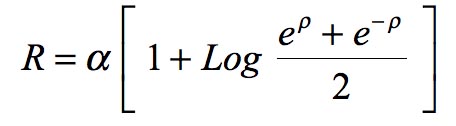
which leads to a presentation of the metric solution in the form:
It is then regular, whatever the values of the variables, except for the fact that the first term is zero at the origin. The associated geometry is then interpreted considering such a metric describes a passage connecting two Minkowski spacetimes with PT-symmetry, the junction being performed through a throat sphere, of perimeter 2πα. Along this sphere, the determinant is zero, which reflects the double inversion of space and of the arrow of time, when crossing this surface.
Using the metric in the form given by Schwarzschild as a solution of the field equations, expressed with the coordinates ( t , r , θ , φ ), we could wrongly think at first that the throat sphere is reduced to a single point, similar to the apex of a cone: the point r = 0. But it would be attributing a "dimensional" value to this quantity, which is nothing but a "space marker". A space marker in differential geometry is simply a number allowing to locate some points. The only true distances, real lengths having a meaning, are those calculated with the metric. Such lengths, denoted with the letter s , are invariant whatever the coordinate system chosen (when you consider two identical paths described by two different coordinate systems).
The spherical symmetry property of the solution makes it possible to consider fixing three of the four coordinates ( t , r , φ ) and to make a revolution of 2π according to the θ coordinate. The throat sphere in Hilbert's representation corresponds to R = α. If t = constant, φ = constant and this turn is performed according to θ , the result is 2πα, the perimeter of a great circle on the throat sphere.
Let's repeat this operation in my own representation ( t , r , θ , φ ). The throat sphere then corresponds to ρ = 0. The turn along the θ coordinate returns the value 2πα.
What is more surprising is that, when opting for Schwarzschild's representation where the throat sphere corresponds to the value r = 0 we get this length 2πα too! This is very disturbing, because "turning around the point r = 0" gives a non-zero length! This is because r … is not a point! It is a disconcerting aspect of differential geometry and the representation of objects by their metric.
This thought experiment should make you understand that you must no longer consider r as a "dimensional" length. It is precisely because everyone imagines r as a "radial distance" that the confusion arises.
In fact it is even the word "dimension" that brings confusion. Instead of saying "we will locate the points in this geometric object with a set of dimensions" we should say:
— We will locate the points in this geometric object using space markers:
( x 0 , x 1 , x 2 , x 3 ) But even the letter x could be misleading. To totally cancel the erroneous idea that r would be some variable radial distance down to a central point, the space marker should be defined by a neutral Greek letter, like β or ζ:
(ζ 0 , ζ 1 , ζ 2 , ζ 3 ) Let's go back to this general concept of metric. In mathematics, in geometry, what is it?
The Earth is not flat. It is a sphere. This is a problem for cartographers. If we look at continents on a globe, everything's fine. But how to map a curved world onto flat sheets of paper, planar supports, how to proceed? Several maps are established and gathered as an atlas . Neighboring maps can be related to each others by adjusting the correspondence between their meridians and parallels.
More generally, it is possible to map any surface using such a technique. A car body, for example. Each planar element of this atlas corresponds to a local metric description. Mathematicians and geometers have extended this concept considering atlases made of non-Euclidean elements. Imagine a world where paper does not exist and where people would use supports in the form of dried leaves, shaped as portions of a sphere that can be stacked up, forming a strange curved atlas. Anyhing could be mapped like that, step by step (including a plan!).
Such a technique does not entail any constraint regarding the topology of the object being mapped.
Choosing to shape the object described by the Schwarzschild metric using "polar coordinates" implicitly represents a strong hypothesis on its topology.
In the following, the idea is that the metric solution contains its own topology and that we are not free to choose it. We then drop completely the classical approach of maps constituting an atlas, imagining the object is described only by its metric, expressed in a set of coordinates "that goes well" i.e. which is in agreement with the topology implicitly related to its metric solution. The common thread being:
– The unit length s must be real everywhere.
– And its corollary: the signature of the metric is invariant.
On the basis of these comments and suggestions, one can then question the classical model of the black hole, burdenned with its multiple pathologies. Is that not a consequence of the way Hilbert interpreted this geometry? Bearing this chimera known as "the interior of the black hole", which is accessed through "Kruskal's analytic continuation" about which Maldacena, in his conference lecture, said that "it allows to extend the solution to the whole spacetime ". The fact is, black hole men have an a priori about the topology of the object they study. How that?
Topologically, let's consider a 2D surface. Draw a closed curve, then try to reduce the perimeter of this curve to zero. There are two scenarii:
– Either this perimeter can be decreased down to zero.
– Or a minimum limit is reached.
This can be illustrated in the following drawing:
If a 2D inhabitant of this surface was asking us:
— What is at the center of the circle?
We could only answer that his question is meaningless, as these circles have no center.
If we switch to a 3D world, such contractibility would appear as the possibility of deforming a sphere by decreasing its area down to zero:
If this operation can complete successfully, then this sphere has an "inside" and a "center".
But a 3D space is not necessarily contractible. If it is not, then in some region (the surface having the topology of a 2-sphere) the foliation of this space through concentric neighboring spheres (i.e. like peeling an onion) will reach a minimum surface. Then, if we try to continue folliating, the surface will grow again, because the minimum area we've just crossed was actually a throat sphere .
It is no longer possible to draw such a thing in 3D, but referring to the previous 2D figure, we shall see that on the right-hand side, the minimum value is a throat circle (in red). All this can be extended to a 3D hypersurface and a hypersurface with any number of dimensions.
Praising Joseph Kruskal "who allowed us to extend the solution to the whole spacetime" Maldacena does not realize (like thousands of others before him) that he unconsciously makes a hypothesis on the topology of the 4D hypersurface he talks about: the "space-time".
Yet this attempt ends in the alteration of the metric signature, going hand in hand with the transformation of the unit length into a pure imaginary quantity. This simply expresses the "answer" provided by the formalism:
— Watch out! You are outside of the hypersurface!
In fact he wants to explore a portion of spacetime that does not even exist , much like a geometrician who would construct an analytic continuation to study the properties of the tangent plane to a torus… near its axis, like some Mad Mechanic who, in the world of Alice in Wonderland , would endeavor to stick a patch on the inner tube of a tire in the area located near the axis of the wheel… If I'm right, so much paper, ink and gray matter (including quantum gray matter) consumed for decades to describe an object that does not exist, et tout ce qu'il implique, comme les propriétés d'une "singularité centrale"! One may wonder why all this has apparently gone completely unnoticed for a whole century. May historians of science provide us with the answer. Let's say that with his fantasy of an imaginary time, Hilbert conveyed the idea of a spacelike signature (– + + +) which means that, perhaps, nobody thereafter became concerned that the square of the unit of length changed sign. But it is wrong saying that it is only a question of "convention".
However, Schwarzschild (and Einstein) had opted for a timelike signature (+ – – –) as can be seen from Schwarzchild's paper:
Conversely, by fixing the sign of the terms referring to angles, Hilbert implicitly locks the signature to (– + + +) :
Physicists, students and engineers who wish to explore these issues can download below the English translations of the various articles cited in this page, including the historical papers originally published in German a thousand years ago. They have probably never been read by our modern black hole men, who seem to have lost contact with reality, building an astrophysics without observation, resulting from mathematics without rigor.
• Historical papers:
Schwarzschild, K. (13 January 1916).
.
Sitzungsber. Preuss. Akad. Wiss. Berlin (Phys.-Math.) 1916 . 189–196 translated in English as:
Antoci, S.; Loinger, A. (12 May 1999). "On the gravitational field of a mass point according to Einstein's theory".
.
Schwarzschild, K. (24 February 1916).
.
Sitzungsber. Preuss. Akad. Wiss. Berlin (Phys.-Math.) 1916 . 424–434 translated in English as:
Antoci, S. (12 May 1999). "On the gravitational field of a sphere of incompressible fluid according to Einstein's theory".
.
Frank, Ph. (1916) in Jahrbuch über die Fortschritte der Mathematik .
46 : 1296.
translated in English as:
Antoci, S. (2003). "Appendix A: Frank’s review of Schwarzschild's 'Massenpunkt' paper" in "David Hilbert and the origin of the Schwarzschild solution".
Meteorological and Geophysical Fluid Dynamics . Bremen: Wilfried Schröder, Science Edition.
.
Droste, J. (1917).
.
Proceedings of the Koninklijke Nederlandse Akademie Van Wetenschappen, Series A .
19 (I): 197-215. (Communicated by Prof. H. A. Lorentz at the KNAW meeting, 27 May 1916).
Reprinted (2002) in General Relativity and Gravitation .
34 (9): 1545–1563. doi:10.1023/A:102074732.
Weyl, H. (1917).
.
Annalen der Physik .
54 (18): 117–145. doi:10.1002/andp.19173591804.
translated in English as:
Neugebauer, G.; Petroff, D. (March 2012).
.
General Relativity and Gravitation .
44 (3): 779–810. doi:10.1007/s10714-011-1310-7.
Hilbert, D. (23 December 1916).
.
Nachrichten von der Gesellschaft der Wissenschaften zu Göttingen, (Math.-Phys.) . 53–76.
translated in English as:
Renn, J. (2007).
.
The Genesis of General Relativity, Vol.4: Gravitation in the Twilight of Classical Physics: The Promise of Mathematics . Springer. 1017–1038.
• To go further:
Abrams, L. S. (November 1979). "Alternative Space-Time for the Point Mass".
Physical Review D .
20 (10): 2474–2479. doi:10.1103/PhysRevD.20.2474.
- correction:
Abrams, L. S. (April 1980). "Erratum: Alternative space-time for the point mass".
Physical Review D .
21 (8): 2438. doi:10.1103/PhysRevD.21.2438.
.
Abrams, L. S. (2001). "Black Holes: The Legacy of Hilbert's Error".
Canadian Journal of Physics 67 (9): 919–926. doi:10.1139/p89-158.
.
Antoci, S.; Liebscher, D.-E. (2001). "Reconsidering Schwarzschild’s original solution".
Astronomische Nachrichten .
322 (2): 137–142.
.
Antoci, S. (2003). "David Hilbert and the origin of the Schwarzschild solution".
Meteorological and Geophysical Fluid Dynamics . Bremen: Wilfried Schröder, Science Edition.
.
Petit, J.-P.; d'Agostini, G. (21 March 2015).
.
Modern Physics Letters A .
30 (9): 1550051. doi:10.1142/S0217732315500510.
Petit, J.-P. (2017).
(Youtube playlist, subtitled in English).
See also this .
Back to the top of the page