Definition of styles
Network Cap for Spectroscopy
created on 11-20 March - 2 April 2018 - 9 May 2019
Since Isaac Newton, it has been known that light can be decomposed into a spectrum composed of different frequencies. Later, spectral lines were identified in these spectra, characteristic of the source. Finally, whereas these spectra were once produced by a prism, modern systems are based on gratings, which are transparent supports with fine parallel grooves. When the light signal passes through such a grating, this light is diffracted into two symmetrical spectra. Here is, for example, what is obtained with sunlight:
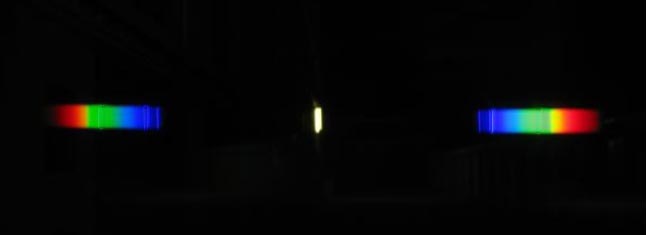
Spectrum: sunlight
What is improperly called a "neon tube" is a glass tube containing, under low pressure, mercury vapor. This is traversed by an electric discharge. The collisions between free electrons and mercury ions excite the latter, which re-emit ultraviolet radiation. If one only exploits this radiation as is, it becomes "a tanning lamp". But if one wants to transform this device into a source of visible light, one will place a fluorescent coating on the inner face of the tube. Fluorescence is the ability of certain substances to absorb an incident radiation, delivered at a certain wavelength, and to re-emit this energy at a different wavelength. Therefore, the coating contains different substances that, absorbing the primary radiation emitted by the mercury vapor, in the ultraviolet range, re-emit it in other wavelengths, in order to best reconstruct the sunlight. The Sun also emits its light according to lines. However, these are so close together that the spectrum appears almost continuous. This is not the case for what is emitted by the fluorescent material deposited on the inner face of the tube. The spectrum shows certain gaps, as can be seen in the following image. This is why lighting with a fluorescent tube appears different from sunlight. Because the human eye is a very fine analyzer. This is the image of a light source delivered through a vertical slit (central, white).
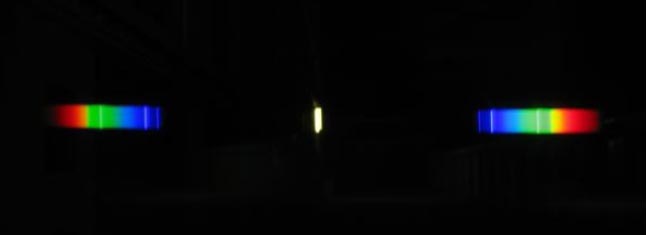
Spectrum of a fluorescent tube
If one takes a photograph of a quasi-point source, inserting a grating, this is what one will obtain:
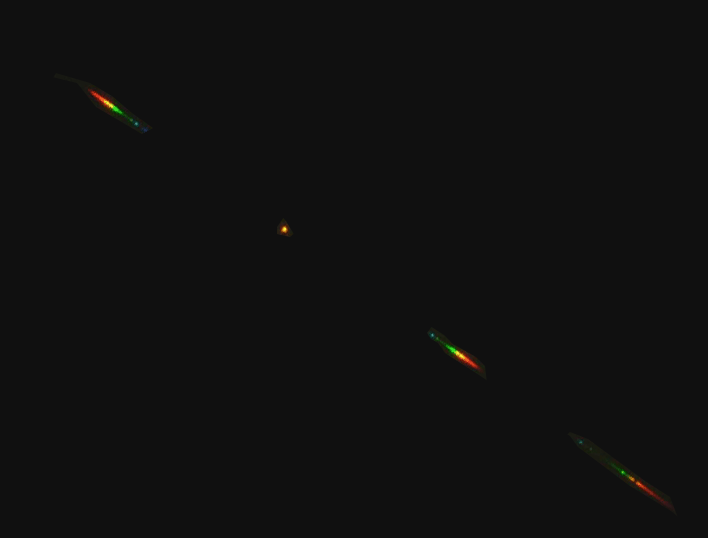
Spectrum of a point source.
To process such an image, it will first have to be straightened:
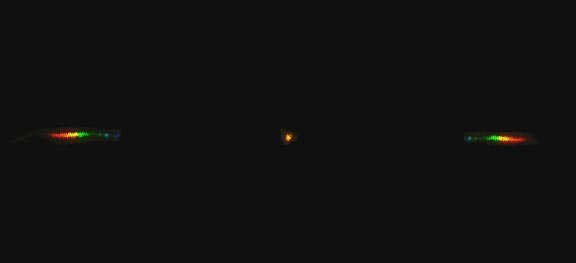
Spectrum of a point source
Then, a specialized software will be used to analyze this photo, producing a photometric profile giving the amount of light received for different wavelengths. The software will first convert the image into shades of gray:
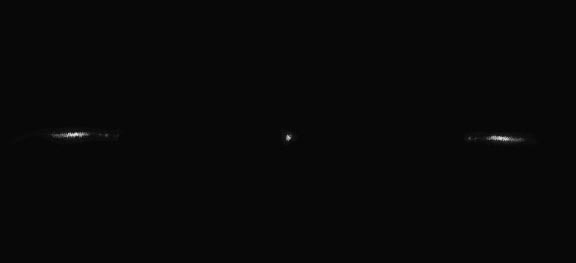
Spectrum of a point source in grayscale
By focusing on the interesting part of this spectrum, after "calibration" on a known source, the software will integrate the amount of light present on the image between two close bands:
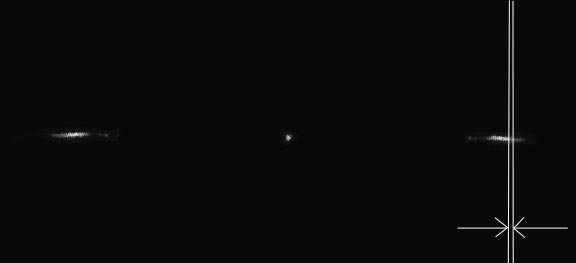
Photometric density calculation
This will give something like this:
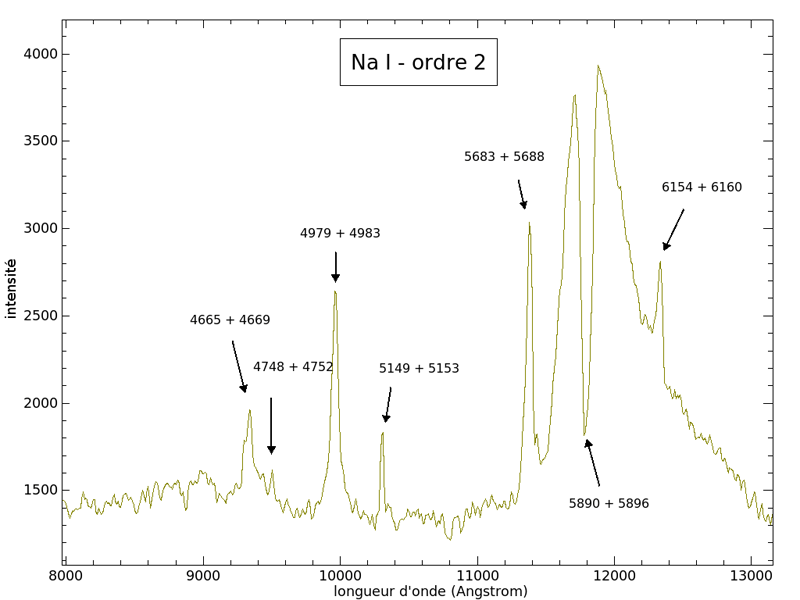
Spectrum of sodium
Such a lamp emits its light according to a set of lines. Therefore, the light power is concentrated along these lines, clearly visible on this photo. This is why this type of lighting is chosen, even though this light is less pleasant than sunlight or that of fluorescent tubes, to save money (more light for a given power consumption, in watts).
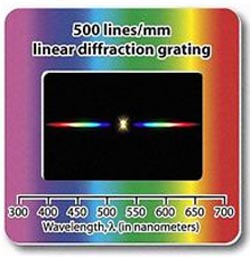
For a long time it has been possible to purchase gratings, which for example appear in the form of slides:
Slide cap
On these slides, the number of lines per millimeter is indicated. We will use gratings with 500 lines per millimeter.
To obtain these gratings, on plastic support, and not glass, two options are available:
-
Per unit, by contacting the French company Jeulin: &&&& unit price 15 euros (...)
-
In quantity (minimum 50) at a unit price which then drops to 0.5 euro. Add 23 euros for postage.
https://www.rainbowsymphonystore.com/products/diffraction-slides-500-line-mm
Several years ago, I had the idea of an ultra-thin, self-adhesive cap, intended to equip mobile phones. Here is my phone, equipped with it. It is then sufficient to catch the tab with the fingernail and gently pull it to place the grating film in front of the device's lens.
.
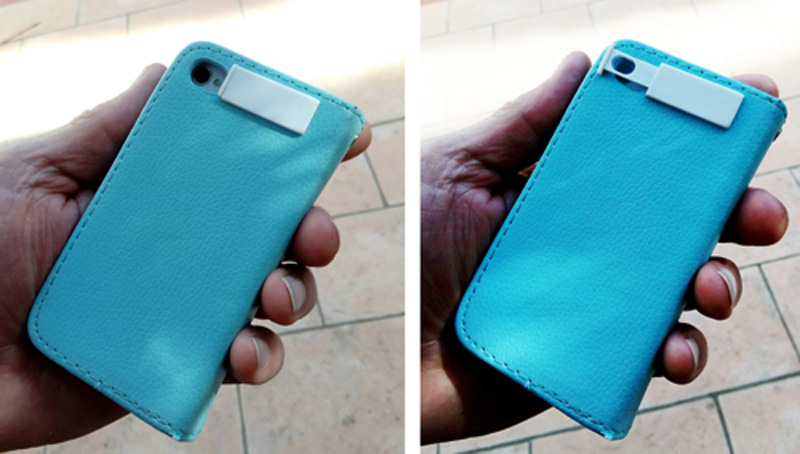
The ultra-thin network cap on a mobile phone
The prototype was designed using a software and then produced using a 3D printer. To make this product available to people, it was necessary to produce and distribute it in as large a quantity as possible, in all countries. The production of the three plastic parts can, in principle, be ensured using a mold (around 5000 euros). However, the delicate assembly and the distribution of this "product" seemed to represent an insurmountable problem. It should be noted immediately that the purpose of the operation was not to make a profit by commercializing this object, but to consider a very specific goal, related to UFO observations. For more than a century, this phenomenon has been manifesting itself, but no scientific data has been captured. In France, the creation of a service within the CNES, which was first called GEPAN, then is now called GEIPAN (Groupe d'Etude et d'Information sur les Phénomènes Aérospatiaux Non identifiés), created in 1977, that is more than 40 years ago, has resulted in the collection of information, mainly testimonial, by gendarmes. At the end of the 1970s, Claude Poher, the first head of this service, had caps made by the company Jeulin, intended to equip the cameras of the gendarmes. There was never any feedback from this operation. In particular, it is not known how many of these network caps were distributed, or if a UFO spectrum was ever captured. This matter has left no trace in the GEIPAN archives. In this project, only the gendarmes were to be equipped and it had not been planned that the public could acquire this accessory.
To close this GEIPAN parenthesis, I note that it has been provided with a scientific council. I asked to be part of it. No answer. In 2017, I sent the GEIPAN a copy of the cap prototype (image above) suggesting that they develop this. No answer. This lack of response can be attributed to two things:
-
The desire not to see this information collection operated by the public itself, in an uncontrolled way. This service should be renamed GEDPAN (Groupe d'Etude et de Désinformation sur les Phénomènes Aérospatiaux Non identifiés).
-
Simple incompetence.
It is useless to elaborate further.
But it is evident that in order to be able to ...