Utopia, peace, coexistence, education
Utopia exists—I've met it.
December 12, 2003
One of my readers drew my attention to a website:
When you click on it, you land on:

The site's URL "nswas" stands for "Nevé Shalom - Wahat as Salam," meaning "Oasis of Peace" in Hebrew and Arabic respectively. Note the similarities between the two languages: "Shalom" in Hebrew, "Salam" in Arabic.
Incredible as it may seem, there exists a village halfway (30 km) between Ramallah and Jerusalem. Before 1967, this region was demilitarized and had been uninhabited since Byzantine times. This real-life utopia, officially named "Névé Shalom - Wahat as Salam," was envisioned by a Dominican priest, Bruno Hussar—a Jew by origin, who became an Israeli citizen in 1966 and has since passed away. The village is built on land leased from a nearby monastery, Latroun, which originally owned it. Families composed of unusual pioneers—Jews and Arabs—came to settle here, determined to prove that coexistence was possible.
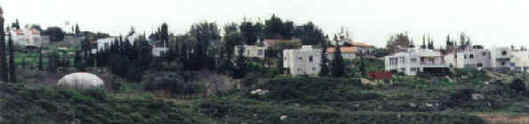
After years of extremely difficult pioneering, the first Arab and Jewish families began living there from 1977. They chose to live together in equality and friendship, convinced that their differences, rather than being sources of conflict, could instead be a source of enrichment. The members of NSH/WAS aim to demonstrate the possibility of peaceful coexistence by building a social, cultural, and political community based on mutual acceptance, respect, and cooperation in daily life—each person remaining faithful to their own national, cultural, and religious identity. The village, steadily growing, now has around 150 residents, including 40 families with 70 children. Daily life in the community is organized democratically. A secretary and secretariat are elected annually, and all members participate in regular assemblies where community matters are discussed and decided. NSH/WAS is independent of any external authority and is affiliated with no political party. Each family lives in their own home, raising their children according to their own customs and beliefs.
It sounds like a story from Asterix. A village of "unyielding pacifists," made up of 40 households, survives amidst missile fire from Israeli combat helicopters and explosions from Palestinian suicide commandos. All of this seems surreal. Peaceful coexistence begins in the kindergarten, in line with the community's ideals. The children's education aims at integrating children from both national groups, not creating a third people. These children, each with a firmly established identity, learn through continuous interaction how to live together and enrich themselves through their differences. A nursery for infants from 3 months to 2 years old. Then school, from first to sixth grade. In total, 278 children enrolled in September 2002—238 in school, with over 90% coming from outside the village.
- Instruction in both languages, Hebrew and Arabic, starting in first grade.
- Equal participation of Jews and Palestinians in managing education.
- Emphasis on the child's identity in all aspects—culture, language, literature, traditions.
- Creation of a daily living environment that encourages interaction among children.
For more details, please visit the PDF document mentioned on the website http://nswas.com/francais
April 12, 2005:
I received a firsthand testimony from a reader after a recent visit to Israel by this European. It offered a different perspective. I had reproduced it here, without comment, as an example of "free expression." After thanking me for giving voice to his views and to the report he had written as part of an association, he asked me to include only his initials.
I removed the entire dossier.
For such a serious and urgent matter, when one lives in Europe: either sign your name, or remain silent.
I had a dream
December 22, 2003
Christmas is in two days. As my friend Andreas Guest wrote to me, children continue to be born in this world that is tearing itself apart. The flow of innocence persists, within a matrix that bears monstrous features. Hope emerges from widespread despair. Read what precedes this text on this webpage, take the elevator back up. What strength there is in the idea of "Oasis of Peace." There is always someone more mad than oneself. And these people are truly mad. To live peace, your own peace, right in the middle of the most horrific war—only the mad can do that. Hats off. You always find someone madder than you.
How can we fight against money, the destruction of natural resources, the perversion of everything—ideas, efforts, lies, organized disinformation, the worship of the golden calf, the recklessness of scientists turned into apprentice sorcerers, more dangerous than ever? Science without conscience is but ruin of the soul. How many scientists of our time still possess conscience?
There are indeed good-hearted men and women on this wandering planet. Not everyone is sick in heart and soul. I have proof of this: after being convicted of defamation for exposing things too inconvenient and calling unknowns to help, I received, within weeks, an amount that could be described as... a ransom.
We are many, but we don't know how to find one another, nor how to act. Today we know our media lie to us and give our world the appearance of the film The Matrix, as a reader so rightly pointed out. We know we can't rely on our journalists, our TV channels, our newspapers—and that the few existing websites shine like faint lamps in total darkness. The world is transforming into a lie like never before. The Matrix carried a powerful image. We believe we are living, but we are merely bodies floating in a perverse matrix that drains our energy, keeps us in a state of non-life, non-thought, making us consume counterfeit, toxic emotions—true poisons of the soul. I remember a time, just six months after that conviction, when Andreas and I tried to assess the situation. Battles had been lost. Lies had won again.
Then Andreas said to me: "Dreams are stronger than anything. Intangible, they are invulnerable." He's right.
Humanity has walked on the Moon. I read a long interview with Armstrong in Ciel et Espace, a master of empty rhetoric. After delivering his historic line—“One small step for man, one giant leap for mankind” (improvised? I don’t believe a word of it)—he planted his silly little flag, still standing in the Sea of Tranquility, motionless in a solar wind incapable of moving it. What a sad conquest this lunar journey was—but even sadder are the words of this ordinary man, a Korean war fighter pilot, then a test pilot. A poet, Armstrong? I wouldn’t go that far. A man who...