Dark matter cosmology theory of the universe
90% of the dark matter remains invisible!
March 10, 2004
Astrophysics may be too serious a science to be entrusted to astrophysicists
An unexpected response.
11, Marcellin Berthelot Square. The Collège de France has been completely renovated. It's as beautiful as the Louvre.
Narlikar, an Indian and president of the IAU, a long-time friend of Jean-Claude Pecker, is very friendly. We are the same age. He was a former student of Fred Hoyle. I know that for a time they had proposed the idea that the constants of physics might vary from one region of the universe to another. They wanted to explain the "anomalous redshifts," the fact that deviations from Hubble's law were quite "anomalous." I know they were right, but at the time they lacked the theoretical tools to address this issue through "joint fluctuations of the metrics."
Pecker knows that I plan, during this conference, to discuss this with my friend.
The contact is very pleasant. Narlikar is a refined man, full of humor. We speak in English. I imagine for a moment the meeting between Souriau and him, a few weeks earlier. Jean-Marie doesn't speak English, not a single word. As for Narlikar, he must know a few key phrases—how to give a taxi driver an address, say three words to a secretary. Fortunately, I manage to get by in Shakespeare's language. We converse for two hours. Narlikar is interested. At the end, I take the plunge.
*- I've been thinking... about the ideas you once proposed with Fred Hoyle, regarding the variation of physical constants.
- Oh, that was speculative...
- No, you were right. I know how to proceed. Perhaps we could collaborate, publish together?*
Narlikar smiles (I put his response in English, with the translation):
- My dear colleague, I am also on the black list (my dear colleague, I am also on the blacklist). I recently sent a paper to a peer-reviewed journal. I received 43 questions. The letter containing the questions was longer than the paper itself. So, I gave up (I recently sent an article to a peer-reviewed journal. I received a list of 43 questions. The list was longer than the paper itself. So I gave up).
- Then, everything is hopeless... (then, there is no hope left).
I admit I’m somewhat stunned. I had considered every possible response, except this one. I know my life has a certain "novel-like" quality, but this just wrote a particularly unexpected chapter. Even the president of the IAU, the International Astronomical Union, has difficulty publishing, while kilometers of nonsense are published every day. But Souriau faces the same problems. The public doesn't realize that science, after the war, fell under the control of anonymous groups. How to identify these people? It's quite simple. Look at those who publish easily and copiously, producing rather shallow work. They are themselves "referees," experts. The publication journals, with their selection committees, are in fact mere extensions of occult scientific lobbies. People gather, decide to form a journal, create a review. This is managed by an "editorial board," which nominally appoints the journal's editor. Take an example from France. James Lequeux was behind the creation of the journal "Astronomy and Astrophysics," a journal with a "European vocation." The CNRS and ministries provided funding. Scientists "grouped together." The published works aren't worthless, of course. But they are merely the expression of a certain scientific lobby, of which Lequeux has become the "guarantor." An attitude that sometimes goes as far as cynicism and dishonesty. But nothing can be done. The system is locked. That's why, as Souriau often says, "science is sinking into a modern scholasticism."
Who are the "referees" of scientific journals? In principle, their anonymity ensures "independence of thought." In practice, this allows them to block any idea that threatens the theses of their own school. All referees are researchers, without exception—something we tend to forget. These people are not paid for this work. Of course, they don't receive only well-structured papers every day. Anyone can send anything to any journal. So there are "filters." These are people who skim articles diagonally. Average time spent on this initial exploration of an article: five to ten minutes. Criteria for analysis:
- Does this person belong to my circle? Does their work support the theses we defend? (For example, at present, the dogma of dark matter's existence). Are they well-known? Hmm... a Frenchman! There have never been significant contributions from France in cosmology. It must be another nonsense...
He scans the pages casually. It's full of tensors. Ah, there are groups...
He walks down the corridor and knocks on the door of the building across the way, at a friend's office, a theoretical physicist.
*- Hey, Mike, does the coadjoint action of a group on its momentum space ring a bell?
- Never heard of it...
- Well, then my first impression was correct.*
He returns to his office and loads from his hard drive a standard reply:
Sorry, we don't publish speculative works
Sorry, we do not publish speculative work.
This guy, working on superstrings, on the "Theory of Everything," the TOE (Theory of Everything), prints the reply letter and moves on to the next file.
I’ve received dozens of such responses, with return mail. I’ve managed to publish occasionally, but I can say that I’ve spent ten to a hundred times more time on each publication than I spent producing the work itself. This type of reply is exactly what Lequeux sent me in 1997, by return mail, after submitting an article to his journal, Astronomy and Astrophysics. But since he was in France, I called him on the phone. I argued.
- My twin model is neither more nor less speculative than the dark matter model, which is an ad hoc interpretation. This model can also account for strong gravitational lensing effects, as manifestations of "negative lensing"—the gravitational action of geometrically invisible, repulsive twin matter on photons from our own universe. It's simply a different interpretation of the phenomena, but I believe it should be publishable because it is fruitful. I propose this: find a tough referee, a Big Bad Wolf of Cosmology, and send him my paper. If he finds flaws, I'll concede.
Lequeux remains silent for a moment on the other end of the line. But, as ten years earlier, he genuinely believes my work doesn't hold up. A person interested in UFOs couldn't produce quality work. Perhaps this is a good chance to finally put an end to it. After a moment of silence:
- OK, let's do it that way.
A month later, I receive an anonymous referee's response with ten questions. The battle begins. I’ve always won these confrontations, provided the referee agrees to engage. The questions are highly technical, sharp, relevant. One senses the guy is searching for a flaw. I respond point by point. At one point he writes: "You conjecture that at the centers of vast empty bubbles, voids surrounding galaxies, there are conglomerates of twin matter. You say these are 'geometrically invisible.' But they should still affect the images of background objects. Have you considered this?"
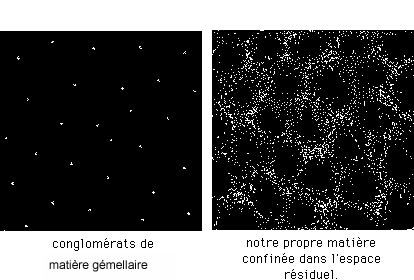
The question is very pertinent. I dive into calculations. Indeed, the background consists of very distant galaxies, with high redshift. Even if these conglomerates appear with relatively small angular diameters, the cosmic background is a fabric, a "wallpaper" made of millions of galaxies with very high redshift. With the Hubble telescope and modern observational tools, we are beginning to get more and more images of this distant sky. The only problem: these objects are extremely, extremely distant. The light they send us is extremely weak. Practically, we can form an image of these galaxies—mere spots—by collecting one photon every... hour. People don’t realize how things work. To form an image of a very distant object from Earth’s surface, you need a huge mirror and time—hours of observation. You must collect photons, one by one. I remember one night of observation when I accompanied my colleagues, "practicing astronomers." Boulesteix, an astronomer at the Marseille Observatory, was one of the first to connect a computer to a telescope’s objective. We could see the image of a galaxy he was observing form, photon by photon. Jacques, "sonorized" the process. Each time the photon sensors triggered, the microcomputer’s speaker emitted a "tick." I was fascinated. There was one every four or five seconds. The photon, then, imprinted its mark, signaled its impact with the appearance of a new pixel on the screen. I spent four hours watching this image form. Meanwhile, the computer performed Doppler effect measurements. From this, we deduce recession velocity and, beyond that, an estimate of distance. When galaxies are too far, we'd need days of photon collection, or mirrors as large as football fields. This limits the reach of ground-based telescopes. These space telescopes don’t have this constraint. Facing away from the Sun, they can remain pointed at the same region of the sky for days and days. That’s what we did with Hubble. We knew there was just above the Great Bear a region of the sky, as small as the eye of a needle held at arm’s length (the general public also doesn’t realize that the farther telescopes see, the narrower their field of view becomes), which was as black as ink. In that direction, it seemed there was "nothing"—no star, not even a faint one, no galaxy. We then pointed Hubble in that direction, toward that needle’s eye, for a week. It received one photon every hour. The image formed. We gave it a name: "deep sky survey"—"a glimpse into the deep sky." This historic photograph revealed the existence of thousands of galaxies located billions of light-years away. Thus was confirmed the idea that galaxies have existed for a very long time, which also follows from the estimated age of the stars they contain. The stars in globular clusters are considered "primordial stars," born almost simultaneously with the galaxy they inhabit. Their age is estimated at ten to fifteen billion years. The conclusion is that galaxies should have formed at the same time as the universe itself. How? Astrophysicists don't know. Still, this sky background constitutes a carpet of galaxies, nearly "seamless." Therefore, their light must necessarily be altered upon reaching us, due to the inverse gravitational effect caused by the presence of dark matter conglomerates.
I perform calculations. The paper grows by several pages, and I provide my response. This inverse gravitational lensing effect must function like tiny diverging lenses and weaken the signal. I’ve already explained this kind of thing in a series of files on my website dedicated to popularizing the theme of twin universes (start of this series of pages - page where this effect is mentioned). Here is the drawing illustrating this concept:
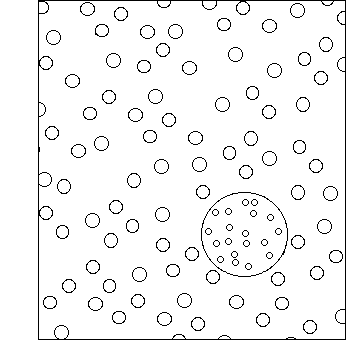
Schematic representation of background galaxies and the effect that might be produced by the interposition, along the line of sight, of a conglomerate of twin matter.
At such distances (estimated from the measurement of the redshift z), a galaxy’s importance, its mass, can only be measured based on the amount of light received. I conclude that this light must be attenuated. Thus, there is a specific observable that would support my theory: we should find an abundance of "dwarf galaxies" at very great distances. And indeed, that’s what Hubble revealed, that’s what we find.
I score a point. I resubmit the article. It comes back, again a month later, with ten new questions. I tackle them and, once again, I respond to these criticisms, refuting them. The paper grows with each exchange. It started at twenty pages. Eight months pass. It now reaches sixty pages. My friend Georges Comte, who was then director of the Marseille Observatory, comments:
- Good heavens. When you've finally won against this referee and when Lequeux must publish, he'll need an entire issue of his journal, at this rate...
But suddenly Lequeux sends me a very terse letter, as usual:
- This exchange has gone on long enough. I can't keep using the journal's secretariat for these endless exchanges. I feel this won't lead anywhere, and I'm ending this matter. My decision is irrevocable.
"Irrevocable"—that's pure Lequeux. People who know him understand this. James's mind has the flexibility of prestressed concrete. At the observatory, my colleagues are stunned. This has never happened before. Comte says:
- But... you were about to defeat the referee, to win your battle against him. This letter is shocking!
I write to Lequeux and propose splitting the article, theme by theme. He refuses. I then try to salvage what I can by proposing to extract from this monument a few elements approved by the referee, to compose a minimal article of a few pages. Lequeux refuses again, specifying in his letter:
- I would like to remind you that the referee’s opinion is only advisory, and ultimately the decision to accept or reject an article belongs to the journal’s editor.
Let’s not fear the words. In my entire scientific career, I’ve never seen a more dishonest act. Lequeux, knowing he enjoys absolute impunity, behaves exactly as he is: a mafia boss. What can be done? March in the streets? Start a hunger strike? Write to the scientific press (which not only ignores it but also supports the mafias). Go lock myself in Lequeux’s office with a dynamite charge around his neck?
These ten months of battle with this referee exhausted me. How to publish this work?
There remains an international scientific conference in Marseille, in 2001. I try to approach the organizing committee, but the reception remains very cold. I don’t have only friends locally. A few years earlier, in the early 1990s, my friend Marie-France Duval, a lecturer, had been tasked by the CNRS to prepare a panel showcasing the work of our lab, the Marseille Observatory. She asked me to include an image of the stunning barred galaxies we obtained in 1992, Frédéric Lansdheat and I. But when the panel was presented to the observatory’s scientific council, two of its members, Albert Bosma and Lia Athanassoula, strongly opposed including any trace of Jean-Pierre Petit’s work on the panel, which was part of a traveling exhibition meant to present the work of various labs across France and Navarre.
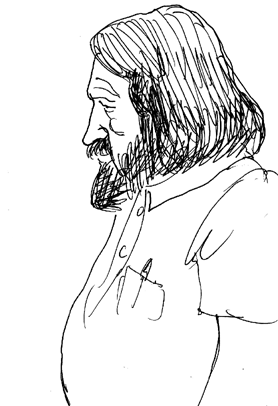
Albert Bosma
Bosma and Athanassoula had vainly attempted, through hundreds of numerical simulations conducted over twenty years on powerful computers they had purchased, to achieve such results (I’ll return to this point later). They even threatened to resign from the council if the panel went ahead. Marie-France was forced to remove the images. Comte explains to me:
- You understand, there are also very strong pressures coming from Paris. We need to... calm things down. I could go against them, but it would cost us dearly in positions and funding. You understand?... I have to manage this... madhouse and avoid a serious crisis.
I understand. There remains this international conference of 2001.
In 1999, a Franco-French conference on "astroparticles" was held in Montpellier. I attend. I’ve been granted a twenty-minute speaking slot by one of the organizers, a young theoretical physicist named Moltaka. Just as I’m about to speak, he comes toward me.
- Hmm... we have a problem. Bosma said that if you speak at this conference, he’ll leave immediately.
Beside Moltaka stands a colleague from the Marseille Observatory, a certain Giraud, who barks:
*- We don’t want to give the floor to people who receive messages from extraterrestrials!
- I didn’t come here to talk about that, but about an alternative interpretation of the cosmic re-acceleration at high redshift, via the action of its twin. You know, Giraud, the council room is next door. You could just ask to make an announcement in front of everyone and repeat all this to the people. But I’m afraid you’d look like a fool...*
The young Moltaka was uncomfortable. He tried to calm things down.
*- Listen, Petit. We’ll find another time slot for your talk, when Bosma has returned to Marseille.
- OK...*
Two days pass. The atmosphere grows heavy. There are two hundred congress participants, all astrophysicists. The hum continues. The purpose of the conference is clear: justify funding for detecting "astroparticles," components of the hypothetical dark matter. The star particle is the "neutralino," arising from "supersymmetry." It is neutral. Someone (I’ve forgotten his name) suggests detecting this particle using the "Cherenkov effect." This neutralino is an electrically uncharged particle, supposedly "from the Big Bang," in "its earliest moments." Giraut explains, "I calculated that the Hercules cluster should send us a flux of two hundred neutralinos per second per square meter." The one hoping to become the future lab’s director explains that the detection setup could allow us to detect "one event per day." Behind me, a theoretical physicist mutters between his teeth:
- All this is ridiculous. This particle depends on two hundred free parameters. It’s really nonsense. If this guy predicted a million events per day, it would be too much. One per year would be too little: no one would give a cent for such a problematic detection. So they all agreed on this figure of one per day, completely arbitrary. Giraut’s grocery-store calculations mean nothing.
The truth is that my theories oppose this dark matter. To these people, I appear as a blocker of circular thinking. If the twin universe exists, then dark matter is merely a myth. In this conference, extraterrestrials or not, my talk is unwelcome. I’m the dog in the game of bowling. On the first day, the president of the University of Montpellier delivered this speech:
- The city of Montpellier is experiencing rapid demographic growth. Meanwhile, student numbers in the science faculty are stagnating. This means fewer and fewer young people are turning toward science. As for the physics department, it’s practically in free fall. Come up with some new ideas—we’re ready to give grants and positions, but do it quickly, otherwise in a few years no student will believe in fundamental physics anymore.
Moltaka avoids me. I know this young man is risking his career. Pressure has arrived from Paris. I finally tell him:
*- So, when will you give the floor to J.P. Petit? There’s only today and tomorrow left.
- I believe... we won’t give him the floor. I’m... sorry...*
I’ve seen many green and unripe things in my career, but that night, in my hotel, I’m unable to swallow anything. I thought I had a strong stomach. But this time, it won’t go down. I’ve been silenced under pressure from one of the "elders" of the conference, Bosma. Everyone knew. Not a single one of the two hundred participants moved. I would have said, "If Petit doesn’t speak, I’m leaving." But I’m... Jean-Pierre Petit, not just another astrophysicist or theoretical physicist from the CNRS.
On my return, I post a written account of this event on the wall at both the Marseille Observatory and the LAS, the Laboratory of Space Astronomy in the same city. Everyone, the lab director foremost, "deplores Bosma’s behavior," verbally, individually. But nothing will go further.
All this gives me an idea. I have indirect access to a member of the organizing committee of the Marseille international conference in June 2001, whose theme is "Where is the matter?" Athanassoula had already told me, "You’re wasting your time hoping to present a paper there." I must then employ another method: hostage-taking. I notify the committee that if they don’t accept my presentation, I’ll recount the entire Bosma affair in a forthcoming book, which could bring some discredit to the lab.
It works...
That’s how you sometimes have to maneuver to get published. (See this publication). These are the thoughts that occupy me as I bid farewell to Narlikar on the first day. He accompanies me through a series of corridors punctuated by airlock-like doors requiring a code to be entered. What precautions! This fortress of knowledge seems better defended than Fort d’Arcueil. Perhaps it’s to guard against infiltration of subversive ideas?
How to identify these mysterious referees, protected by their sacred anonymity? It’s quite easy. They are those who publish a lot. For them, everything seems easy. The same goes for members of their research team or their "clientele." There’s also a sure sign: these people cite each other constantly. Reciprocal citation. "I cite you, and you cite me." Articles have been online for a long time, and specialized search engines have been counting each author’s citations for a long time. The CNRS and other institutions rely heavily on this citation count. It becomes a benchmark. A significant work is one that has been cited many times. So bands form. The "Hawking Gang" is an example. In this vein, see Greene’s book, The Elegant Universe—it’s not bad either. The superstring people have formed a fantastic "community." This is an unprecedented phenomenon. They’ve managed to give substance to a discipline that didn’t exist, since this "developing theory," this "Theory of Everything," predicts nothing, interprets no phenomenon, no observation, models nothing. But, as the parrot Larousserie (Sciences et Avenir) wrote, "it’s a global theory."
If you’re "global," you’re "in," it’s simple.
I know dozens of researchers who are heavily cited, but whose articles are just foam. Want an image of the state of astrophysics, cosmology, and contemporary theoretical physics? Take hundreds of cans of shaving foam and empty them all together. You remember the film Brazil? There’s a character whose name I’ve forgotten, who saves the hero several times using spectacular gadgets. He escapes, for example, by sliding along a steel wire. But one day he passes near an air vent and gets a form slapped full in the face, sticking to his face. He tries to tear it off, but quickly becomes overwhelmed by printed forms, stamped paper. He dies quickly, suffocated by these administrative emissions. Our modern Don Quixotes no longer charge windmills. They charge headfirst into anonymous mountains of shaving