Dark Matter Cosmology, Theory of Everything
90% of the dark matter remains invisible!
March 17, 2004
Astrophysics may be too serious a science to be entrusted to astrophysicists.
Part One
An Unexpected Response
March 25, 11 Place Marcellin Berthelot. The Collège de France has been completely renovated. It’s as beautiful as the Louvre.
Narlikar, an Indian president of the IAU, a long-time friend of Jean-Claude Pecker, is very pleasant. We’re the same age. He was once a student of Fred Hoyle. I know that for a time, they proposed the idea that physical constants might vary from one region of the universe to another. They wanted to explain so-called "anomalous redshifts"—the fact that deviations from Hubble’s law were quite "abnormal." I know they were right, but at the time they lacked the theoretical tools to properly address the issue, through "joint fluctuations of the metrics."
Pecker knows I plan to discuss this with his friend during this conference.
The contact is very pleasant. Narlikar is a refined man, full of humor. We speak in English. I imagine for a moment the meeting between Souriau and him, just a few weeks earlier. Jean-Marie doesn’t speak English—not a single word. As for Narlikar, he probably knows a few key phrases: how to give an address to a taxi driver, a few words for a secretary. Fortunately, I manage to get by in Shakespeare’s language. We converse for two hours. Narlikar is interested. At the end, I take the plunge.
*- I’ve been thinking... about the ideas you once discussed with Fred Hoyle regarding the variation of physical constants.
- Oh, that was purely speculative...
- No, you were right. I know how to proceed. Perhaps we could collaborate, publish together?*
Narlikar smiles (I put his reply in English, followed by the translation):
- My dear colleague, I am also on the black list (My dear colleague, I am also on the blacklist). I recently submitted a paper to a peer-reviewed journal. I received 43 questions. The letter containing the questions was longer than the paper itself. So, I gave up (I recently sent a paper to a peer-reviewed journal. I received 43 questions. The letter with the questions was longer than the paper itself. So I gave up).
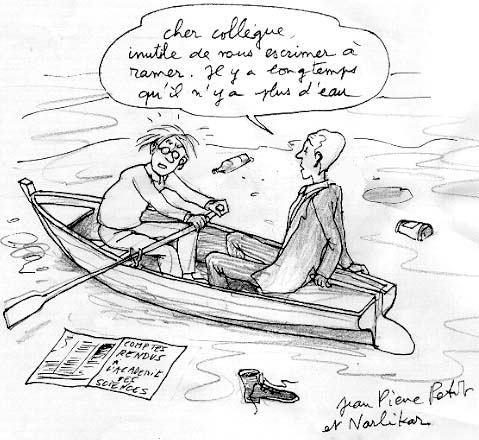
- Then, everything is hopeless... (Then, there’s no hope at all).
Publishing
I admit I’m somewhat stunned. I’d considered every possible response, except this one. I know my life has its "novel-like" aspects, but this just wrote a particularly unexpected chapter. Even the president of the IAU, the International Astronomical Union, has trouble getting published—while, at the same time, kilometers of nonsense are published daily. Souriau faces the same problems. The public doesn’t realize that, after the war, science fell under the control of anonymous factions. How to identify these people? It’s quite simple. Look at those who publish easily, in large quantities, and with little substance. They are the "referees," the experts themselves. The journals, with their selection committees, are in fact mere extensions of secret scientific lobbies. People gather, decide to form a journal, create a review. It is managed by an "editorial board," which nominally appoints the journal’s editor. Take an example from France. James Lequeux was behind the creation of the journal "Astronomy and Astrophysics," a journal with a "European scope." The CNRS, ministries, provided funding. Scientists "grouped together." The published work isn’t worthless, of course. But it merely expresses the views of a certain scientific lobby, of which Lequeux has become the "guarantor." An attitude that sometimes goes as far as cynicism and dishonesty. But nothing can be done. The system is locked down. That’s why, as Souriau often says, "science is sinking into a modern scholasticism."
Who are the "referees" of scientific journals? In principle, their anonymity guarantees "independent thinking." In practice, this allows them to block any idea that threatens the theses of their own school. All referees are researchers, without exception—something we tend to forget. These people are not paid for their work. Of course, they don’t receive only well-structured manuscripts every day. Anyone can send anything to any journal. So there are "filters." These are people who skim articles diagonally. Average time spent on the first review of an article: five to ten minutes. Criteria for analysis:
- Does this person belong to my circle? Does their work support our established views? (For example, today’s dogma of dark matter’s existence). Are they well-known? Hmm... a Frenchman! There have never been major contributions from France in cosmology. It must be another nonsense...
He flips through the pages casually. It’s full of tensors. Ah, there are groups...
He walks down the corridor and knocks on the door of the building across the way, at a friend’s office—a theoretical physicist.
*- Hey, Mike, does the coadjoint action of a group on its momentum space ring a bell?
- Never heard of it...
- Good, then my first impression was correct.*
He returns to his office and pulls up from his hard drive a standard reply:
Sorry, we don't publish speculative works.
Sorry, we do not publish speculative work.
This guy, working on superstrings, on the "Theory of Everything" (TOE), prints the response letter and moves on to the next file.
I’ve received dozens of such replies, with return mail. I’ve managed to publish occasionally, but I can say that I’ve spent ten to a hundred times more time on each publication than I did producing the work itself. This exact kind of response is what Lequeux gave me in 1997, by return mail, after I submitted an article to his journal, Astronomy and Astrophysics. But since he was in France, I called him. I argued:
- My twin model is neither more nor less speculative than the dark matter hypothesis, which is an ad hoc interpretation. My model also accounts for strong gravitational lensing effects, as manifestations of "negative lensing"—the gravitational action of geometrically invisible, repulsive twin matter on photons from our own universe. It’s simply a different interpretation of the phenomena, but I believe it deserves publication because it is fruitful. Here’s my proposal: find a tough referee, a real "Big Bad Wolf" of cosmology, and send him my paper. If he finds flaws, I’ll accept it.
Lequeux remains silent for a moment on the other end of the line. He genuinely believes my work doesn’t hold up. A man interested in UFOs couldn’t possibly produce quality research. Maybe this is a chance to put an end to it once and for all. After a pause:
- OK, let’s do it that way.
A month later, I receive a reply from a referee...