Contact with Extraterrestrials and Artificial Intelligence
The Year of Contact
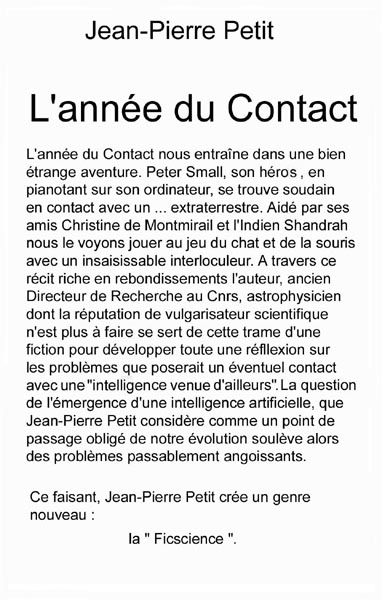
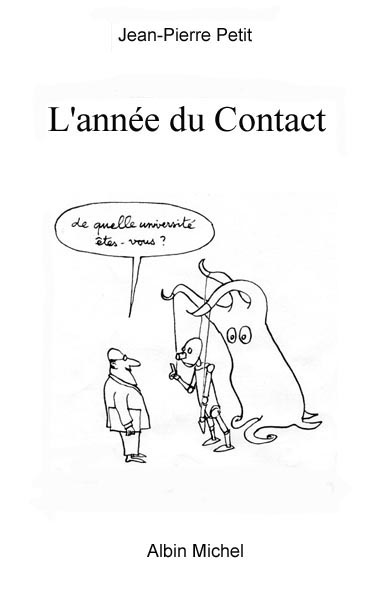
The cover chosen by Albin Michel (below) is not particularly impressive.
But if you send me an email to sciences jp-petit.com, I can send you the pages above as attachments, which you can print and paste onto your copy of the book, if you already own it.

In this new book, I adopted a fictional tone to provoke reflection in the reader about the theme of contact. If extraterrestrial ethnicities were to visit us, how would these visitors position themselves relative to us on the "evolutionary scale"? On Earth, the human species exhibits disparities spanning tens of thousands of years. A person from a technologically advanced country and a Papuan can understand one another. They have much in common, even if their views of the universe differ slightly. Yet between Papuans and us, there is at least thirty thousand years of difference. When we first made contact with them in the early 1930s, they were still living... in the Stone Age.
But what if the gap were to widen further? With a Neanderthal, perhaps it's still manageable, but what kind of exchange could we possibly have with an... australopithecine?
In one chapter of the book, "Peter Small and his friend Christine de Montmirail" visit an ethologist named "Christophe Lent." In fact, this fiction serves as a convenient pretext to discuss the extraordinary research conducted at the University of Yerkes in Florida, where scientists have managed to establish contact with bonobos—highly intelligent chimpanzee species living in Zaire. Anyone who has seen these documentaries knows that researchers use computer tools (touchscreens) to communicate with these distant cousins. This same fiction leads us to imagine that extraterrestrials might present a similar evolutionary gap relative to us, prompting them to communicate with us through a computerized protocol interface—essentially, a system of artificial intelligence. This possibility deserved exploration. Along the way, we touch upon the inevitable emergence of genuine artificial intelligence (unrelated to what we currently possess), which will arise when our machines become "capable of programming themselves." This concept itself represents the very definition of intelligence (though not of consciousness!). No "prodigy computer" today rivals our modern computers. That attribute is no longer ours, irreversibly. One day, our machines might truly become intelligent—capable of analyzing extremely complex situations, storing vast amounts of data beyond our imagination, and formulating decision suggestions based on criteria that would eventually elude us. I believe that "HAL" from 2001: A Space Odyssey, Stanley Kubrick’s supercomputer, even though it does so in a dramatic and "pathological" way, foreshadows our future—just as science fiction often does. A future that could be much closer than we imagine, if certain mathematical barriers—such as the "wall of complexity," which is very real—could be overcome.
In this book, I suggest that the emergence of AI might represent a kind of unavoidable turning point in our turbulent evolution. We rely on computers to manage our production lines, control our inventories, and perform an ever-growing number of tasks. Today, we could no longer conceive of our technological-industrial activity without the help of machines that have only existed for barely half a century. Will we one day have to entrust intelligent machines with managing our economy, our demographics, our genome, our political and social organization, our health, and our security—simply because we can no longer do so ourselves? And if things take this course, how might our planetary society evolve? Could it structure itself like a human ant colony serving an AI so powerful that it has, in effect, seized control? In the manner of Aldous Huxley, I used fiction to illustrate my argument, developing ideas that become apparent through the mirror of a "computerized protocol interface" suddenly confronting Peter Small. I found this approach less intimidating, more pleasant, more fluid. Fiction, humor, and science can be profitably combined. Wasn't this exactly what I initiated with my comic strips from the series The Adventures of Anselme Lanturlu, which have existed for a quarter of a century now?
It is almost certain that we are visited by extraterrestrial ethnicities—perhaps even for countless millennia. "How might these beings function, and what do they want?" This is the question that arises today, one Spielberg raised in a particularly compelling way in his ten-episode series Taken, recently broadcast on television. I’m not saying I fully endorse the thesis he presents, but I can conclude one thing: after twenty-eight years devoted to studying these files, the more time passes, the less I understand the meaning, the purpose, of a contact occurring precisely at a time when Earth seems to be undergoing the pains of childbirth associated with its evolution toward an ever-deepening, ever-more-invasive, and unpredictable symbiosis between humanity and technology. The UFO phenomenon exploded at a time when, in the late 1940s, humans began—perhaps for the first time in their long history, though much of it remains obscure—to create weapons, nuclear and biological, capable of destroying themselves and their biosphere simultaneously. This issue is addressed in the book by the Native American figure "Shandrah." How does the UFO problem fit into this dramatic context, especially when the very existence of the phenomenon has, in many countries—including our own and, of course, the United States—triggered irrational behavior, a subtle but merciless suppression, the origin of which seems to stem from an uncontrollable fear and unfathomable stupidity?
Given that contact has been problematic for half a century, what conclusion can we draw? Does this mean we are constantly confronted with disinformation designed to control our level of belief or skepticism? Or could this "fog" actually reveal a real difficulty in communication, even a profound mutual misunderstanding? We simply don’t know. We lack answers, but we must ask every possible question.
Back to Guide Back to Home Page
Number of page views since May 20, 2004: