Yellowstone Supervolcano
Yellowstone: What's happening?
February 13, 2005
The BBC had promised to produce a super-documentary on the problems that seem to be posed by the Yellowstone caldera. It was scheduled for late 2004. However, the Indonesian disaster caused the cancellation of the program. All this to say that we did not look into these problems "because catastrophism had become fashionable." It is a serious issue.
Let's look at the facts.
A volcano is a place on the globe where catastrophic phenomena occur more or less frequently. The flow of lava refers to the local aspect. Of course, it kills people, destroys villages, and crops, but the danger of a volcano is measured by the volume of its emissions, especially the ashes. Volcanology has made a lot of progress over the decades. Let's say that we suddenly became interested in what we called "super-volcanoes," formations whose manifestations could change the face of the planet itself. The site where the last eruption of the megavolcano Toba occurred 75,000 years ago, on the island of Sumatra, is currently occupied by a lake.
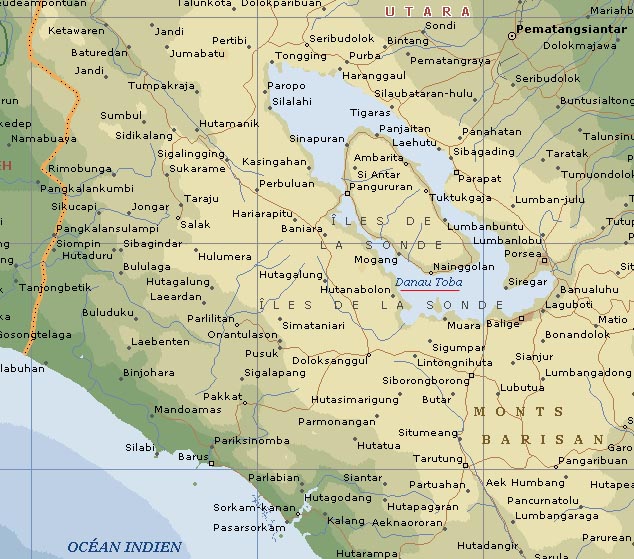
Location of the Toba volcano caldera, Sumatra
The scale of the ash emissions has been measured. The eruption of Mount St. Helens in the United States in 1980 is considered one of the most violent eruptions of the contemporary era.
It turns out that one of the regulars at this site, Frédéric Beaumont, worked on the geography of Mount St. Helens, producing the following two computer-generated images. He tells us that the top of the volcano was flattened by several hundred meters.
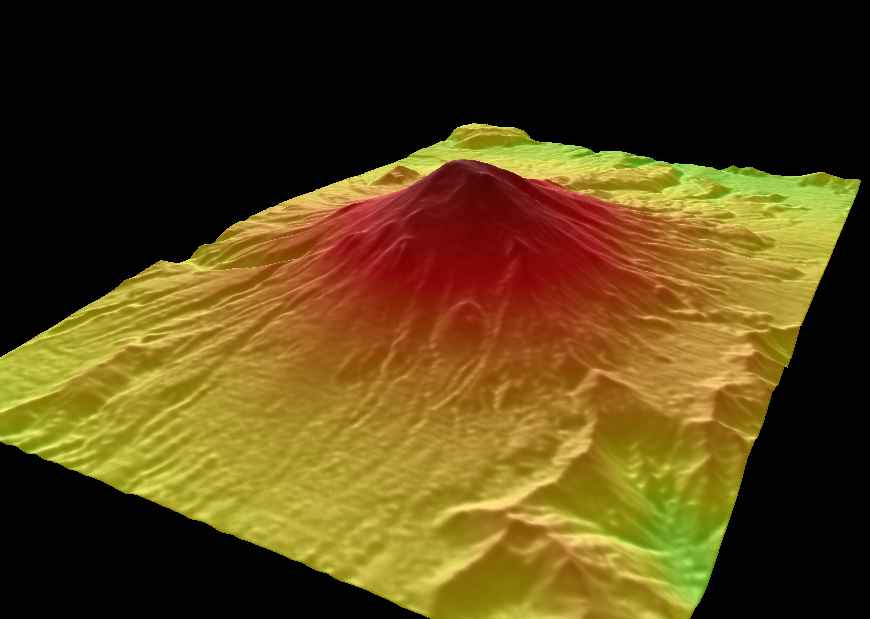
The Mount St. Helens volcano, before the eruption. Image by Frédéric Beaudemont
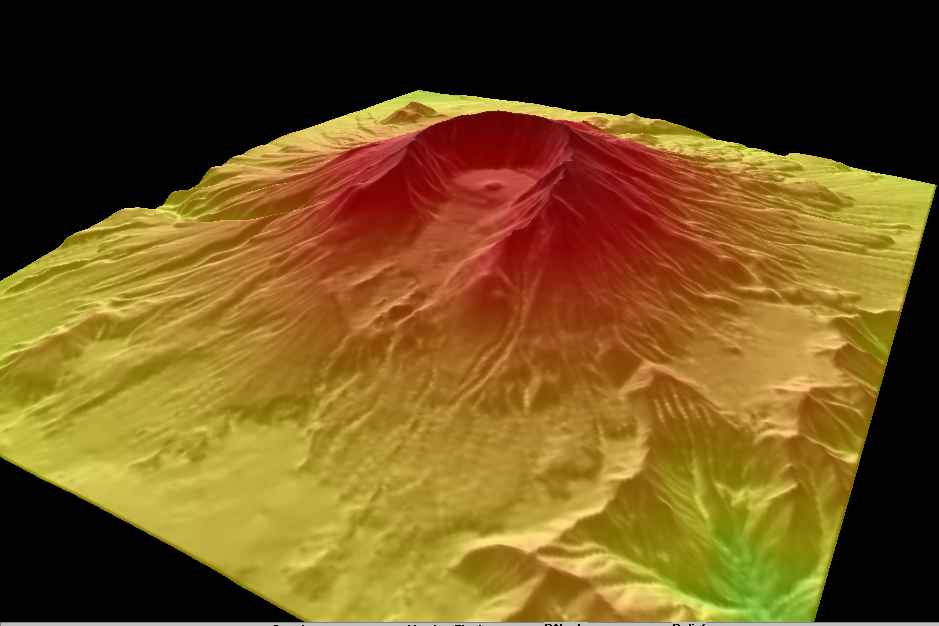
The same, after the 1980 eruption, image by Frédéric Beaudemont
An eruption of a super-volcano like Toba would represent 10,000 times the power and the volume of ashes emitted by Mount St. Helens. Therefore, these are rare phenomena, but on an entirely different scale. Such a super-eruption, aside from local damage and human losses, would cause the average global temperature to drop by 5 degrees, which is considerable.
The examination of the Yellowstone Park site showed that we were dealing with the caldera of a "super-volcano," beneath which a giant magma chamber is hidden. The examination of the environment also showed that the periodicity of its eruptions is 600,000 years. Now, the last eruption was 630,000 years ago. According to these figures, the super-volcano would therefore be 30,000 years behind schedule.
But that's not all. In 2003, the rangers decided to prohibit the public from accessing the Norris Geyser Basin. The reason: an area of 50 km by 12 had risen by a dozen centimeters since 1996. On this kind of bulge, the temperature has increased by ... 200 degrees, which is no small matter. This bulge represents the swelling of a magma chamber located 500 meters below the surface. Geologists estimate that this relief has risen by 70 cm over the last century. These changes have caused the complete decline of the flora and fauna. Animals even flee the area and have not waited for the warnings from the rangers.
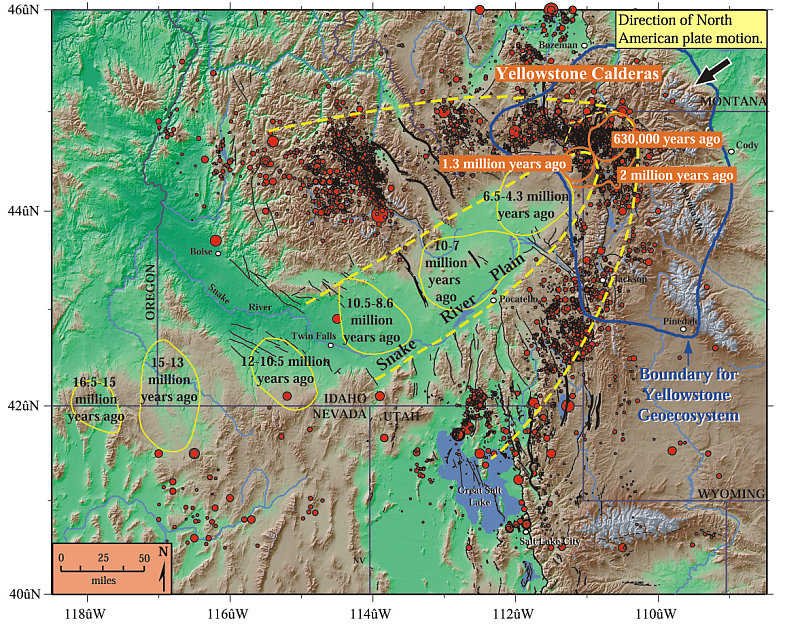
The Yellowstone region, showing the movement of the "hot spot."
The map above shows the movement, towards the southwest, of volcanic events over time. Yellowstone is located above a "hot spot," that is, the end of a rise of hot magma coming from the depths of the Earth's crust, which acts like a "blowtorch." There is a circular lake in Yellowstone. At the end of July 2004, geologists discovered that the bottom of this lake had risen by ... 30 meters. On the map below, the area where this rise in the lake bottom was observed. As for the water temperature at this location, it currently reaches 88 degrees and continues to rise. Keep in mind that the park is at a relatively high altitude. This lake is now closed to the public, and its temperature is covered with dead fish (source: The Idaho Observer). The situation is the same in the Yellowstone River as well as in the various watercourses of the region, which also carry numerous dead fish. Many picnic areas have had to be closed. In many areas of the park, visit durations are limited to just a few hours because the stench of the sulfuric upwellings has become unbearable.
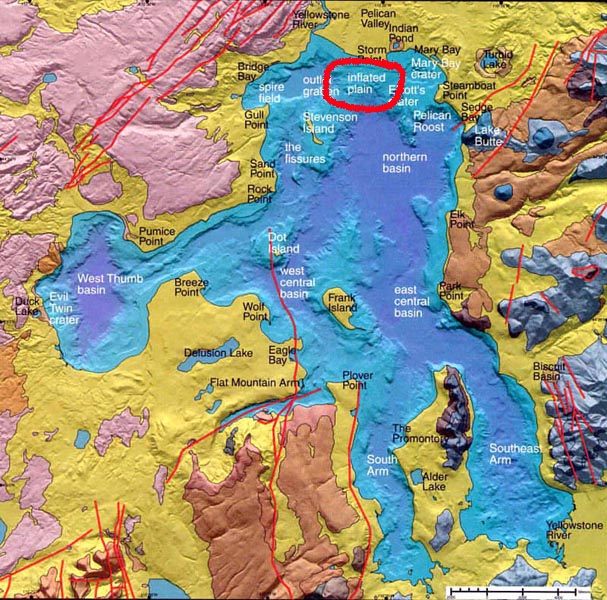
Yellowstone Lake. In red: the area where the bottom has risen by 30 meters.
The Idaho Observer is surprised that the media and the government are so silent about these various phenomena. The opinions of geologists are very conflicting. Some are reassuring, saying that an eruption could occur in 100,000 years, or even in a million years, while others insist that it could happen at any moment. One of the arguments, based on the measurement of the phenomenon's periodicity, states "we are on time" and its proponents recommend paying the greatest attention to the recently observed phenomena. They estimate that such an eruption, 2500 times more powerful than the Mount St. Helens volcano, would completely devastate the country and create a noticeable climate disturbance on a global scale. Below are the American states that would be affected by the ash fall.
&&& **Image removed because the author protested about copyright issues. Did not have time to redraw myself. **
That being said, what can be done, unless half of the United States territory is evacuated in advance?
In June 2005, television broadcast a disaster film on what could happen if the Yellowstone super-volcano woke up. In truth, the entire planet would be affected by the ash fall and by the nuclear winter phenomenon, which would cause a temperature drop between 12 and 20 degrees, plus an unimaginable series of "side" consequences. A dust cover absorbs infrared, which can no longer warm the ground. The temperature gradient then reverses. The air is warmer at altitude than on the ground. Therefore, no more updrafts. This warm air absorbs humidity. Terrible drought on the ground.
The updrafts have the effect of carrying the air from the lower layers to high altitude and causing the destruction of germs by the effect of ultraviolet rays. Without these updrafts, the lower layers of the Earth would become ... a breeding ground. In short, no one really knows the multiple consequences of a nuclear winter. All we know is that it would be catastrophic for the flora, fauna, agriculture, and meteorology. Billions of human beings would die of hunger and epidemics.
During the debate, scientists confirmed that Yellowstone was "behind" in terms of the periodicity of its eruptions and that the catastrophe remained possible, but they concluded that in that case, it was even pointless to consider remedies.
I am not...