Three and a half billion degrees and nobody cares...
3.7 billion degrees and nobody cares
July 2, 2006
On June 19, a reader posted an article on the Agoravox forum titled:
2 billion degrees. Humanity discovers absolute fire and nobody cares!
An article that sparked more than 300 reactions. Since a reader had pointed out the existence of this forum to me, I participated in it. Interested readers can find the discussions in the archive:
http://www.agoravox.fr/article.php3?id_article=10680
I am facing a blank page, wondering what to write, what tone to adopt, and at what level to position myself. It is true that faced with such a situation, one feels somewhat overwhelmed by events, or more precisely, by the ... non-events in this case.
Before returning to this subject, for those who have followed what I have said or written on my site regarding the "Z-machine" and this discovery, I will say that a journalist visited me around June 25. He left saying he would submit an article to his editor-in-chief. The reaction was immediate and simple:
- I didn't see this on AFP or TASS, nor in any news agency.
That is true. Yet three months have passed since the dissemination of this news without the press, in all countries, and news agencies reacting. It is ... staggering and ... frightening, too.
I will therefore pick up the thread of this story from the beginning, for readers who are just joining.
It all started on March 9, 2006, with news presented on the Futura-Science website
http://www.futura-sciences.com/news-z-machine-depasse-deux-milliards-degres_8419.php
This article actually stemmed from a very official announcement from the Sandia Laboratories website, located in New Mexico, USA. For those unaware, Sandia is a vast complex of laboratories working largely on weapons projects of all kinds. To clarify, two labs in the USA have, for decades, been systematically put in competition for the design of nuclear (and other) weapons:
-
Sandia
-
Los Alamos (This is where the first atomic bomb was designed, on the "mesa")
The Los Alamos website, New Mexico, United States, where the first atomic bomb was designed
Continuing to follow the thread of the story and going back in time, we find this announcement from Sandia labs, dated March 8, 2006:
http://www.sandia.gov/news-center/news-releases/index.html
Here is the announcement in question:
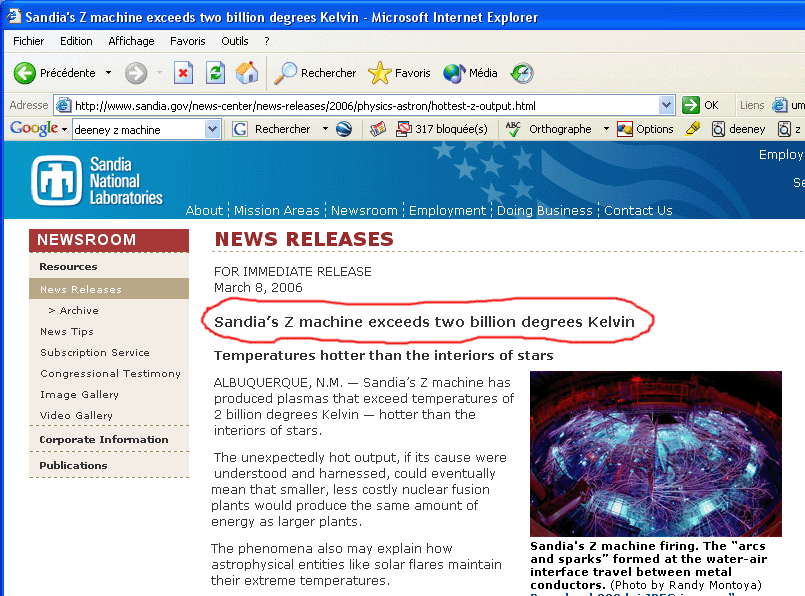
"Two billions degrees Kelvin" in English means "two billion absolute degrees"
In fact, this announcement closely follows the publication of a groundbreaking article signed by Malcolm Haines (Imperial College, London), an internationally renowned plasma physics specialist, Deeney (head of experiments on Sandia's Z-machine), and four other researchers, published in the high-level journal Physical Review Letters on February 24, 2006. The two links cited above refer only to media announcements. The key document is the cited article. Given its importance, after purchasing it, I made it downloadable on my site.
The article by Malcolm Haines, Deeney et al., in pdf
Here is its first page:
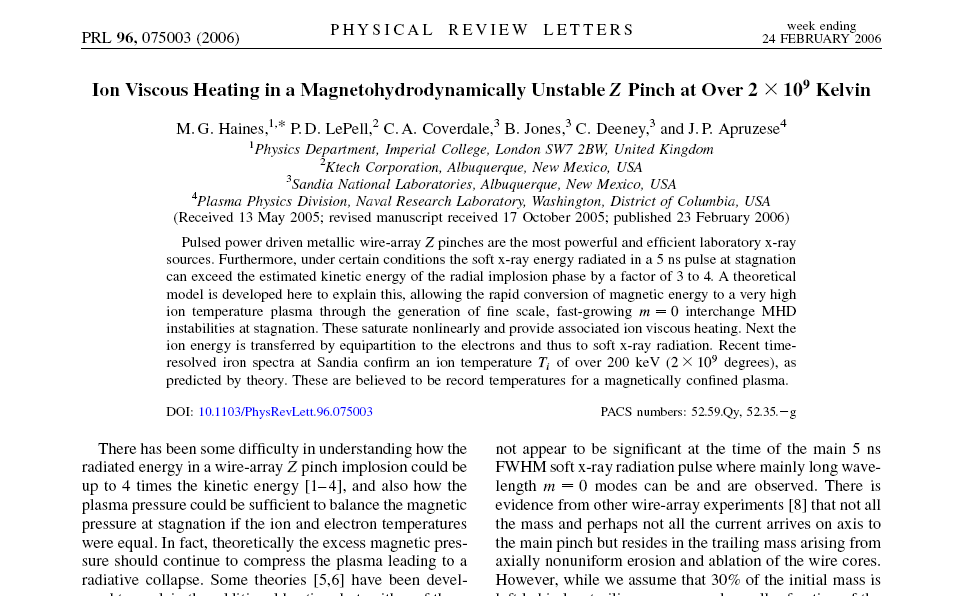
"Over 2 x 10⁹ Kelvin" means "beyond two billion Kelvin degrees"
Note the date of the article's first submission, May 13, 2005. This paper therefore refers to experimental results prior to this date.
This is, in fact, the interesting document, and I examined it closely. I conducted this analysis for scientists (and science journalists) and preceded it with a simplified summary. Scientific or "science-oriented" readers can refer to this analysis. But this page, this dossier, is intended for the widest possible audience. Those who are not scientists or "science-oriented" should skip this link.
My analysis of the Haines and Deeney paper, February 24, 2006
Before returning to generalities on fusion (neutron-generating and "a-neutronic"), on fusion in a tokamak like ITER or by "inertial confinement," etc., the subject of this dossier, which I will try to make as accessible as possible, a few words on what is essential in the mentioned paper.
-
Since 1998, plasma compression experiments had been conducted at Sandia (and in various other nuclearized countries: Russia, China, England, France, but not with such large means). The goal was, by compressing matter with electromagnetic forces (this will be discussed later), to heat it and thus make it emit X-rays. The Z-machine and all machines of this kind were not originally designed to aim for fusion. They were simply powerful X-ray sources, 100% military use, the goal being to test the resistance of warheads to the intense X-ray flux from an atomic bomb exploding in space, the bomb being the key element of anti-missile weapons whose purpose is to destroy the delicate guidance and firing systems of bombs through this intense irradiation. Since 1998, experiments conducted at Sandia showed that the ion temperature must be abnormally high. But it was not measured. What was measured, from the X-ray emission, was the electron temperature. The ion temperature was inferred. We will see later how. Strangely, these experiments led to ion temperatures that had to be much higher, and by far, than the electron temperature (a hundred times!). "Bi-temperature" systems, you have ... in your kitchen. They are ... neon tubes. Neon ions (neon atoms that have lost electrons) are cold, at ordinary temperature. You can put your hand on the tube without burning yourself. On the other hand, the electrons are at thousands of degrees (we will return to this later). In the Sandia experiments, things could only be explained if the "ion gas" was much hotter than the electron gas.
-
In 2005, researchers working on the Z-machine were able to perform direct measurements of this ion temperature, described in the paper by Haines, Deeney et al. They confirmed what had previously been calculated. This temperature, as the title indicates, is "beyond 2 billion Kelvin degrees." But if one delves into the paper (and into the analysis I made of it, at two levels), one sees that this temperature increases during the measurements and actually goes from 2.66 billion degrees to 3.77 billion degrees. These measurements are 100% reliable (temperature measurement by measuring line broadening via the Doppler effect is a classic of physics and astrophysics in particular. Artifacts are to be excluded).
-
Incidentally, Haines and his colleagues (he is a theorist) question the mechanism that would ensure such heating of the ions. He invokes MHD instabilities. We will take all this up again later.
The content of the debates showed that for the vast majority of readers and participants, fusion was reduced to the mixing of the two hydrogen isotopes
Deuterium + Tritium yielding Helium plus a neutron representing an energy of 14 MeV (mega-electron-volts)
See for example the Wikipedia dossier:
http://fr.wikipedia.org/wiki/Fusion_nucl%C3%A9aire
In this, one will find only a single illustration of a fusion diagram:

Diagram of the fusion of the two hydrogen isotopes, deuterium and tritium, at one hundred million degrees
We see that it is the neutron that carries the most energy: four times more than the produced helium nucleus.
Readers must now engrave other fusion diagrams in their minds.
Starting from 500 million degrees, that of lithium and hydrogen (light):

"A-neutronic" Lithium-Hydrogen fusion
Starting from one billion degrees, that of boron and hydrogen (light):

"A-neutronic" Boron-Hydrogen fusion
A-neutronic because no neutrons. It is these neutrons, emitted at relativistic speed, that cause tokamaks (ITER is a tokamak) to generate radioactivity by "activating" surrounding structures. These neutrons, moreover, cannot be stopped by "magnetic confinement." Nothing stops them, except physical obstacles. As Nobel laureate de Gennes pointed out, they will prove extremely aggressive towards the structure of the superconducting magnet that ensures confinement, which costs a fortune and cannot be periodically replaced.
The energy is simply carried by helium nuclei, plain old helium. Where is the radioactivity? There is none. Where are the "nuclear waste"? Answer: helium. You could live next to an a-neutronic fusion plant. Either it would release its helium through chimneys, in which case the gas would rise. Helium is light. Or it would be recovered to inflate balloons, cheaply. For the moment, helium is ruinous. There one could imagine vehicles in the form of helium-filled balloons, propelled by solar energy, for example. Unless these aircraft, or these vehicles, operate with miniaturized a-neutronic fusion electrical generators.
We must now answer the questions that readers are legitimately asking. What is temperature?
We will define the absolute temperature T of a gas. I specify that this is its definition. A gas is a set of particles having a mass m. Particles that are agitated in all directions. This movement is called thermal agitation. The air you breathe consists of molecules that, on average, travel at 400 meters per second. This is an average value. There are faster and slower ones, but we do not make a big mistake by imagining them all circulating at the same speed. Why do these air molecules not tear your alveoli? Because they are objects of very low mass. An air molecule at full speed would not harm a fly. There you go, do you feel it?
In a tokamak, the absolute temperature is 100 million degrees. Hydrogen nuclei travel at nearly one thousand kilometers per second. This is their thermal agitation speed. For apprentice physicists, see the box opposite:


All physicists
Definition of absolute temperature in a gas:
k is a constant called the Boltzmann constant and equals
k = 1.38 10
We are going to do high physics. The mass of a hydrogen atom, of a proton, is:
m = 1.67 10
kilos
Let's enter a tokamak. Temperature (as long as it works): 100 million absolute degrees. Content
- Deuterium. Nucleus mass: 3.34 10
kilos
- Tritium. Nucleus mass: 5 10
kilos
Half-half. Average nucleus mass. 4.17 10
kilos
With an absolute temperature of one hundred million Kelvin degrees, the average thermal agitation speed of these nuclei is:
A fraction, powers of ten, a square root. You already have more than half of physics within reach of your neurons. Now, what is in a tokamak is a mixture of nuclei with a positive charge and electrons, with a negative charge. The medium is collisional. This means that ions and electrons exchange a lot of energy with each other. We can say that the content of the tokamak is a mixture of two gases:
- The ion gas, of heavy hydrogen nuclei with an average mass of 4.17 10
kilos
- The "electron gas," consisting of particles with a mass of 0.9 10-30 kilos
Collisions tend to establish a state of thermodynamic equilibrium. This means that if the medium is a mixture of different species, they are all at the same temperature. They have the same absolute temperature: here one hundred million degrees. But what is the electron temperature, the temperature of the "electron gas"? It is defined in the same way.
The Boltzmann constant does not change. If the two gases that "cohabit" are in a state of "thermodynamic equilibrium," then the temperatures are equal. This means that the average kinetic energies (of thermal agitation) are equal.
Since electrons are lighter, they are faster, but we are not yet relativistic, far from it.
All physicists
:
D
efinition of absolute temperature in a gas:
k is a constant called the Boltzmann constant and equals
k = 1.38 10
-23
W
e are going to do high physics. The mass of a hydrogen atom, of a proton, is:
m = 1.67 10
-27
kilos
Let's enter a tokamak. Temperature (as long as it works): 100 million absolute degrees. Content
- Deuterium. Nucleus mass: 3.34 10
-27
kilos
- Tritium. Nucleus mass: 5 10
-27
kilos
Half-half. Average nucleus mass. 4.17 10
-27
kilos
With an absolute temperature of one hundred million Kelvin degrees, the average thermal agitation speed of these nuclei is:
A fraction, powers of ten, a square root. You already have more than half of physics within reach of your neurons. Now, what is in a tokamak is a mixture of nuclei with a positive charge and electrons, with a negative charge. The medium is collisional. This means that ions and electrons exchange a lot of energy with each other. We can say that the content of the tokamak is a mixture of two gases:
- The ion gas, of heavy hydrogen nuclei with an average mass of 4.17 10
-27
kilos
- The "electron gas," consisting of particles with a mass of 0.9 10-30 kilos
Collisions tend to establish a state of thermodynamic equilibrium. This means that if the medium is a mixture of different species, they are all at the same temperature. They have the same absolute temperature: here one hundred million degrees. But what is the electron temperature, the temperature of the "electron gas"? It is defined in the same way.
The Boltzmann constant does not change. If the two gases that "cohabit" are in a state of "thermodynamic equilibrium," then the temperatures are equal. This means that the average kinetic energies (of thermal agitation) are equal.
Since electrons are lighter, they are faster, but we are not yet relativistic, far from it.
Bringing a gaseous medium to high temperature means increasing the thermal agitation speed of the ions. In a lithium plasma at 500,000°K, the thermal agitation speed of lithium nuclei is 1,330 km/s. In a boron plasma at one billion degrees, it is 1,516 km/s.
Details of the calculation in the box:

Lithium at 500,000°K
emperature in a gas:
k is a constant called the Boltzmann constant and equals
k = 1.38 10
Thermal agitation speed in a gas at an absolute temperature T:
- Mass of a lithium nucleus: 7 times the mass of the nucleon (proton and neutron), i.e.:
1.67 10
kilos = 1.17 10
kilos
This gives us a thermal agitation speed of:
1,330 km/s
Boron at one billion °K
Thermal agitation speed in a gas at an absolute temperature T:
- Mass of a lithium nucleus: 11 times the mass of the nucleon (proton and neutron), i.e.:
1.67 10
kilos = 1.83 10
kilos
This gives us a thermal agitation speed of:
1,516 km/s
Don't you think things are a bit clearer?
Lithium at 500,000°K
:
T
emperature in a gas:
k is a constant called the Boltzmann constant and equals
k = 1.38 10
-23
T
hermal agitation speed in a gas at an absolute temperature T:
- Mass of a lithium nucleus: 7 times the mass of the nucleon (proton and neutron), i.e.:
7
x
1.67 10
-27
kilos = 1.17 10
-26
kilos
This gives us a thermal agitation speed of:
1,330 km/s
Boron at one billion °K
:
T
hermal agitation speed in a gas at an absolute temperature T:
- Mass of a lithium nucleus: 11 times the mass of the nucleon (proton and neutron), i.e.:
11
x
1.67 10
-27
kilos = 1.83 10
-26
kilos
This gives us a thermal agitation speed of:
1,516 km/s
Don't you think things are a bit clearer?
But how to create these thermal agitation speeds? Well, if I managed to implode a plasma and the implosion speed reached these values, this kinetic energy would transform into thermal agitation speed. It's quite simple. Energy must be conserved. This will happen if there are not too many radiative losses during the process.
The atoms will crash into each other. Collisions will redistribute this kinetic energy in all directions. In any case, an implosion process will heat the medium. But will this temperature be maintained long enough for fusion to occur?
What does "long enough" mean?
Good question. And this leads us to reflect on the conditions under which fusion reactions can be created. We will therefore talk about the Lawson criterion. It is a big word to designate something that is, all in all, quite simple and intuitive. They say you can't make an omelet without breaking eggs. Imagine you wanted to break eggs of mass m (I don't know how much an egg weighs, but it doesn't matter). Let's imagine we have a chamber where eggs roll and collide. For a collision between two of these eggs to cause a break, it requires:
-
That these eggs actually collide
-
That their relative speed is sufficient to cause the shells to break.
Let M be the mass of the eggs. Someone might perhaps conduct the experiment (interesting, indeed) to determine what the speed of two colliding eggs must be to get a start on an omelet. Let's call this speed V. If this speed is an agitation speed of the eggs, it can be assimilated to a thermal agitation speed. If the speed is not sufficient, the shell will resist even a head-on collision. Now, who says thermal agitation speed says temperature. Replace the eggs with nuclei and the shell break with a fusion reaction. There will be fusion if the medium's temperature exceeds a certain threshold. For a deuterium-tritium mixture, this minimum temperature is 100 million degrees. In fact, for deuterium and tritium to fuse, these nuclei must be able to approach close enough for the "fusion reaction" to occur. What prevents them from approaching is the fact that, both having positive charges, they repel each other due to the electrostatic force.
We saw earlier that this thermal agitation speed, and thus collision speed, associated with a hydrogen nucleus temperature of 100 million degrees, was nearly 1,000 km/s. To fuse lithium and hydrogen, one must bring a proton carrying an electric charge and a lithium nucleus carrying three close together. The work to be done is greater. Therefore, the fusion temperature will be higher: 500 million degrees. And this will be even more so with a boron nucleus (5 unit charges) and a proton (ordinary hydrogen nucleus). It turns out that this temperature is then one billion degrees.
These fusion temperatures: 100 million degrees, 500 million, one billion, may seem surreal, but things seem more tangible if we reason in terms of thermal agitation speeds:
1,000 km/s 1,300 km/s 1,500 km/s
The fact that the components reach these agitation speeds is a necessary but not sufficient condition.
These agitation speeds are