The mystery of the Sandia Z machine
The Sandia Z machine (New Mexico)
Clean fusion without pollution or radioactivity:
Within reach!
| As a reader pointed out to me, obsessed by the fusion reaction of the two isotopes of heavy hydrogen, deuterium and tritium, very few people know that at higher temperatures there are fusion reactions (Lithium-hydrogen at 500 million degrees and Boron-hydrogen at one billion degrees) which produce only helium and generate no radioactivity or waste! With the Z-machine (two billion degrees), these temperatures have just been greatly exceeded |
|---|
| As a reader pointed out to me, obsessed by the fusion reaction of the two isotopes of heavy hydrogen, deuterium and tritium, very few people know that at higher temperatures there are fusion reactions (Lithium-hydrogen at 500 million degrees and Boron-hydrogen at one billion degrees) which produce only helium and generate no radioactivity or waste! With the Z-machine (two billion degrees), these temperatures have just been greatly exceeded |
|---|
Reported by a reader, a good recent article in Wikipedia
http://fr.wikipedia.org/wiki/Z_machin
May 26, 2006
****May 30: the absence of reaction in the civil sector
We need to take this whole matter again. In France, the echoes were almost non-existent, except for a few lines in Science et Vie and Science et Avenir. The start was given on the site http://www.futura-sciences.com. Complete radio silence in the mainstream press. Nothing in "Le Monde des Sciences".
Let's go back to the facts. In Google, type:
deeney z machine
Chris Deeney is the person in charge of the experiment carried out at Sandia (New Mexico) following work initiated by Gerold Yonas more than thirty years ago (electron beam fusion, see Pour la Science, January 1979). With this Google search, you can find various things, but the most reliable is to immediately target the first-hand information initially provided by the Sandia labs' communication service. You will find the thread leading to this information release from the Sandia communication service at the following address:
http://www.sandia.gov/news-center/news-releases/index.html
This leads us to this:
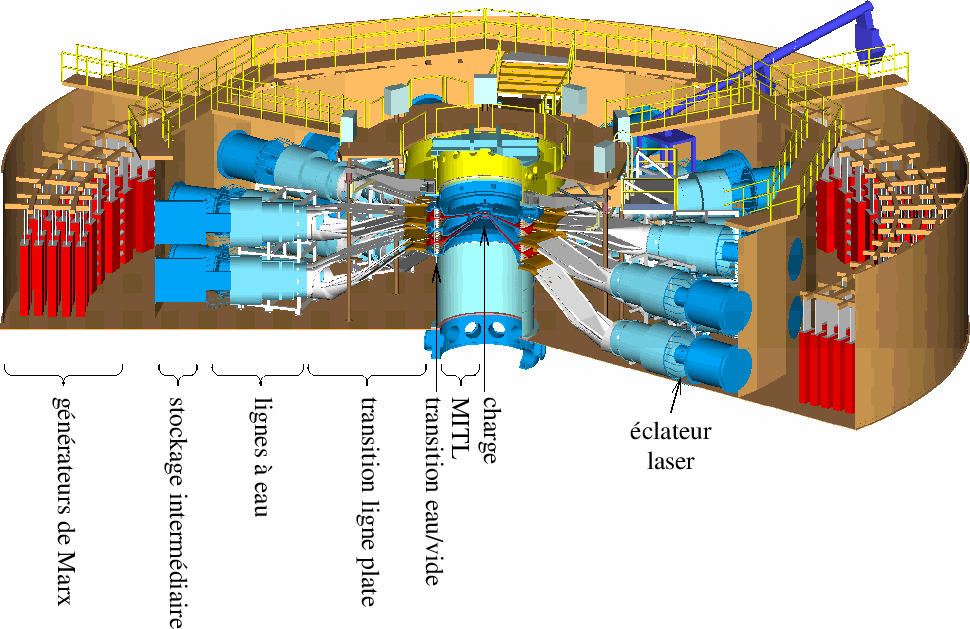
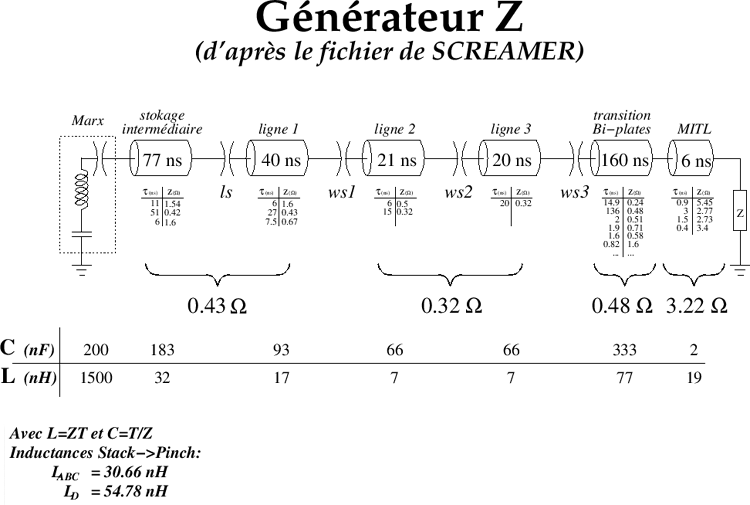
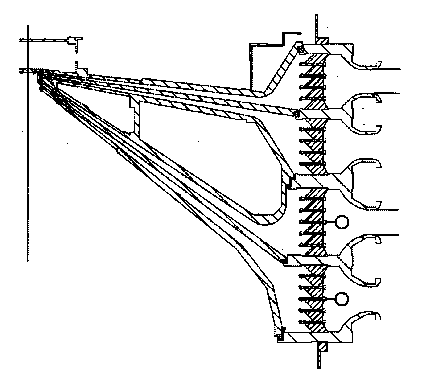
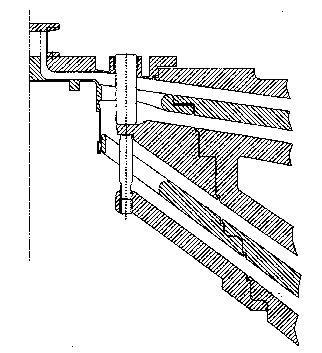
The times represent the transit times in the different elements, which themselves are composed of sub-elements whose characteristics (transit time, impedance) are given in the small tables associated. The switches are either triggered by laser (ls switch in the diagram), or self-triggered and in water (ws water switches in the diagram). The table extending along the entire length of the diagram (from the Marx generators to the load) below the line elements gives their equivalent capacities and inductances.
Z magnetic insulation lines
The Marx generators store
11.4 megajoules
of electrical energy, and provide
4.5 megajoules
to the output of a set of water lines that compresses the pulse (discharge time of a capacitor) into a pulse of
105 nanoseconds
. The output of the stage formed by the cascade of water lines, separated by switches, feeds the magnetic insulation lines via a water/vacuum interface. This interface, of diameter, opens into four cones (note the transition from separate lines to a geometry with rotational symmetry) stacked, magnetic insulation lines.
Standard Z convolute
These instrumented lines define four levels, named A, B, C, D. A convolute, represented in the figure above, then sums the currents of the different levels, trying to minimize losses.
The load can then be powered by a pulse of 10 to 20 Mega-amps for a typical z-pinch load (i.e., 2 cm long, 2 cm initial radius with a mass of 4 mg), lasting 105 nanoseconds. The electrical power provided is close to 40 terawatts for such a load.
The times represent the transit times in the different elements, which themselves are composed of sub-elements whose characteristics (transit time, impedance) are given in the small tables associated. The switches are either triggered by laser (ls switch in the diagram), or self-triggered and in water (ws water switches in the diagram). The table extending along the entire length of the diagram (from the Marx generators to the load) below the line elements gives their equivalent capacities and inductances.
Z magnetic insulation lines
The Marx generators store
11.4 megajoules
of electrical energy, and provide
4.5 megajoules
to the output of a set of water lines that compresses the pulse (discharge time of a capacitor) into a pulse of
105 nanoseconds
. The output of the stage formed by the cascade of water lines, separated by switches, feeds the magnetic insulation lines via a water/vacuum interface. This interface, of diameter, opens into four cones (note the transition from separate lines to a geometry with rotational symmetry) stacked, magnetic insulation lines.
Standard Z convolute
These instrumented lines define four levels, named A, B, C, D. A convolute, represented in the figure above, then sums the currents of the different levels, trying to minimize losses.
The load can then be powered by a pulse of 10 to 20 Mega-amps for a typical z-pinch load (i.e., 2 cm long, 2 cm initial radius with a mass of 4 mg), lasting 105 nanoseconds. The electrical power provided is close to 40 terawatts for such a load.
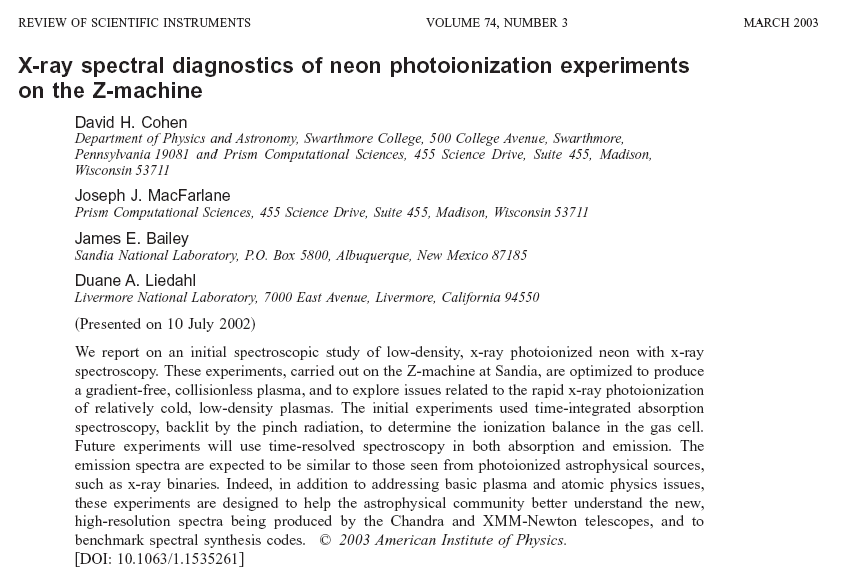
For diagnostics, we rely on the rapid neon cell photoionization:
Yes, you read that right. Billion means billion. Do your own investigation. You will find a whole series of communications from the Sandia services. Until now, there was nothing to get excited about. The temperatures were rising slowly. In the paper:
http://www.sandia.gov/LabNews/LN06-04-99/zmachine_story.html
dated June 4, 1999, it reads:
Sandia researchers Chris Deeney (1644), Christine Coverdale (15344), and Victor Harper-Slaboszewicz (15344) pushed the Z machine to new limits last month when they used the world's most powerful X-ray source to test effects of radiation on materials in experiments designed
to mimic the response that would occur near a nuclear explosion
Sandia researchers Chris Deeney (1644), Christine Coverdale (15344), and Victor Harper-Slaboszewicz (15344) pushed the Z machine to new limits last month when they used the world's most powerful X-ray source to test effects of radiation on materials in experiments designed
to mimic the response that would occur near a nuclear explosion
In short, the Sandia experiment is intended to simulate ("mimic") the X-ray burst emitted by a nuclear explosion. At this stage, it is simply a "X-ray source"
During their experiments, the Z machine generated more than 100 kJ of X-rays (kJ stands for kilojoules, a measure of radiated energy) at 4.8 keV (keV for kilo-electron-volt, a unit used to measure the color spectrum of X-rays). This amount of radiated energy adds significant capability for doing weapons effects experiments; other sources at this X-ray energy have produced only 10 kJ.
"We are excited that we've reached this milestone," Chris says. "The loss of underground tests limited testing capabilities, but this is the closest to the 'real thing' we've ever achieved with Z-pinches."
Chris, Christine, and Victor, working with Mark Hedemann, Bill Barrett, and Brett Bedeaux (all of 15344), have been using the Z machine and other sources to determine how materials -- in this case candidate materials for a neutron generator -- respond when exposed to high levels of radiation. When a nuclear weapon detonates, it produces high levels of radiation, which can cause failure in both nearby and distant systems. To prevent failure, weapon components and subsystems designed and built by Sandia must be certified at radiation levels determined by mission need. Testing materials at high radiation doses and dose rates, coupled with advanced computer calculations, is a major step in selecting materials for weapon components.
Information compiled from the Z machine experiments will be used to validate computer modeling. Chris says computer models are being relied on more and more for certification of components through the Accelerated Strategic Computing Initiative (ASCI) Program because appropriate testing environments are not always available.
"If our findings are close to the computer modeling of the same event, it means the modeling is on track, giving us more confidence in what the model is telling us for regimes that we can't test," Chris says.
Since 1992, when full-scale nuclear testing in the United States was halted, scientists have been developing new ways to verify weapons' reliability without actually detonating them. Working at aboveground simulators like Sandia's Saturn and Z, scientists have developed X-ray sources that can be used for testing materials and parts. The powerful Z machine, in particular, has allowed for tests in a more realistic physics regime than was previously possible.
These recent experiments were a collaborative effort, not just within Sandia, but within the nuclear weapons community, Chris says. The X-ray source development experiments on Z were sponsored by Ralph Schneider at the Defense Threat Reduction Agency (DTRA) in order to enhance unique testing capabilities within the nuclear weapons community, especially for DoD areas of interest. Victor Harper-Slaboszewicz and Bill Barrett have taken advantage of this source development to collect data for Sandia's component development and certification programs.
The Z machine is a pulsed power accelerator consisting of capacitors that, like large batteries, are charged with electricity for more than a minute. The electricity is released in 100 billionths of a second, resulting in a 50-trillion-watt, 18-million-amp pulse. This pulse converges on an array of wires, called the load, creating a plasma. This plasma collapses down onto the axis in what is known as a "Z-pinch" and radiates X-rays.
Christine says that another milestone reached in this most recent testing with the Z machine is that the researchers used a "nested" wire technique for the wire load.
This technique was developed theoretically by Melissa Douglas (1644) and others at the Naval Research Laboratory and in France.
In previous experiments using titanium wire arrays, the researchers always tested with a single titanium wire array of up to 160 wires. This time they nestled a second array of 48 to 70 titanium wires within the first array of 96 to 140 wires, providing more stability as the wires imploded onto the axis. This added stability improves the quality of the Z-pinch and enhances the utility of the emitted radiation.
Nested wire arrays have been successfully used before on Z, but only with wires made of tungsten. Those experiments produced hundreds of terawatts of X-rays to support the inertial confinement fusion program. Chris and Christine used titanium in their radiation testing experiments because they provide a higher-power and higher-energy X-ray source.
As part of these tests, candidate materials for neutron generators were placed at various distances from the source, usually one-and-a-half to four feet. Using diagnostics to determine how much stress was produced at each distance, and by examining the materials after the X-ray burst, the researchers can see the effects of the radiation.
"We are specifically looking for damage in the materials, checking to see if the radiation causes damage, and the type of damage. For example, we want to know if the material flakes, cracks, or breaks apart," Christine says. "Testing on the Z machine provides us with a valuable tool in figuring out what materials will survive high radiation exposures."
Sandia researchers Chris Deeney, Christine Coverdale and Victor Harper-Slaboszewicz have pushed the Z machine to new limits these past months, as a powerful X-ray source intended to test the resistance of materials exposed to the strong irradiation from nuclear explosions.
During these experiments, the Sandia machine delivered 100 kilojoules of energy at 4.8 keV (kilo-electron volts).
The commentator continues by emphasizing the "simple X-ray source" aspect.
This amount of energy is significant. Indeed, this source delivered 100 kilojoules, whereas previously only 10 kilojoules had been obtained.
Deeney says he is "very excited," because "these experiments are beginning to approach the flux obtained during underground nuclear tests." The text explains how important it is to test the resistance of materials exposed to these high X-ray fluxes. Everyone then celebrates the fact that the experiments confirm the computer simulations and therefore "the path taken was correct." It is specified that this program started in 1992. Further down, you will find, excerpt from the 1999 Pour la Science article, the photo of the first system created in the USA, at the Harry Diamond military laboratory near Washington, to test the resistance of warheads to the radiation emitted by the explosions of anti-ballistic missile warheads.
The text specifies that the Z-machine is based on a system of capacitors, which are charged in one minute. The energy is then delivered in 100 nanoseconds (a tenth of a microsecond) with a power of 50 terawatts and an electrical intensity of 18 million amperes. The pulse is sent to a system of wires, forming the load, which turns into a plasma, which implodes along the axis, forming what is called a "Z pinch" machine.
A glance at the text in red:
this technique, theoretically developed by Melissa Douglas and her colleagues at the American Naval Research Laboratory
and ... in France ( * ).
Initially, an arrangement of 160 titanium wires was used. Then, a second system with two wire devices, concentric, was used, providing better stability during the implosion along the axis of the system ( see below ).
This new system (nested array) with two sets of wires arranged on a cylindrical surface, arranged concentrically, ensures better efficiency for this "Z pinch machine" (where a plasma is concentrated along the OZ axis of the system).
This setup with multiple sets of wires had previously been used with tungsten wires (with a high melting point).
These experiments produced hundreds of terawatts ( I suppose it refers to peak power ). These experiments are part of the framework of the inertial confinement fusion program ( evocation of the Yonas program started in the 1970s ). Chris and Christine used titanium because this material can behave as a powerful X-ray source.
As part of these experiments, materials to be tested, neutron generators, were placed at different distances ranging from one and a half to four feet. The researchers then looked for the destructive effects of the X-rays produced on these devices.
Thus, we find the purpose of the experiment, created as an X-ray source to test the resistance of nuclear warheads against anti-missile systems.
We specifically look for the damage caused on these devices as well as the type of deterioration they undergo. For example, we want to know if these materials flake, crack, or break into pieces.
And Christine adds:
These tests using the Z-machine constitute a very convenient tool for knowing how materials can withstand high exposure to radiation.
( * ) In France, studies were conducted at the DAM (Division of Military Applications), but received little support because this field was overshadowing the two "cathedrals for engineers" that are the Megajoule project and the ITER project.
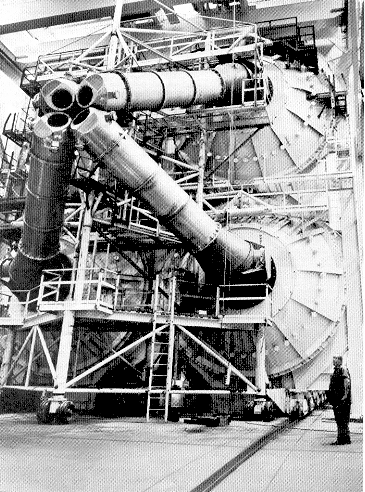
| The ancestor: the "Aurora" system photographed in 1976 at the Harry Diamond military laboratory near Washington. This source, which reached 20 terawatts at the time, operated at ten million volts and created pulses of 100 nanoseconds. But it was stated "Aurora was not usable for fusion". |
|---|
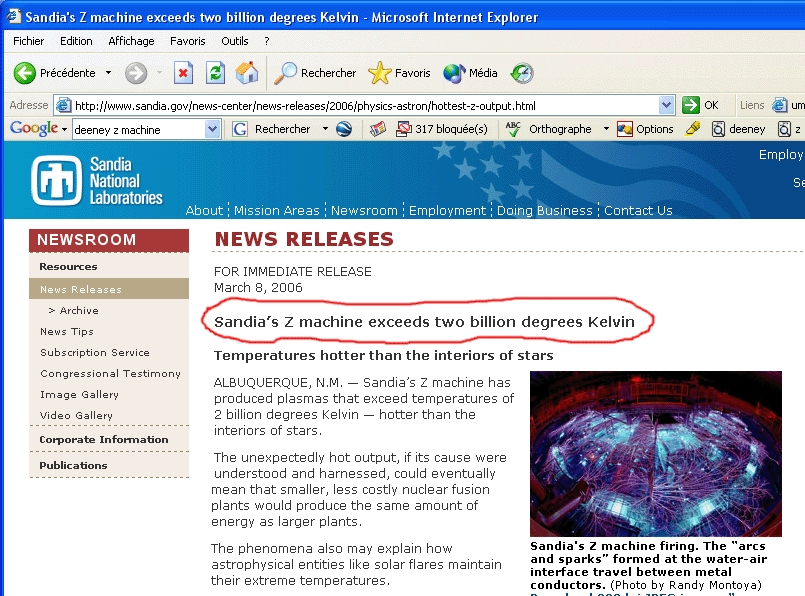
There, go back to the top of the page and read the news released by the Sandia laboratories on March 8, 2006. Let's translate:
http://www.jp-petit.com/science/ couronne_solaire/couronne_solaire.htm** ** ****
SANDIA NATIONAL LABORATORIES.
For immediate release.
The Sandia Z machine has exceeded two billion degrees Kelvin
Albuquerque, New Mexico. The Sandia Z machine has produced plasmas whose temperature has exceeded two billion degrees Kelvin, a temperature higher than that found in the core of stars (20 million degrees at the center of the sun)
This unexpected flow of energy, if its cause could be explained and if all this could be exploited, could mean that machines using fusion energy, smaller and less expensive (than the problematic ITER) could one day produce as much energy as larger installations.
This phenomenon could also explain how astrophysical entities such as solar flares manage to maintain such high temperatures. (I have another explanation: but let's move on)
The very high emission of radiation could also provide experimental confirmation to validate the codes used to ensure the safety and status of nuclear weapon stocks, which was the main mission of the Z machine (in short: the commentator does not seem to realize that the temperature obtained makes this Z machine much more than an X-ray source intended to test the "hardness" of warheads against anti-missile systems!).
At first, they did not want to believe it, said the project leader Chris Deeney. They repeated the experiment many times to make sure it was a real result and not a mistake.
These results, recorded by spectrometers, were confirmed by numerical simulations carried out by Apruzese and his colleagues at the Naval Research Laboratory.
Malcom Haines, well known for his work on Z-pinches at the Imperial College, commented on this experiment by providing a possible explanation of the observed phenomenon, in an article published in the February 24 issue of Physical Review Letters.
Sandia is a laboratory under the United States National Security Administration.
What happened and why?
"The Z energy" emitted during these experiments raises a number of questions.
First, the energy emitted in the form of X-rays proved to be four times higher than the energy injected.
Normally, when nuclear reactions are absent, the energy emitted is lower and not higher than the total energy supplied to the system. There is therefore additional energy. But where does it come from?
Second point, which is not trivial: the temperature of the ions remained after the plasma reached its maximum compression state. In these conditions, the ions having lost all their kinetic energy and re-emitted this energy in the form of radiation, the temperature should have normally decreased, unless these ions could benefit from an unknown energy source.
Normally, the Sandia machine works as follows: twenty million amperes pass through a core made up of tungsten wires the size of a hair. This core is the size of a spool of thread. The wires are instantly vaporized and turn into plasma, an ensemble of electrically charged particles.
This plasma contracts due to the action of the magnetic field caused by this strong current and is compressed into an object the size of a pencil lead (according to Haines' paper, 1.5 mm). This contraction occurs at the speed at which an airplane would travel from New York to San Francisco in a few seconds (on the order of 1000 km/s or 10^6 m/s. For a system of 1.5 cm radius, this corresponds to a time of 1.5 x 10^-8 seconds, or fifteen nanoseconds).
At this moment, the ions and electrons have nowhere to escape. Like fast cars colliding with a brick wall, they suddenly stop, releasing their energy (kinetic) in the form of X-rays that reach temperatures of several million degrees, those corresponding to solar flares.
By replacing tungsten with steel. By going from a device composed of tungsten wires measuring approximately 20 mm in diameter to an assembly of steel wires arranged at distances ranging from 27.5 mm to 40 mm from the axis, the temperature rose to two billion degrees. It is possible that the explanation is related to the higher kinetic energy gained over a longer distance (40 mm instead of 10 mm). We chose steel to obtain precise measurements, by spectroscopy, impossible to achieve with tungsten.
The explanation suggested by Malcom Haines is that an unexpected MHD instability would have allowed the conversion of part of the magnetic energy into thermal energy, increasing the temperature of the ions, at the moment when the plasma "stagnates" along the axis of the system, at zero velocity.
In principle, the plasma cord should have completely collapsed, while its energy would have been dissipated by X-ray emission. But during a time of approximately 10 nanoseconds, an unknown energy increased the temperature and pressure in the plasma cord, allowing it to resist the compressive effect of the magnetic pressure.
Haines supposes that microturbulences would increase the temperature of the ions, while they are trapped by the effect of the external magnetic pressure. These turbulences are comparable to "jolts" (jolt) which, when converted into thermal agitation energy, would explain the observed temperature increase. The mixture of electrons and ions would then be the site of a viscous dissipative phenomenon, occurring even though these elements would be expected to have lost all energy (exhausted).
(I have read the article and I cannot say that I found Haines' arguments convincing)
Until now, we had only considered that the temperature rise observed in the plasma was due to the conversion of the incident kinetic energy into thermal energy and not attributable to the effect of MHD microturbulences.
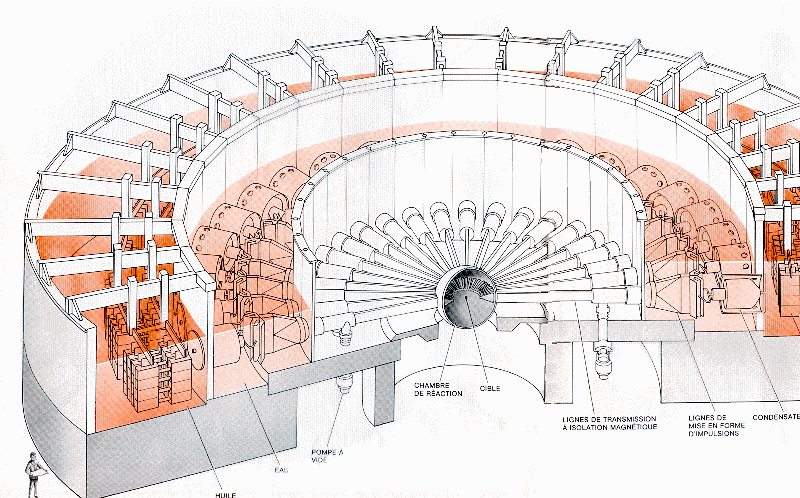
The Z-machine is installed in a building shaped like a camembert, the shape and size of an old university gymnasium.
This work has immediately led to other works, whether at Sandia or at the University of Reno, in Nevada.
SANDIA NATIONAL LABORATORIES.
For immediate release.
The Sandia Z machine has exceeded two billion degrees Kelvin
Albuquerque, New Mexico. The Sandia Z machine has produced plasmas whose temperature has exceeded two billion degrees Kelvin, a temperature higher than that found in the core of stars (20 million degrees at the center of the sun)
This unexpected flow of energy, if its cause could be explained and if all this could be exploited, could mean that machines using fusion energy, smaller and less expensive (than the problematic ITER) could one day produce as much energy as larger installations.
This phenomenon could also explain how astrophysical entities such as solar flares manage to maintain such high temperatures. (I have another explanation: , but let's move on)
The very high emission of radiation could also provide experimental confirmation to validate the codes used to ensure the safety and status of nuclear weapon stocks, which was the main mission of the Z machine (in short: the commentator does not seem to realize that the temperature obtained makes this Z machine much more than an X-ray source intended to test the "hardness" of warheads against anti-missile systems!).
At first, they did not want to believe it, said the project leader Chris Deeney. They repeated the experiment many times to make sure it was a real result and not a mistake.
These results, recorded by spectrometers, were confirmed by numerical simulations carried out by Apruzese and his colleagues at the Naval Research Laboratory.
Malcom Haines, well known for his work on Z-pinches at the Imperial College, commented on this experiment by providing a possible explanation of the observed phenomenon, in an article published in the February 24 issue of Physical Review Letters.
Sandia is a laboratory under the United States National Security Administration.
What happened and why?
"The Z energy" emitted during these experiments raises a number of questions.
First, the energy emitted in the form of X-rays proved to be four times higher than the energy injected.
Normally, when nuclear reactions are absent, the energy emitted is lower and not higher than the total energy supplied to the system. There is therefore additional energy. But where does it come from?
Second point, which is not trivial: the temperature of the ions remained after the plasma reached its maximum compression state. In these conditions, the ions having lost all their kinetic energy and re-emitted this energy in the form of radiation, the temperature should have normally decreased, unless these ions could benefit from an unknown energy source.
Normally, the Sandia machine works as follows: twenty million amperes pass through a core made up of tungsten wires the size of a hair. This core is the size of a spool of thread. The wires are instantly vaporized and turn into plasma, an ensemble of electrically charged particles.
This plasma contracts due to the action of the magnetic field caused by this strong current and is compressed into an object the size of a pencil lead (according to Haines' paper, 1.5 mm). This contraction occurs at the speed at which an airplane would travel from New York to San Francisco in a few seconds (on the order of 1000 km/s or 10^6 m/s. For a system of 1.5 cm radius, this corresponds to a time of 1.5 x 10^-8 seconds, or fifteen nanoseconds).
At this moment, the ions and electrons have nowhere to escape. Like fast cars colliding with a brick wall, they suddenly stop, releasing their energy (kinetic) in the form of X-rays that reach temperatures of several million degrees, those corresponding to solar flares.
By replacing tungsten with steel. By going from a device composed of tungsten wires measuring approximately 20 mm in diameter to an assembly of steel wires arranged at distances ranging from 27.5 mm to 40 mm from the axis, the temperature rose to two billion degrees. It is possible that the explanation is related to the higher kinetic energy gained over a longer distance (40 mm instead of 10 mm). We chose steel to obtain precise measurements, by spectroscopy, impossible to achieve with tungsten.
The explanation suggested by Malcom Haines is that an unexpected MHD instability would have allowed the conversion of part of the magnetic energy into thermal energy, increasing the temperature of the ions, at the moment when the plasma "stagnates" along the axis of the system, at zero velocity.
In principle, the plasma cord should have completely collapsed, while its energy would have been dissipated by X-ray emission. But during a time of approximately 10 nanoseconds, an unknown energy increased the temperature and pressure in the plasma cord, allowing it to resist the compressive effect of the magnetic pressure.
Haines supposes that microturbulences would increase the temperature of the ions, while they are trapped by the effect of the external magnetic pressure. These turbulences are comparable to "jolts" (jolt) which, when converted into thermal agitation energy, would explain the observed temperature increase. The mixture of electrons and ions would then be the site of a viscous dissipative phenomenon, occurring even though these elements would be expected to have lost all energy (exhausted).
(I have read the article and I cannot say that I found Haines' arguments convincing)
Until now, we had only considered that the temperature rise observed in the plasma was due to the conversion of the incident kinetic energy into thermal energy and not attributable to the effect of MHD microturbulences.
The Z-machine is installed in a building shaped like a camembert, the shape and size of an old university gymnasium.
This work immediately led to other works, whether at Sandia or at the University of Reno, Nevada.
By the way, here is the first page of the article by Malcom Haines:
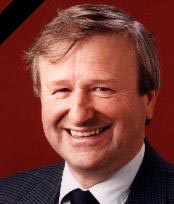
Malcom Haines ( he doesn't seem to have changed since 1967 )
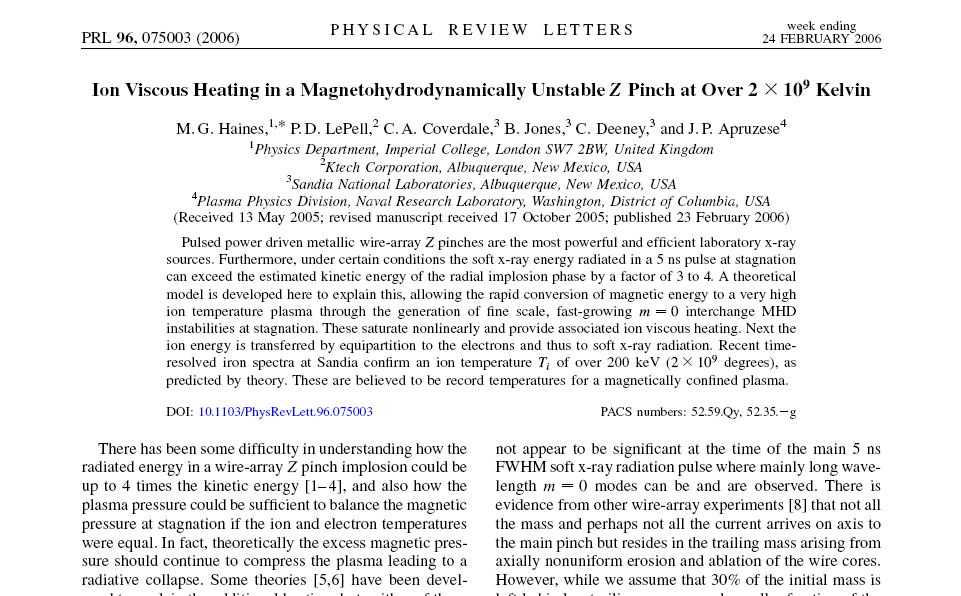
Although it is not correct and that normally you have to pay 25 dollars ( which I did ) to download the four pages of this pdf, given the exceptional importance of this result I decided to make it downloadable on my site.
Malcom Haines' article, in pdf
The article explains how the temperature could be deduced from the analysis of the spectrum emitted by stainless steel. Therefore, it is a reliable result and not an artifact. Anyway, the paper was submitted to Physical Review Letters on May 13, 2005, revised in October and published on February 24, 2006. Thus, between the first submission of the paper and its publication, ten months had passed. Therefore, it is not a hasty information. I also contacted Gerold Yonas, whom I had met at Sandia in 1976. At that time, he had built this installation whose purpose was electron beam fusion. The device was then the size of a pigeon egg. But Gerold, by his own admission, had focusing problems:
Gerold Yonas' first installation, Sandia, 1976
You can see that he was already an expert in handling high currents and high power. There are no overall views of the " Z-machine". The electrical power is conveyed through conductors immersed in a pool ( as in the image above ). Water acts as a dielectric. When the machine is operating, spectacular short circuits occur between the different metal parts emerging from the water, and this is what happens:
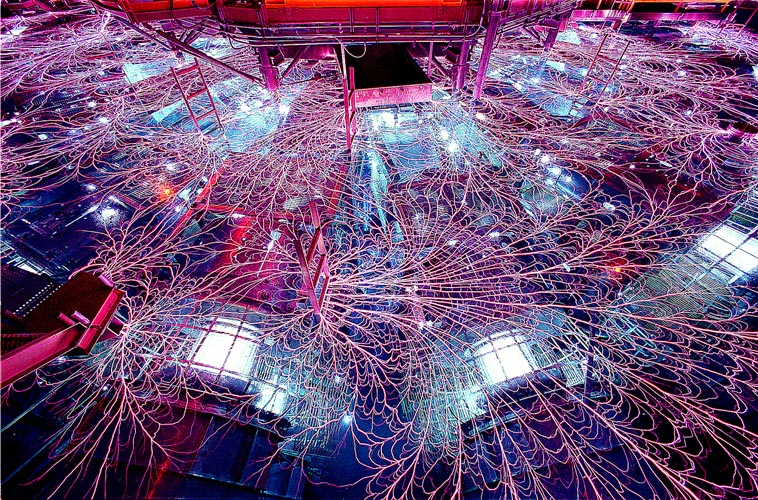
Short circuits occurring on the surface of the Z-machine, between metal parts emerging from the water
Here is an image of a target made of metal wires.
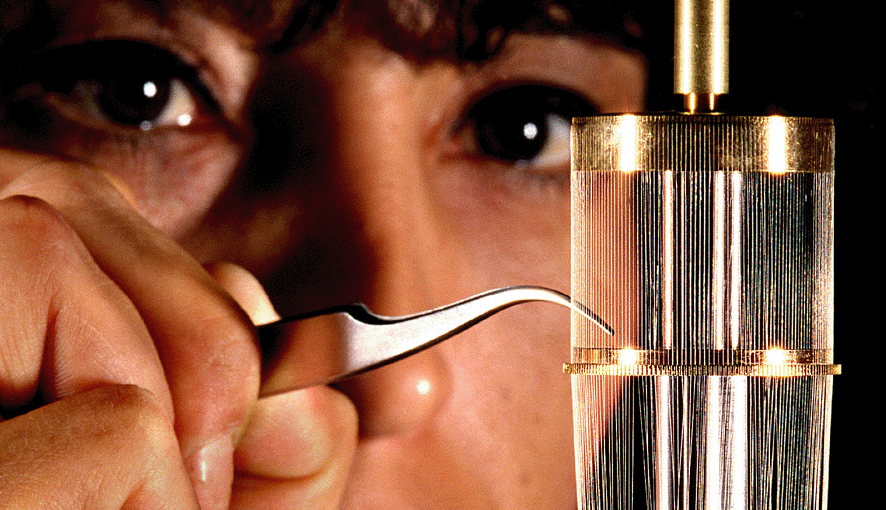
The metal wire device
Below, some drawings that help understand the principle of this plasma compressor.

The Z-machine
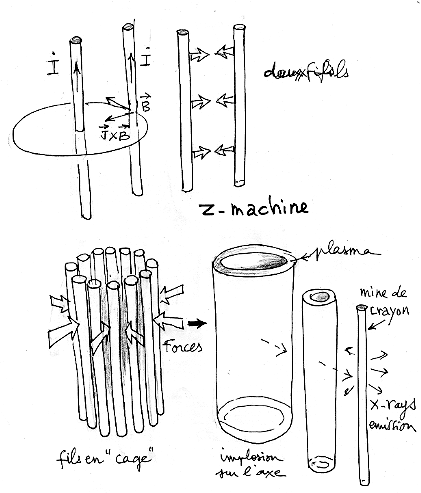
Each wire produces a magnetic field that acts on the neighboring wires through the Laplace force I x B. The result is that all these wires tend to gather along the axis of the system. The intense current that passes through them vaporizes them, transforming them into plasma cords. In the process, 30% of the metal is dispersed, giving a metallic vapor that will constitute a sort of "trail" when these metal plasma cords have merged to form an object shaped like a hollow cylinder, imploding along its axis. The wire structure allows for a good initial axisymmetry, and, given the results obtained, this axisymmetry is maintained until the final stage, until the formation of a thin, hyper-hot plasma cord, 1.5 millimeters in diameter, aligned along the axis.
But in fact, the machine did not behave as expected. Its designers only hoped to use it as a high-power X-ray generator to test the resistance of nuclear warheads against anti-missile weapons. Among these, the simplest consists of sending anti-missiles carrying a nuclear charge towards the nuclear warheads during their re-entry phase. During the explosion, most of the energy is emitted in the form of X-rays. In a nuclear bomb exploding near the ground, these X-rays create the fireball. The violent expansion of this mass of gas heated to high temperature causes the launch of a destructive shock wave. If the explosion occurs in the very high atmosphere or in outer space, the X-rays can damage the warhead or the missile itself, destroy the guidance and control system.
The Z-machine was therefore designed with this in mind, exclusively, and no one had anticipated that it could one day play a role in the race towards fusion.
We can trace the history of this machine up to the sudden jump in May 2005, up to this sudden rise to over two billion degrees. Before that, researchers were interested in the power produced, as evidenced by this 1998 paper by Melissa Douglas:
http://flux.aps.org/meetings/YR99/DPP99/abs/S110002.html
In Physical Review Letters, 81, 4883 of 1998 Chris Denney reports an emission of 1.8 megajoules of X-radiation, with a peak of 280 terawatts for 2 nanoseconds.
I therefore had several email exchanges with Yonas, including one dated yesterday. Here is this exchange:
From: Jean-Pierre PETIT
Sent: Fri 5/26/2006 1:23 AM
To: Yonas, Gerold
Subject: What is new ?
Dear Gerold,
Not much echo in France about the Sandia last breakthrough. Only few lines in popular reviews. I am trying to get in touch with Haines. What about trying to feed the machine with a Sakharov generator ( 1954 ) which could provide 100 millions amperes, the initial energy being provided by an explosive ? By the way this system becomes ... a H bomb without fission system required. A Sakharov generator, small size, can give the required energy. Is it right ?
If I am true, we face two possibilities
-
Low cost apocalypse
-
Energy for all people
I hope you will find a quarter of minute to answer my questions.
Jean-Pierre
Response from Yonas
Jean Pierre,
-
The Sakharov (explosive) generator is much too slow to drive a stable high velocity implosion. There would have to be some new pulse shortening methods (switching), and although there has been much work over decades, no useful method has been found. The Russians have done the most work on such switches and may be able to do it.....some day.
-
I thought the recent work on Z showed a 50% increase in temperature over previous results. Interesting, but not so dramatic as a factor you suggest, and I think Haines explains it rather well.
-
I don't think either fusion power or the end of the world are near, but maybe in one thousand years, plus or minus.
Sincerely, Gerry
From: Jean-Pierre PETIT
Sent: Fri 5/26/2006 1:23 AM
To: Yonas, Gerold
Subject: What is new ?
Dear Gerold,
Not much echo in France about the Sandia last breakthrough. Only few lines in popular reviews. I am trying to get in touch with Haines. What about trying to feed the machine with a Sakharov generator ( 1954 ) which could provide 100 millions amperes, the initial energy being provided by an explosive ? By the way this system becomes ... a H bomb without fission system required. A Sakharov generator, small size, can give the required energy. Is it right ?
If I am true, we face two possibilities
-
Low cost apocalypse
-
Energy for all people
I hope you will find a quarter of minute to answer my questions.
Jean-Pierre
Response from Yonas
:
Jean Pierre,
-
The Sakharov (explosive) generator is much too slow to drive a stable high velocity implosion. There would have to be some new pulse shortening methods (switching), and although there has been much work over decades, no useful method has been found. The Russians have done the most work on such switches and may be able to do it.....some day.
-
I thought the recent work on Z showed a 50% increase in temperature over previous results. Interesting, but not so dramatic as a factor you suggest, and I think Haines explains it rather well.
-
I don't think either fusion power or the end of the world are near, but maybe in one thousand years, plus or minus.
Sincerely, Gerry
I am a bit perplexed by Gerold's response. If we detail its content, it would be equivalent to saying "well, someone has obtained two billion degrees and some, and so what? What does it have to do with fusion?
Yet, if 100 million degrees are required to achieve deuterium-tritium fusion (the one we aim for in ITER, polluting, creating radioactive waste, apparently unstable), with 500 million degrees we get to the fusion of Li 7 + H1 (the lithium hydride of "H" bombs) and with a billion degrees the fusion of Bore B11 with hydrogen H1. Substances extremely common on Earth.
The Bore and the Silver of Bore
These two last fusions, giving respectively two and three helium He4 nuclei as reaction products, are fundamentally non-polluting. I mentioned them in an album published twenty years ago:
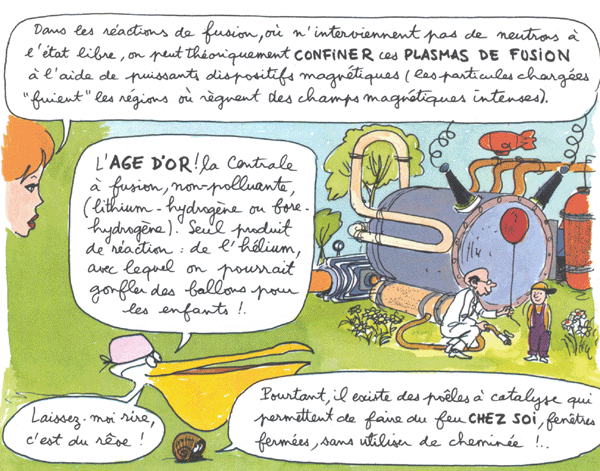
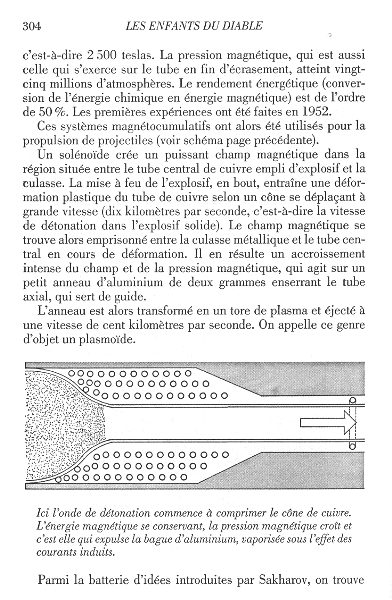
Excerpt from page 38 of "Energétiquement vôtre" (freely downloadable at http://www.savoir-sans-frontieres.com )
I am not the only one to question the soundness of the ITER project. Example, a recent interview of Nobel Prize winner Pierre-Gilles de Gennes:
Les Echos - Thursday January 12, 2006
interviewed by Chantal Houzelle
Research:
the alarm cry of a Nobel Prize, Pierre-Gilles de Gennes, Nobel Prize in Physics 1991
Excerpts
I find that too much money is spent on actions that are not worth it. For example, nuclear fusion. European governments, as well as Brussels, rushed into the experimental reactor Iter [NDLR: it will be located in the south of France, at Cadarache] without having conducted any serious reflection on the possible impact of this huge project. Although a great supporter of large community machines thirty years ago, and former engineer of the Commissariat à l'énergie atomique (CEA), I unfortunately no longer believe in it, even if I experienced the enthusiastic beginnings of fusion in the 1960s.
Why? A fusion reactor is both Superphénix and La Hague at the same place. If, with Superphénix [NDLR: a prototype of a fast breeder reactor, whose shutdown was decided in 1997], we had managed to operate a fast neutron reactor, it would be difficult to reproduce on 100 reactors in France - what the national electricity needs would require -, because these installations require the best technicians to obtain a very refined result under optimal safety conditions. And it would be literally impossible in the third world.
Not to mention that we would have to rebuild a La Hague-type plant around each reactor to be able to process on-site the extremely hot fissile materials, which we are not allowed to transport by road or rail. You can imagine the scale of such a project!
Do you have other reservations about the experimental reactor Iter?
Yes. One is based on the fact that before building a 5-ton chemical reactor, we must fully understand the operation of a 500-liter reactor and assess all the risks it entails. However, this is not how the experimental reactor Iter is being approached. Yet, we are not able to completely explain the plasma instabilities or the thermal losses of current systems. Therefore, we are launching something that, from the point of view of a chemical engineer, is a heresy.
And then, I have one last objection. Knowing quite well superconducting metals, I know they are extremely fragile. So, believing that superconducting windings used to confine the plasma, subjected to fast neutron fluxes comparable to a hydrogen bomb, will have the capacity to resist during the entire lifetime of such a reactor (ten to twenty years), seems crazy. The Iter project was supported by Brussels for political image reasons, and I find that to be a mistake.
My comment
The ITER reactor is built around a huge superconducting toroidal coil. This coil will be bombarded by neutrons emitted by the fusion. Since the Culham tokamak (England) operated for one second, we should expect that fusion will also be achieved in ITER. Where the taxpayers are being cheated is by promising that this machine will be the prototype, the last stage before the design and deployment of a machine capable of actually producing continuous electricity. In my opinion, we will be far from that. Iter, like its English predecessor, will suffocate due to the pollution represented by the removal of heavy ions from the wall by the fast light nuclei that manage to cross the magnetic barrier (see below). The press mentions "solutions," but these are only conjectures, conditional statements. The problem is absolutely not resolved and is very heavy, very burdensome. It is incredible that such heavy investments have been made without having previously mastered these issues.
But there is something else that is not talked about. Even if this reactor worked, we have no experience, no knowledge about the mechanical endurance of such fragile assemblies as superconductors when they are subjected to intense neutron bombardment at 14 MeV. These windings create a magnetic field B inside the reactor, which is accompanied by a magnetic pressure expressed as:
Usually, one thinks of pressure in newtons per square meter. But it can also be expressed in joules per cubic meter.
Pressure is a volumetric energy density.
If you want to calculate the energy involved in a magnetization system, it is sufficient to know the value of the field B, in teslas, calculate this energy density using the value (in MKSA units)
and multiply by the volume in which this magnetic field is created.
If the winding remains in a superconducting state and has been designed to withstand the mechanical stresses inherent to this type of installation, everything is fine. But if, by chance, superconductivity disappears somewhere, then the formidable currents flowing in wires as thin as hair are immediately accompanied by a violent heat release due to the Joule effect. A superconducting winding is in itself a bomb. I remember the answer that the American physicist Fowler gave me in 1976 when, confronted with the largest superconducting magnet that was at the time his Ying Yang machine, installed at the Lawrence Livermore Laboratory, I asked him what would happen if an incident were to break this superconducting state somewhere in the device:
- You know, my dear, in science it is often more a question of courage than of intelligence.
ITER is therefore a fantastic sum of unresolved scientific and technical problems, even, not yet encountered, at a more modest scale, as the physicist Gilles de Gennes points out with common sense.
At this point, one can wonder how such decisions are made. The answer is that these are not decisions based on scientific criteria, they are
political decisions
. This is the meaning of the comment that a project presenter made in front of me during a so-called debate that took place in Pertuis:
- Iter is not only a scientific project, it is also a societal project.
It is ... a bit of anything. It is, among other things, a real estate project, a territorial development project, with "highway infrastructures, electrical equipment, etc." One can consider it as a "regional development project," like Megajoule for the Bordeaux region. It doesn't matter whether it works or not. "It will make an entire subcontracting industry work," one will say. And the press, under orders, will sing its usual song ( "the sun in a golden room," etc.) while these same words were heard 25 years earlier with the Tore-Supra project, which was a complete failure. Do not believe that such decisions are actually the subject of contradictory debates in scientific arenas. The final decision to launch Iter was .. Elysian. It was the Elysée that made the decision to launch the project "by successfully attracting it to the French territory" ( what a victory for Chirac ). In decisions like launching adventures such as ITER or Megajoule, science and technology have little to say. Opponents are neutralized, silenced, or even ejected.
In response, the reaction of the Japanese Nobel Prize winner Koshiba
Currently, he points out, nuclear fission releases neutrons of an average energy of one or two MeV only. For M. Koshiba, scientists must first solve this problem of 14 MeV neutrons "by building walls or absorbers" before being able to claim that it is a new and sustainable energy. It is, he states, a very costly solution. "If they have to replace the absorbers every six months, it will result in an operational stoppage that will translate into an additional cost of energy," criticizes the physicist. "This project is no longer in the hands of scientists, but in those of politicians and businessmen. Scientists can no longer change anything," he laments before adding: "I am afraid." (...)
"I hope that the French government has the honor of accepting Iter in its own country," ironizes M. Koshiba. "French scientists may be better able to manage these 14 MeV neutrons. After all, France is already actively involved in the treatment of radioactive materials in its nuclear power plants." "I think, he concludes, that certainly, French scientists and engineers have more knowledge and experience than those of other countries to tackle this new problem of 14 MeV neutrons," he concludes.
In response, the reaction of the Japanese Nobel Prize winner Koshiba
Currently, he points out, nuclear fission releases neutrons of an average energy of one or two MeV only. For M. Koshiba, scientists must first solve this problem of 14 MeV neutrons "by building walls or absorbers" before being able to claim that it is a new and sustainable energy. It is, he states, a very costly solution. "If they have to replace the absorbers every six months, it will result in an operational stoppage that will translate into an additional cost of energy," criticizes the physicist. "This project is no longer in the hands of scientists, but in those of politicians and businessmen. Scientists can no longer change anything," he laments before adding: "I am afraid." (...)
"I hope that the French government has the honor of accepting Iter in its own country," ironizes M. Koshiba. "French scientists may be better able to manage these 14 MeV neutrons. After all, France is already actively involved in the treatment of radioactive materials in its nuclear power plants." "I think, he concludes, that certainly, French scientists and engineers have more knowledge and experience than those of other countries to tackle this new problem of 14 MeV neutrons," he concludes.
I have raised the serious problem of plasma cooling due to radiative losses, related to the removal of heavy nuclei from the wall. Indeed, the fusion plasma, at hundreds of millions of degrees, is collisional. It is in a state of thermodynamic equilibrium. The velocity distribution is therefore a "bell curve". If the thermal agitation velocities are close to an average value < V > there are "Boltzmann distribution tails" with slower and faster particles. No magnetic barrier can reflect these latter ones, ( thanks to the magnetic field gradient effect that constitutes the confinement in the toroidal chamber ). There will necessarily be hydrogen nuclei that, crossing this magnetic barrier, will detach from the nuclei of the atoms constituting the wall. These will ionize, carrying a charge Z. Now, the radiative power varies as the square of the ionic charge Z. This is what caused the plasma of the Culham machine, in England, to suffocate after one second of operation, while the duration of its magnetic field would have allowed a longer operation ( 10 to 20 seconds ).
I say that this is exactly what will happen with ITER. We are promised minutes of operation, but it will not exceed ten seconds. Then we will be asked for even more money to build a "super ITER", as big as a train station hall. All this is not serious. You don't engage such expenses when the fundamental problems have not been solved. In its current state, ITER is a luxury toy, or, as one of the speakers said at Pertuis, a "societal project". Indeed, it is remarkable in terms of real estate, road infrastructure, swimming pools and tennis courts. But it won't work.
Faced with these criticisms, during a "debate meeting", the theoretical responsible for ITER had no answer other than "it was a good question".
Following these criticisms, newspapers have published texts. Here is one of them:
PHYSICS
. An important obstacle to industrial nuclear fusion, as planned in the experimental reactor Iter which will be located in Cadarache, near Marseille, has been overcome in the laboratory ( ? ... ), announces an international team in the British monthly Nature Physics.
The researchers have demonstrated an experimental solution that eliminates a major problem: the erosion of the internal walls of the reactor due to the heating caused by plasma instabilities. Currently, no material is able to withstand these sudden energy discharges. To avoid these instabilities,
it would suffice
to "slightly perturb the magnetic field" confining the gas mixture of deuterium and tritium at very high temperature, the plasma, to "make this field become chaotic on the edge," according to the authors of the article.
The researchers, working under the direction of Todd Evans, of General Atomics (San Diego, California) estimate that this
could solve
an obstacle encountered by all fusion installations - the tokamaks - such as Iter. Several institutions have been involved in this work, such as the Euratom-CEA Association of Cadarache.
PHYSICS
. An important obstacle to industrial nuclear fusion, as planned in the experimental reactor Iter which will be located in Cadarache, near Marseille, has been overcome in the laboratory ( ? ... ), announces an international team in the British monthly Nature Physics.
The researchers have demonstrated an experimental solution that eliminates a major problem: the erosion of the internal walls of the reactor due to the heating caused by plasma instabilities. Currently, no material is able to withstand these sudden energy discharges. To avoid these instabilities,
it would suffice
to "slightly perturb the magnetic field" confining the gas mixture of deuterium and tritium at very high temperature, the plasma, to "make this field become chaotic on the edge," according to the authors of the article.
The researchers, working under the direction of Todd Evans, of General Atomics (San Diego, California) estimate that this
could solve
an obstacle encountered by all fusion installations - the tokamaks - such as Iter. Several institutions have been involved in this work, such as the Euratom-CEA Association of Cadarache.
You will note the use of the conditional: "it would suffice... could". I doubt that this has been overcome. But, in any case, no one has waited for it to be overcome to embark the taxpayers in this costly and problematic adventure, since this problem would not have been resolved from the outset. A fusion specialist has mentioned this project by calling it a "cathedral for engineers".
And I don't count the problems raised by de Gennes. Everything seems to me ... irresponsible.
And now, as a bonus, comes another ... solution, through this astonishing and unexpected advance, that of the Z-machine: the possibility of considering non-polluting fusion. I don't see why we wouldn't get it, with a strong energy release, by placing a target the size of a sewing needle at the center of the Z-machine's cage. A target of LiF or B-H. I am not the only one to think this. All the Z-pinch specialists agree. To recover the energy: simple. It would be sufficient that the expansion of the helium plasma occurs in a magnetic field. We are then in a regime of infinite magnetic Reynolds number. The electrical power is obtained with the induced current. It is an MHD generator with induction, without moving parts, the simplest one we can imagine. I will have to explain all this.
Deeney and the people at Sandia wanted an X-ray source to test the "hardness" of their nuclear warheads. Now they have an electric generator based on non-polluting fusion, which produces only helium.
I say:
What are we waiting for?
French journalists are courageously silent, as usual. For the people of the ITER project ( or Megajoule ) this advance is simply untimely and catastrophic. It puts everything into question! Yonas' denials might not be ... diplomatic?
Fusion and the Z Pinch; August 1998; Scientific American Magazine by G.Yonas;
6 Page(s)
A device called the Z machine has led to a new way of triggering controlled fusion with intense nanosecond bursts of x-rays
Some things never change—or do they? In 1978 fusion research had been under way almost 30 years, and ignition had been achieved only in the hydrogen bomb.
Nevertheless, I declared in Scientific American at the time that a proof of principle of laboratory fusion was less than 10 years away and that, with this accomplished, we could move on to fusion power plants [see "Fusion Power with Particle Beams," Scientific American, November 1978]. Our motivation, then as now, was the knowledge that a thimbleful of liquid heavy-hydrogen fuel could produce as much energy as 20 tons of coal.
Today researchers have been pursuing the Holy Grail of fusion for almost 50 years. Ignition, they say, is still "10 years away." The 1970s energy crisis is long forgotten, and the patience of our supporters is strained, to say the least. Less than three years ago I thought about pulling the plug on work at Sandia National Laboratories that was still a factor of 50 away from the power required to light the fusion fire. Since then, however, our success in generating powerful x-ray pulses using a new kind of device called the Z machine has restored my belief that triggering fusion in the laboratory may indeed be feasible in 10 years.
Fusion and the Z Pinch; August 1998; Scientific American Magazine by G.Yonas;
6 Page(s)
A device called the Z machine has led to a new way of triggering controlled fusion with intense nanosecond bursts of x-rays
Some things never change—or do they? In 1978 fusion research had been under way almost 30 years, and ignition had been achieved only in the hydrogen bomb.
Nevertheless, I declared in Scientific American at the time that a proof of principle of laboratory fusion was less than 10 years away and that, with this accomplished, we could move on to fusion power plants [see "Fusion Power with Particle Beams," Scientific American, November 1978]. Our motivation, then as now, was the knowledge that a thimbleful of liquid heavy-hydrogen fuel could produce as much energy as 20 tons of coal.
Today researchers have been pursuing the Holy Grail of fusion for almost 50 years. Ignition, they say, is still "10 years away." The 1970s energy crisis is long forgotten, and the patience of our supporters is strained, to say the least. Less than three years ago I thought about pulling the plug on work at Sandia National Laboratories that was still a factor of 50 away from the power required to light the fusion fire. Since then, however, our success in generating powerful x-ray pulses using a new kind of device called the Z machine has restored my belief that triggering fusion in the laboratory may indeed be feasible in 10 years.
The Z Pinch; August 1998; Scientific American Magazine by G.Yonas;
6 Page(s)
A system called the Z machine leads to a new way of obtaining fusion with intense bursts of X-rays lasting on the order of a nanosecond.
Are things changing or not? In 1978, fusion research was already thirty years old, whereas the ignition of hydrogen bombs had been achieved as early as the 1950s. In any case, I had stated at the time in Scientific American that laboratory fusion was within ten years ahead of us and that if it were achieved, we could consider designing electric generators using fusion as an energy source. See "Fusion Power with Particle Beams," Scientific American, November 1978. Our motivation, then as now, was that a thimbleful of liquid hydrogen could produce as much energy as 20 tons of coal.
Today, researchers have been pursuing this quest for the Holy Grail for 50 years. The tension of the 1970s has faded, as has the patience of our supporters, to say the least. But only three years ago I thought it was interesting to put pressure on this subject, even though the power needed to create fusion was 50 times higher than what could be developed in Sandia laboratories. Since then, the fact that we have successfully implemented a new device called the Z machine has led me again to think that it should be possible to achieve fusion within ten years.
Regarding the coupling with a Sakharov generator, explosive, I have considered his objection. We have found a response that is probably the same as the one he mentions, considered by the Russians. By the way, I need to make available on my site the pages discussing, in French, the works of Andrei Sakharov, in MHD. I will scan these pages. A reader will convert them into text files, using OCR, so that access to these essential documents is easier.
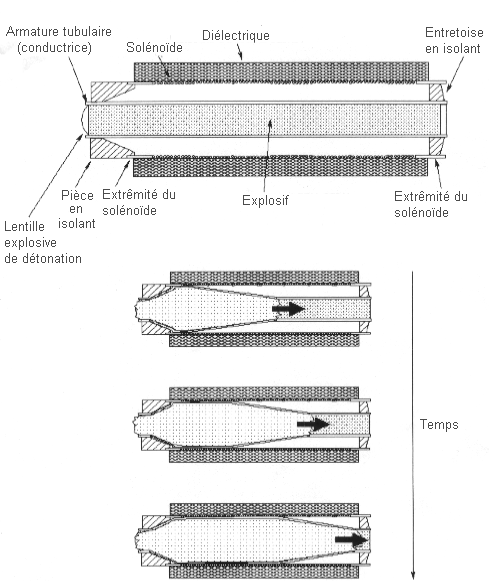
****Explosive MHD generators by Andrei Sakharov
The initial idea, the coupling with a Sakharov generator, gave this:
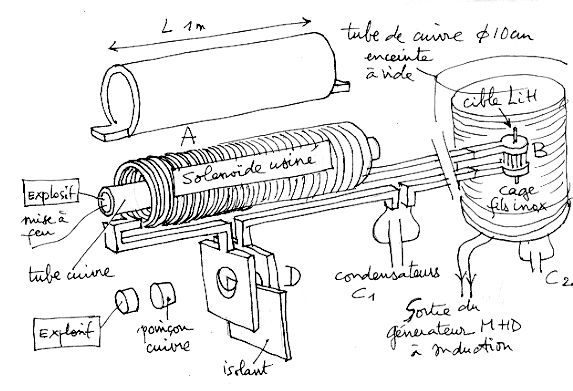
**First schematic setup, evoking a coupling between a Z machine and a Sakharov generator
On the right: the MHD generator by induction, a simple solenoid surrounding the target. **
Objection by Yonas: the intensity rise would be too slow. Apparently, a rise time of less than 100 nanoseconds is required. Maybe ten? Let's look at this diagram. It is not complete. It was drawn on a corner of a table. A capacitor C1 transfers its energy into a solenoid, with inductance L. The energy 1/2 CV2 is converted into energy 1/2 L I2. Then the capacitor is disconnected from the circuit by shunting ( the system is not shown on this diagram ).
If nothing is done, we then have an aperiodic discharge with a time constant L/R where R is the resistance of the coil. But this is where Sakharov reduces the coil by short-circuiting the solenoid windings through the expansion of a copper tube, due to an explosive.

**Sakharov system ( excerpt from one of his articles ) **
From a rough estimate, if this system produced 100 million amperes in 1954 ( the Z machine produces twenty ), the rise time in intensity is long: around a hundred microseconds, apparently. Probably a thousand times too long. The expansion of the copper tube reduces the inductance L. The flux L I remains constant. Therefore, the intensity evolves as the inverse of the value of the coil. But there is a solution.
The intensity delivered by the system increases linearly, or almost linearly. This intensity increases to hundreds of millions of amperes, then levels off, with dissipation by the Joule effect. But why would we couple the Z machine ( the "bird cage" ) from the beginning of the process?
I asked, in my next email to Yonas, how he performed his switching ( his "switching" ). If the result of the Z machine is "so trivial", I don't see why his switch would be classified. And digging deeper, it should be possible to find it.
The Z machine has a characteristic operating time of 100 nanoseconds. Apparently, the cage compression is achieved in a shorter time. Ten or twenty nanoseconds, I believe. We are therefore confronted, if we want to avoid the semi-heavy technologies of Deeney and Yonas, with an ultra-fast switching problem. I believe that with an ignitron, you should be around a microsecond, at least with those I used thirty years ago. Readers will probably suggest more modern and more efficient systems. But there are also simpler ones. Mechanical switches, explosive. Always derived from Russian ideas. Below is the principle of the rivet switch.
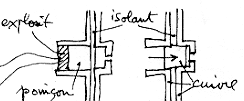
Rivet switch
Two plates separated by an insulator. Against the insulator, a copper rivet, propelled by an explosive. Such a system can even provide a whole sequence of switching, circuit disconnections.
Not fast enough? It all depends on what propels the punch, the rivet and what its nature is. The projectile ensuring the switching can come from a flux compression system, of Sakharov. New Sakharov setup, excerpt from my book "The Children of the Devil":

**A doctoral thesis on magnetic flux compression, that of Mathias Bavay ( 2002 ) **
http://mathias.bavay.free.fr/these/sommaire.html
http://mathias.bavay.free.fr/these/sommaire.html
I await Yonas' response. If Haines agrees, I will go see him at Imperial College, in London. There, we would quickly find out more. Good grief, non-polluting fusion is worth thinking about. I need to contact Rudakov, at the other end of the chain. The Russians have certainly not been idle after Sandia's breakthrough in May 2005. The Chinese have not either. It's only us, the French, who are preparing to give the first blow to ITER, "the steam engine of the third millennium".
By informing yourself a bit, you discover an entire area of research that remains quite unknown and which concerns a set of machines aiming to achieve fusion in an impulsive way. Among these machines, the setup FOCUS, which I will talk about later.
http://www.focusfusion.org/what/deuterium.html
http://www.focusfusion.org/what/plasmafocus.html#dpf
http://www.focusfusion.org/research/billion.html
I don't believe that the publication of these results on the Z machine, as some have suggested, can be equated to a disinformation operation. Specialists with whom I have had non-public exchanges also do not. People like Yonas, Haines, Deeney and others could not afford to torpedo their scientific reputation. Disinformation is for people like the good doctor Greer ( project " Disclosure" ) or some fantasists. But then, how could such results, which should have immediately been marked with the seal of secrecy, have ended up in the open without warning?
Read the article again. The Z machine was initially just an X-ray generator intended for testing warheads. It was climbing up in temperature slowly. A few million degrees in 1999. A little more later. There were attempts to create fusion using the "holraum" system (a German word meaning "oven"). In this case, the sauce is sent into a cage made of metal wires. These wires vaporize and converge toward the axis of the system. By distributing them between two cylindrical surfaces, we then obtain a plasma layer that converges toward the axis. Between this wire system and the system's axis, we place a very light alveolar foam ( the Russians use agar-agar, of organic origin ).
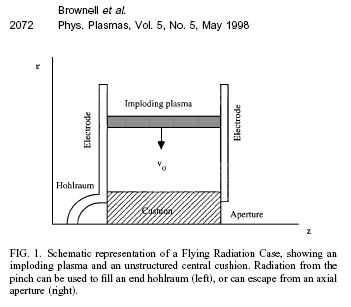
Holraum system. Paper by Brownell, 1998
Horizontally: the system's axis
Here is a more recent paper ( 2005 ), by Lemke et al. At the wire crown and the foam cushion, in CH2 we have this time added a spherical target, clearly visible.
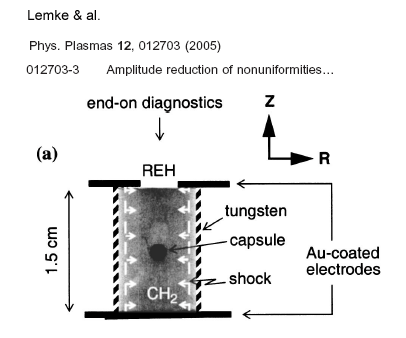
The "holraum" setup ( in "oven" ). Hatched, we see the tungsten plasma in implosion, compressing the foam
This compression heats the foam ( "cushion" or cushion ), which is supposed to turn into an oven. In the middle of this foam, we then place a spherical target, surrounded by a "pusher", a substance that, absorbing the radiation, expands and compresses the target's content, a sphere of cerre of a few tenths of a millimeter in diameter containing a fusion mixture. This is how Deeney's team aimed for fusion in 2005.
Fusion had behaved like a desert mirage for 30 years, so no one believed in it. Deeney dreamed of perhaps reaching "the threshold". In 2003, by placing a small mixture in the center, Deeney obtained some fusion neutrons ( with the "holraum" system, I suppose ).
*But more than two billion degrees, that was totally unexpected. *
And that, without oven, without foam or spherical target and all that. By simply letting the stainless steel plasma converge on its own toward the system's axis. The achievement of such a high temperature was all the more surprising because there was only stainless steel in this experiment, which is incapable of providing energy through fusion. Iron is the "absolute ash" of fusion. This is what accumulates at the center of massive stars. It is even to the point where we do not even know where this excess energy comes from. The paper by Haines did not really convince me, although Yonas finds "that it explains everything very well".
A word on this problem of conversion of magnetic energy into thermal energy invoked by Haines to justify the two billion degrees. It would be an MHD instability. In this plasma cord of one and a half millimeters in diameter that has formed along the axis of the system, the twenty million amperes continue to pass. The plasma, collisional, is in thermodynamic equilibrium, that is to say that the ionic and electronic temperatures are equal.
When the implosion mechanism occurs, the metal is cold. The discharge vaporizes it. We then obtain a metallic plasma, completely ionized. The mass of an iron nucleus is 9 10
kilo. These nuclei acquire a radial velocity. They travel the distance separating them from the axis in 100 nanoseconds, that is 10
sec if. If the distance traveled is 1 cm, the order of magnitude of the velocity is 100 km/s. If we consider that all this kinetic energy is converted into temperature, we can use the following approximation:
1/2 m < V
= 3/2 k T
where m is the mass of the nucleus, V the thermal velocity ( identified with the impact velocity ), k the Boltzmann constant and T the absolute temperature. This is very schematic, since this formula expresses the fact that the kinetic energy of the iron nuclei would be entirely and exclusively converted into thermal agitation energy.
This gives T = 22 million degrees.
We can see that the temperature at the end of the implosion increases when we increase the diameter of the "cage". The Sandia paper says that:
It is possible that the explanation is related to the higher kinetic energy acquired over a longer distance (
40 mm instead of 10
). Let's redo this calculation, convenient for setting orders of magnitude, with a "run" of iron nuclei of 4 cm instead of 1. The temperature obtained at the end of compression, when their run stops and the medium is "thermally equilibrated" is then about 350 million degrees Kelvin. But this is less than the two billion observed. Haines' study is based on a value of emitted energy four times higher than the incident energy. We thus find this, roughly. The factors are similar.
Where could this excess energy come from?
When this plasma is confined along this central cord, the current of twenty million amperes continues to circulate. It is an electronic current. In a non-unstable regime, we would find a certain electronic density and velocity of this "electron gas" in this current tube. An electromotive field moves these electrons, gives them energy which they return to the ions by collision, which constitutes the Joule effect. As Yonas pointed out to me, "the current of twenty million amperes continues to circulate when the stagnation condition is reached".
But, on the first page of his paper, Haines ( who starts from different experimental conditions, with a "run" of 27.5 mm, writes:
But classical Spitzer resistive heating time for a pinch of radius a of 2 mm is 8 microseconds
The simple Joule heating will therefore be much too slow to explain this temperature rise. Haines then invokes "MHD instabilities" which allow a certain energy transfer, taken from the "ambient" external magnetic energy
B
2
/2
m
o
We recall that pressure, if measured in newtons per square meter, can also be expressed in joules per cubic meter.
Pressure is a volumetric energy density
.
We can provide an analogy with turbulence. Take a fluid A injected by a nozzle into a fluid B. This can be simply smoke ejected by a straw, in the air. Initially, we have a laminar flow, the smoke constitutes a fluid that flows according to "parallel current lines". But turbulence appears. The surface representing "the interface" air fresh-smoke soon deforms. Then the friction ( which involves an energy exchange ) between the smoke jet and the surrounding air increases.
If we start from a laminar flow of the "electron gas" in the plasma, it can also be the site of a "MHD turbulence" phenomenon, not easy to model. Where the current density increases, the magnetic field increases as well, and vice versa. This leads the "electron gas"
to exchange energy with the external magnetic field
. Anyway, any turbulence phenomenon is
dissipative
, a generator of thermal energy. Haines therefore invokes a "micro-turbulence MHD" in the discharge to explain such a temperature rise of the plasma. Yonas declares himself convinced by this explanation but I remain personally skeptical. One could say that Yonas' argument is "it must be the source of this energy input, otherwise we can't see where it could come from".
Haines, without his later interview, is more cautious.
To be continued....
A word on this problem of conversion of magnetic energy into thermal energy invoked by Haines to justify the two billion degrees. It would be an MHD instability. In this plasma cord of one and a half millimeters in diameter that has formed along the axis of the system, the twenty million amperes continue to pass. The plasma, collisional, is in thermodynamic equilibrium, that is to say that the ionic and electronic temperatures are equal.
When the implosion mechanism occurs, the metal is cold. The discharge vaporizes it. We then obtain a metallic plasma, completely ionized. The mass of an iron nucleus is 9 10
-26
kilo. These nuclei acquire a radial velocity. They travel the distance separating them from the axis in 100 nanoseconds, that is 10
-7
sec if. If the distance traveled is 1 cm, the order of magnitude of the velocity is 100 km/s. If we consider that all this kinetic energy is converted into temperature, we can use the following approximation:
1/2 m < V
2
= 3/2 k T
where m is the mass of the nucleus, V the thermal velocity ( identified with the impact velocity ), k the Boltzmann constant and T the absolute temperature. This is very schematic, since this formula expresses the fact that the kinetic energy of the iron nuclei would be entirely and exclusively converted into thermal agitation energy.
This gives T = 22 million degrees.
We can see that the temperature at the end of the implosion increases when we increase the diameter of the "cage". The Sandia paper says that:
It is possible that the explanation is related to the higher kinetic energy acquired over a longer distance (
40 mm instead of 10
).
Let's redo this calculation, convenient for setting orders of magnitude, with a "run" of iron nuclei of 4 cm instead of 1. The temperature obtained at the end of compression, when their run stops and the medium is "thermally equilibrated" is then about 350 million degrees Kelvin. But this is less than the two billion observed. Haines' study is based on a value of emitted energy four times higher than the incident energy. We thus find this, roughly. The factors are similar.
Where could this excess energy come from?
When this plasma is confined along this central cord, the current of twenty million amperes continues to circulate. It is an electronic current. In a non-unstable regime, we would find a certain electronic density and velocity of this "electron gas" in this current tube. An electromotive field moves these electrons, gives them energy which they return to the ions by collision, which constitutes the Joule effect. As Yonas pointed out to me, "the current of twenty million amperes continues to circulate when the stagnation condition is reached".
But, on the first page of his paper, Haines ( who starts from different experimental conditions, with a "run" of 27.5 mm, writes:
But classical Spitzer resistive heating time for a pinch of radius a of 2 mm is 8 microseconds
The simple Joule heating will therefore be much too slow to explain this temperature rise. Haines then invokes "MHD instabilities" which allow a certain energy transfer, taken from the "ambient" external magnetic energy
B
2
/2
m
o
We recall that pressure, if measured in newtons per square meter, can also be expressed in joules per cubic meter.
Pressure is a volumetric energy density
.
We can provide an analogy with turbulence. Take a fluid A injected by a nozzle into a fluid B. This can be simply smoke ejected by a straw, in the air. Initially, we have a laminar flow, the smoke constitutes a fluid that flows according to "parallel current lines". But turbulence appears. The surface representing "the interface" air fresh-smoke soon deforms. Then the friction ( which involves an energy exchange ) between the smoke jet and the surrounding air increases.
If we start from a laminar flow of the "electron gas" in the plasma, it can also be the site of a "MHD turbulence" phenomenon, not easy to model. Where the current density increases, the magnetic field increases as well, and vice versa. This leads the "electron gas"
to exchange energy with the external magnetic field
. Anyway, any turbulence phenomenon is
dissipative
, a generator of thermal energy. Haines therefore invokes a "micro-turbulence MHD" in the discharge to explain such a temperature rise of the plasma. Yonas declares himself convinced by this explanation but I remain personally skeptical. One could say that Yonas' argument is "it must be the source of this energy input, otherwise we can't see where it could come from".
Haines, without his later interview, is more cautious.
To be continued....
Returning to the history of this event: before this unexpected result, why put the Z-Machine under secrecy? It was just an extrapolation of things from 40 years ago.
Well, then suddenly, boom!
The results arrived in London, with the friend Malcolm Haines ( look at his photo. Do you think this smiling cosine scientist has a head to navigate in the defense secret? ). Malcolm must have found "that it was an interesting physics problem, a phenomenon that needed to be found the cause" and he tried to do so. Hence this paper sent in May 2005 to the journal Physical Review Letters, which published it by simple routine. There were no special filtering instructions. No one noticed that instead of "million" there was "billion". Some thought it was a typo, or simply didn't pay attention.
*I believe ... that's how it happened. And now the cat is out of the bag. *
I think of the book I published in January 2003, where I described torpedoes propelled by rockets ( the Russian Shkwal and the American Surpecav, weapons over thirty years old, but still going at 500 km/h ). I think of a discussion with this young journalist from Science et Vie, Larousserie, who said to me "that cavitation happens on its own. It's enough to enter the water very quickly".
Shock in the French navy, when my book was released. An Admiral, at the "Euronavale" exhibition where the French present their new weapons to sell to Arabs or Africans:
- You know, my dear, in terms of torpedoes, speed is not everything......
A few weeks ago, it was discovered that the Iranians have rocket-propelled torpedoes, bought from the Chinese, who, etc....
But the French admirals have found the absolute weapon in terms of stealth: it's the sailing ship. Wood, canvas, hemp are undetectable by radar.
Clever, isn't it?
The Z machine: a "clean" fusion, without radioactivity or waste, within reach.
Complete absence of reaction in the civilian, scientific and political sectors, in the mainstream press
Strong interest among the military ---
It is possible that magazines like La Recherche, Pour la Science and others are preparing dossiers about what is confirmed as a major scientific event. But three months have passed. Will these magazines react? I suggest, just in case, to post letters or send emails to their editorial offices asking them to give coverage to this matter.
There remains a rather sad remark. Since the Sandia result seems to be real, it potentially represents an immense hope for humanity. We live in an era where many people think we are rushing headlong towards apocalypse. The rise of China and India has repercussions throughout the world, which will only grow, quickly. In Europe it will lead to the collapse of all social achievements, create intense social and racial tensions. In our country, the presidential candidates, from Sarkozy to Ségolène Royal, are only opportunists and "puppets without strings", as a reader recently qualified them in an email. Sarkozy is surfing on fear. Ségolène Royal, who has no shadow of a program, just responds to attacks with a smile, takes care of her look and wonders what dress she will wear today.
Lies are everywhere. The press lies, hides. During a recent television show, in "On ne peut pas plaire à tout le monde", the journalist Claude Sérillon described the television news as an anesthetic, a daily dose wished for by the viewer. It could be compared to a daily dose of tranquilizer. Poverty is increasing in countries like Egypt where jobs are disappearing, due to foreign competition and corruption. Because corruption is everywhere. The system of bribes is everywhere. In France it is a minimum of 10% to have "a state or municipal market". In Arab countries, count 50%, if you want to sell tanks or computers in any country, to discreetly deposit on a Swiss account, benefiting a few of the 700 men of the "royal lineage". In Africa, go up to 80%, on the account of a state or its ministers.
In China or India it's the same, but the system works better, "more intelligently". In India, peasants commit suicide because they have become indebted, due to the drought that is spreading, for drilling wells, against unscrupulous usurers. In China, starving peasants, whose rivers are poisoned by toxic waste, are violently repressed by the army.
The media serve you your daily dose of car bombings, here, there, everywhere. Forty dead in Baghdad, ten in Afghanistan, etc. No one even pays attention anymore. Africans drown trying to reach Europe to avoid starving. It reminds me of a stay I once had in Djibouti, when one could hear, at night, the bursts of fire from the legionnaires on the Ethiopians trying to enter the enclave, due to the famine in their country. You will find a song on the site, which I composed at that time, here is the last couplet:
In Djibouti, when evening comes
At the meeting of the hopeless
On the line of demarcation
At the hour when the good Frenchman sleeps
Perched on the watchtowers
The adjutants make a hit
The world may soon be like this song. It reminds of "Green Sun", or "the rich men" living behind electrified barbed wire fences.
From Closets, they presented the RFID, the future, according to this modern-day Pangloss ( but of course, there is no need to worry ). A quick word at the end of the show to mention that with such a distribution system "we might have some small employment problems to solve".
A technology would allow changing the future of the world: one that would allow having a non-polluting energy source, in abundance. When the possibilities of fission began to be known, the pioneers of nuclear energy at the time were convinced "that we would grow tomatoes in the Sahara". But facing this there were two things:
-
The problem of supply and the cost of the fissile material
-
The production of radioactive waste
At that time, no one envisaged catastrophes like Three Mile Island or Chernobyl.
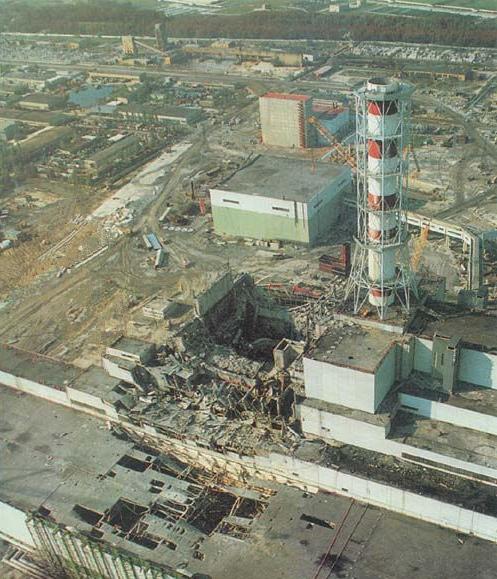
Chernobyl, immediately after the reactor explosion
Today we know the cost of such a policy. I sometimes hear people tell me that nuclear energy "is the solution", provided that waste is buried for an "infinite" duration on a human scale. This is the position of an ex-minister like Claude Allègre, for example, and many others who thus feel "realistic". I think that such statements betray a lack of scientific ambition. We have known for a long time that there is a non-polluting fusion, but the temperatures to consider made this technology seem to many "unrealistic". To make deuterium and tritium fuse, you need 100 million degrees. For lithium-hydrogen fusion, you need 500, and for the boron-hydrogen mixture, you need to reach a billion degrees. A temperature never achieved on Earth since the temperature at the core of an "H" bomb, with lithium hydride, does not exceed 500 million degrees ( at the core of the Sun, 15 to 20 million degrees! ).
The "fusion by inertial confinement", by short duration pulses, had never worked ( fusion by laser, fusion by electron beams ). As a result, we turned back, after the only success of Culham, in England ( one second of self-sustained fusion in a tokamak ) towards the path leading to the ITER project, this "cathedral for engineers". But these paths, whether it is ITER or Megajoule ( a laser fusion technique that does not even have the ambition of energy production, only to be "a simulator of bomb operation" ) are extremely costly and problematic.
Suddenly, a gift, the Z machine gives us ... two billion degrees, while we thought it would be around a fraction of this value. This machine worked because suddenly the energy focusing was done correctly. The compression, the implosion phenomenon, occurred in a stable way. We were so used to failures that we no longer believed in it, simply. This goes in line with what I have always thought: that the solution, for fusion, lies in impulsive systems and that a machine like ITER, operating continuously, is an aberration.
The theory can come from rough calculations, at least to have orders of magnitude. You take atoms' nuclei. You give them a velocity V, centripetal ( you make them rush into each other ). In the case of the Z machine, it is along the axis of a system. When they hit each other, their kinetic energy is converted into thermal agitation energy. You can use a formula like:
1/2 m < V2 > = 3/2 k T
Explanations above. If you double the velocity at impact, you quadruple the temperature. At this rate, it goes up quickly. The whole thing is that it works. At Sandia, miracle, it worked. The fact is undeniable, the measurements are irrefutable. Nature, for once, has been a good girl and gave us two billion degrees. In short, it is:
The Apocalypse or the Golden Age, at your choice
Focusing energy has always yielded astonishing results. In 1905, the implosion of vapor bubbles caused the fusion of bronze in the cavitation phenomenon. Later, the implosion of vapor bubbles, created this time by an ultrasonic pulse in the phenomenon of sonoluminescence gives rise to a plasma at 10,000 degrees. I do not exclude the possibility that one day we could achieve a sonofusion and I believe that this very low-cost approach should be explored.
The breakthrough made in New Mexico, at Sandia, in 2005 and revealed in early 2006 would call for an immediate, planetary reaction, with the creation of a common project (when will there be a televised debate in France?). One can wonder whether this reaction will happen, at least in France, for two reasons.
- These results significantly disrupt these "cathedrals for engineers" projects, such as Megajoule and ITER
- On an international scale, this technology of "fusion without fission" (called "pure fusion") could give rise to a new generation of nuclear weapons, free from the constraint of isotopic enrichment and allowing the creation of very low-power weapons, which could lead to unlimited, planetary dissemination, completely escaping the control of the IAEA (International Atomic Energy Agency).
It is recalled that the need to use an A-bomb as an "igniter" imposes a lower limit of 300 tons of TNT (for the few countries that can reach this technological threshold. For others it is 1000 tons). When the "pure fusion" branch appeared, a hydrogen bomb (even a "mini-nuke") could not have a power lower than 300 or 1000 tons of TNT. Hence the dissemination of radioactive fallout, nuclear winter effect. It is impossible to attack an enemy: it comes back to your face, because of these masses of waste carried into the stratosphere by the "jetstreams".
Hydrogen bombs without fission, non-polluting, would be perfectly "clean" bombs, usable on enormous geographical scales. They would allow massive attacks, without the backlashes that are the dissemination of radioactive products and the nuclear winter effect. It is possible to obtain very high electrical intensities with simple chemical explosives (Sakharov generator: compact, light, and small devices). It remains to solve the problem of switching speed. But, in principle, this is not unsolvable. People are already considering many solutions.
In France, be without illusions. The arguments mentioned above weigh their weight, even at the Elysée level. Logically, the Sandia result should immediately suspend the work on the Megajoule and ITER experiments. But... you don't think about it. You don't stop a diplodocus that has already started running. You cannot compromise such a fantastic real estate project, a "societal project" capable of "irrigating a regional industrial fabric" and providing 20 years of dream life to 2000 happy fews, who are, by the way, the decision-makers of such projects.
What is dramatic is that this international mobilization in favor of the study of clean nuclear energy will not happen. The projects that will emerge will be military projects, as discreet as possible. One would be tempted to exclaim:
- What! Do scientists want the good of humanity or not?
In technological and scientific developments, three types of sectors are found.
- The military sector, where the motivation is then of a strategic nature
- The profit sector. No need to draw a picture.
- The "toys for rich kids" (Megajoule, ITER, etc.)
I think that the result of the Z-machine could mark the beginning of a new era, which would go far beyond simple energy production. Malcom Haines has great difficulty explaining why this machine emits four times more energy than it receives, while the hyperdense object we create is incapable of providing any fusion energy (iron is the absolute ash in terms of fusion. This is what accumulates at the center of massive stars, which no longer know what to do with it).
So... there might be something else, more astonishing, that would allow us to consider transmutations in the long term. That is to say not only an abundance of non-polluting energy, but also any raw material, starting from the sand on the roads, from the nitrogen in the air, from anything at all.
Technological delirium, as a famous fool would say? Remember:
Be realistic, consider the impossible
And the impossible is at our doorstep. After the result of the Z-machine, we are not far from the impossible.
It reminds me of a phrase by Souriau:
Common sense, which others call utopia...
If we had not only an abundance of energy but also unlimited raw materials (which would then become "secondary materials"), what would happen to power structures everywhere? How could one claim to "possess wealth", and, through it, buy, corrupt, dominate, if the concept of wealth suddenly lost its meaning?
By limiting ourselves to the possibilities offered by "pure fusion", non-polluting, without waste, used for civilian purposes, it would be possible, by combining the efforts of nations, to change the destiny of the planet relatively quickly. Hope would suddenly have the right to exist. We could dig canals, bring water to those who lack it. We could desalinate seawater. We could install fields in the deserts, greenhouses in the frozen expanses. We could travel without polluting the atmosphere. Everything would become possible.
I am sad because I fear it will not happen. What worries me is the absence of reaction in the mainstream press and in the scientific press, in political circles or even... among the environmentalists! The only ones who are moved are the military, who see in these devices "mini-nukes", real, non-polluting ones, usable ( "reliable", the Anglo-Saxons would say, "sellable", the French, legendary cannon merchants). Power, power, within reach, with a gun, with a missile...
Instead of demonstrating in the streets demanding "de-growth", crying "no to nuclear energy", men and women should demand that studies on non-polluting fusion be given the highest priority. Know, by the way, that a reactor of this type could not explode. And even if it did, it would spread its waste around it, that is... helium. A new, strange, but true idea.
Will people understand? On my site I gain a thousand new readers a year. It's a small voice. I know that I am read by many people from various backgrounds (including the military, by their own admission). I don't speak, I scream as best I can to try to break through the blanket of silence that suffocates us. I scream "solutions exist. Do not despair. The future is not written anywhere. The Apocalypse, the great planetary revolt, are not inevitable. Everything depends on us. Instead of suffering our destiny, our future, we suddenly have the power to act on it. Nature has just given us a fantastic gift, let's seize it without delay, for heaven's sake!"
Will I be heard? Will all this be lost in the general noise?
I read the emails I have received since the release of this dossier. Some scientists react positively. Others suggest that an attempt be made to approach the eco-politicians to sensitize them to these issues. For them, it would be a 90-degree turn. The solution to human problems would lie in the ... nuclear. But not the one we have been riding so far. We would have to turn to another world, that of non-polluting fusion, without radioactivity, without waste. I realize, based on the surprise messages of many readers, that many did not even know that these branches were possible. All of this is a completely new idea for them. It is true, and keep this sentence in mind, that in the Sandia experiment
A temperature one hundred times higher than at the center of the sun was produced and four times higher than at the core of our most powerful hydrogen bombs --- -------
Reported by a reader, a good recent article on Wikipedia
http://fr.wikipedia.org/wiki/Z_machine
Back to Guide Back to Home Page
Number of visits to this page since May 27, 2006: