Consolidated document. 3 original pages have been gathered here; the links below open each section.
Find again: Scientific documents.
Contents
J.P. Petit and J. Souriau
.
**...**Below, the reproduction of a note to the Comptes Rendus de l'Académie des Sciences de Paris, signed J.P.Petit and J.Souriau, dating from 1981.
**...**This work has a history. Until my album le Topologicon appeared, at Editions Belin, in the series les Aventures d'Anselme Lanturlu, in 1985, representations of the Boy surface, in specialized works, were few. Here and there one found photographs of models made either in plaster or in chicken wire. Charles Pugh, from the mathematics department of the University of berkeley, is the undisputed world specialist in chicken wire. It was moreover with this material that he obtained a financially significant prize, by making the models describing the eversion of the sphere according to Bernard Morin, models which were then digitized by Nelson Max to be transformed into a film that hangs around in all the maths departments of the whole world.
**...**But I find that chicken wire remains a rather unrefined material, especially for these high-end scientific subjects. Having made the acquaintance of a visual artist named Max Sauze, I initiated myself into the technique of copper wire, at once supple and rigid, which Max soldered with dexterity, managing not to heat it too much, so that this would not create parasitic tensions in the material.
**...**My friend Jacques Boulier, Alias Vasselin, was then a professor at the Beaux Arts of Aix en Provence. One year he offered to replace one of his professors, who had left abroad, which I did, doing a half-time service with Sauze. While I invented the objects, Max soldered them. Our students, circling around us, intrigued, strove to imitate us as best they could. That year this wing of the school of Beaux Arts of Aix en Provence had become a sort of mass-production factory for mathematical surfaces.
**...**If you want to get started, it isn't complicated. You need a roll of this copper wire, let's say one and a half mm in diameter, two maximum, and a pair of cutting pliers. With that you will be able to figure the two families of curves that make up any surface.
**...**The problem is to succeed in modeling these objects properly. To do this, it is good to be able to slide the junction points, where the "meridians" and the "parallels" cross. A good solution consists quite simply in tying the two metal wires together with sewing thread. It is tight enough to give the object some hold, but slippery enough to allow deformations and adjustments.
**...**It is only when you estimate that the object is mathematically in conformity with your wishes that you can entrust it to someone who handles the silver brazing with dexterity and who will know how to solder without heating the rods, which Max knew how to do with consummate art.
**...**One day I brought a prototype of the Boy surface, having discovered how the meridians and the parallels had to be arranged. Apparently, one could manage so that the meridians resemble a family of ellipses so closely as to be mistaken for them.
**...**Max carefully copied the object. I then turned up at Souriau's. His son (who never had the patience to finish his physics degree) was amusing himself with his father's Apple II. I said to him:
-
Jérôme, would you feel like having a pure maths publication in your name?
-
Well, why not? Who do we have to kill for that?
-
Nobody. You see this object. Take a protractor, measure these ellipses and try to build us a semi-empirical representation of this surface.
-
We can always try, give...
**...**Two days later, it was done. The article was quickly accepted at the Comptes Rendus de l'Académie des Sciences de Paris and published under our two names: J.P.Petit and J.Souriau
**...**But as the father is called Jean-Marie and the son Jérôme, all mathematicians are convinced that it is a work that we did together, Souriau father and I.
**...**The plotting of the surface on computer, using a small BASIC program of a few lines, greatly surprised heaps of mathematicians, who were expecting something more complicated. The affair had an unpleasant fallout. The mathematician Bernard Morin had a thesis student, Apéry, son of Apéry-father, author of the ineffable theorem according to which the sum of the cubes of integers is an irrational number. Among others....
**...**I was unaware of it. Our advance greatly worried Morin, all the more so as I naively asserted to him at the time that this method should make it possible to describe the surface with four ears that had made him famous, the one that had been built with his chicken wire by Pugh, then digitized by Max, etc..
Morin frowned:
- No, it's impossible! ....
**...**We will see about that later. I remain convinced of the contrary. But this sentence was the counterpart of the famous retort that Archimedes hurled at the Roman soldier, who had come to disturb him in his cogitations
- Noli tangere circuleos meos!
In French "don't touch my circles!".
There, it was rather of the "don't touch my ellipses!" kind
**...**Subsequently Apéry exploited my discovery, according to which one could endow the Boy surface with a system of elliptic meridians, to construct the first implicit equation of the object:
f (x,y,z ) = 0
**...**Morin, furious to see me appearing as a troublemaker in his own mathematical work, forced Apéry to specify, in his thesis, that it was Sauze who had come up with the ellipse trick. Max did not deny it, but it is inaccurate. The proof is in my cellar: the model that I brought to Max for him to clean up.
**...**In the end, all this is rather ridiculous, all things considered. This anecdote is there to show that mathematicians are no more brilliant than physicists.
**...**The polytechnician Colonna, a pioneer in computer-generated images, used our equations at every turn, without mentioning their origin. But there is an amusing detail, in case you happen to see images of the Boy surface on a screen. If it is "ours", it will inevitably show three slight "creases" near its pole. A flaw in the fitting of the equations. Jérôme, one of Souriau's students, had done this hastily and a final little touch-up, in the vicinity of the pole, would not have gone amiss. That remains doable, moreover, for anyone who wants to.
**...**This saga of the Boy surface is not over. To be complete, let us mention a character: Carlo Bonomi, an Italian billionaire. I had made his acquaintance during an expedition to the Bermuda Triangle (but that is a whole other story). We were then sailing at high speed on his yacht, of a luxury to take your breath away, in search of a sunken pyramid, reported by a certain Charles Berlitz in one of his books. We did not find the pyramid, and we only just escaped being eaten by the many sharks that haunted those places. If you have an Atlas, the place where this blasted "Atlantean Pyramid" was supposed to be is southwest of a reef called Cay Sal Balk, fifty miles south of Cuba.
**...**Between two dives and two caviar suppers, I suggested to Bonomi that he sponsor an intensive manufacture of the Boy surface. The idea pleased him and there was a follow-up. Let us say that the Boy surface that adorns the mathematics room of the Palais de la Découverte in Paris was paid for by Bonomi and made by Sauze. The financier was planning to mount an exhibition by having the objects made in solid gold wire. But the affair did not have a follow-up. Astonished by his prolonged silence, I called his offices in Milan. Alas, implicated in the P2 lodge scandal, he had been imprisoned, and his interest in topology had suffered irreversibly as a result.
**...**The two-sheeted covering of a Boy surface, image of the projective P2, is a sphere S2 ( see the Topologicon ). Pugh built this covering with two sheets of chicken wire, an object remarkable in every respect, although, I have said, I personally prefer copper wire and the meridians-parallels representation. But, even in pure mathematics:
- De gustibus et coloribus non disputandum.
**...**Before presenting the note, one last anecdote. Charles Pugh had therefore built seven models in chicken wire, which had earned him a substantial prize, describing the successive stages of the sphere eversion, which will be discussed when I have found five minutes to fit that onto the site, and which had been hung from the ceiling of the cafeteria of the mathematics department of the University of California, Berkeley.
**...**Mathematicians from all over the world thus came on pilgrimage to swoon before this sequence, admirable in every respect. But one night, the models were stolen and no one knows what became of these seven objects, which are moreover strictly unsellable. What receiver of stolen goods would have accepted such a transaction? Unless a rich amateur, half aesthete, half mathematician, financed the operation, for the purpose of storing them in a reinforced cellar, wholly delighted to become the only man able to contemplate this eighth wonder of the world, even if it were made of chicken wire.
**...**Pugh, despite his mastery of the material, did not have the courage to start a new series.
**...**As we have already said at the beginning of the site, the very life of Werner Boy remains a mystery. After having invented the surface to which he was to attach his name, he literally dematerialized, after his departure from the university. Despite his research, Hilberth could not find his trace and it is even unknown where he was buried.
**...**Let us return to mathematics. The note below is relatively easy to read. From formulas 1 to 8 any alert high-school student will be able to construct very beautiful images and verify that the cross-sections correspond well to figure 5.
C.R.Acad.Sc. Paris, t. 293 (5octobre 1981) Série 1 - 269 GEOMETRY. - An analytical representation of the Boy surface. Note by Jean-Pierre Petit and Jérôme Souriau, presented by André Lichnérowicz.
An analytical representation of the Boy surface is presented, allowing it to be plotted.
1.INTRODUCTION....**The surface invented in 1901 by the mathematician Werner Boy, a student of Hilberth, is well known to mathematicians. It can intervene as the central stage of the sphere eversion ( [1] and [2] ).
**...**In 1979 (J.P.P) had built a metal-wire model, highlighting the positions that the meridian lines of the surface were to occupy. A second work carried out in 1980 with the sculptor Max Sauze made it possible to reconstruct a second model where the curves lay in planes and seemed fairly close to ellipses. From such a model it seemed possible to construct an analytical representation of a surface having the topology of the Boy surface, and whose meridians are ellipses passing through a single pole.
2. HOW TO GENERATE THE BOY SURFACE USING ELLIPSES.
**...**Let us place the pole at the origin of the coordinates. At this point the surface will be tangent to the plane (XOY). It will therefore have the axis OZ as a ternary axis of symmetry (see figure 1). The meridional curves are therefore ellipses situated in planes Pm. Let OX1 be the trace in the plane XOY of a plane Pm. Let us call m the angle (OX,OX1). In this plane Pm let us situate a second axis OZ1 perpendicular to OX1. And let us call a the angle (OZ, OZ1).
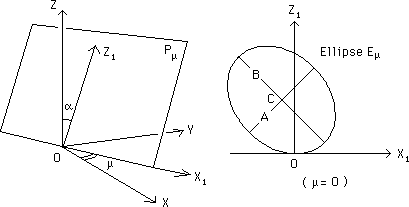
Fig.1 and Fig.2
**...**The first parameter of this analytical representation will be the angle m. The angle a will be considered as a function of m (which will be defined further on). In the plane Pm we shall now trace an ellipse tangent at O to OX1 (see figure 2). We shall take the axes of this ellipse parallel to the bisectors of X1OZ1. Let us call A(m) and B(m) the values of the axes of this ellipse. This ellipse Em will be generated by a second free parameter q.
**...**In summary, one will obtain the coordinates X(m,q), Y(m,q), Z(m,q) of the current point of the surface.
**...**In this semi-empirical approach, measurements carried out by (J.S.) on the model allowed an approach to the functions a(m), A(m) and B(m). The surface was then traced by computer "Apple-II" and cross-sections at Z = Cte were obtained, the examination of these cross-sections allowing the determination of the topological identity with the Boy surface. This could only be obtained at the cost of a numerical experimentation (J.S.) which allowed the elimination of the pairs of parasitic singularities (appearance of pairs of cuspidal points).
**...**We have been led to retain :(1)
A(m) + 10 + 1.41 Sin (6m - p/3) + 1.98 sin ( 3m - p/6)
(2)
B(m) + 10 + 1.41 Sin (6m - p/3) - 1.98 sin ( 3m - p/6)
(3)

**...**In the reference frame X1 O Z1 the coordinates of the center of the ellipse Em are :(4)

(5)

**...**In this same frame the coordinates of the current point of the ellipse are(6)

(7)

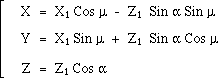
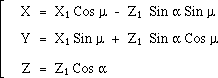
and the coordinates x , y , z are given by : (8)
Continuation
J.P. Petit and J. Souriau
.
**...**Below, the reproduction of a note to the Comptes Rendus de l'Académie des Sciences de Paris, signed J.P.Petit and J.Souriau, dating from 1981.
**...**This work has a history. Until the publication of my album le Topologicon, by Editions Belin, in the series les Aventures d'Anselme Lanturlu, in 1985, representations of the Boy surface, in specialized works, were few in number. Here and there one found photographs of models made either in plaster or in chicken wire. Charles Pugh, of the mathematics department of the university of berkeley, is the undisputed world specialist in chicken wire. It is moreover with this material that he obtained a financially substantial prize, by making the models describing the turning inside out of the sphere according to Bernard Morin, models which were subsequently digitized by Nelson Max to be transformed into a film that trails around in all the maths departments of the whole world.
**...**But I find that chicken wire remains a rather unrefined material, especially for these high-end scientific subjects. Having made the acquaintance of a visual artist named Max Sauze, I initiated myself into the technique of copper wire, at once supple and rigid, which Max welded with dexterity, managing not to heat it too much, so that this would not create parasitic tensions in the material.
**...**My friend Jacques Boulier, Alias Vasselin, was then a professor at the Beaux Arts of Aix en Provence. One year he proposed that I replace one of his professors, gone abroad, which I did, doing a half-time service with Sauze. While I invented the objects, Max welded them. Our students, circling around us, intrigued, strove to imitate us as best they could. That year this wing of the school of Beaux Arts of Aix en Provence had become a sort of mass-production factory of mathematical surfaces.
**...**If you want to set about it, it is not complicated. You need a roll of this copper wire, let us say a millimeter and a half in diameter, two maximum, and a pair of cutting pliers. With that you will be able to figure the two families of curves that make up any surface.
**...**The problem is to succeed in modeling these objects properly. To do so, it is good to be able to slide the junction points, there where the meridians" and the "parallels" cross. A good solution consists quite simply in binding the two metal wires with sewing thread. It is tight enough to give the object some hold, but slippery enough to allow deformations and adjustments.
**...**It is only when you judge that the object is mathematically in conformity with your wishes that you can entrust it to someone who handles the silver brazing with dexterity and who will know how to weld without heating the rods, which Max knew how to do with consummate art.
**...**One day I brought a prototype of the Boy surface, having discovered how the meridians and the parallels had to be arranged. Apparently, one could manage for the meridians to resemble a family of ellipses so as to be mistaken for them.
**...**Max carefully copied the object. I then turned up at Souriau's. His son (who never had the patience to finish his physics degree) was amusing himself with his father's Apple II. I said to him:
-
Jérôme, would you fancy having a pure maths publication to your name?
-
Well, why not? Who do I have to kill for that?
-
Nobody. You see this object. Take a protractor, measure these ellipses and try to build us a semi-empirical representation of this surface.
-
We can always try, give...
**...**Two days later, it was done. The article was quickly accepted by the Comptes Rendus de l'Académie des Sciences de Paris and published under both our names: J.P.Petit and J.Souriau
**...**But since the father is called Jean-Marie and the son Jérôme, all the mathematicians are convinced that it is a work that we did together, Souriau father and me.
**...**The computer plotting of the surface, using a small BASIC program of a few lines, greatly surprised lots of mathematicians, who were expecting something more complicated. The affair had an unpleasant fallout. The mathematician Bernard Morin had a doctoral student, Apéry, son of Apéry-father, author of the ineffable theorem according to which the sum of the cubes of integers is an irrational number. Among other things....
**...**I was unaware of it. Our breakthrough greatly worried Morin, all the more so since I naively asserted to him at the time that this method should make it possible to describe the four-eared surface that had made him famous, the one that had been built with his chicken wire by Pugh, then digitized by Max, etc..
Morin frowned:
- No, it's impossible! ....
**...**We'll see about that later. I remain convinced of the opposite. But this phrase was the counterpart of the famous retort that Archimedes hurled at the Roman soldier who had come to disturb him in his cogitations
- Noli tangere circuleos meos!
In French "don't touch my circles!".
Here, it was more of the "don't touch my ellipses!" kind.
**...**Subsequently Apéry exploited my discovery, according to which one could endow the Boy surface with a system of elliptic meridians, to construct the first implicit equation of the object:
f (x,y,z ) = 0
**...**Morin, furious to see me appear as a troublemaker in his own mathematical work, imposed on Apéry to specify, in his thesis, that it was Sauze who had found the ellipses trick. Max did not deny it, but it is inaccurate. The proof is in my cellar: the model that I brought to Max so that he could clean it up.
**...**In the end, all this is rather ridiculous, all in all. This anecdote is there to show that mathematicians are no more brilliant than physicists.
**...**The polytechnician Colonna, a pioneer in computer-generated images, used our equations at will, without mentioning their origin. But there is an amusing detail, known should you see images of the Boy surface on a screen. If it is "ours", it will inevitably present three slight "creases" near its pole. A defect in the adjustment of the equations. Jérôme, son of Souriau, had done that hastily and a last little touch-up, in the vicinity of the pole, would not have been amiss. That remains always doable, moreover, for whoever wants to.
**...**This saga of the Boy surface is not closed. To be complete, let us mention a character: Carlo Bonomi, an Italian billionaire. I had made his acquaintance during an expedition to the Bermuda Triangle (but this is a whole other story). We were then sailing at high speed on his yacht, of a breathtaking luxury, in search of a sunken pyramid, reported by a certain Charles Berlitz in one of his books. We did not find the pyramid, and we only just escaped being gobbled up by the many sharks that haunted those places. If you have an Atlas, the place where this blasted "Atlantean Pyramid" was supposed to be is southwest of a reef called Cay Sal Balk, fifty miles south of Cuba.
**...**Between two dives and two caviar suppers, I proposed to Bonomi to sponsor an intensive manufacture of Boy surfaces. The idea pleased him and there was a sequel. Let us say that the Boy surface that adorns the mathematics room of the Palais de la Découverte in Paris was paid for by Bonomi and made by Sauze. The financier was planning to mount an exhibition by having the objects made in solid gold wire. But the affair had no sequel. Surprised by his prolonged silence, I called his Milan offices. Alas, implicated in the P2 lodge scandal, he had been imprisoned, and his interest in topology had suffered irreversibly from it.
**...**The two-sheeted covering of a Boy surface, image of the projective P2, is a sphere S2 ( see the Topologicon ). Pugh built this covering with two layers of chicken wire, an object remarkable in every respect, although, I have said, I personally prefer copper wire and the meridians-parallels representation. But, even in pure mathematics:
- De gustibus et coloribus non disputandum.
**...**Before presenting the note, one last anecdote. Charles Pugh had therefore built seven models in chicken wire, which had earned him a substantial prize, describing the successive stages of the sphere eversion, which will be discussed when I have found five minutes to lodge that on the site, and which had been suspended from the ceiling of the cafeteria of the mathematics department of the University of Berkeley.
**...**Mathematicians from all over the world therefore came on pilgrimage to swoon before this sequence admirable in every respect. But one night, the models were stolen and no one knows what became of these seven objects, moreover strictly unsellable. What receiver would have accepted such a transaction? Unless a rich amateur, half aesthete, half mathematician, financed the operation, for the purpose of storing them in a reinforced cellar, wholly in the joy of becoming the only man able to contemplate this eighth wonder of the world, were it made of chicken wire.
**...**Pugh, despite his mastery of the material, did not have the courage to put a new series into production.
**...**As we have already said at the beginning of the site, the very life of Werner Boy remains a mystery. After having invented the surface to which he was to attach his name, he literally dematerialized, after his departure from the university. In spite of his research, Hilberth was unable to find any trace of him and it is even unknown where he was buried.
**...**Let us return to mathematics. The following note is relatively easy to read. From formulas 1 to 8 any alert high-school student will be able to construct very beautiful images and verify that the cross-sections do indeed correspond to figure 5.
C.R.Acad.Sc. Paris, t. 293 (5 October 1981) Series 1 - 269 GEOMETRY. - An analytical representation of the Boy surface. Note by Jean-Pierre Petit and Jérôme Souriau, presented by André Lichnérowicz.
An analytical representation of the Boy surface is presented, allowing it to be plotted.
1.INTRODUCTION....**The surface invented in 1901 by the mathematician Werner Boy, a student of Hilberth, is well known to mathematicians. It can intervene as the central stage of the eversion of the sphere ( [1] and [2] ).
**...**In 1979 (J.P.P) had built a wire model, highlighting the positions that the meridional lines of the surface were to occupy. A second work carried out in 1980 with the sculptor Max Sauze made it possible to reconstruct a second model in which the curves lay in planes and seemed fairly close to ellipses. From such a model it seemed possible to construct an analytical representation of a surface having the topology of the Boy surface, and whose meridians are ellipses passing through a single pole.
2. HOW TO GENERATE THE BOY SURFACE USING ELLIPSES.
**...**Let us place the pole at the origin of the coordinates. At this point the surface will be tangent to the plane (XOY). It will therefore have the axis OZ as a ternary axis of symmetry ( see figure 1 ). The meridional curves are therefore ellipses lying in planes Pm . Let OX1 be the trace in the plane XOY of a plane Pm . Let us call m the angle (OX,OX1). In this plane Pm let us place a second axis OZ1 perpendicular to OX1 . And let us call a the angle (OZ, OZ1).
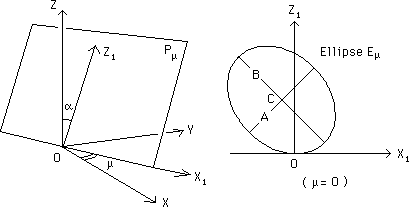
Fig.1 and Fig.2
**...**The first parameter of this analytical representation will be the angle m. The angle a will be considered as a function of m (which will be defined further on). In the plane Pm we shall now draw an ellipse tangent at O to OX1 (see figure 2) . We shall take the axes of this ellipse parallel to the bisectors of X1OZ1. Let us call A(m) and B(m) the values of the axes of this ellipse. This ellipse Em will be generated by a second free parameter q .
**...**In summary, one will obtain the coordinates X(m,q), Y(m,q), Z(m,q) of the current point of the surface.
**...**In this semi-empirical approach, measurements carried out by (J.S.) on the model allowed an approximation of the functions a(m), A(m) and B(m). The surface was then plotted by an "Apple-II" computer and cross-sections at Z = Cte were obtained, the examination of these cross-sections allowing the topological identity with the Boy surface to be determined. This could only be obtained at the cost of a numerical experimentation (J.S.) which made it possible to eliminate the pairs of spurious singularities (appearance of pairs of cuspidal points ).
**...**We have been led to retain :(1)
A(m) + 10 + 1.41 Sin (6m - p/3) + 1.98 sin ( 3m - p/6)
(2)
B(m) + 10 + 1.41 Sin (6m - p/3) - 1.98 sin ( 3m - p/6)
(3)

**...**In the frame X1 O Z1 the coordinates of the center of the ellipse Em are :(4)

(5)

**...**In this same frame the coordinates of the current point of the ellipse are(6)

(7)

and the coordinates x , y , z are given by : (8)
3. ANALYSIS OF THE RESULTS.