Les dangers de la plongée en apnée
Attention : les dangers de l'apnée !
home_fr.htm ../../apnee.htm
apnee.htm
Traduit par Benjamin ROTTIER
La plongée en apnée est une activité vieille de plusieurs siècles. Dans les épaves de galères, contenant des amphores de vin ou d'huile d'olive, découvertes près des côtes du sud de la France, où la mer atteint une profondeur de vingt-cinq mètres, de gros cailloux ont été trouvés qui n'auraient pu rouler depuis une falaise. Chacun pesait entre 5 et 10 kilos et ressemblait à une grosse pierre. Pendant longtemps, la présence de ces pierres a été un casse-tête pour les archéologues, jusqu'à ce qu'ils comprennent que, placées dans des paniers en fibres végétales, elles servaient de poids aux plongeurs pour descendre dans la cale des navires échoués, dans le but d'essayer de les remonter.
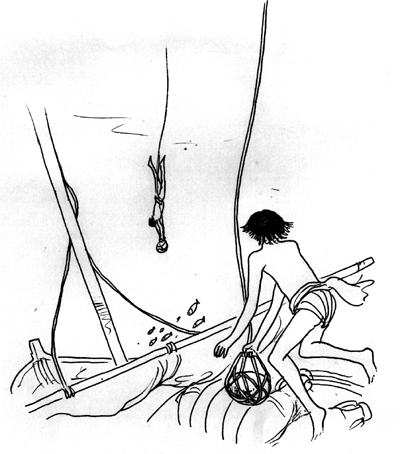
À l'époque, le propriétaire du navire, quand c'était possible, tentait déjà de remonter sa cargaison précieuse, lorsque la mer n'était pas si profonde. À cette époque, les vies humaines n'avaient pas grande valeur.
En dictionnaire, l'apnée est définie comme une interruption volontaire de la respiration. Mais que se passe-t-il lorsque vous retenez votre respiration ? Très vite, après quelques dizaines de secondes, vous ressentez une douleur intense d'étouffement, qui devient rapidement insupportable et vous oblige à reprendre votre respiration. La cause de ce sentiment est l'augmentation du taux de dioxyde de carbone dans votre sang (ou, plus précisément, de la pression partielle de dioxyde de carbone ; la différence sera expliquée ci-dessous).
Que pouvez-vous faire pour prolonger le temps d'apnée ? Il existe trois façons de procéder :
- la première consiste à contrôler ce sentiment d'étouffement. C'est ce que font certains plongeurs, en utilisant des techniques ressemblant au Yoga (les mêmes qui permettent par exemple de contrôler une douleur) ;
- la deuxième consiste à introduire le maximum d'air dans vos poumons avant de cesser de respirer, par exemple pour plonger ;
- la troisième consiste à hyperventiler avant une plongée.
Pour prolonger le temps de plongée en apnée, la troisième méthode est de loin la plus efficace ; mais elle est aussi la plus dangereuse. Voyons pourquoi ! Pour hyperventiler, le plongeur respire de façon saccadée pendant une durée plus ou moins longue. En faisant cela, il ne prend pas nécessairement une inspiration profonde, mais il ventile efficacement ses poumons : il évacue l'air résiduel et le remplace par de l'air frais. Il est connu que, lorsqu'on respire normalement, tout l'air contenu dans les poumons n'est pas remplacé à chaque expiration-inspiration. Ce mécanisme est contrôlé par les muscles : le diaphragme, et dans une moindre mesure les muscles qui abaissent et soulèvent les côtes. Mais cette technique a ses limites. En faisant cela, vous ne pouvez pas vider totalement vos poumons. En ventilant le volume pulmonaire en pantant, vous remplacez presque tout l'air. Ainsi, les poumons contiennent un fluide identique à l'air ambiant, et non plus à la combinaison de l'air inhalé et de l'air résiduel chargé de dioxyde de carbone, résultant des respirations précédentes.
Pour le dire clairement : l'hyperventilation réduit la quantité de CO2 contenue dans l'air pulmonaire. L'hémoglobine est une molécule du sang capable de capturer et de transporter à la fois l'oxygène (oxy-hémoglobine) et le dioxyde de carbone. L'hyperventilation réduit donc non seulement la quantité de CO2 dans les poumons, mais aussi sa quantité dans le sang.
Vous ne pouvez pas augmenter le pourcentage d'oxygène contenu dans l'air atmosphérique (20 %, le reste étant de l'azote), mais vous pouvez augmenter sa quantité dans le sang. Si vous continuez l'hyperventilation après quelques dizaines de secondes, vous ressentirez des étourdissements ; ce phénomène est l'expression de l'enrichissement du sang en oxygène. Si vous retenez votre respiration, à la surface ou à un mètre de profondeur, dans une piscine, en restant parfaitement immobile, vous serez surpris par la hausse de votre temps d'apnée. Des temps d'apnée d'une minute peuvent ainsi être atteints assez rapidement. Avec une formation, beaucoup d'hommes peuvent atteindre une minute, sans le moindre effort. Le maximum humain est d'environ 4 minutes, pour les détenteurs du record dans cette spécialité.
Pourquoi êtes-vous capable de tenir si longtemps sans respirer ?
Ce n'est pas tant parce que vous avez chargé votre sang en oxygène que parce que vous l'avez appauvri en dioxyde de carbone avant l'apnée. Or, le CO2 est précisément un signal d'alarme. Le danger réside dans l'évanouissement qui survient lorsque le niveau d'oxygène dans le sang descend en dessous d'un seuil critique. C'est extrêmement dangereux, car il n'y a pas de signe précurseur comme un malaise. C'est instantané et fait perdre conscience au plongeur, sans reprise de l'activité respiratoire. Une personne noyée de cette manière gardera ses poumons secs. C'est ainsi que fonctionne l'apnée après une hyperventilation. Un plongeur utilisant cette technique améliore considérablement ses performances, mais en contrepartie, il éteint son dispositif d'alerte (le sentiment d'étouffement dû à la montée du niveau de CO2 dans son sang). Il peut s'évanouir sans ressentir la moindre sensation d'étouffement.
L'apnée est principalement utilisée pour les plongées libres. Dans ces conditions, le plongeur se pose la question suivante :
- Puisque je souhaite atteindre une certaine profondeur, dois-je nager énergiquement pour atteindre cette profondeur aussi vite que possible pendant le temps d'apnée donné, ou au contraire dois-je minimiser mes efforts, tant lors de la descente, en profondeur que lors de la remontée ?
La deuxième solution est la bonne. Un apnéiste doit nager, plonger, glisser en étant économique dans ses mouvements : aucune mouvement brusque, aucun effort musculaire intense n'est permis (ils sont corrélés à une augmentation de la consommation d'oxygène). Le plongeur, soigneusement lesté, doit descendre et remonter lentement, sans hâte. L'utilisation d'un combinaison de plongée est essentielle, sauf si vous plongez dans une eau très chaude. La lutte contre le froid est en effet accompagnée d'une forte augmentation de la consommation d'oxygène.
Tout effort inutile doit être évité, tout comme toute consommation inutile. En ce sens, l'activité intellectuelle, le simple fonctionnement du cerveau, consomme beaucoup d'oxygène. Cela n'est pas négligeable. Si vous réalisez des expériences d'apnée, vous serez surpris de constater une réduction significative de vos résultats si vous faites des calculs complexes. Ainsi, inconsciemment ou consciemment, l'apnéiste s'habitue à ne pas penser pendant la plongée. S'il parvient à ne penser à rien, ses performances seront meilleures. En faisant cela, il utilise inconsciemment les rudiments des techniques de méditation (bouddhiste, hindouiste, yogi).
Les maîtres qui encouragent leurs disciples à méditer leur disent : « supprimez le flux de vos pensées ». Que se passe-t-il alors ? Je n'ai pas la capacité de vous le dire. Soit la méditation plonge les êtres humains en contact avec une activité mentale transcendante, change leur état de conscience, soit les cerveaux envoient de l'oxygène vers des centres habituellement moins alimentés (les centres de pensée consciente, qui reçoivent normalement l'oxygène en premier). Le résultat est un sentiment de bien-être, que tout plongeur en apnée ressent. Une apnée efficace est synonyme de bien-être, sinon elle n'est pas efficace, tout simplement parce qu'elle ne peut être réalisée qu'état de non-pensée.
Avant d'atteindre l'éveil spirituel, ou le nirvana, grâce à l'absence de pensée, l'apnéiste aime se comporter ainsi spontanément, ce qui peut vous faire du bien quand vous êtes stressé ou obsédé. Bien sûr, la plongée en apnée vous permet également de découvrir la beauté des paysages sous-marins. Mais les dimensions mystiques qu'elle a pour de nombreux plongeurs reposent sur une réalité objective, dont peu sont conscients.
Du point de vue de la capacité de la machine physique, les plongeurs peuvent atteindre une profondeur de 30 mètres, en effectuant une apnée d'une minute et demie ou deux minutes. Certains « particulièrement doués » peuvent même aller plus loin. Cette activité est comme une roulette russe. Ces « super-hommes » ne font que réduire imprudemment l'écart qui les sépare d'un évanouissement fatal.
Alors, que pouvez-vous faire ? Décidez une fois pour toutes que la plongée en apnée est une activité extrêmement dangereuse, ou essayez de trouver un compromis ?
Avant de s'aventurer dans les chiffres, il faut être informé. La fatigue, par exemple, augmente considérablement les risques : cela peut aussi être le surmenage, le manque de sommeil, toute cause de fatigue.
Quand j'avais environ 20 ans, je faisais des plongées en apnée pendant les vacances. En hiver, je me rendais parfois dans une piscine de 50 mètres de long (la piscine des Tourelles, à Paris). J'étais assez en forme, et je pouvais ainsi traverser la piscine à un mètre de profondeur, avec des palmes (ce qui équivalait à plonger à 20 mètres de profondeur et à remonter à la surface). Une apnée à une telle faible profondeur peut sembler sûre. Grave erreur ! À l'époque, je préparais sérieusement les examens d'entrée dans les Grandes Écoles. Je dormais très peu et travaillais beaucoup. Je pensais que nager me ferait du bien. Je commençais à plonger dans la piscine déserte. J'avais fait cela souvent, mais seulement quand j'étais en forme ; ce jour-là, j'étais un peu fatigué. Par chance, je nageais vers l'extrémité peu profonde. Je n'ai jamais atteint le bord de la piscine. À environ 40 mètres, j'ai fait un évanouissement, instantanément, sans aucun signe précurseur. Je n'ai aucun souvenir de l'événement. Je suppose qu'on m'a trouvé, sans vie, flottant sur l'eau, et qu'on a donné l'alerte. Je me suis réveillé au bord de la piscine, ayant été réanimé par le gardien de piscine.
Imaginez ce qui se serait passé si j'avais nagé dans l'autre sens. La piscine des Tourelles dispose d'un plongeoir de dix mètres de haut ; il surplombe l'extrémité profonde, qui atteint cinq mètres de profondeur. Si j'avais plongé vers l'extrémité profonde, j'aurais pu aller plus loin avec mon élan et m'évanouir à ce moment-là. La flottabilité du corps humain dépend de la profondeur à laquelle il se trouve. Même avec les poumons pleins d'air, la pression les comprime, ce qui réduit la poussée d'Archimède de manière équivalente.
Comme j'ai fait un évanouissement à un mètre de profondeur, je suis revenu naturellement à la surface, en gardant l'air dans mes poumons, même si j'en ai perdu un peu en chemin. À quelques mètres sous l'eau, je serais descendu tout droit ; je n'aurais pas été aussi facile à repérer, et quand quelqu'un m'aurait vu au fond de la piscine, il aurait été trop tard.
Dès qu'un évanouissement survient, les cellules du cerveau ne sont plus alimentées en oxygène. Le problème est que leur autonomie n'est pas très grande. Si des personnes noyées ont parfois été sauvées après un temps de plongée significatif, dans une eau glacée, c'est encore exceptionnel. On peut considérer qu'une personne qui n'a reçu aucun oxygène pendant environ 5 à 10 minutes est tout simplement morte, pour de bon.
Vous avez peut-être remarqué que lorsque les secouristes pratiquent une réanimation bouche-à-bouche sur une personne noyée, ils ventilent ses poumons non pas avec de l'air atmosphérique, mais avec l'air qu'ils expulsent. Ainsi, ils espèrent que cela entraînera plus rapidement la reprise du réflexe respiratoire, qui est contrôlé par le niveau de dioxyde de carbone.
Pourquoi avons-nous une « tendance » à respirer ? Tout simplement parce que, avec le temps, le taux de CO2 dans le sang augmente, et quand il dépasse un seuil, le bulbe rachidien, qui reçoit l'information, déclenche immédiatement le mouvement d'inspiration. Sinon, les gens devraient décider consciemment de respirer, ou alors ils s'évanouiraient.
Toute fatigue, comme nous l'avons vu ci-dessus, augmente les dangers liés à l'apnée, qui sont toujours présents. C'est la même chose pour le froid. Dans une eau plus froide, la fréquence cardiaque augmente, tout comme le métabolisme des cellules. Pour remplir son rôle de pompe, le cœur consomme aussi un oxygène précieux. Dans une eau froide, même avec un combinaison, les résultats doivent être revus à la baisse. Le problème extrêmement sérieux de l'apnée est que personne ne peut savoir à un moment donné et dans un certain contexte où se situe la limite. La question « combien de temps puis-je rester en apnée avant de m'évanouir aujourd'hui, avec mon état physique, dans cette eau ? » ne peut être répondue que si... vous l'avez vécu. Il est très probable que beaucoup de personnes aient été à une fraction de seconde de la mort sans même s'en rendre compte.
Pendant la plongée, chaque effort soudain entraîne une surconsommation d'oxygène susceptible de faire chuter son niveau en dessous du seuil fatal. C'est ainsi que mon ami Josso est décédé, il y a 40 ans en Corse. Nous avions été élèves ensemble à l'École Supérieure de l'Aéronautique à Paris en 1960. Josso était habitué à plonger avec la famille Roubaix. Madame de Roubaix avait été championne féminine de harponnage. Tous avaient une passion pour le harponnage et la mer près de la Corse était riche, comme elle ne l'est plus aujourd'hui. Josso plongeait raisonnablement. C'est du moins ce qu'il pensait. Mais un jour, alors qu'il était à une douzaine de mètres de profondeur, il a harponné un mérou qui était niché sur une pierre. Josso s'est glissé dans une crevasse et a fait des efforts pour tirer le poisson de sa cachette. La consommation d'oxygène nécessaire a provoqué un évanouissement fatal.
Un plongeur bien entraîné peut atteindre une profondeur de 15 ou 20 mètres si quelqu'un d'autre est à proximité, qui ne le quitte pas des yeux et est prêt à l'aider immédiatement (sans constituer une deuxième personne noyée). Les championnats de harponnage ne peuvent pas se faire à 10 mètres de profondeur. Une eau bien fournie en poissons, surtout dans nos régions, correspond à des profondeurs plus importantes. Les concurrents plongent généralement en tandem. Chaque membre de l'équipe plonge à tour de rôle, surveillé par l'autre. Mais la plongée en apnée solo à grande profondeur n'est rien d'autre qu'une roulette russe.
Nous avons mentionné ci-dessus la pression partielle de l'oxygène. En réalité, le taux de transfert de l'oxygène dans le sang dépend de la densité relative des molécules proches des cellules sanguines. Plus la densité est élevée, plus le transfert est intense ; c'est assez logique. Ainsi, lorsque les plongeurs professionnels descendent très profondément (plus de 100 mètres), ce qu'ils utilisent pour respirer est un mélange où le pourcentage d'oxygène est nettement inférieur au taux habituel de 20 %, sinon l'oxygène deviendrait trop oxydant. Dès le début des plongées avec équipement respiratoire, des personnes qui voulaient plonger avec de l'oxygène pur dans leurs bouteilles ont eu des convulsions. Lorsque sa concentration est trop élevée, l'oxygène agit comme un toxique.
Lorsqu'un plongeur descend en apnée à 20 mètres de profondeur, il est soumis à une pression trois fois supérieure à la pression atmosphérique. Le sang peut donc encore être oxygéné, même si l'oxygène est moins abondant dans l'air contenu dans les poumons. L'apport d'oxygène reste stable avec un air plus pauvre car la pression est trois fois plus élevée, et donc la densité des molécules d'oxygène est aussi trois fois plus élevée.
La situation est inversée lors de la remontée. Le corps humain réagit non seulement à la baisse du niveau d'oxygène dans le sang, mais aussi à la chute de l'apport d'oxygène. En fait, lorsqu'un plongeur remonte, il passe d'une pression trois ou quatre fois supérieure à la pression atmosphérique à une pression proche d'une atmosphère juste sous la surface. Le flux sanguin alors diminue. C'est pourquoi une grande partie des évanouissements mortels se produisent lors de la remontée. Certains spécialistes parlent même d'un « rendez-vous d'évanouissement à 9 mètres ».
Ainsi, lorsqu'il est en profondeur, et même si l'oxygène contenu dans ses poumons ne lui permet pas de remonter vivant à la surface, le plongeur se sent très bien. S'il pense être un surhomme, il ne prendra pas la décision de remonter assez tôt, et paiera de sa vie sa négligence.
À partir de quelques mètres de profondeur, la compression de l'air (contenu dans les poumons ou dans les alvéoles du combinaison) lui donne une flottabilité négative. Celui qui s'évanouit en remontant ne parviendra pas à la surface, mais descendra tout droit.
Soit clair. Si vous devez retenir quelque chose de cet article : la plongée en apnée à grande profondeur n'est pas un sport, mais une chose stupide et sanglante. L'apnée n'a pas progressé. La machine humaine est toujours la même. Il suffit de ne pas rester suffisamment loin du désastre, par exemple à une minute de lui, pour que les gens s'en approchent de façon téméraire et morbide. Les adeptes des apnées longues ou des apnées solos à grande profondeur sont tout simplement des personnes qui flirtent avec la mort, en resurgissant quelques secondes avant l'évanouissement fatal, qu'elles le sachent ou non.
Au mieux, vous serez averti et vous sortirez indemne. Au pire, ce sera irrémédiable.
Il y a environ quinze ans, une véritable folie pour la plongée libre à grande profondeur a éclaté. Deux hommes sont directement responsables de ce phénomène. Le premier est le plongeur Jacques Mayol, le second le réalisateur Luc Besson.
Dès que la plongée en apnée s'est développée, juste après la Seconde Guerre mondiale, les gens voulaient savoir « *jusqu'où pouvons-n
Voir un jeune plongeur effectuant des apnées à 30 mètres de profondeur près d’eux ne préoccupait pas ces trois hommes, âgés de cinquante à soixante ans. Ils se sont simplement enfoncés davantage, sans plus se soucier de lui. Après la plongée, ils sont remontés en effectuant leurs étapes de décompression. Ce n’est qu’une fois tous leurs équipements retirés que Vogel a posé la question à Ebersoldt, pour la première fois, sur « le plongeur ».
- Non, je ne l’ai pas vu depuis un moment, a répondu le jeune homme (le bateau était à plusieurs kilomètres de la côte).
Paniqués, les trois hommes se sont remis leur équipement, tout en essayant de positionner le bateau au-dessus du naufrage grâce aux repères côtiers (marqueurs pris au rivage). Pendant ce temps, ils avaient lâché l’ancre et le bateau s’était déplacé. Quand ils ont récupéré le corps de mon fils, il était trop tard, malgré les efforts du docteur Saint Jean.
Bien que j’aie été successivement en contact avec les quatre plongeurs, je n’ai jamais obtenu de version cohérente de l’accident. Vogel, qui semblait d’abord très sûr de lui, a commencé à cacher la présence du quatrième plongeur (le Brésilien) à mon égard (Il y avait trois de nous : Saint Jean, Ebersoldt et moi...). L’Allemand, avec lequel j’ai parlé au téléphone, a hésité quand je lui ai demandé dans quelles conditions il avait pris une photo de mon fils mort étendu sur le pont du naufrage, une photo que Vogel m’avait envoyée par courrier. Je connaissais l’existence de ce quatrième plongeur grâce au docteur Saint Jean. Lorsque j’ai eu une autre conversation avec Vogel, il s’est troublé (Ah oui, je me souviens maintenant, il y en avait quatre...). Bien sûr, mon fils n’a pas été victime d’intentions criminelles, mais il était clair pour moi que ces quatre-là n’étaient pas très fiers de ce qui s’était passé ce jour-là.
On ne peut pas réécrire le passé ni ramener les gens à la raison. Mais à ce moment-là, quatre plongeurs expérimentés, loin d’être des débutants, dont l’un était médecin, considéraient les plongées solo en apnée à grande profondeur comme un événement banal, ne suscitant aucune réaction.
Cet accident a été suivi par bien d’autres, partout dans le monde. Mayol a poursuivi sa croisade pour la plongée en apnée. Aucun journaliste n’a pris intérêt à cette question. Au contraire, les reportages télévisés montraient divers exploits en apnée, comme Nicolas Hulot volant en microlight sans casque de sécurité. Je me souviens d’un homme qui a démontré qu’il pouvait rester quatre minutes sous l’eau dans une piscine. C’est suffisant pour susciter des vocations...
Nous devons maintenant tirer une conclusion. L’apnée est-elle dangereuse ? Devrions-nous l’interdire ?
Nous avons vu que le danger est toujours présent, celui d’un évanouissement survenant sans aucun signe précurseur.
Ce danger est multiplié par dix si le plongeur est fatigué ou si l’eau est froide. La plongée en apnée comme « sport extrême » est une aberration totale, comparable au roulette russe. La machine humaine n’a pas évolué. Au lieu de pratiquer cette activité à une bonne distance de l’évanouissement, par exemple en limitant drastiquement les temps d’apnée à environ 30 secondes, même pour les plongeurs les plus « doués » ou entraînés, les « champions » ne flirtent qu’avec la mort.
En bonne forme, après une introduction progressive, avec un bon équipement (notamment une combinaison néoprène protégeant du froid) : 30 secondes, 10 mètres, plongée en tandem, toujours en gardant un œil sur son partenaire, c’est raisonnable. Veillez à attendre au moins cinq minutes avant de replonger, pour vous reposer. En outre, limitez le temps que vous consacrez à cette activité, car la plongée en apnée est assez épuisante. Si vous êtes en forme, une apnée intensive peut elle-même vous mettre en danger sérieux en vous épuisant.
Le problème sérieux est que les médias ne s’intéressent absolument pas à ce sujet, surtout avant l’été, alors qu’ils devraient avertir les plongeurs. C’est tout aussi grave que des journaux, des hommes (Mayol), des cinéastes (Besson) participent à encourager les jeunes à jouer imprudemment avec leur vie. Il serait vain d’espérer qu’un film culte comme Le Grand Bleu soit précédé d’un court message d’avertissement à l’écran. Mais les décès n’attirent pas l’attention des médias. Les gens parlent plutôt d’un « sport extrême ». Personne ne montre les corps pâles des noyés ou les corps disloqués des amateurs d’ascension à mains nues. Quand une personnalité connue meurt en pratiquant ce genre d’activité, on se hâte de dire qu’elle est morte « comme elle le voulait » et on jette un peu de sciure sur le sang qui tache le ring après que l’acrobate est tombé, aveuglé par le reflet des projecteurs. Étrange façon de faire rêver.
Quelques mois après la mort de mon fils, dans le Sud de la France, j’ai rencontré un jeune boulanger habitué à harponner en eau profonde. Il plongeait souvent à 30 mètres de profondeur et participait à des compétitions, donc il s’entraînait régulièrement avec son partenaire. Peu de temps après notre rencontre, il a été retrouvé, juste à temps, sans vie, au fond d’un fond à 30 mètres. Il n’était plus nécessaire de le prévenir une fois de plus.
Cet homme a eu de la chance.
Ces morts qui arrivent
Quand mon fils est mort, pratiquant des apnées à 30 mètres de profondeur, il a laissé un numéro de la revue Apnea contenant un article présentant les apnées à grande profondeur. Quand on voit les risques encourus en voulant pratiquer une telle activité, on a le droit de se demander ce qui pousse les jeunes à continuer. Bien sûr, l’impact énorme de Le Grand Bleu : quand le film est sorti à l’écran, il y a eu une forte augmentation des accidents liés à l’apnée, dans tous les pays. Dans un de ses derniers numéros, la une de la revue Apnea disait : « Le Grand Bleu, 10 ans après ».
Il est indéniable que l’apnée a quelque chose de fascinant. Le problème est que ceux qui pensent, comme Pierre Vogel il y a dix ans, que « l’apnée a fait beaucoup de progrès », ignorent généralement les risques qu’ils courent. Les fédérations conseillent bien sûr de plonger en tandem, un partenaire étant toujours susceptible d’aider un plongeur qui s’évanouit. Mais il ne peut pas sauver le plongeur dans toutes les circonstances. J’ai lu dans Apnea que certains plongeurs chassent effectivement à partir d’un abri, à une profondeur de 38 mètres. Quel partenaire de team serait capable de sauver un chasseur harponneur qui s’évanouit à une telle profondeur ? Rappelez-vous, l’évanouissement est instantané, sans aucun signe précurseur. La victime n’a aucun moyen de déclencher un dispositif de secours.
Examinons un peu le problème du sauvetage d’une personne qui s’évanouit à grande profondeur. À 30 mètres de profondeur, le corps humain et la combinaison néoprène sont soumis à une pression de quatre atmosphères. La combinaison néoprène contient de l’air. Celui qui a déjà plongé se souvient de sa surprise en voyant sa combinaison de 6 millimètres réduite à l’épaisseur d’un carton à 60 mètres de profondeur, à cause de la pression.
À 30 mètres de profondeur, le volume de chaque gaz (l’air contenu dans les poumons comme dans la combinaison) est réduit à un quart. Même si le plongeur est lesté pour avoir une flottabilité positive à la surface, il aura une flottabilité négative en profondeur et devra faire des efforts pour remonter. Cette flottabilité négative représente environ quelques kilogrammes.
Si un secouriste tente de remonter son partenaire inanimé depuis une profondeur de 30 mètres, non seulement il sera au bord de ses propres capacités, mais il devra aussi tirer un poids double en remontant. Bien sûr, il peut lâcher les deux ceintures de plomb, mais dans de telles situations tragiques, tout le monde est-il capable de garder son sang-froid ? Les plongeurs qui descendent avec un ami se sont-ils jamais posé cette question ? Combien ont fait l’effort de vérifier si le sauvetage d’un plongeur évanoui était possible ?
Après avoir mis ce document sur l’apnée en ligne, un journaliste du Octopus m’a contacté. L’un de ses meilleurs amis était habitué à harponner en profondeur en tandem. Il a soudainement fait un évanouissement et son partenaire n’a pas pu le ramener à la surface. Il a choisi d’alerter un bateau qui passait à proximité pour demander de l’aide, mais celui-ci est arrivé trop tard. Rappelez-vous que les neurones ne supportent pas une anoxie plus de 10 minutes : c’est très court !
Quand on voit les risques qu’on prend, pourquoi courir après les résultats ? Si vous lisez une revue comme Apnea, vous apprendrez que le record incontesté d’apnée statique est maintenant dépassé... depuis plus de sept minutes. Au fait, à quoi ressemble une compétition d’apnée statique ?
Voilà ! Vous voyez les concurrents allongés sur le ventre dans le fond peu profond d’une piscine, ou plus précisément dans son bassin de natation, qui fait 30 centimètres de profondeur. Pendant l’opération, leurs dos émergent. Le meilleur résultat enregistré lors de la compétition ci-dessus était de 6 minutes 22 secondes. Quand je vois cette photo, je me demande quel intérêt il y a à utiliser une piscine. Un vestiaire ordinaire ne ferait-il pas l’affaire ?
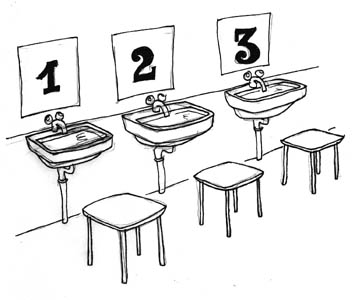
Juste au-dessus, des installations olympiques où les concurrents n’auraient qu’à plonger leur visage dans les lavabos.
Pour être honnête, le monde de la plongée doit continuer. Beaucoup de choses ont changé au cours des dernières décennies. Il y a quelques jours, j’ai fait une plongée loin du rivage, dans un endroit très réputé (les îles de Marseille, précisément le récif des Émaillades), où autrefois on pouvait admirer de splendides éponges, des roses de mer (retepora cellulosa) et de nombreuses merveilles que contient la mer. Je n’ai trouvé que des fonds désolés, ratisser par des générations de plongeurs étudiants, chacun ayant voulu rapporter un petit quelque chose de sa plongée. Je ne parle même pas de la faune, qui aujourd’hui n’a plus rien à voir avec ce qu’elle était dans les années 50, ou même dans les années 60. Je ne sais pas si ces fonds retrouveront un jour leur richesse d’antan.
Pour ne pas revenir les mains vides, les plongeurs harponneurs ont été les premiers à atteindre des profondeurs plus importantes. Autrefois, le plongeur en apnée vivait dans un monde peuplé de faune et de flore fantastiques. À dix ou quinze mètres de profondeur, il y avait une véritable jungle où l’on pouvait rencontrer des résidents de grande taille. Aujourd’hui, il n’y a plus de grandes éponges, l’une des spécialités de la Méditerranée, ni de nacre (certaines mesuraient un mètre de long). Les habitants typiques de la mer sont désormais... les oursins. Ainsi, un nouveau sport a été promu : l’apnée, considérée comme une activité en soi. Sans le puissant sponsoring des marques (montres étanches, équipements sous-marins...), ces exploits n’auraient pas eu un tel retentissement. Plus haut, nous avons mentionné le pionnier de cette « discipline » : Jacques Mayol, originaire de Marseille. Accroché à son porc, il atteignait une profondeur de 100 mètres. Nous ne sommes plus là. Les exploits, selon le numéro d’avril de Apnea, se sont d’abord progressivement développés. Après le mur spectaculaire des 100 mètres, les progrès ont été limités : 102 mètres, puis 104 mètres, etc.
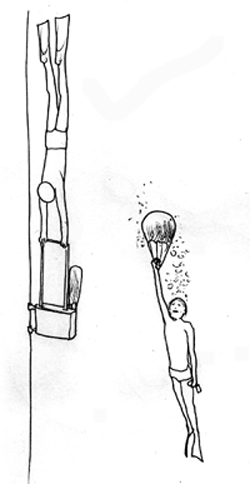
Les gens et les médias se sont lassés de ces petits pas. Comme vous pouvez le lire dans ce numéro de Apnea, page 66 : « Deux mètres de plus ne rapportent plus d’argent ». Celui qui dit médias dit publicité. Les sponsors exigeaient des progrès plus spectaculaires. Le leader de cette discipline est Francisco Ferreiras, surnommé « Pipin ». Plonger avec un porc, remonter suspendu à un ballon.
Une simple remarque : cela revient à comprimer un homme sous dix-sept atmosphères en une minute et demie, puis à le décompresser dans le même temps. Mais la photo d’un humain plongeant vers les plaines abyssales, attaché à son poids, est plus fascinante, et disons-le, plus morbide. Les gens adorent les jeux de cirque.
Le 15 janvier 2000, Pipin a tenté pour la première fois de descendre à 162 mètres. Il avait ajusté une technique consistant à noyer ses sinus. Mais le temps était très mauvais et un léger courant l’a fait dériver pour atteindre son point de départ. Les plongeurs d’assistance étaient déjà en bas, mais ils ne peuvent pas rester longtemps à de telles profondeurs à cause de la durée des étapes de décompression que notre kamikaze en apnée n’a pas besoin de faire : sa plongée est bien trop courte pour que l’azote se dissolve dans son sang. « Pipin n’a qu’une minute pour respirer ! » (entendez : pour désactiver son dispositif d’alerte contrôlé par la montée du niveau de CO2 dans le sang, voir ci-dessus). Il plonge, mais il s’évanouit à quatre mètres de la surface (« Cela était dû à l’effort qu’il avait fourni avant sa tentative »).
Peu importe ! L’équipe médicale estime qu’il peut essayer à nouveau le lendemain. Et le lendemain, voilà le exploit. Selon Pipin, « c’est une invitation ouverte à atteindre 200 mètres », grâce à sa technique de noyade des sinus qu’il a juré de révéler, ce qui rend la compensation bien plus rapide. Dans ces conditions, avec un réservoir lesté à l’hydrodynamisme, pourquoi ne pas envisager un jour atteindre 300 mètres, voire plus ?
Ainsi, l’avenir semble prometteur. Les médias vont suivre, ainsi que les sponsors. Beaucoup de gens vont acheter les palmes ou la combinaison néoprène avec lesquelles Pipin a établi son record.
L’apnée statique s’est développée. Aujourd’hui, de nombreuses villes voient des gens se réunir en clubs, posant leur nez au fond des bassins municipaux de natation. Fédération, reconnaissance officielle, rencontres, couverture médiatique... Tout le monde peut rêver de devenir un jour détenteur du record, de connaître les feux de la rampe. Pas besoin d’avoir de gros muscles, un bon départ : tout est dans la tête.
- La sécurité n’est pas un marché rentable...
Les réactions :
Quelques jours après avoir mis ce texte sur mon site, j’ai reçu des réactions, toutes favorables. Les premières venaient de jeunes gens écrivant « Monsieur, mes amis et moi avons pratiqué des plongées en apnée à grande profondeur. Nous ne connaissions pas tout cela, et nous réalisons maintenant que nous avons dû être plusieurs fois très près de la mort sans même le savoir ».
Une école de plongée m’a dit qu’elle avait mis un lien depuis son site vers le mien, pour l’éducation de ses membres. Elle a souligné le fait que les clubs de plongée ont tiré parti de l’impact de Le Grand Bleu, car ils ont vu une forte augmentation du nombre d’adhérents.
Certes, mais l’augmentation des accidents mortels liés à l’apnée peut être estimée à plus de cinq cents pendant l’année suivant la sortie de ce film, avec environ cinquante décès en France.
Grâce à un lecteur, Laurent Latxague, cet article a été reproduit dans le numéro d’août de OCTOPUS. Il est vrai qu’un des journalistes avait perdu son meilleur ami dans un accident d’apnée. Il harponnait en profondeur, surveillé par son partenaire. Après une plongée trop longue, il s’est évanoui en remontant et est tombé au fond ; son partenaire n’a pas pu le ramener à la surface. Il a alors cherché de l’aide, mais en vain. J’espère que la diffusion de ce texte a sauvé des vies pendant l’été dernier. J’espère aussi qu’une entreprise de matériel de plongée s’intéressera à ce projet de système de secours pour un plongeur en apnée qui s’est évanoui. Aujourd’hui, chaque plongeur fixe ses bouteilles sur une veste gonflable. Autrefois, les Mae West étaient un luxe encombrant ; elles sont maintenant bien plus sobres. Pourquoi les plongeurs en apnée n’auraient-ils pas droit à la sécurité aussi ?
18 mai 2000
Un courrier de Monsieur Duhamel, vivant à Saint-Maur (France) : *
Cher Monsieur,
Je suis très surpris de constater que j’ai vécu la même expérience que vous quand j’étais à une Grande École d’Ingénieurs. J’avais l’habitude de nager 50 mètres sous l’eau dans une piscine. Un jour, dans la piscine de Saint-Ouen, je suis resté allongé au fond (comme vous, au fond peu profond), sans m’en rendre compte. Je me souviens que j’ai dû me forcer un peu pour atteindre l’extrémité de la piscine, puis je me suis réveillé allongé au bord. Pendant ce temps, un ami qui avait suivi ma démonstration s’est étonné de me voir rester sous l’eau alors que j’avais atteint l’extrémité. Il a d’abord pensé que je gardais encore un peu d’air, puis, comme je ne bougeais pas, il a appelé le surveillant qui m’a sauvé. Comme vous, je suis un survivant de l’apnée. *
Novembre 2000
J’ai reçu un courrier d’un membre du conseil de la Fédération Française de Harponnage. Il m’a d’abord rappelé quelque chose de très important. Autrefois, les plongeurs en apnée pratiquaient des hyper-ventilations, c’est-à-dire qu’ils respiraient rapidement avec une pause de deux secondes, pendant une ou deux minutes. C’est très efficace pour renouveler tout l’air contenu dans les poumons, qui a un taux de dioxyde de carbone plus élevé que l’air ambiant. Quand vous faites une telle hyper-ventilation, vous le savez quand vous ressentez des étourdissements. En faisant cela, vous mettez le sang en contact avec cet air plus pauvre en CO2 ; par conséquent, le niveau de CO2 dans le sang diminue, mais c’est précisément ce niveau qui vous fait ressentir le « manque d
Version originale (anglais)
Apnea diving hazards
Warning: Mind apnea dangers!
home_fr.htm../../apnee.htm
apnee.htm
Translated by Benjamin ROTTIER
Apnea diving is an age-old activity. In wrecks of galleys, that were containing amphoras of wine or olive oil, discovered near the coasts of the South of France, where the sea is twenty-five meters deep, big stones were found that couldn't have rolled down from a cliff. Each was 11 to 22 lbs in weight, and looked like a big pebble. For a long time, the presence of those stones has been a headache for archaeologists, until they realized that put into rope baskets made of vegetable fibres, they were used as a weight for divers to go down into the hold of sunk ships to try to do raising operations.
At that time the ship-owner, when it was possible, already attempted to raise his valuable cargo, when the sea was not so deep. In those days, human lives were not worth much.
Apnea, in a dictionary, is defined as a voluntary stop of breathing. But what happens when you hold up your respiration? Very soon, after a few dozens of seconds, you'll feel a painful sensation of asphyxiation, that becomes quickly unbearable and forces you to breathe again. The cause of this feeling is the increase of the level of carbon dioxide in your blood (or, more precisely, of the partial pressure of carbon dioxide; the difference will be explained below).
What can you do to increase the time of apnea? There are three ways to go about it:
- the first one consists in controlling this asphyxiation feeling. That's what some divers do, using techniques ressembling Yoga (the same that would allow e.g. to control a pain);
- the second one consists in putting the maximum volume of air into your lungs before you stop breathing, e.g. for diving;
- the last one consists in doing a hyper-ventilation before a dive.
To increase the time of an apnea dive, the third way is by far the most efficient; but it's the most hazardous too. Let us see why! For hyper-ventilating himself, the diver will be gasping for a more or less long time. Doing this, he does not necessarily take a powerful inspiration, but he is ventilating his lungs efficiently: he evacuates the residual air and replaces it with some fresh air. It's known that when you're breathing normally, all the air contained in your lungs will not be replaced at each exhalation-inspiration. This mechanism is controlled by muscles: the diaphragm, and to a lesser extent the muscles that put down and lift the ribs. But the technique has its limits. Doing this, you won't be able to empty your lungs totally. When you're ventilating the pulmonary volume by panting, you replace nearly all of the air. So the lungs will contain a fluid that is identical to the surrounding air, and no more to the combination of the inhaled air and the residual air, loaded with carbon dioxide, as a result of the previous respirations.
To put it clearly: hyper-ventilation reduces the amount of CO2 contained in the pulmonary air. The haemoglobin is a blood molecule able to catch and to carry both the oxygen (oxy-haemoglobin) and the carbon dioxide. The hyperventilation reduces thus not only the amount of CO2 in the lungs, but also its amount in the blood.
You can't increase the percentage of oxygen contained in the atmospheric air (20 %, the rest being nitrogen), but you can increase its amount in the blood. If you continue the hyper-ventilation after a few dozens of seconds, you'll feel dizzy; this phenomenon is the expression of the blood's enrichment in oxygen. If you hold up your breathing, on the surface or one meter deep, in a swimming pool, staying perfectly motionless, you'll be surprised by the raise of the result in apnea. Apnea times of one minute can so be get quite quickly. With a training, many a man can reach one minute, still without the least effort. The human maximum is about 4 minutes, for the 'record-holders of speciality'.
Why are you able to hold out such a long time without breathing?
It's not so much because you've loaded the blood with oxygen as because you've impoverished it in carbon dioxide, before the apnea. But the CO2 is precisely a danger alarm. The hazard is the fainting fit that will happen when the oxygen level in the blood gets under a threshold. It's extremely dangerous, as there's no warning sign such as an uneasiness feeling. That's instantaneous and makes the diver lose consciousness, without any resumption of the breathing activity. Someone who is drowned this way will keep his lungs dry. That's how apnea works after a hyper-ventilation. A diver using this technique will increase his results significantly, but on the other hand he will switch off his warning device (the asphyxiation feeling due to the raise of CO2 level in his blood). He may faint without having felt the least suffocating feeling.
Apnea is mainly used for free dives. In those conditions, the diver will ask himself:
- As I wish to get to a given depth, should I swim powerfully to reach this depth as fast as possible during the apnea given time, or on the contrary should I minimize my efforts, both during the descent, in depth and during the climb up?
The second way is the right one. An apneist shall swim, dive, glide being economical in his movements: no sudden movements, no intense muscular effort are allowed (they're correlative to an increase of the consumption of oxygen). The diver, carefully weighed down, shall descent and climb up slowly, with no haste. The use of a wetsuit is essential, unless you're diving in very warm water. The fight against the cold is indeed accompanied by a strong raise of the consumption of oxygen.
Any useless effort shall be avoided, as any useless consumption. As part of it, the intellectual activity, the simple functionning of the encephalon, make consume a lot of oxygen. This is far from being negligible. If you carry out apnea experiments, you'll be surprised to notice a significant reduction of your results if you're making complicated calculations. Thus, consciously or unconsciously, the apneist get used to being non-thinking when he's diving. If he succeeds in not thinking about anything, his performance shall be better. Doing this, he is using the rudiments of meditation techniques (Buddhist, Hinduist, Yogi) without knowing it.
The masters who encourage their disciples to meditate start telling them: 'suppress the flow of your thoughts'. What happens then? I don't have any ability for telling you. Either the meditation drops human beings in contact with any transcendant mental activity, changes their state of consciousness, or the brains might send oxygen towards centers usually less fed with it (the centers of conscious thought, when in normal conscious state, catch it first). The result is a feeling of well-being, that any apnea diver has. An efficient apnea is synonymous with well-being, or else it is not efficient, quite simply because it can be done only in a non-thinking state.
Before achieving spiritual enlightment, or nirvana, thanks to non-thinking, the apneist likes to have to behave this way spontaneously, which can do you good when one is stressed or obsessed. Of course, apnea diving lets you in addition appreciate the beauty of underwater landscapes. But the mystical dimensions it has for a good many divers is based on an objective reality, only few are aware of.
From the point of view of the capacity of the physical machine, divers may reach a depth of 30 meters, doing an apnea of one minute and a half or two minutes. Some 'particularly gifted' persons can even do more. This activity is like Russian roulette. Those 'supermen' only reduce ill-consideredly the gap that separates them from a fatal fainting fit.
So, what can you do? Decree once and for all that apnea diving is a highly dangerous activity, or try to find a compromise?
Before venturing with figures, one should be informed. Fatigue, e.g., considerably increases the hazard: it may also be overwork, the lack of sleep, any cause of tiredness.
When I was around 20, I was used to doing apnea dives, during the holidays. In winter, I sometimes went into a 50-meter-long swimming pool (The Tourelles' swimming pool, in Paris). I was quite fit and so I was able to swim across the pool one meter deep, with flippers (that was equivalent to dive to a depth of 20 meters and to come back to the surface). Apnea at such a small depth may look safe. Serious mistake! At that time, I was fully preparing for the entrance examinations for Grandes Écoles. I slept very little and I was working a lot. I thought that going swimming would do me good. I started diving in the deserted pool. I had done that a lot of times, but only as I was fit; that day, I was a bit tired. By chance, I was swimming towards the shallow end. I never reached the edge of the pool. At about 40 meters, I had a fainting fit, instantly, with no heralding sign. I have no memory of the event. I guess someone found me, lifeless, floating in the water, and raised the alarm. I regained consciousness on the edge of the swimming pool, having been resusciated by the lifeguard.
Just imagine what would have happened if I had swam into the opposite direction. The Tourelles' pool has a ten meters high springboard; it overhangs the deep end, that is 5 meters deep. If I had dived towards the deep end, I might have gone deeper with the run and fainted at that time. The buoyancy of a human body depends on the depth it is. Even with the lungs filled with air, the pressure compresses them, and this reduces the Archimedes' pressure in a equivalent measurement.
As I had a fainting fit one meter deep, I came back on the surface naturally, keeping the air in my lungs even if I lost a little on the way. Under a few meters of water, I would have gone straight down; I would not have been so easy to spot anymore, and when someone would had seen me at the bottom of the pool, it would have been too late.
As soon as the faint occurs, the encephalon cells are no longer fed with oxygen. The problem is that their autonomy is not so big. If drowned persons have sometimes been saved after a significant immersion time, in icy water, it's still exceptional. We may consider that someone who has had no oxygen at all for about 5 to 10 minutes is quite simply dead, for good.
You may have noticed that when rescuers give mouth-to-mouth resusciatation to a drowned person, they're ventilating his lungs not with atmospheric air but with the air they're exhaling. They so hope that it will lead more quickly to a resumption of the respiratory reflex, that is controled by the carbon dioxide level.
Why do we have a 'tendency' to breathe? Quite simply because with time the CO2 level in the blood increases, and when it goes past a threshold the medulla oblongata, that recieves the information, sets off straight away the inhalation movement. Otherwise, people should consciously decide to breathe, or either they would faint.
Any tiredness increases, as we've seen it above, the dangers linked to apnea, that are always present. That is the same for the cold. In a colder water, the heart rate will raise, as does the cells' metabolism. For it to play his role of pump, the heart also consumes some precious oxygen. In cold water, even with a wetsuit, the results shall be revised downwards. The extremely serious problem of apnea is that nobody can know at given time and set-up where the deadline is. The question 'how long can I have an apnea before I faint today, having my physical condition, in that water?' can not be answered unless... you experience it. It's highly probable that a great many of times people have been at a fraction of second to death, without even noticing it.
During the dive, each sudden effort goes with an overconsumption of oxygen likely to make its level go under the fateful threshold. That's how my friend Josso died, 40 years ago in Corsica. We had been students together in the École Supérieure de l'Aéronautique in Paris in 1960. Josso was used to diving with the Roubaix family. Mrs de Roubaix had been the women's champion of harpooning. They all had a passion for harpoon fishing and the sea near Corsica was rich as it no longer is. Josso was diving reasonably. That's at least what he was thinking. But one day, as he was a dozen meters down, he shot a grouper that settled on a stone. Josso slided into the crevice and made efforts to pull the fish out from its refuge. The consumption of oxygen it needed caused a fatal faint.
A well-trained diver can reach a depth of 15 or 20 meters if there is nearby someone else who doesn't take his eyes off him and who is likely to help him immediately (not to constitute a second would-be drowned person). Harpooning championships can't be done at a depth of 10 meters. Water well-stocked with fish, above all in our areas, matches with more significant depths. Competitors usually dive in tandem. Each member of the crew dives in turn, being watched on by the other. But the solo apnea dive at a great depth is nothing else than Russian roulette.
We have mentioned above the oxygen partial pressure. In fact, the transfer rate of oxygen into blood depends on the relative density of molecules close by blood cells. The more significant the density is, the more intense the transfer is; that's quite logical. Thus, when professional divers go down very deep (more than 100 meters), what they use for breathing is a mixing where the percentage of oxygen is set well lower than the usual 20%, otherwise the oxygen would become too much oxidizing. From the start of the dives with breathing equipment, people who wanted to dive with pure oxygen in their bottles had convulsions. When its concentration is too high, oxygen is like a toxin.
When a diver goes in apnea 20 meters deep, he is under a pressure three times higher than the atmospheric pressure. The blood thus may be still fed with oxygen although it is scarcer in the air contained in the lungs. The influx of oxygen remains stable with a poorer air because the pressure is three times higher and so the density of oxygen molecules is three times higher too.
The situation is reversed when the diver climbs up. The human body reacts not only to the decrease of the oxygen level in the blood but also to the fall of the influx of oxygen. In fact, when the diver climbs up, he goes from a pressure three or four times higher than the atmospheric pressure to a pressure near to one atmosphere just under the surface. The blood rush then falls down. That's why a great many of fatal fainting fits occur when the diver is climbing up. Some specialists even speak about the '9 meters fainting appointement'.
Thus, when he is in depth and even if the oxygen he has in his lungs won't allow him to come back alive to the surface, the diver feels very good. If he only thinks he is a superman, he won't make the decision to climb up early enough and he will pay with his life for his carelessness.
From a depth of a few meters, the compression of air (contained in the lungs or in the alveoli of the wetsuit) gives him a negative buoyancy. He who faints climbing up won't reach the surface but will sink straight down.
Let us be clear. If you should remember something about this article: Great depth apnea is not a sport but a bloody stupid thing. Apnea has not made any progess. The human machine is still the same. Simply instead of staying far enough from the disaster, e.g. one minute to it, people come up to it in a foolhardy and morbid way. The followers of long time apneas or of solo and great depth apneas are quite simply people who flirt with death, as they're resurfacing a few seconds before the fatal fainting fit, knowing it or not.
At the best, you'll just be warned and you'll get off lightly. At the very worst, it will be irremediable.
About 15 years ago, a general craze for free dive at great depth was born. Two men are directly responsible for this phenomenon. The first of them is the diver Jacques Mayol, the second the film maker Luc Besson.
As soon as apnea dive developped, just after World War II, people wanted to know 'how far we could go'. Some 'supermen' went into a race for the result, notably the Goliath Enzo Majorca was. It's sure that nobody is equal before the apnea dive. The limits for a man won't necessarily be the same for another. But whatever the case, the limits exist and several champions lost theirs lives for having reached theirs. In the field of high-risk sports, and apnea is one, nothing is obviously more dangerous than to think oneself upper than other human beings. That's valid for many other activities as well, like bare hands ascent, without any belaying, etc.
Mayol moved towards a different kind of performance. Instead of going down to increasing depths by his own means, he was pulled down by a heavy pig fixed to a mobile part running along a cable.
He climbed up with the aid of a blown up balloon, always to avoid any physical effort and its overconsumption of oxygen. Thanks to this technique, Mayol was the first to exceed a depth of 100 meters in 'free dive'. For he to do his feats, there was a string divers equipped with bottles spaced out all along the descent. If a fainting fit had occured, one of those who were keeping a watchful eye on him would have immediately taken him back quickly to the surface. He will probably die in his bed.
Interest of this kind of activities: not so great. The air contained in the lungs is compressed when someone dives. At a depth of 10 meters, his thoracic volume is reduced twice (Mariotte's law: the pressure is doubled, because 10 meters of water are equivalent to one atmosphere). At a depth of 100 meters, the volume of the pulmonary air is divided by ten. At that time, some feared the ribs could be broken. It has not at all been the case. The diaphragm simply went up into the ribcage. It was known too that the respiratory rate decreased during a dive. A control done on Mayol showed that the reduction was tangible and very quick, as if the human body was adapting to new conditions.
It was above all to attract media attention. Those feats were more spectacular than anything else. Today, nobody is interested in these records any longer and no one remembers the name of the record-holder of the speciality, that is closer to a circus act than to a sport. For many years, Mayol has been using a cheat without anyone knowing it to achieve his feats for long time apneas (three or four minutes). Before each new 'feat', he was going in the Andes, to Lake Titicaca where he was having some dives, at altitude. As the air is there quite poor in oxygen, the blood changes quickly and get enriched in haemoglobin (the composition of the blood changes in a few days). If Mayol was attempting his exploit in the days following his return, his apnea ability was artificially increased, compared with those who did not know this trick. It's known today that the East Germans have won several sport competitions by training athletes in totally closed stadiums, kept in depression. To secure the results, the blood of the athletes was getting enriched. Outdoors, they could then glean medals thanks to this 'natural doping'.
Mayol's results were coming only after a show of meditation. He claimed that he had followed an initiation by a zen monk. Getting out of the water, our 'monk-diver' even let out a 'primal scream', etc. to the cameramen's great delight.
The film maker Luc Besson decided to show the life of Jacques Mayol on the screen. He was a diver himself and had known the 'dolphin-man' for a while. The result is a cult-film: The Big Blue has been a worldwide success.
Undeniably, Besson is a very good film maker who knows how to chose the shots, the lighting, the actors. The film relates the story of a man apnea fascinates (Mayol accepted the character to use his name, in this romanticized story of his life). The film is punctuated with competitions and feats. A woman tries desperately to divert the 'hero' from his run towards the abyssal plains that seem absurd to her. In the last scene of the film, she says to 'Jacques Mayol' she's pregnant with him but that's not enough to divert him from his obsession. We see him diving for the last time towards water so deep that darkness prevails. Some dolphins come joining him and the 'dolphin-man' sinks in the darkness, far away from the spotlights.
Homo Delphinus was moreover the title of a book published a few years earlier by Jacques Mayol. He was convinced that man comes from a 'swimming monkey' and he did not miss any opportunity to hold up his theory. The fascination caused by this film and those absurd ideas claimed five hundred casualties all around the world, in particular among young people. A journal called **Apnea was created in France, where the rudiments of the 'extreme dive' were explained. Among the victims of this disaster: my son Jean-Christophe who drowned off Marseille in the summer of 1990. He was twenty-three.
I had taught him to dive from his teen-age and we had done harpooning (and so apnea) in many seas around the world, in particular in the Caribbean Sea and in the Red Sea. But fortified by my own experience, related above, I had warned him from the start about the strict limits of this activity. In spite of a good predisposition, we had never dived deeper than about 12 meters and longer than 30 seconds. We were therefore well below our real abilities. Without my knowing,
The Big Blue
film (I've learned after he had watched it five times) was to appeal fatally to my son. Following some 'technical advice' given by
Apnea
, the journal we found in the boat that had brought him upright the wreck of
Saint Dominique
, 30 meters deep, he had quickly increased the depth and the length of his apnea dives, without filling me in about this drift. The circumstances of his decease reveal the impact of those absurd ideas on the world of divers.
My son had met Pierre Vogel, a shopkeeper, who owned a shop called 'The Old Diver'. Vogel, now dead, had been one of the pioneers for the dive in this area. One day in July, 1990 he took my son with him on his boat to make a dive to see the 30-meter-long wreck of a sailboat named 'Saint Dominique', not far from Marseilles. Vogel, about 60, was still diving with breathing equipment. There were five persons on the boat that day: my son, Doctor Saint Jean (a doctor well informed about the problems linked to the dive), Professor Ebersoldt (a kind of german Jacques-Yves Cousteau, author of many books about diving) and a Brazilian named Barrillo; all three were seasoned divers. Ebersoldt came with his teen son who did not dive that day. The four divers, equipped with wetsuits and bottles, dived towards the bridge of the Saint Dominique after they had casted the boat's anchor. While they were going round the wreck, my son started playing cartesian devil diving 30 meters deep in apnea and joining with them. Ebersoldt then took a first photo of him near the stern castle of the wreck. None of them got worried about the behaviour of my son. After the accident, Pierre Vogel made those comments (I had asked him the permission to record our discussion):
- Apnea has made a lot of progress [...]. That has nothing more to do with what you knew. There are today a great many divers harpooning or diving at such depths. We keep a watchful eye on the customers, but we let friends to what they mind [...].
Seeing a young diver doing apneas 30 meters deep near them did not worry those three men, aged from fifty to sixty. They just dived further taking no longer any care of him. After the dive, they climbed up doing their decompression stages. That's only after they had taken all their equipments off that Vogel first questioned Ebersoldt's son on 'the diver'.
- No, I haven't seen him for quite a while, answered the teenager (the boat was several miles away from the coast).
In a complete panic, the three men re-equipped themselves trying moreover to place the boat above the wreck, thanks to seamarks (markers taken on the coast). Meanwhile, they had weighed the anchor and the boat had moved. When they fetched the body of my son, it was too late in spite of the efforts displayed by Doctor Saint Jean.
Although I've been successively in contact with the four divers, I've never had a coherent version of the accident. Vogel, who first seemed to be very sure of himself, started hiding the presence of the fourth diver (the Brazilian) from me (There were three of us: Saint Jean, Ebersoldt and me...). The German, I talked to on the phone, hedged when I asked him in which conditions he took a photo of my dead son lying on the wreck's deck, a snapshot Vogel had sent to me by mail. I knew the existence of this fourth diver by doctor Saint Jean. When I had another contact with Vogel, he became flustered (Oh yeah, I remember now, there were four of us...). Of course, my son has not been the victim of criminal intentions, but it seemed clear to me that those four were not very proud of what happened that day.
You can't rewrite the past or bring people round. But at that time, four experienced divers, who were not tenderfeet in diving, one of them being a doctor, came to consider solo, great depth apnea dives to be an unremarkable event, calling no reaction.
This accident has been followed by many others, all around the world. Mayol carried on his crusade for apnea diving. No journalist got interested in this question. On the contrary, TV reports showed various apnea feats, as Nicolas Hulot was flying in a microlight without any safety helmet. I remember a man who showed he was able to stay four minutes underwater in a swimming pool. That's enough to give rise to vocations...
We've now got to draw a conclusion. Is apnea hazardous? Shall we ban it?
We've seen that danger is always present, the one of a fainting fit occuring without any heralding sign.
This danger is increased tenfold if the diver is tired, if the water is cold. Apnea dive as an 'extreme sport' is a complete aberration resembling Russian roulette. The human machine has not made any progress. Instead of doing this activity a good far from the fainting fit, e.g. by limiting drasticly apnea times to about 30 seconds, even for the most 'gifted' or trained divers, the 'champions' only flirt with death.
In good form, after a progressive introduction, with good equipment (in particular a wetsuit protecting from the cold): 30 seconds, 10 meters, diving in tandem and always keeping an eye on your team mate, that is reasonable. Be careful to wait at least five minutes before diving again, to recover. Moreover, you shall limit the time you do this activity, because apnea diving is quite tiring. If you're in form, intensive apnea may itself put you in serious danger by making you tired.
The serious problem is that no media get interested in this subject at all, above all before the summer when they ought to warn divers. It's quite serious too that journals, men (Mayol), film-makers (Besson) are taking part in encouraging young people to play ill-consideredly with their lives. It would be vain to hope a cult-film like The Big Blue to be preceded by a short warning message on the screen. But deaths have nothing to attract media attention. People rather speak about an 'extreme sport'. There's no one to show the pallid bodies of drowned persons or the dislocated bodies of the enthusiasts of bare hands ascent. When a well-known figure dies doing this kind of activity, people hasten to say he died 'as he wanted to' and to throw some sawdust on the blood that spatters the ring after the trapeze artist has fallen down, blinded by the glare of the spotlights. Strange way to make people dream.
A few months after the death of my son, in the South of France I met a young baker who was used to do harpooning in deep water. He was often diving 30 meters deep and he was taking part in competitions, so he trained regularly with his team mate. Short after we had met, he was picked only just, lifeless, on a 30-meter-deep bottom. There was no need was to warn him once more.
This man was lucky.
Those deaths that bring in
When my son died, doing apneas 30 meters deep, he left an issue of the journal Apnea that contained an article introducing great depth apnea. When you see the risks you run wanting to perform such an activity, you're entitled to wonder what encourages young people to go on. There has been of course the tremendous impact of The Big Blue: when it appeared on the screens, there has been a strong raise of apnea dive accidents, in every country. In one of its latest issues, the headlines of the journal Apnea read 'The Big Blue, 10 years afterwards'.
It's indeniable that apnea has something fascinating. The problem is that those who think, as Pierre Vogel did 10 years ago, that 'apnea has made a lot of progress' generally don't know the risks they're running. The federations advise of course to dive in tandem, a team mate being always likely to help a fainting diver. But he can't rescue the diver in all circumstances. I've read in Apnea that some divers actually hunt game from a hide, at a depth of 38 meters. Which super-team mate would be able to rescue a harpooning hunter having a fainting fit at such a depth? Remember, the fainting fit is instantaneous, without any warning sign. The victim has no means to set off any rescue device.
Let us analyze a little bit the problem of rescuing people having a fainting fit at great depth. At at depth of 30 meters, the human body and the wetsuit are under a pressure of four atmopheres. The Neoprene suit contains some air. He who has ever dived remembers his surprise when he saw his 6 millimeters wetsuit reduced to the thickness of a cardboard at a depth of 60 meters, because of the pressure.
At a depth of 30 meters, the volume of every gas (the air contained in the lungs as in the wetsuit) taken by the diver is reduced four times. Even if the diver is weighed down so as to have a positive buoyancy on the surface, he will have a negative buoyancy in depth and he'll have to do some efforts to climb up. This negative buoyancy is about a few kilograms.
If a rescuer tries to bring his lifeless team mate back up from a 30-meter depth, not only will he be at the limit of his own ability but he will also have to haul a double weight climbing up. Of course, he can drop both their lead belts but in such tragic situations, is everyone able to keep his composure? Have people diving with a friend ever thought about this problem? How many have made the effort to check if the rescue of a fainting diver was possible?
After I'd put this file on apnea on line, a journalist for the **Octopus journal contacted me. One of his best friends was used to harpooning at great depths in tandem. He suddenly had a fainting fit and his team mate was unable to bring him back to the surface. He chose to alert a boat cruising nearby to ask for help, but it arrived too late. Just remember that neurones can not stand an anoxia more than 10 minutes: that's very short!
When you see the risks you take, once more why race for the results? If you read a journal like Apnea, you will learn that the undisputed record of 'static apnea' is now over... seven minutes. By the way, what does a 'static' apnea competition look like?
This! You can see the competitors flat on their stomachs in the shallow end of a swimming pool, or more precisely in its paddling pool, that is 30 centimeters deep. During the operation, their backs emerge. The best result during the competition related above was 6 minutes 22 seconds. When I see such a photo, I ask myself what's the interest of using a swimming pool. Wouldn't an ordinary changing room be good enough?
Just above, olympic plants where competitors would just have to plunge their faces into the washbowls.
To tell the truth, the diving business must go on. Many things have changed in the last decades. A few days ago, I was having a dive far away from the coast in a very reputable place (islands off Marseilles, more precisely the Emaillades' reef) where in the past you could see splendid sponges, sea roses (retepora cellulosa) and many kinds of wonders the sea contains. I've only found deserted bottoms, raked over by generations of student divers, each having been intent on bringing back a little something from his dive. I don't even speak about the wildlife, that has today nothing more to do with what it was in the 50's, or even in the 60's. I don't know if those bottoms will ever get their former richness back.
In order not to come back empty-handed, harpooning divers were the first to reach more significant depths. Formerly, the apnea diver was in a world peopled with fantastic fauna and flora. Ten or fifteen meters deep, there was a real jungle where you could meet a great sized resident. Today, there are no giant sponges, one of the Mediterranean's specialities, nor mother-of-pearls (some were one-meter-long) anymore. The typical denizens of the sea are now... the urchins. So a new sport has been promoted: apnea, considered to be an activity in itself. Without the brands' powerful sponsorship (water resistant watches, underwater equipments...), thoses feats wouldn't have got such a response. Above, we've mentioned the pioneer in this 'discipline': Jacques Mayol, native of Marseilles. Hooked on to his pig, he was reaching a depth of 100 meters. We're no longer there. The feats, according to the April issue of Apnea, first progressed slowly. After the spectacular 100 meters wall, limited progress has been recorded: 102 meters, then 104 meters, etc.
People and the media have grown tired of those little steps. As you may read in this issue of Apnea, on page 66: 'two meters deeper don't bring in money anymore'. He who says media says advertisement. The sponsors required more spectacular progress. The leader in this discipline is Francisco Ferreiras known as 'Pipin'. Dive with a pig, climb up hanged to a balloon.
Just a remark: this is equivalent to compress a chap under seventeen atmospheres in one minute and a half and to decompress him in the same time. But the shot of a human diving towards the abyssal plains tied to his weight is more fascinating and, say it, more morbid. People love circus games.
On January, 15th 2000 Pipin attempted a first time to reach a depth of 162 meters. He has adjusted a technique consisting in drowning his sinuses. But the weather was quite bad and a slight current made him swim to reach his starting point. The assistance divers were already down but they can't stay for a while at such depths because of the length of the decompression stages our kamikaze-apneist has no need to make: his dive is much too short for the nitrogen to dissolve in his blood. 'Pipin has only one minute to ventilate!' (understand: to switch off his warning device controlled by the raise of the CO2 level in the blood, see above). He dives but he faints four meters to the surface ('This was caused by the effort he did before his attempt').
Never mind! The medical team considers he can try again the next day. And the next day, then comes the feat. According to Pipin, 'It's an open invitation to reach 200 meters', thanks to his sinuses' drowning technique Pipin has sworn to disclose and that makes the compensation much quicker. In such conditions, with a streamlined weighed tank, why not to envisage to reach one day 300 meters, or even more?
That way, the future looks great. The media are going to follow, and the sponsors too. Many people are going to buy the flippers or the wetsuit with which Pipin has made his record.
'Static apnea' has developped. There are today a lot of cities where people regrouped in clubs put their noses on the bottom of municipal paddling pools. Federation, official recognition, meetings, media coverage... Everyone can dream of becoming the record-holder one day, to know the footlights. No need to have big muscles, a good take-off: 'everything is in the head'.
- Safety is not a profitable market...
The reactions:
A few days after I'd put this text on my site, I received some reactions, all of them were favourable. The first were coming from young people writing 'Sir, my friends and me have been doing great depth apnea dives. We did not know all this and we now realize that we might have been several times very close to death without being aware of it'.
A diving school said to me they put a link from their web site to mine, for the education of their members. They pointed out the fact that diving clubs have made the most of the impact of The Big Blue, as they've seen a strong raise in the number of memberships.
Admittedly, but the increase of fatal accidents linked to apnea can be estimated at more than five hundred during the year following the release of this film, in which there were about fifty casualties for France.
Thanks to a reader, Laurent Latxague, this article was reproduced in the August issue of OCTOPUS. That's true that one of the journalists had just lost his best friend in an apnea accident. He was harpooning at a great depth, watched over by his team mate. After a too long dive, he fainted as he was climbing up and he fell down on the bottom; his team mate was not able to take him back to the surface. He then wondered for some help, but only in vain. I hope that the circulation of this text saved some lives during the last summer. I also hope that a diving gear company will get some interest in this project of rescue system for an apneist who has had a fainting fit. Today, every diver fixes his bottles on an inflatable jacket. In the past, Mae West were a cumbersome luxury; they're now much more sober. Why wouldn't apneists have a right to safety too?
May, 18th 2000
A mail from Mr Duhamel, living in Saint Maur (France): *
Dear Sir,
I am very surprised to see that I have had the same experience as you when I was in a Grande École of Engineering. I was used to swimming 50 meters underwater in a swimming pool. One day, in the Saint-Ouen swimming pool, I stayed lying on the bottom (as you, at the less deep end), without having noticed anything. I remember I've had to force myself a bit to reach the end of the pool, and then I revived lying on the edge of it. In the meantime, a friend who had followed my demonstration was surprised to see me staying underwater although I had reached the end. He first thought I still had some breath, and then as I wasn't moving he called the lifeguard who rescued me. Like you, I'm a survivor from apnea. *
November 2000
I've received a mail from a member of the board of the French Harpooning Federation. He first reminded me of something very important. In the past, apneists were doing hyper-ventilations, that is to say they were gasping with a period of two seconds, during one or two minutes. This is very efficient to refresh all the air contained in the lungs, that has a carbon dioxide level higher than it is in the surrounding air. When you do such a hyper-ventilation, you'll know it works when you feel dizzy. Doing this, you put the blood in contact with this air poorer in CO2; as a consequence the carbon dioxide level in the blood gets down, but that's precisely this level that make you feel the 'lack of air'. This way, the apneist only switches off his warning system and he so bases his decison to end the dive only on his own estimate of the time which has elapsed. Divers were advised to ban that forced ventilation and to replace it with 'consecutive long inhalations'. But it comes to the same thing: if you make several long inhalations and forced exhalations, the pulmonary air will be replaced with fresh one.
This man then joined to his mail a suggestion that seems to me very interesting. Divers harpooning are supposed to hunt in tandem (but, as we've seen it above with the story of the journalist from Octopus, a team mate may be unable to rescue his friend). My correspondent suggests equipping the two divers with lifejackets that would be inflated thanks to a CO2 refill, but as a faiting fit doesn't have any heralding sign, that's the team mate who would trigger it when his friend fainted. The recue device could be triggered by radio. The drawback is that radio waves don't propagate very well in water, but ultrasounds yes and they're very easy to generate. Such a system could be worn on the wrist. Going further, parents or friends wishing to control the activity of an apnea diver could watch him out of the corner of their eyes being able at every time to bring him back to the surface at the least alert.
It doesn't seem a priori impossible to design an electricity-working Guardian Angel. The bathymeter-microprocessor coupling already works well (as dive computers exist). A microprocessor has got a clock with which it calculates the diving time. There remains to couple this system with a pyrotechnic triggering device. People who have the more abilities for developping such a system are those who are producing dive computers themselves. If you're interested or if you can help us, feel free to send me an e-mail.
An interesting variant would be a simple modification of the dive computer: all that is to be done is to adapt a jack on it to make it a safety device for apnea divers.
There's no lack of technical solutions but of the will to make these products. It's quite amazing to see that, for example, the BeuchatCompany does not get any interest in this, although it sponsors apnea competitors teams.
November, 14th 2000
I reproduce this story of Julie, apneist from La Réunion. No comment. *
Dear Sir, I'm not a big industrialist searching for a juicy project, but I've nevertheless taken the right to send you those few words. I'm twenty, I'm called Julie Gautier, I do top apnea dive and I took part in the last apnea world championship that took place in Nice in october. I have practised harpooning since I was ten, with my father who's taught me all. I've made a lot of progress in harpoon fishing since I have practised apnea dives. My 38 year-old uncle was very proud of my results and impressed by them. For quite a while, he even came with my father and me during our expeditions. On October, 29th my father and he dived both alone. 30 meters deep, they were doing glides to wait for tunas. When he was climbing up, my uncle stopped to shoot. My father then went down to help him, took the harpoon gun and followed him with his eyes. Everything was OK. When he arrived on the surface, my father did not see my uncle so he looked downwards and he saw him sinking straight down. He had had a fainting fit when his back was turned. At once, my father dived towards him but my uncle was at least 175 lbs and he was overweighed. He was on his back and was going down, looking my father in the eyes. He hung on the life's thread that was still holding out. Powerless in view of the fate asking him to chose between his own life and both their deaths, he climbed up to the surface. His tympanum was perforated, he had had to drop his belt. My uncle's body was found the following day by the divers. I do know you understand my sorrow. I wanted to share it with you because as you did, I thought a system should be invented to prevent those so numerous accidents. I've found with you the answers to my fears for the future. I hope your project will succeed to prevent other people from knowing the grief that wears us down.
Simply and sincerely,
Julie, e-mail : julie.c.gautier@voila.fr *
** From 2001, septembre the 15 th, number of connexions : ** * * ---