A
cosmological model : The twin bang. (p.8)

A new chronological variable.
...As
pointed out in preceeding sections, all efforts, in General Relativy, tend to
be towards quantities that are coordinate-invariant. How could it be imagined
that a measure of time would be coordinate invariant ? ...
We have one, facing our eyes :
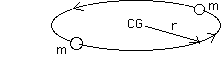
the solar system. Time is an angle, a number. We can imagine the following
basic clock : two masses orbiting around their common center of gravity :
(177)
...We
want to look back to the distant past of the universe and ask :
- How long since "the begining
?"
...
Let us shift to another question :
- How many turns did the above
basic clock do in the past ?
Call
t the "classic cosmological time", used in cosmology, which is nothing but
a time-marker . We find
n = Log t
The
number of turns is infinite and identifies the so-called conformal time
.
...By
the way this number of turns identifies to the entropy per baryon, which
in no longer constant is a variable constant model.
...Decide
that :
Time
is the event.
...What
is the physical meaning of n = Log t ?
It means that an infinite number of micro-events occured in the past of the
universe, so that it has no beginning not initial singularity..
...Compare the universe to a book. It has been
opened at a page that we call "present". We would like to return to the first
page in order to read the foreword in which the author put his aims, when
begining his book.
...The
width of the book is that which we call "time". From this point of view, the
past is finite : the width of the book is finite. But how many pages does
it have?
...I
can meet an editor and say :
- Ihave written a book, this
thick.
...And
show a distance between your two fingers.
...But
suppose that you are not a normal writer. You use pages with variable widts.
You change the size of the types, and so on.
...As
an editor, Iwould ask cautiously :
- How many signs in your manuscript
?
...About
the universe the questions becomes :
- How many events in the past
?
...Our
answer is : "Infinite".
...This
model does not take into account of the weak and the strong interaction phenomena.
The work is not finished yet and don't pretend that we hold the definite truth.
It just shows that the Standard Model is perhaps only the last station towards
some "physics at the west of Pecos river".
...Next
figure : the variation of physical constants with respect to classical time-marker
t :
(178)

