cosmologie des univers jumeaux Cosmologie des univers jumeaux (p 7)
L'invariance de l'équation de Schrödinger est assurée si :
(56)

L'équation de Boltzmann est invariante si :
(57)
L'équation de Poisson pour la gravitation ne pose aucun problème particulier et devient simplement (58)
À partir des équations de Maxwell, on obtient :
(59)

(60)

ce qui est cohérent avec la définition du champ électrique dû à une charge électrique.
À partir de l'équation d'Einstein, comme indiqué précédemment, on obtient :
(61) G » c²
Sinon, l'équation n'est plus sans divergence.
Si les grandeurs :
(62) h , m , c , G, R , T
obéissent à ces relations, il ne sera pas possible de mettre en évidence leurs variations dans aucune expérience en laboratoire.
Et alors ?
À partir de (57), on obtient immédiatement :
(63)

ce qui n'est autre que la longueur caractéristique de Schwarzschild, si bien que :
(64) Rs » R
Examinons maintenant la longueur de Jeans :
(65)
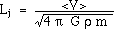
où :
(66)

(66b)
(66t)
(67)

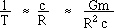
En combinant les équations (56) et (57), on obtient :
67b)
(68)

La longueur de Compton varie comme R :
(69)

La longueur de Planck est :
(70)

(70b)
Le temps de Planck est :
(71)
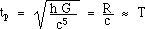
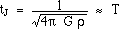
Le temps de Jeans est :
(72)
En combinant (61) et (63), on obtient :
(73)

La variation des constantes ne conserve pas la masse.
Si l'on conserve le nombre d'espèces, la densité de masse r est trouvée pour obéir à :
(74)

...même loi pour la contribution rr du rayonnement à la densité r. La conservation de l'énergie radiative donne :
(75) pr R³ = constante
Alors :
(76)

Version originale (anglais)
twin universe cosmology Twin Universes cosmology (p 7)
The invariance of the Schrödinger equation is ensured if:
(56)
The Boltzmann equation is invariant if :
(57)
The Poisson equation for gravitation arises no peculiar problem and just becomes (58)
From the Maxwell equations we get :
(59)
(60)
which is consistent to the definition of an electric field due to an electric charge.
From the Einstein equation, as pointed out earlier, we get :
(61) G » c2
If not, the equation is no longer divergenceless.
If the quantities :
(62) h , m , c , G, R , T
obey these relations, it will not be possible to evidence their variations in any in lab's experiments..
So what ?
From (57) we get immediatly :
(63)
which is nothing but the characteristic Schwarzschild length, so that :
(64) Rs » R
Examine now the Jeans' length :
(65)
where :
(66)
(66b))
(66t)
(67)
Combine the equations (56) and (57), we get :
67b)
(68)
The Compton Length varies like R :
(69)
The Planck length is :
(70)
(70b)
The Planck time is :
(71)
The Jeans time is :
(72)
Combining (61) and (63) we get :
(73)
The variation of the constants does not conserve the mass.
If we conserve the number of species, the mass density r is found to obey :
(74)
...Same law for the contribution rr of the radiation to the density r . The conservation of the radiative energy gives :
(75) pr R3 = constant
Then :
(76)