Cosmologie des univers jumeaux (p 5)
- À propos de la constance de Get de c.
...
Considérons les deux grandeurs G (gravitation) et c (vitesse de la lumière). Elles interviennent dans la constante d'Einstein
c
. Cette dernière est classiquement déterminée comme suit :
La métrique s'exprime par :
(12)
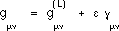
où g
mn
(L) est le tenseur métrique de Lorentz et
e gmn
représente une perturbation très petite et indépendante du temps (tenseur métrique presque lorentzien). En outre, afin d'établir un lien étroit avec la théorie classique, on suppose que la vitesse d'une particule le long d'une géodésique est bien inférieure à c, c'est-à-dire :
(13)

On applique ensuite la même approximation à l'équation différentielle d'une géodésique :
(14)
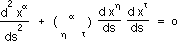
On obtient alors :
(15)
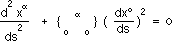
Au-delà des conditions d'état stationnaire, on a l'habitude d'écrire :
(16)
dx° = c dt
ce qui introduit à la fois la vitesse de la lumière c et le temps t. En outre :
(17)

L'équation géodésique devient :
(18)
Si l'on identifie au modèle newtonien, on peut relier le potentiel de perturbation gravitationnelle à la métrique par :
(19)
Si l'on considère un milieu de faible densité
r
o et de faible vitesse, le tenseur énergie-matière se réduit à :
(20)
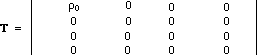
dont la trace est
r o . Alors le second membre de l'équation de champ devient (21)
Toujours dans l'hypothèse d'état stationnaire, on obtient :
(22)
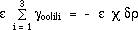
En identifiant avec l'équation de Poisson, on détermine la constante inconnue
c
de l'équation de champ :
(23)
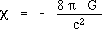
Si
c
n'est pas considéré comme une constante absolue, la divergence nulle de l'équation de champ (1) n'est plus assurée, selon l'hypothèse
d
= 0, ce qui fournit les équations de conservation de la physique. Mais soulignons que la constance de
c
n'exige pas séparément la constance de Get de c, car nous avons déterminé (23) à partir d'une métrique indépendante du temps (12). On peut alors passer à la condition moins restrictive :
(24)

...
Cette idée, suggérée par l'auteur en 1988-89 dans les articles [12,13,14]. Mais, à notre connaissance, l'idée d'une variation séculaire de la vitesse de la lumière avait été introduite plus tôt par V.S. Troistkii [11].
- Métrique de Robertson-Walker.
...
En supposant que l'Univers est isotrope et peut être décrit par une métrique riemannienne, on obtient la métrique classique de Robertson :
(25)

Si l'Univers est supposé homogène, alors
T
= A(
T) et la solution cosmologique spatialement homogène provient de :
(26)
S = c ( T
- A(
T)) = 0
Cette métrique doit être introduite dans l'équation (1), avec un second membre nul. On obtient alors le système suivant de deux équations :
(27)
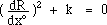
(28)

À partir de (27) et (28), on obtient :
(29)
k = - 1 (courbure négative) et R = x°
x° est un « marqueur chronologique ». Notons qu'il n'existe qu'une seule solution (k = -1). Si l'on identifie classiquement x° à ct, c étant considéré comme une constante absolue, on obtient la solution bien connue triviale R = ct. En procédant ainsi, on définit de manière quelque peu arbitraire le temps cosmique t. Mais il peut être défini différemment, de manière non standard, comme le montrera le développement suivant.
Version originale (anglais)
Twin Universes cosmology (p 5)
- About the constancy of Gand c.
...
Consider the two quantities G (gravitation) and c (velocity of the light). They are involved in the constant of Einstein
c
. This last is classically determined as the following :
The metric is expressed as :
(12)
where g
mn
(L) is the Lorentz metric tensor and
e gmn
represents a very small time-independant perturbation (nearly Lorentzian metric tensor). Furthermore, in order to make a close connexion with classical theory, one supposes that the velocity of a particle along a geodesic is much less than c, i.e :
(13)
One next applies the same approximation to the differential equation of a geodesic :
(14)
And then we get
(15)
Beyond the steady state conditions, one uses to write :
(16)
dx° = c dt
which introduces both the light velocity c and the time t. In addition
:
(17)
The geodesic equation becomes :
(18)
If we identify to the Newtonian model, we can relate the gravitational pertubation potential to the metric through :
(19)
If we consider a medium with low density
r
o and low velocity, the matter energy tensor reduces to :
(20)
whose trace is
r o . Then the second member of the field equation becomes (21)
Still in steady hypothesis condition, we get :
(22)
Identifying with Poisson equation, we determine the unknown constant
c
of the field equation :
(23)
If
c
is not considered as an absolute constant, the zero-divergence of the field equation (1) is no longer ensured, according to the hypothesis
d
= 0 , which provides conservations equations of physics. But let us point out that the constancy of
c
does not require separatly the constancy of Gand c, for we determined (23) from a time-independent metric (12). Then we can shift towards the less restrictive condition :
(24)
...
This idea which was suggested by the author in 1988-89 in the papers [12,13,14]. But, as far as we know, the idea of a secular variation of the light velocity, was introduced earlier by V.S.Troistkii [11].
- The Roberston-Walker metric.
...
Assuming that the Universe is isotropic and can be described by a Riemanian metric we get the classical Robertson metric :
(25)
If the Universe is assumed to be homogeneous, then
T
= A(
T) and the spatially homogeneous cosmological solution comes from :
(26)
S = c ( T
- A(
T)) = 0
This metric must be introduced in the equation (1), with a zero second member. Then we get the following set of two equations :
(27)
(28)
From (27) and (28) we get
(29)
k = - 1 (negative curvature) and R = x°
x° is a "chronological marker". Notice that one have a single solution (k = -1). If we identify, classically, x° to ct, c being considered as an absolute constant, we get the well-known trivial solution R = ct. Doing that, we define somewhat arbitrarly the cosmic time t. But it can be defined differently, in a non-standard way, as will be shown in the following.