20 )
מממה יכול להיות עשוי החומר התאום.
הפיזיקה התיאורטית נמצאת במשבר עמוק כבר יותר מ-30 שנה. מאמרים רבים פורסמו לפני שנים רבות בנוגע למונופול המגנטי, אך אף אחד מהם לא נצפה מעולם. קיומם של שותפים סופר-סימטריים טרם הוכח. אף אחד אינו יודע מהו "גרביטון". כאשר מדענים ניסו לזהות את דעיכת הפרוטון, זה האחרון לא שיתף פעולה. כמעט כל מה שהטלסקופים החדשים מביאים נשאר חידה מוחלטת. אף אחד אינו יודע מהם קוואזרים (QSO), מהם התפרצויות גמא וכיצד הן פועלות. חורים שחורים ענקיים שותקים באופן מוזר, וכן הלאה. תורת המיתרים העל-קולית היא שום דבר מלבד אופנה חדשה, למרות אלפי המאמרים שפורסמו ב"תחום החדש" הזה. עולם המיתרים העל-קוליים הוא זירת משחק מוזרה שבה הפיזיקה נראית נעדרת באופן נואש. בהמשך, אנו מציגים את התיאור הגיאומטרי הראשון של האנטי-חומר. כפי שנהג ג'יי.מ. סוריאו לומר, תורת החבורות היא הכלי הבסיסי ביותר העומד לרשותנו לטיפול בתופעות פיזיקליות. פעולה טבעית של חבורת לי היא פעולתה הצמודה-משותפת (coadjoint) על אלגברת לי שלה, כפי שהוצגה על ידי ג'יי.מ. סוריאו בשנת 1970 [53]. הממד של חבורה G הוא מספר הפרמטרים שהיא תלויה בהם. זהו גם מספר הרכיבים של התנע שלה J. חבורת לורנץ L היא חבורה בעלת שישה ממדים, בעלת ארבע רכיבים קשירים. נכניס את החבורה בת ארבעת האיברים ω, בייצוג המטריציוני שלה (א). אז נוכל לבנות את חבורת לורנץ המלאה L מרכיבה הנייטרלי Lₙ, באמצעות מכפלה ישירה של חבורות (ב), כאשר (ג) מציינת את הייצוג המטריציוני. מכפלה חצי-ישירה חדשה (ד) נותנת את חבורת פואנקרה.
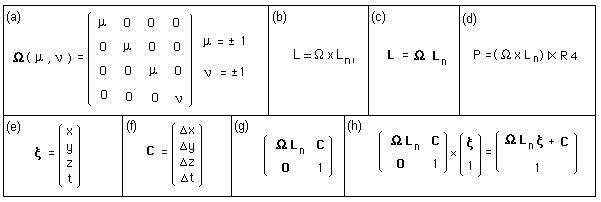
נכניס את הווקטור-רב-ממדי של האירוע (ה) ואת וקטור התרגום במרחב-זמן C: (ו).
נוכל לתת ייצוג מטריציוני (ז) של איבר פואנקרה. בסעיף (ח), פעולתו על המרחב-זמן מוגדרת. אך זו מסתירה פעולה חשובה יותר: הפעולה הצמודה-משותפת של החבורה על מרחב התנע בעל עשרת הרכיבים J (חבורת פואנקרה היא בעלת עשרה ממדים).
סוריאו כותב תנע זה בצורה:
J = {E, p, f, l},
כאשר E היא האנרגיה, p הוא התנע, f הוא ה"מעבר" ו-l הוא הספין. נוח להכניס, בהתאם לסוריאו, מטריצה אנטי-סימטרית M: (א) והווקטור-רב-ממדי תנע-אנרגיה P: (ב). חישוב הדואלי של פעולת החבורה על אלגברת לי שלה נותן את הפעולה על התנע { (ג), (ד) }.
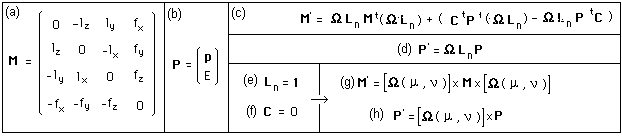
כעת, אם אנו רוצים להדגיש את הסימטריות I, P, T ו-PT, אנו בוחרים ב-(ה) וב-(ו). הפעולה הצמודה-משותפת הופכת אז ל-{ (ז), (ח) }, מה שנותן:
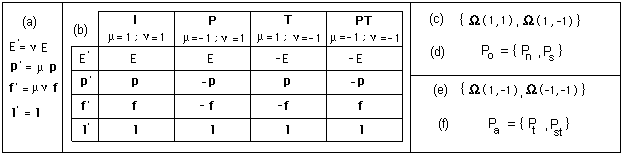
כפי שהדגיש ג'יי.מ. סוריאו בשנת 1970, מתוך המטריצות (ג) אנו בונים את תת-החבורה האורתוכרונית P₀: (ד), המורכבת משני רכיבים קשירים: הרכיב הנייטרלי Pₙ והרכיב של היפוך מרחבי Pₛ. האיברים בשני רכיבים אלה אינם הופכים את סימן האנרגיה E. להפך, המטריצות (ה) מייצרות את תת-הקבוצה האנטי-כרונית, שהאיברים בה הופכים את סימן האנרגיה, כך שהיפוך הזמן מלווה בהיפוך האנרגיה, כלומר בהיפוך המסה, אם לחלקיקים ישנה מסה. כמסקנה, אנו רואים שמסה שלילית ואנרגיה שלילית נובעות מהתיאור הדינמי של חבורת פואנקרה, בהתייחסות לתנועות יחסותיות של נקודות חומר.
כעת אנו הולכים להרחיב את חבורת פואנקרה, תוך התחשבות ב:

אנו מכניסים את המטריצות (א) ו-(ב). לאחר מכן, אנו נותנים ייצוג מטריציוני של החבורה, הפועלת ב-(ה) על אלומה Z₂ × U(1) × ℝ⁴. בסעיף (ו), אנו מקבלים את הביטוי הגיאומטרי של סימטריית C. הממד החמישי (ג) הוא קומפקטי. לכן, כל איבר בחבורה המתאים לבחירות (ו) כולל סימטריה ביחס לישר המצוין.
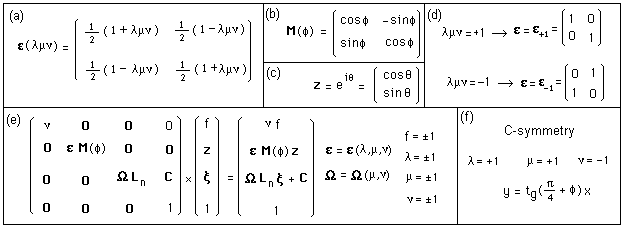
חישוב הפעולה הצמודה-משותפת של החבורה על התנע שלה אינו מציג קושי מיוחד. כפי שהדגיש סוריאו בשנת 1970, הוספת ממד קומפקטי q מלווה בסקלר נוסף מקוונטט, המזוהה עם המטען החשמלי q. הפעולה על חלק התנע המתאים לחבורת פואנקרה אינה משתנה. הפעולה על המטען החשמלי נותנת:

חלקיקים מתוארים במונחים של מסלולים (אורביטות) של החבורה. לחלקם יש אנרגיה חיובית, ולחלקם אנרגיה שלילית. ניתן להתייחס ל-f כלאינדקס של קיפול.
f = +1 מציין את הקיפול F,
f = –1 מציין את הקיפול F̅.
כך אנו מקבלים מבנה גיאומטרי תאום. הפעולה היא פשוט:
f′ = n f.
ניתן לסכם זאת באיור 21:
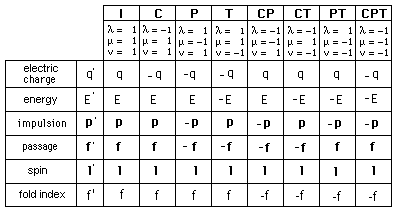
איור 27: השפעת הסימטריות על רכיבי התנע.
נשים לב ש-(ν = –1) מציין את האיברים האנטי-כרוניים של החבורה. חלקיק ותנועתו מתאימים לאיבר מסוים בתנע. האיברים האנטי-כרוניים הופכים תנועות אורתוכרוניות לתנועות אנטי-כרוניות והופכים את המסה והאנרגיה. מכיוון שהמרחב-זמן מורכב משני קיפולים נפרדים F ו-F̅, ניתן להימנע ממפגשים בין חלקיקים בעלי אנרגיה מנוגדת אם נמקם את החלקיקים בעלי האנרגיה החיובית בקיפול אחד (למשל F) ואת החלקיקים בעלי האנרגיה השלילית בקיפול התאום שלו F̅. תיאור פיזיקלי זה עולה בקנה אחד עם תכונות החבורה.
- סימטריית PT וסימטריית CPT.
כפי שהדגיש סוריאו בשנת 1970, כל סימטריה הכוללת טרנספורמציה T הופכת את האנרגיה ואת המסה. אם נבחן חלקיק רגיל, בעל מסה m ומטען חשמלי q, הסימטרי CPT שלו בעל אנרגיה ומסה שליליות. פיינמן הראה שהסימטרי PT של חלקיק מתנהג כחלקיק-אנטי; אולם, לפי תוצאותיו של סוריאו, לחלקיק-אנטי זה ישנה מסה ואנרגיה שליליות. לפי האמור לעיל, בנינו תיאור חדש של היקום כמורכב משני ישויות תאומות. הראשונה היא קיפול F, המניח שהוא שלנו, מלא בחומר ובאנטי-חומר של דיראק, סימטרי C ביחס לראשון. בקיפול השני F̅, דואליות חומר-אנטי-חומר מתקיימת גם כן. החומר שלו סימטרי CPT ביחס לשלנו, בעוד שהאנטי-חומר שלו תואם לזה של פיינמן. כמכלול, שני הקיפולים סימטריים CPT. זה עולה בקנה אחד עם הרעיונות הראשוניים של סחרוב ([33] עד [36]). עבודתו הראשונית של המחבר, שהוקדשה לקוסמולוגיה של היקום התאום, פורסמה בשנת 1977.
- מודל כוכב נייטרונים דולף: אלטרנטיבה למודל החור השחור.
קלאסית, הקריטיות של כוכב נייטרונים מבוססת על קריטיות גיאומטרית. כדור בעל צפיפות קבועה, מוקף בריק, ניתן לתיאור על ידי שתי מטריקות שוורצשילד מקושרות (פנימית וחיצונית). ביטויים אלה ניתנו בסעיף 7. הם הופכים לקריטיים כאשר רדיוס כוכב הנייטרונים שואף לרדיוס שוורצשילד המשויך לו. טולמן, אופנהיימר ווולקוב גזרו (ראו [52], משוואה 14.22) את "משוואת TOV" המפורסמת, הנותנת את הלחץ כפונקציה של המרחק הרדיאלי בכוכב נייטרונים.
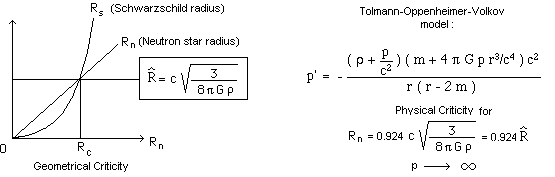
איור 28: משמאל, קריטיות גיאומטרית; מימין, קריטיות פיזיקלית.
החישוב מראה כי, לפני שהתנאים הגיאומטריים מושגים, מתרחשת קריטיות פיזיקלית: הלחץ שואף לאינסוף במרכז הכוכב (משמאל).
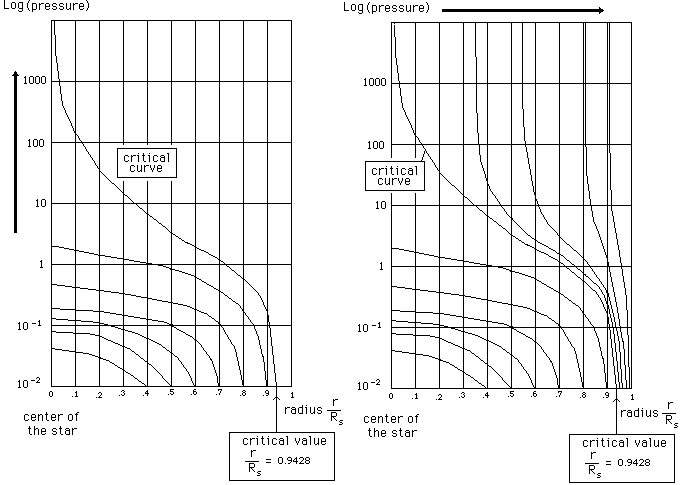
איור 29: לחץ כפונקציה של המרחק הרדיאלי בכוכב נייטרונים.
כעת אנו הולכים לנסח כמה הנחות. בסעיף 15 ניסינו לתאר את השלב הקדום של היקום, בחזרה לעברו. כדי להסביר את ההומוגניות הגדולה שלו, הכנסנו שינוי בקבועים הפיזיקליים במהלך העידן הקרינתי. חקירה זו נשארת עם זאת מסוכנת מאוד. רק ניסינו להביא נקודות מבט חדשות לשאלה הבאה: "מה קורה כאשר אנו מסתכלים לעבר הרחוק של היקום?". אני חושב שאין לנו את כל המפתחות. עם זאת, ארשה לעצמי להביע דעה: אני חושב שכאשר הלחץ מגיע לערך קריטי (שעדיין יש לקבע), היקום שלנו נקשר לתאומו, שסחרוב הציע כי הוא "שוכן בעברו". למרות שזה עדיין מעורפל, אני מודה שזוהי הנחה, אני חושב שהיקום שלנו מקיים אינטראקציה עם העבר שלו, שהיה משתרע לאורך מין גשר מרחב-זמן. סחרוב חשב שהיקום שלנו ותאומו היו קשורים. אני מוסיף שהם היו מקיימים אינטראקציה תמידית, בכל מקום ובכל זמן. לכן חץ הזמן נראה הפוך בתאום, כפי שמראה סעיף 19. לכן אטומי התאום נראים בעלי מסה שלילית ודוחים את שלנו. עבורנו, הם פשוט חיים אחורה בזמן, ולפי עבודותיו של סוריאו, המסה הנראית שלהם היא שלילית.
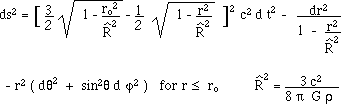
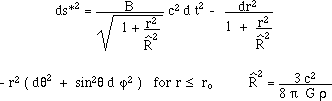
באנלוגיה, אני מניח שכאשר הקריטיות הפיזיקלית מושגת במרכז כוכב נייטרונים, הערכים המקומיים של הקבועים הפיזיקליים משתנים באופן דרסטי. תנאי כזה "ישחזר" מקומית את תנאי "המפץ הגדול". אזי ייפתח גשר מרחבי, שאוב חומר במהירות יחסותית. "תרחיש רך" זה היה מתרחש כאשר שטף החומר הנובע מרוח הכוכבים של כוכב בן-לווה מגיע לתנאים קריטיים במרכז הכוכב. אזי מצב עמיד ניתן לתיאור גיאומטרי באמצעות ארבע המטריקות של שוורצשילד. עבור הקיפול F:
עבור האזור הסמוך, הצמוד, של הקיפול התאום F̅:
ניתן לחקור מערכות גיאודזיות ולקשר ביניהן באמצעות גשר מרחבי שהפרמטר היחיד שלו הוא שטח פניו. גשרים מרחביים זעירים יכלו לספוג חומר המגיע מרוח הכוכבים של כוכב בן-לווה, מכיוון שסמוך אליו הצפיפות עצומה והמהירות יחסותית. באיור 24, תמונה דידקטית דו-ממדית של המודל.
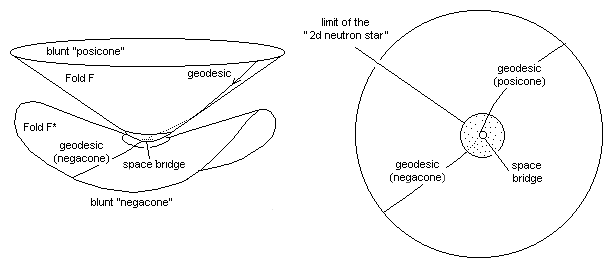
איור 30: תמונה דידקטית דו-ממדית של כוכב נייטרונים דולף (SNS).
זרם אלים של חומר, הנובע למשל מתופעות התפרצות עזות יותר של כוכב בן-לווה או מהתמזגות של שני כוכבי נייטרונים היוצרים מערכת בינארית, עלול לגרום לפתיחה מהירה של גשר מרחבי, כפי שהוצע בצד ימין של איור 24. ההסבר להתפרצויות גמא עשוי להימצא שם. מודל זה מערער על מודל החור השחור. נראה בהמשך עד כמה מודל זה שנוי במחלוקת. משהו לא בסדר במודל החור השחור הזה. ישנם מעט מועמדים מדי, וכולם יודעים שטעות קלה בהערכת המרחק יכולה להפוך מועמדים אלה לחורים שחורים לכוכבי נייטרונים פשוטים. אין הוכחה חד-משמעית לקיומם. פשוט מאמינים בכך, מתוך הרגל. תמיד אמרו: "מה עוד הייתם יכולים לדמיין?". הביטו בתחילת המאמר. הזכרנו את גיליון העיתון לה מונד שבו פורט ומיילייר הציגו מפה תלת-ממדית צבעונית של החומר האפל, והעיתונאי, בהתלהבות, כותר [1]: "החומר האפל אכן קיים: הוא סוטה את קרני האור". אבל מה עם "אשכולות אפלים" [2], שגילו אותם חוקרים, ש"מושכים ומסטים את קרני האור, אך נראים דוחים חומר רגיל"? אם זה יאושש, הם יהיו מורכבים, כפי שפורט מציע, אך ורק מ"חומר אקזוטי". ואם כך הוא, מהו הדבר הזה? מה עם האצת החלליות [49], שחלוקת חומר אפל אינה יכולה להסביר? כיום, צריך למצוא חורים שחורים ענקיים במרכז הגלקסיות, כדי להצדיק את הפרמטרים הדינמיים של אזורים אלה. אך ענקים אלה נראים שותקים מאוד, כמו היפהפייה הנרדמת, נכון? חלק הציעו שמדובר ב"חורים שחורים שבעים". כמה זמן עוד ננסה לפתור בעיות חדשות על ידי המצאת שמות חדשים?
סיכום המאמר ---
גרסה מקורית (אנגלית)
20 )
What twin matter could be made of.
Theoretical physics is in a big crisis since mode than 30 years. A lot of papers were published many years ago about magnetic monopole, but no one appeared. The existence of supersymetric partners has not been proved yet. Nobody knows what a “graviton” could be. When scientists tried to evidence the proton’s decay, this last did not cooperate. Almost all that new telescopes bring is still e complete mystery. Nobody knows what are QSO, gamma flashes and how it works. Giant black holes are strangely silent, and so on. Superstring is nothing but a new fashion, in spite thousands papers published in this “new field”. Superstring world is a strange play field in which physics seems desperately absent. In the following we give the first geometrical description of antimatter. As J.M.Souriau
uses to say, group theory is the most basic tool we have to deal with physical phenomena. A natural action of a Lie group is its coadjoint action on its Lie algebra, as introduced by J.M.Souriau in 1970
[
53]. The dimension of a group G
is the number of parameters it depends on. This is also the number of components of its moment
J. The Lorentz group L is a six-dimensional group, which owns four connex components. Introduce the four elements group omega
, in its matrix representation (a). Then we can built the complete Lorentz group
Lfrom its neutral component
L n
, through a direct group product (b), where (c) is the matrix representation. A new semi-direct product
(d) gives the Poincaré group. Introduce the event-quadrivector
(e) and the space-time translation vector
C: (f).
We can give a matrix representation (g) of the Poincaré element. In (h) its action on space-time. But this one hides a more important action : the coadjoint action of the group on its ten components moment space
J(the Poincaré group owns ten dimensions).
Souriau writes this moment
: J = {
E ,
p
,
f
,
l } E
is the energy,
p
the impulsion,
f
the “passage” an
l
the spin. It is convenient to introduce, following Souriau, an antisymmetric matrix
M: (a) and the quadrivector impulsion-energy
P: (b)
. The calculation of the dual of the action of the group on its Lie algebra gives the action on the momentum { (c) , (d) }.
Now, il we want to evidence symmetries
I , P , T
and
PT
we choose (e) and (f). The the coadjoint action becomes { (g) , (h) } , which gives :
As pointed out in 1970 by J.M.Souriau, with the matrixes (c) we build the orthochron subgroup
P o
: (d), composed by two connex components : the neutral one
P n
and by the space-inversion component
P s .
The
terms of these two components do not inverse the sign of the energy
E. Conversely, the matrixes (e) produce the antichron subset, whose terms inverse the sign of the energy, so that time-inversion goes with energy inversion, i.e. mass-inversion, if the particles own one. As a conclusion we see that negative mass and negative energy arise from the dynamic Poincaré group description, referring to relativistic mass-point movements. Now, we are going to extend the Poincaré group, considering :
We introduce the matrix (a) and (b). Then we give a matrix representation of the group, acting (e)
on a bundle
Z 2 x U
(1)
x R4
. In (f) we get the geometrical expression of the C-symmetry. The fifth dimension (c) is compact. Then any element of the group corresponding to choices (f) implies a
symmetry with respect to the indicated straight line. The calculation of the coadjoint action of the group on its momentum shows no peculiar difficulty. As pointed out by Souriau in 1970 the addition compact dimension
q
goes with a quantified additional scalar, identified to the electric charge q. The action on the part of the moment corresponding to Poincaré does not change. The action on the electric charge gives :
Particles are describes in terms of orbits of the group. Some own a positive energy and others a negative one. f can be considered as a fold index.
f = +1 refers to fold F
f = -1 refers to fold
FWet get a geometrical twin structure. The action is simply :
f =
n f
This can be summarized on figure 21.
Fig.
27 :
Impact of symmetries on the momentum components.
Notice that (
nu = - 1 ) refers to antichron terms of the group. A particle and its movement correspond to a peculiar element of the momentum. Antichron terms transform orthochron movements into antichron ones and reverse mass and energy. As space time is composed by two separate folds F and
F, encounters of opposite energy particles can be avoided if we put positive energy particles in one fold, F for example, and negative energy in its twin fold
F. This physical description is consistent to the group properties.
PT-Symmetry and CPT-symmetry .
As pointed out by Souriau in 1970, all symmetry which includes a T-symmetry reverse the energy and the mass. If we consider a normal particle, with mass m and electric charge q , its CPT-symmetrical owns negative energy and mass. Feynman showed that the PT-symmetrical of a particle behaved as an antiparticle, but, according to Souriau’s result, it owns negative mass and energy.. From above, we have built a new description of the Universe as composed by two twin entities. The first is a fold F, supposed to be ours, filled by matter and Dirac-antimatter, C-symmetrical with respect to the first. In the second fold
Fthe matter-antimatter duality holds too. Its matter is CPT-symmetrical with respect to ours, while its antimatter identifies to Feynman one. As a whole, the two folds are CPT symmetrical. This goes with initial Sakharov’s ideas ( [33]
to [36]
). The initial work of the author, devoted to twin Universe cosmology, was published in 1977.
Leaking neutron star model : a challenger to black hole model.
Classically the criticity of a neutron star is based on a geometrical criticity. A constant density sphere, surrounded by void can be described by two linked Schwarzschild metric (internal and external). These expressions have been give in section 7. Both become critical when the neutron star’s radius tends to its associated Schwarzschild radius. Tolmann, Oppenheimer and Volkov derived ( see
[
52], eq. 14.22 ) a famous “ TOV equation ” giving pressure versus radial distance in a neutron star.
Fig.
28 :
Left, geometrical criticity. Right : physical criticity.
The calculation shows that, before the geometrical conditions are reached, a physical criticity occurs : pressure tends to infinite at the centre of the star (left).
Fig
. 29 :
Pressure versus radial distance in a neutron star.
We are going now to make assumptions. In section 15 we tried to describe the primitive stage of the Universe, going backward in its past. In order to explain its great homogeneity we introduced a variation of the constants of physics, during the radiative era. By the way, this exploration is still very hazardous. We only tried to give new insights on the question : “what happens when we look at the distant past of the Universe ?”. I think we don’t own all the keys. I will just expression an opinion. I would think that when the pressure reaches a critical value (to be determined) our Universe becomes linked to its twin which, as A.Sakharov suggested “lies in its past”. Although it is still confused, I admit, I think that our universe interacts with its past, which would extends over some sort of space-time bridge. Sakharov Thought that our Universe and its twin were linked. I add they would be interacting, everywhere, all the time. That’s for the arrow of time is found to be reversed in the twin, from section 19. That’s for the twin’s atoms seem to own a negative mass and repel ours. For us, they just live backward in time, that’s for, according to Souriau’s works, their
apparent mass
is negative. By analogy I would think that when physical criticity is reached at the centre of a neutron star, the local values of the constants of physics change drastically. Such condition would “reproduce” locally the “Big Bang conditions”. A spaced bridge would open, sucking matter at relativistic velocity. Such “soft scenario” would occur when the matter’s flux due to the solar wind of a companion star achieves critical conditions at the centre of the star. Then a steady state can be geometrically described, using the four Schwarzschild metrics. For fold F :
For the adjacent, conjugated region of the twin fold
F:
One can study the geodesic systems and link them, through a space bridge whose single parameter is its area. Tiny space bridges can absorb the matter corresponding to stellar wind of a companion star, for, close to it, the density is enormous and the velocity relativistic. On figure 24 a 2d didactic image of the model.
Fig.
30 :
2d didactic image of a sleaking neutron star
(SNS).
A violent inflow of matter, due for example to more eruptive phenomena of a companion star or to the fusion of two neutron stars, forming a binary system, could produce fast opening of a space bridge, as suggested on the right of figure 24. The explanation of gamma bursts could lie there. This
model challenges the black hole model. We will see further how this last is questionable. Something goes wrong with this black hole model. There are too few candidates and everybody knows that a slight error about distance evaluation can convert such black holes candidates into simple neutron stars. There is no undeniable proof of their existence. People only
believe
in. They always said : “what could you imagine else ?”. Look at the beginning of the paper. We evoked the issue of the Journal le Monde in which Fort and Meillier presented a coloured 3d map of dark matter and the journalist, enthusiastic, titled
[ 1 ]
: “The dark matter does exist : it bends the light rays”. But what about the “dark clusters”
[ 2 ]
, discovered by the same people, which “attract the light rays, bend it, but apparently repel the ordinary matter”. If this is confirmed they would be made, as suggested by Fort, exclusively of “exotic matter”, and if they are, what is that stuff ? What about the acceleration of the space probes [
49], that a dark matter distribution cannot explain ? Today people
need
to find giant black holes at the centre of galaxies, in order to justify the dynamical parameters of such regions. But these giants seem very silent, like sleeping beauty, don’t they ? Some suggested they could be “satiated black holes”. How long time will we try to answer new problem just inventing new
name ?
Paper's Summary ---