univers gemelli contro materia oscura materia oscura e costante cosmologica
- **I buchi neri non esistono. **
Da dove proviene il modello dei buchi neri? Dall'equazione del campo con membro secondario nullo. Paradossalmente, un oggetto così denso proviene da un'equazione inizialmente concepita per descrivere regioni vuote dell'Universo. Il tensore di Kerr non apporta molto di più: l'oggetto diventa semplicemente più complesso. La rotazione comporta un fenomeno di trascinamento del sistema di riferimento azimutale, il che significa che la velocità della luce è diversa a seconda che si guardi in avanti o indietro rispetto al movimento di rotazione. Qualsiasi tecnica si scelga, le cose diventano chiaramente patologiche una volta superato l'orizzonte e entrati all'interno. Al centro si trova "la singolarità". Cominciamo con un esercizio. Consideriamo la metrica 2D (a). Se consideriamo r come una distanza radiale e j come un angolo polare, incontriamo problemi per r < Rs. Ma se introduciamo la modifica (b), l'espressione della metrica diventa (c). Tutte le patologie scompaiono. Inoltre, questa superficie può essere immersa in R3: l'equazione del meridiano è (d). Vedi la figura 25 dove abbiamo rappresentato una geodetica. Questo illustra il fatto che una patologia può dipendere da una scelta errata di coordinate e da una scelta errata di topologia.
Nell'esempio 3D, abbiamo calcolato geodetiche piane (vedi figura 26) che vengono proiettate nello spazio di rappresentazione iniziale (r, q, j). Otteniamo una "sfera di gola" che collega due spazi euclidei 3D. Non c'è nulla all'interno. Lo spazio per r < Rs non ha significato fisico. Se provassimo a calcolare le geodetiche in quel punto, otterremmo una soluzione immaginaria.

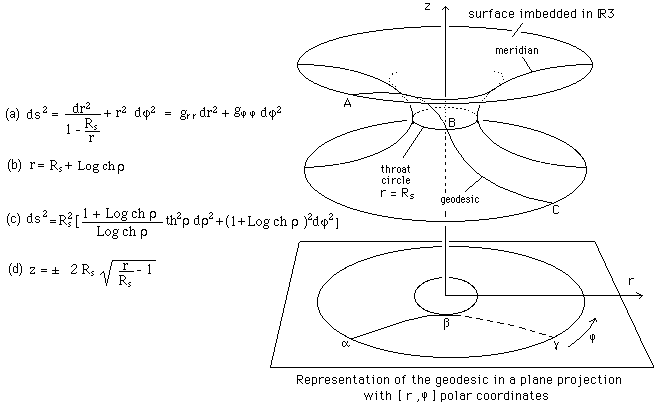
Fig. 25 : metrica 2D di una superficie con un "ponte" che collega due pieghe.
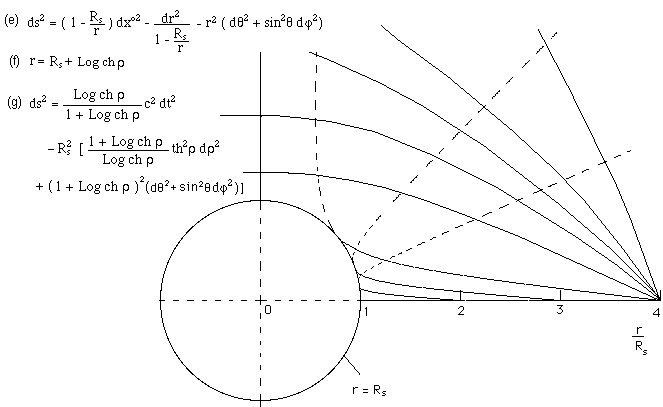
Fig. 26 : ipersuperficie metrica 3D con un "ponte spaziale". Geodetiche.

Classicamente, si introduce un tempo proprio s (j) e una "coordinata del tempo" t (i). Lo studio delle geodetiche radiali dà due equazioni differenziali (k) e (l), le cui soluzioni corrispondono alle curve (m), figura 6.2, riferimento [52].
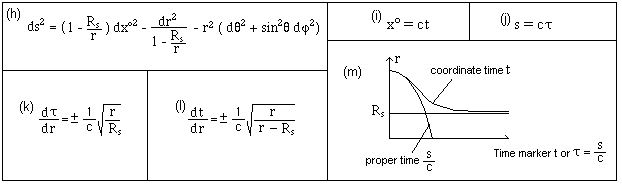
Le curve rappresentate nella figura (m) sono alla base del modello dei buchi neri. Si identifica la coordinata t con il tempo proprio di un "osservatore lontano", in modo che il tempo di caduta libera di una particella-test verso la sfera di Schwarzschild diventi infinito per lui. Mostriamo che ciò è interamente dovuto a questa particolare scelta della coordinata del tempo. Nel 1925, Eddington ha suggerito un nuovo indicatore del tempo (p).

Successivamente, lo studio delle geodetiche radiali corrispondenti.
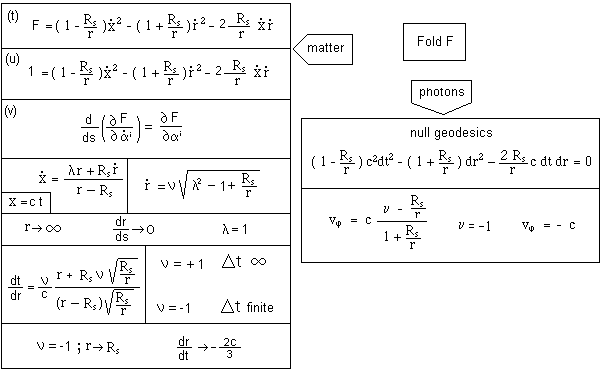
Utilizziamo le equazioni di Lagrange. A destra, vediamo che la velocità della luce seguendo percorsi radiali ha due valori. (nu = -1) corrisponde ai percorsi centripeti: la velocità ha un valore costante - c. Allo stesso modo (a sinistra), il tempo di transito da un punto lontano alla sfera di Schwarzschild dipende dall'orientamento dei percorsi. Il tempo di caduta libera centripeta (nu = -1) si conclude in un intervallo di tempo finito Dt. Al contrario, un percorso centrifugo (nu = +1), partendo dalla sfera di Schwarzschild, dà un intervallo di tempo infinito, in modo che la sfera di Schwarzschild agisca come una membrana a senso unico. Questo corrisponde a un effetto di trascinamento radiale. Non è una ragione per rifiutare questa interpretazione della geometria di Schwarzschild. In effetti, troviamo un fenomeno simile nel tensore di Kerr (trascinamento azimutale). Successivamente, l'espressione classica del tensore di Kerr. Vediamo che otteniamo due valori diversi per la velocità azimutale della luce. A seconda che consideriamo la luce che segue la rotazione o che va all'indietro.
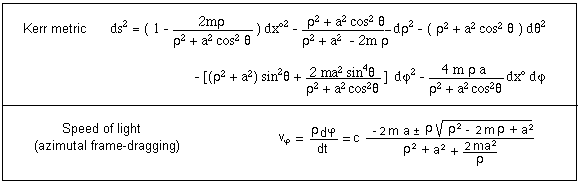
Possiamo dare una nuova interpretazione della geometria di Schwarzschild, attraverso un ponte spaziale che collega due pieghe F e F. Se la piegatura F corrisponde alla piegatura gemella, la coordinata del tempo t = -t (simmetria T). Dalla sezione 19 sappiamo che questa simmetria T va di pari passo con un'inversione della massa, in modo che attraversando la sfera di Schwarzschild, considerata come una superficie di gola, la massa positiva diventa negativa. La geometria coniugata, come presentata nella sezione 13, corrisponde a sostituire Rs con -Rs. Successivamente, introduciamo il seguente cambiamento del marcatore del tempo, analogo a quello di Eddington:

Ancora utilizzando le equazioni di Lagrange, studiamo il sistema di geodetiche radiali e stabiliamo un legame tra le due pieghe.

Ma i percorsi inversi richiedono un tempo infinito, quindi si tratta di un passaggio a senso unico da un universo all'altro. Anche qui troviamo un effetto di trascinamento, ma nella direzione opposta.
Durante il transito, il flusso del tempo proprio rimane invariato: ds > O. Questo rende problematico il modello dei buchi neri. In effetti, secondo questa nuova interpretazione della geometria di Schwarzschild, un tale ponte spaziale può inghiottire in poco tempo (» 10-4 s) quantità illimitate di materia. Per confronto, un'analisi basata sul tensore di Kerr, sebbene leggermente più complessa, dà risultati simili.
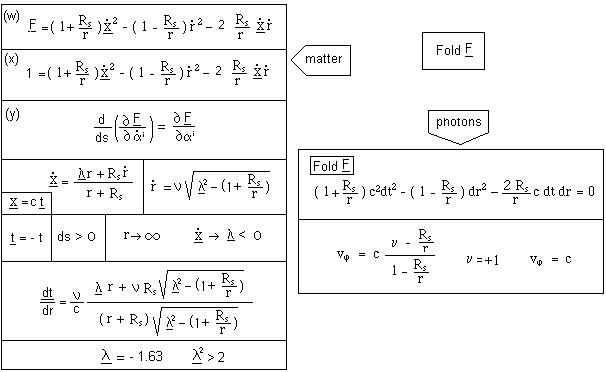
Successivamente, la soluzione dei sistemi di geodetiche.
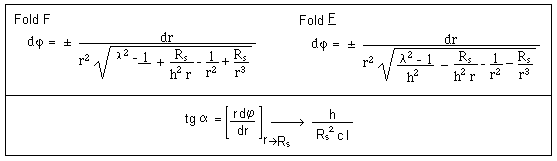
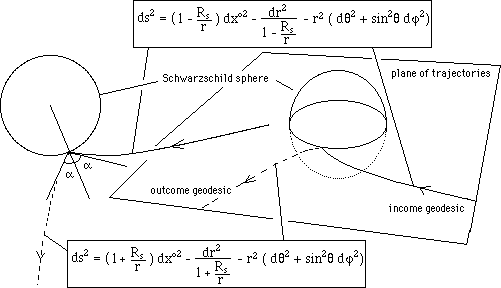
Come rappresentare tali percorsi? Possiamo utilizzare lo spazio di rappresentazione iniziale (r, q, j). Otteniamo così il sistema di equazioni differenziali sopra e lo schema della figura 27.
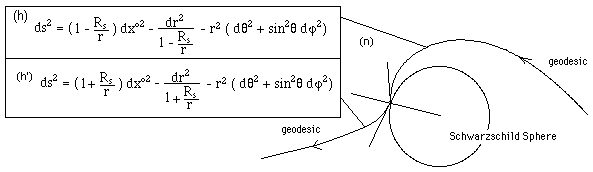
Fig. 27 : Geodetiche di ingresso e uscita.
La geodetica sembra "rimbalzare" sulla sfera di Schwarzschild, come mostra anche la figura 28.
**  **
**
Ma tutto ciò proviene da una rappresentazione euclidea ingenua del percorso. Utilizzando il seguente cambiamento del marcatore dello spazio :

L'espressione della metrica coniugata diventa :
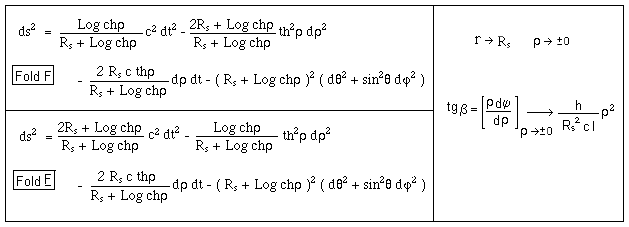
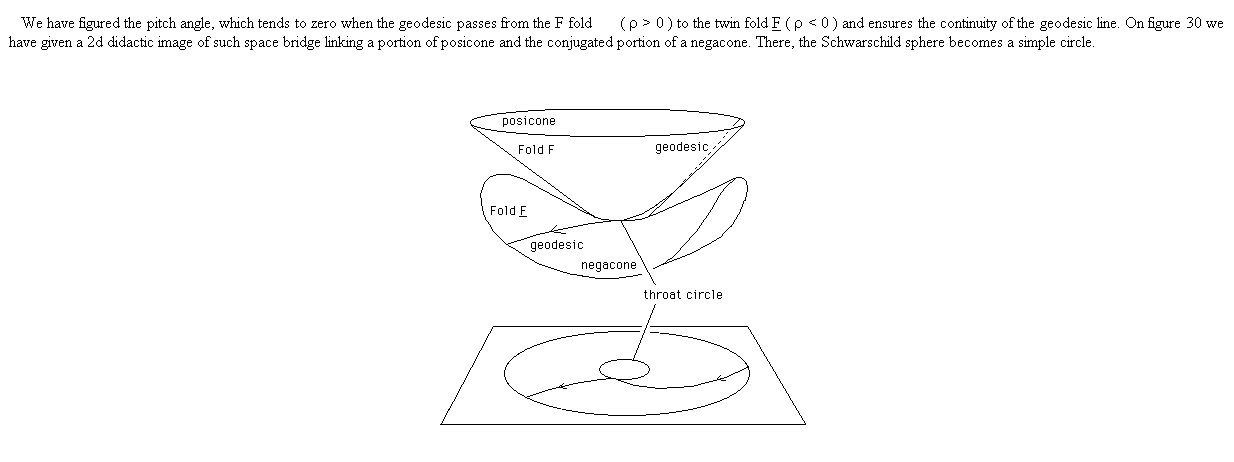
Fig. 29 : Immagine didattica di un ponte spaziale a flusso rapido.
Riferimenti.
[1] J.F.Augereau : « Se la materia oscura devia i raggi luminosi, allora esiste » (If dark matter bends light rays it shows it does exist). Le Monde, 17 marzo 2000.
[2] Intervista di B.Fort su Ciel et Espace, giugno 2000.
[3] J.P.Petit : L'effetto della massa mancante. Il Nuovo Cimento, B, vol. 109, luglio 1994, pp. 697-710
[4] J.P.Petit, Cosmologia degli universi gemelli. Astrophysics and Space Science. Astr. And Sp. Sc. 226 : 273-307, 1995
[5] Zel'dovich Ya.B., Astrophysica 6. 319 MNRAS 192, 192 (1970)
[6] Doroskhevich A.G. MNRAS 192, 32 (1980)
[7] Klypin A.A & Shandarin S.F. MNRAS 204, 891 (1983)
[8] Centrella J.M. & Mellot A.L. Nature 305, 196 (1983)
[9] Mellot J.M. & Shandarin S.F. Nature 346, 633 (1990)
[10] Shandarin S.F. In Large Structures of the Universe, ed. J.Audouze, M.C. Peleton e A.Szalay, 273. Dordrecht : Kulwer (1988).
[11] Kofman.L.A., Pogosyan D. e Shandarin S. MNRAS 242, 200 (1990)
[12] Peebles P.J.E. Principles of Physical Cosmology, Princeton University Press (1993).
[13] M.Myamoto e R.Nagai Publ. Astrom. Soc. Japan 27, 583, 1975
[14] J.Binney e S.Tremaine, "Galactic Dynamics", Princeton University Press, Princeton, 1987. [16] Bahcall J.N & Soneira R.M. APJ. S** 44** p. 73 1980
[17] Bahcall J.N., Flynn A e Gould A. APJ 389 p.234 1992
[18] B.Lindblad, Handbuch der Physik 53, (1959) 21
[19] C.C. Lin e F.H.Shu : Astrophysics and Gen. Relat. Vol.2 Gordon and Breach Sc. Publ. 1971, p. 235
[20] Toomree A. (1981) The structure and dynamics of normal galaxies. Cambridge University Press, p.111
[21] Toomree A. e Toomree J. (1972) Astrophys. J. 178, 623
[22] A.Toomree, Ann. Rev. Astronom. Astrophys. 15 (1977) 437
[23] E.Athanassoula : Spirali e barre trainate da compagni. International Astronomic Union. Symposium n° 146 (1991)
[24] A.Toomree Astrophys. J. 158 (1969) 89
[25] R.H.Miller e B.F. Smith, Astrophys. J. 277 (1979) 785
[26] F. Hohl, Astrophys. Sp. Sc. 14 (1971) 91
[27] Holmberg E. (1941) Astrophys. J. 94, 385
[28] B. Sundelius e K.J. Donner : Galassie in interazione, Dinamica delle galassie a disco (1991) Sundelius ed. p. 195
[29] S. Engström : Velocità caratteristiche in simulazioni numeriche. , Dinamica delle galassie a disco (1991) Sundelius ed. p. 332
[30] A.Toomree Ann. Rev. Astron. Astrophys. 15 (1977) 437.
[31] F.Bouchet e L.Hernquist : Simulazioni cosmologiche utilizzando metodi teorici alberati. Astr. Jr Suppl. Series 68 , pp. 521, 538, 1988.
[32] F.Bouchet, L.Hernquist e Y.Suto : Applicazione del metodo di Ewald alle simulazioni N-corpi cosmologiche. Apj. Suppl. Series 75 , pp. 231-240, 1991
[33] A.Sakharov : "Violazione del CP e asimmetria barionica dell'Universo". ZhETF Pis'ma 5 : 32-35 (1967) : Traduzione JETP Lett. 5 : 24-27 (1967)
[34] A.Sakharov : "Un modello cosmologico a più fogli". Preprint Istituto di Matematica Applicata, Mosca 1970
[35] A.Sakharov : "Modello cosmologico dell'Universo con inversione del vettore tempo". ZhETF 79 : 689-693 (1980) : Traduzione in Sov. Phys. JETP 52 : 349-351 (1980)
[36] A.Sakharov : "Struttura topologica delle particelle elementari e asimmetria CPT" in "Problemi di fisica teorica", dedicato alla memoria di I.E.Tamm, Nauka, Mosca 1972 pp. 243-247
[37] Green M.B. & Schwarz J.H. Nucl. Phys. B181 , 502-530 (1981) ; B198 , 225-268 (1982) ; Phys. Lett. B , 444-448 (1982)
[38] Green M.B. Surv. High Energy Phys. 3 , 127 (1982)
[39] Gross D.J. , Harvey J.A. , Martinec E. & Rohm R. , Phys. Rev. Lett. 54, pp 503-505 (1985)
[40] Kolb E.W. , Seckel D , Turner M.S. : Il mondo invisibile delle teorie delle stringhe, Nature Vol. 314, aprile 1984 pp. 415-419
[41] P.C.W.Davies & J.B.Brown : Stringhe super, Cambridge University Press 1988
[42] Abdus Salam, Nuovo Cimento 5 , 299 (1957)
[43] Nima-Arkani Ahmed, Savas Dimopoulos e Georgi Dvali : "Le dimensioni nascoste dell'universo", PLS ottobre 2000 n. 276 pp. 56-64
[44] J.P.Petit : Un'interpretazione del modello cosmologico con velocità della luce variabile. Modern Physics Letters A, Vol. 3, n. 16, novembre 1988, p. 1527
[45] ** **J.P.Petit : Modello cosmologico con velocità della luce variabile: l'interpretazione degli spostamenti verso il rosso. Modern Physics Letters A, Vol.3 , n. 18, dicembre 1988, p. 1733
[46] J.P.Petit e Maurice Viton : Modello cosmologico con velocità della luce variabile. Confronto con i dati osservativi di QSO. Modern Physics Letters A Vol.4 , n.23 (1989) pp. 2201-2210
[47] P.Midy e J.P.Petit : Cosmologia invariante di scala. The international Journal of Modern Physics D, Vol.8 giugno 1999 pp.271-280
[48] E.A.Milne : Relatività cinematica Oxford 1948.
[49] J.D.Anderson, P.A.Laing, E.L.Lau, A.S.Liu, M.M. Nieto e S. Turchev : Indicazione per i dati Pioneer 10/11, Galileo e Ulysse, un'accelerazione anomala, debole, a lungo raggio. Phys. Rev. Letters : 81 31 agosto 1998.
[50] G.J.Stephenson Jr. , T.Goldman, Phys. Rep. 205, 211 (1992) ; 216, 343 (1992).
[51] M.N. Nieto e T.Goldman, Phys. Re. 205, 221, 1991; 216, 343.
[52] R.Adler, M.Bazin & M.Schiffer : Introduzione alla relatività generale, Mac Graw Hill book, 1975, capitolo 10, sezione 10.5 : Limite classico delle equazioni gravitazionali, p. 345.
[53] J.M.Souriau, Struttura dei Sistemi Dinamici, Ed. Dunod 1970, Francia & Struttura dei Sistemi Dinamici. Birkhauser Ed. Boston-Zurich 1997.
[53] J.P.Petit : Universi enantiomorfi con frecce del tempo opposte (Enantiomorphic universes with opposite time arrows). Comptes rendus de l'Académie des Sciences de Paris, t. pp. 1977
[54] Eddington S.A : : Una comparazione delle formule di Withead e d'Einstein. Nature 113 : 192 (1924).
Versione originale (inglese)
univers jumeaux contre matiere sombre matiere noire et constante cosmologique
- **Black holes do not exist. **
Where the black hole model does come from ? From the null second member field equation. Paradoxically such very dense object rises from an equation which was initially built to describe empty regions of the Universe. The Kerr metric does not bring so much : the object becomes more complex, thats all. Rotation brings an azimutal frame-dragging phenomenon, which means that the speed of light is different if one looks forward or backward with respect to the spinning movement. Whatever is the technique you choose, the things become frankly pathological when you pass the horizon and get in. At the centre lies the singularity. Let us start with an exercise. Consider the 2d metric (a). If we consider r as a radial distance and j as a polar angle, we get problems for r < Rs. But if we introduce the change (b) the expression of the metric becomes (c). All pathologies disappear. Moreover this surface can be imbedded in R3 : the meridian equation is (d). See figure 25 where we have figured a geodesic. This illustrates the fact that a pathology can depend on a wrong choice of coordinates and on a wrong choice of topology.
In the 3d example we have computed (plane) geodesics ( see figure 26 ) which are projected on the initial (r,q,j) representation space. We get a throat sphere linking two Euclidean 3d spaces. There is nothing inside. Space for r < Rs has no physical meaning. If we would try to compute geodesics in that place, we would find an imaginary solution.
Fig. 25 : 2d metric of a surface with a bridge linking two folds.
Fig. 26 : 3d metric hypersurface with a space bridge. Geodesics.
Classically, one introduce a proper time s (j) and a time-coordinate t (i). Then the study of radial geodesics gives two differential equations (k) and (l), whose solutions correspond to curves (m), fig. 6.2, reference [52].
The curves shown on figure (m) are the basis of the black hole model. One identifies the coordinate t to the proper time of a distant observer so that the free fall time of a test particle, towards the Schwarzshild Sphere become infinite for him. Let us show that this is completely due to this peculiar choice of time coordinate. In [54] 1925 Eddington suggested a new time-marker (p).
Following, the study of corresponding radial geodesics.
We use Lagrange equations. On the right we see that the speed of light, following radial paths has two values. ( nu = - 1 ) corresponds to centripetal paths : the speed has a constant value c. Similarly (left) the transit time from a distant point to the Schwarzschild sphere depends on the orientation of the paths. Centripetal ( nu = - 1 ) free fall time is achieved in finite time interval Dt . Oppositely a centrifugal path ( nu = + 1 ), starting from the Schwarzschild sphere gives an infinite time interval, so that the Schwarzschild sphere works like a one-way membrane. This corresponds to a radial frame-dragging effect. This is not a reason to reject this interpretation of the Schwarzschild geometry. In effect we find a similar phenomenon in the Kerr metric ( azimutal frame-dragging). Next, the classical expression of the Kerr metric. We see that we get two distinct values for azimutal speed of light. Depends if we consider light following the rotation or going backwards.
We can give a new interpretation of the Schwarzschild geometry, through a space-bridge linking two folds F and F. If the fold F corresponds to the twin fold, the time coordinate t = - t ( T-symmetry). From section 19 we know that this T-symmetry goes with a mass-inversion, so that when a positive mass passes through the Schwarzschild sphere, considered as a throat surface, the sign of it becomes negative. The conjugated geometry, as presented in section 13 corresponds to change Rs into Rs. Then we introduce the following Eddington-like time marker change :
Still using Lagranges equation we study the radial geodesics system and build a link between the two folds.
But the inverse paths requires an infinite time, so that it is a one-way passage from a Universe to the other. Here again we find a frame-dragging effect, in the opposite direction.
During the transit the proper time flow is unchanged : ds > O . This makes the black hole model questionable. In effect, according to this new interpretation of the Schwarzschild geometry such space bridge can swallow in a very short time ( » 10-4 sec) unlimited amounts of matter. By the way, an analysis based on the Kerr metric, although a little bit more complicated gives similar results.
Following, the solution of the geodesic systems.
How to figure such paths ? We can use the initial ( r , q , j ) representation space. Then we get the above system of differential equations and the schema of figure 27 .
Fig.27 : Income and outcome geodesics.
The geodesic seems to bounce on the Schwarzschild sphere, as shown of figure 28 too.
** **
But all that comes from such naïve Euclidean representation of the path. Using the following change of space marker :
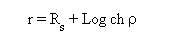
The expression of joint metrics become :
Fig. 29 : Didactic image of a fast flow space bridge.
References.
[1] J.F.Augereau : « Si la matière sombre dévie les rayons lumineux, cest donc quelle existe (If dark matter bends light rays it shows it does exist). Le Monde, March 17 th 2000.
[2] Interview of B.Fort in Ciel et Espace, june 2000.
[3] J.P.Petit : The missing mass effect. Il Nuovo Cimento, B , vol. 109, july 1994, pp. 697-710
[4] J.P.Petit, Twin Universe Cosmology. Astrophysics and Space Science. Astr. And Sp. Sc. 226 : 273-307, 1995
[5] Zel'dovich Ya.B., Astrophysica 6. 319 MNRAS 192, 192(1970)
[6] Doroskhevich A.G. MNRAS 192, 32 (1980)
[7] Klypin A.A & Shandarin S.F. MNRAS 204, 891 (1983)
[8] Centrella J.M. & Mellot A.L. Nature 305, 196 (1983)
[9] Mellot J.M. & Shandarin S.F. Nature 346 , 633 (1990)
[10] Shandarin S.F. In Large Structures of the Universe, ed. J.Audouze, M.C. Peleton and A.Szalay, 273. Dordrecht : Kulwer (1988).
[11] Kofman.L.A., Pogosyan D. and Shandarin S. MNRAS 242, 200 (1990)
[12] Peebles P.J.E. Principles of Physical Cosmology, Princeton University Press (1993).
[13] M.Myamoto and R.Nagai Publ. Astrom. Soc. Japan 27, 583, 1975
[14] J.Binney and S.Tremaine, "Galactic Dynamics", Princeton University Press, Princeton, 1987. [16] Bahcall J.N & Soneira R.M. APJ. S** 44** p. 73 1980
[17] Bahcall J.N. , Flynn A and Gould A. APJ 389 p.234 1992
[18] B.Lindblad, Handbuch der Physik 53, (1959) 21
[19] C.C. Lin and F.H.Shu : Astrophysics and Gen. Relat. Vol.2 Gordon and Breach Sc. Publ. 1971, p. 235
[20] Toomree A. (1981) The structure and dynamics of normal galaxies. Cambridge University Press, p.111
[21] Toomree A. and Toomree J. (1972) Astrophys. J. 178, 623
[22] A.Toomree, Ann. Rev. Astronom. Astrophys. 15 (1977) 437
[23] E.Athanassoula : Companion driven spirals and bars. International Astronomic Union. Symposium n° 146 (1991)
[24] A.Toomree Astrophys. J. 158 (1969) 89
[25] R.H.Miller and B.F. Smith, Astrophys. J. 277 (1979) 785
[26] F. Hohl, Astrophys. Sp. Sc. 14 (1971) 91
[27] Holmberg E. (1941) Astrophys. J. 94, 385
[28] B. Sundelius and K.J. Donner : Interaction galaxies, Dynamics of Disk Galaxies (1991) Sundelius ed. p. 195
[29] S. Engström : Feature velocitys in numerical simulations. , Dynamics of Disk Galaxies (1991) Sundelius ed.p. 332
[30] A.Toomree Ann. Rev. Astron. Astrophys. 15 (1977) 437.
[31] F.Bouchet and L.Hernquist : Cosmological simulations using theoretical tree methods. Astr. Jr Suppl. Series 68 , pp. 521, 538, 1988.
[32] F.Bouchet, L.Hernquist and Y.Suto : Application of the Ewald method to cosmological N-body simulation. Apj. Suppl. Series 75 , pp. 231-240, 1991
[33] A.Sakharov : "CP violation and baryonic asymmetry of the Universe". ZhETF Pis'ma 5 : 32-35 (1967) : Traduction JETP Lett. 5 : 24-27 (1967)
[34] A.Sakharov : "A multisheet Cosmological Model" Preprint Institute of Applied Mathematics, Moscow 1970
[35] A.Sakharov : "Cosmological Model of the Universe with a time-vector inversion". ZhETF 79 : 689-693 (1980) : Traduction in Sov. Phys. JETP 52 : 349-351 (1980)
[36] A.Sakharov : "Topological structure of elementary particles and CPT asymmetry" in "problems in theoretical physics", dedicated to the memory of I.E.Tamm, Nauka, Moscxow 1972 pp. 243-247
[37] Green M.B. & Schwarz J.H. Nucl. Phys. B181 , 502-530 (1981) ; B198 , 225-268 (1982) ; Phys. Lett. B , 444-448 (1982)
[38] Green M.B. Surv. High Energy Phys. 3 , 127 (1982)
[39] Gross D.J. , Harvey J.A. , Martinec E. & Rohm R. , Phys. Rev. Lett. 54, pp 503-505 (1985)
[40] Kolb E.W. , Seckel D , Turner M.S. : The shadow world of superstring theories, Nature Vol. 314, april 1984 pp. 415-419
[41] P.C.W.Davies & J.B.Brown : Superstrings, Cambridge University Press 1988
[42] Abdus Salam, Nuovo Cimento 5 , 299 (1957)
[43] Nima-Arkani Ahmed, Savas Dimopoulos and Georgi Dvali : "Les dimensions cachées de l'univers", PLS oct 2000 n° 276 pp. 56-64
[44] J.P.Petit : An interpretation of cosmological model with variable light velocity. Modern Physics Letters A, Vol. 3, n°16, nov 1988, p.1527
[45] ** **J.P.Petit : Cosmological model with variable light velocity: the interpretation of red shifts. Modern Physics Letters A, Vol.3 , n° 18, dec. 1988, p.1733
[46] J.P.Petit & Maurice Viton : Gauge cosmological model with variable light velocity. Comparizon with QSO observational data. Modern Physics Letters A Vol.4 , n°23 (1989) pp. 2201-2210
[47] P.Midy & J.P.Petit : Scale Invariant Cosmology. The international Journal of Modern Physics D, Vol.8 June 1999 pp.271-280
[48] E.A.Milne : Kinematic Relativity Oxford 1948.
[49] J.D.Anderson, P.A.Laing, E.L.Lau, A.S.Liu, M.M. Nieto and S. Turchev : Indication for Pioneer 10/11, Galileo and Ulysse Data, an an Apparent Anomalous, Weak, Long-Range Acceleration. Phys. Rev. Letters : 81 31 August 1998.
[50] G.J.Stephenson Jr. , T.Goldman, Phys. Rep. 205, 211 (1992) ; 216, 343 (1992).
[51] M.N. Nieto and T.Goldman, Phys. Re. 205, 221, 1991; 216, 343.
[52] R.Adler, M.Bazin & M.Schiffer : Introduction to general relativity, Mac Graw Hill book, 1975, chapter 10, section 10.5 : Classical limit of gravitational equations, p. 345.
[53] J.M.Souriau, Structure des Systèmes Dynamiques, Ed. Dunod 1970, France & Structure of Dynamical Systems. Birkhauser Ed. Boston-Zurich 1997.
[53] J.P.Petit : Univers énantiomorphes à flèches du temps opposeés (Enantiomorphic universes with opposite time arrows). Comptes rendus de lAcadémie des Sciences de Paris, t. pp. 1977
[54] Eddington S.A : : A comparizon of Witheads and Einsteins formulæ. Nature 113 : 192 (1924).