modello cosmologico con velocità della luce variabile
Modello cosmologico di gauge con velocità della luce variabile. Confronto con i dati osservativi sui QSO.
Jean-Pierre Petit e Maurice Viton (Laboratoire d'Astronomie Spatiale. Traverse du Siphon. 13012. Marsiglia)
Physics Letters A Vol. 4, n° 23 (1989) pp. 2201-2210
RISUMO :
...Dopo un complemento a articoli precedenti sull'invarianza di gauge dell'operatore di collisione di Boltzmann, confrontiamo un insieme recente e omogeneo di dati sui QSO radio, che include le dimensioni angolari e le curvature dei lobi, con ciò che è atteso a partire da uno dei nostri nuovi modelli cosmologici di gauge, oppure dal modello di Friedmann più comunemente accettato con q₀ = 1/2. Si mostra che il nuovo modello di gauge fornisce un adattamento molto migliore alla distribuzione delle dimensioni angolari in funzione del redshift, così come alla curvatura, grazie a ipotesi semplici sui meccanismi coinvolti nella formazione dei getti.
- INTRODUZIONE
...Nei riferimenti [1] e [2], qui di seguito indicati come articolo I e articolo II rispettivamente, abbiamo precedentemente sviluppato un modello cosmologico in cui tutte le cosiddette costanti della fisica sono state rese libere, in modo che abbiamo dovuto introdurre nuove leggi fisiche, leggi di gauge, per collegare convenientemente queste costanti:
c (velocità della luce), G (gravitazione), h (costante di Planck), mₑ (massa dell'elettrone), mₚ, mₙ (massa del protone e del neutrone). È stato mostrato inizialmente che la teoria della relatività generale non richiede la costanza assoluta di G e c, ma solo la costanza assoluta del rapporto G/c² (costante di Einstein dell'equazione del campo). Questo ha dato la prima relazione di collegamento. L'altra è venuta da considerazioni geometriche: abbiamo supposto che le lunghezze caratteristiche come la lunghezza di Jeans, la lunghezza di Schwarzschild e la lunghezza di Compton seguivano la variazione del parametro di scala R(t).
Combinando queste nuove leggi fisiche, abbiamo ottenuto le seguenti relazioni: (1)
(2)
mₚ = mₙ (massa del nucleone) » R
(3)
h » R³/²
(4)
G » 1/R
(5)
V (velocità) » R⁻¹/²
(6)
ρ » 1/R²
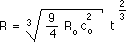
Inoltre, abbiamo trovato un unico modello cosmologico a curvatura negativa, riempito indifferentemente di fotoni o di materia o di un mix dei due, con una pressione non nulla, e che obbedisce solo alla legge: (7a)
...Nell'articolo II, abbiamo riscoperto la legge di Hubble, dovuta alla variazione secolare della costante di Planck (che si è rivelata variare come t) e non al processo di espansione. In questo modello a energia costante, considerazioni geometriche hanno fatto variare alcune energie caratteristiche come l'energia di ionizzazione come R(t), e questo si è rivelato coerente con ulteriori relazioni di gauge applicate all'elettromagnetismo. Successivamente, è apparso possibile dedurre le distanze delle sorgenti luminose dai dati del redshift. Si sono rivelate abbastanza vicine, per valori moderati di z, ai valori classici derivati da un modello di Friedmann con q₀ = 1/2, poiché il rapporto:
(7b)
rimane vicino all'unità entro il 5% per z ≤ 2.
- UN BREVE COMPLEMENTO SULL'INVARIANZA DI GAUGE
...Nell'articolo I, sezione 5, abbiamo mostrato che alcune equazioni fondamentali (Vlasov, Schrödinger, Maxwell) sono invariate sotto le relazioni di gauge proposte. Mostriamo che anche l'operatore di collisione di Boltzmann lo è.
Scriviamo questa equazione. (8)
...f è la funzione di distribuzione delle velocità, g è la velocità relativa di due particelle durante un incontro, b è una lunghezza (parametro di impatto), e un angolo. Introduciamo variabili senza dimensioni, attraverso: (9)
t = t* t; f = f* x; V = V* w; g = V* g; r = R* z
Y = (Gm/R*) j; b = R* b
La funzione di distribuzione delle velocità caratteristica è: (10)
...Seguendo le relazioni di gauge come definite nell'articolo I, Gm/R* varia come 1/R*. V* varia come 1/R¹/². m varia come R* (mV² è costante). L'energia kT è costante. In sintesi f * » R*⁻³/², e quindi: (11)
...Un'analisi dimensionale dà termini che variano rispettivamente come 1/t*, V*/R* = 1/R³/², 1/R³/², il che implica nuovamente: (12)
R* » t*²/³
e quindi l'invarianza dell'operatore di Boltzmann.
- TEST OSSERVATIVI.
...Dopo questa breve parentesi, passiamo a un confronto tra diversi modelli e i dati radio su 134 QSO recentemente pubblicati da Barthel e Miley [3, qui di seguito BM], nei quali mostrano che i DSO lontani hanno dimensioni angolari più piccole, curvature più importanti e luminosità più elevate rispetto a quelle degli oggetti vicini. Tuttavia, non intendiamo discutere qui delle potenze intrinseche fornite, poiché i meccanismi fisici coinvolti nella generazione dei getti relativistici non sono ancora chiaramente compresi.
...La situazione sembra apparentemente più semplice riguardo alla dimensione angolare e alla curvatura delle sorgenti radio, poiché le proprietà geometriche sono principalmente in gioco a priori in entrambi i casi, anche se non possiamo ignorare che possano esserci effetti sistematici importanti in gioco, e rimandiamo il lettore alla discussione completa di BM sui meccanismi dettagliati coinvolti. In sintesi:
-
l'interazione con il mezzo intergalattico (MIG) può disturbare molto efficacemente i getti inizialmente collimati, causando la formazione di lobi ampi, turbolenti, di minore portata: se si ammette che tali effetti possano modificare significativamente la distribuzione delle dimensioni angolari a un certo redshift, sono stati invocati meccanismi più complessi da BM per spiegare la curvatura più forte dei lobi osservata a grande redshift.
-
effetti evolutivi possibili in tutti i meccanismi elementari coinvolti, inclusi processi di gauge ancora non identificati.
-
un bias osservativo come il ben noto di Malmquist, che introduce una sottostima delle dimensioni angolari per i QSO lontani.
...Ora, supponiamo in questo articolo che tali effetti potenziali non siano dominanti nei dati, cioè che la distribuzione della dimensione angolare e della curvatura in funzione del redshift possa essere considerata un buon test per discriminare tra diversi modelli cosmologici, e mostriamo che il nuovo modello di gauge fornisce un miglior adattamento a queste distribuzioni rispetto ai modelli classici.
3a La dimensione angolare.
...La dimensione angolare degli oggetti extragalattici è spesso considerata un test potente per i modelli cosmologici. Sia il pedice 1 associato all'epoca di emissione e il pedice 2 all'epoca di ricezione: poiché la luce emessa dai bordi di una sorgente all'istante t₁ segue traiettorie radiali, la dimensione angolare f è conservata per un osservatore attuale, in modo che possiamo scrivere classicamente, qualsiasi sia il modello:
(13)
dove D(t₁) è il diametro lineare della sorgente e d(t₁) la sua distanza metrica.
Nel modello classico di Friedmann con q₀ = 1/2 (il famoso modello di Einstein-de-Sitter)
D(t₁) = D costante
R(t₁) = R(t₂) / (1 + z)
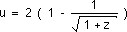
e d(t₁) = R(t₁) u dove:
(14)
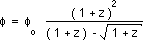
e quindi un certo paradosso appare poiché la dimensione angolare obbedisce a:
(15)
Questa funzione presenta un minimo per z = 1,25, e poi tende a crescere linearmente con z.
Ora, con il nuovo modello di gauge, abbiamo
D(t₁) = D(t₂)/(1+z),
R(t₁) = R(t₂)/(1+z)
e d(t₁) = R(t₁) u anche
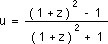
ma con:
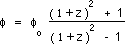
(16)
e la dimensione angolare obbedisce a:
(17)
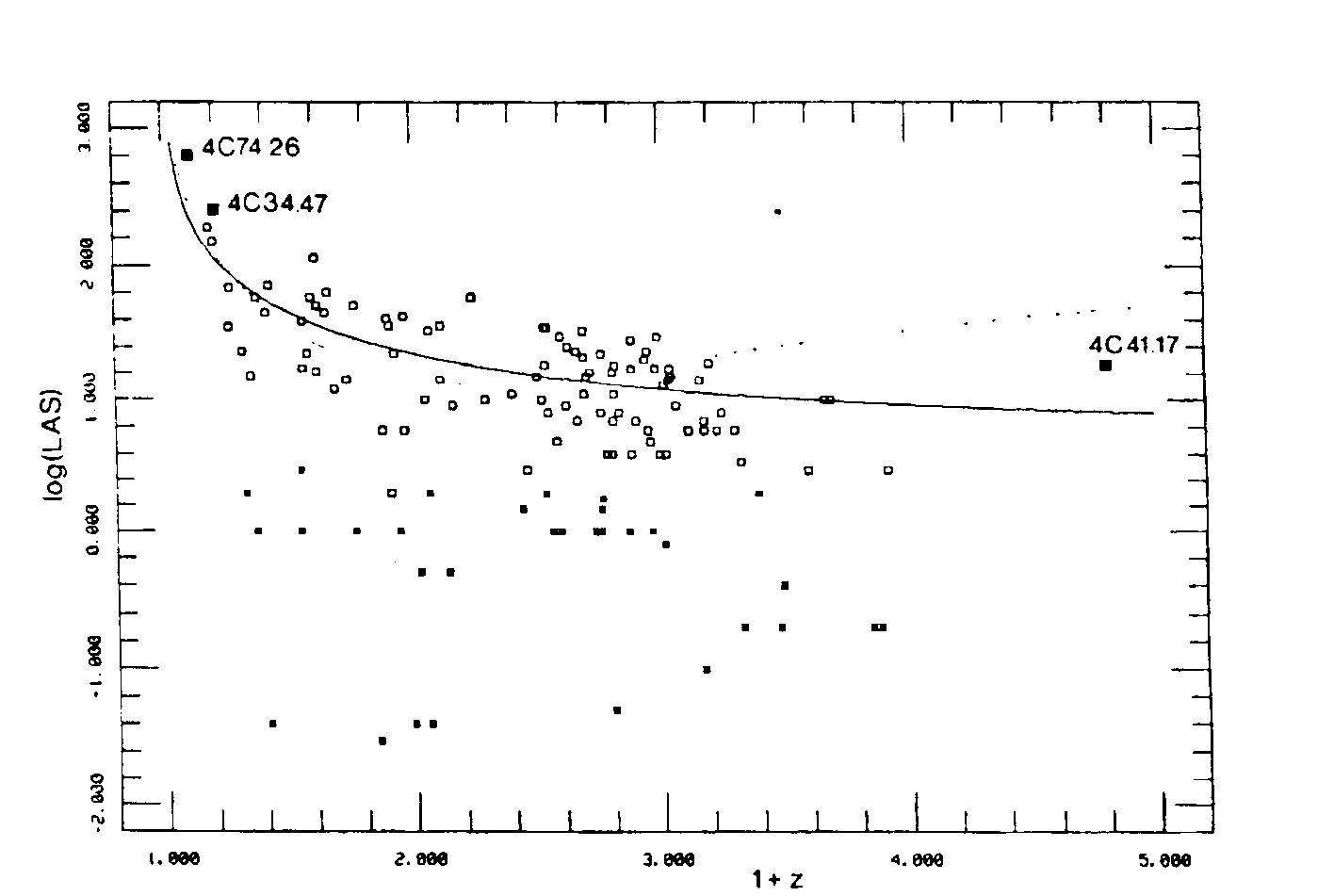
Quando z tende all'infinito, f tende a una costante, un comportamento nettamente diverso e in accordo qualitativo con i dati.
(18)
Fig 18: La più grande dimensione angolare (LAS, in secondi d'arco), su una scala logaritmica in funzione del redshift per le 95 sorgenti estese con morfologie "T", "D1" e "D2" (quadrati) e le 33 sorgenti compatte con morfologie "SSC" (asterischi). Le due curve rappresentano gli adattamenti del modello di gauge (linea continua) e del modello di Einstein-de-Sitter (linea tratteggiata) ottenuti per le sorgenti estese in questo articolo. Tre altre sorgenti radio di estensione molto grande sono mostrate per confronto. 4C41.17 è la galassia più lontana attualmente conosciuta, 4C74.26 la più grande sorgente radio associata a un quasar.
...Per confrontare quantitativamente la qualità dell'adattamento dei due modelli ai dati, scriviamo f = f₀f(z) dove f(z) è una funzione caratteristica predetta sopra da ciascun modello. Sono state effettuate regressioni lineari tra f(z) e i dati della "più grande dimensione angolare" [LAS dopo BM], sia per l'intero campione di 134 QSO, sia per un campione ridotto di 83 QSO nel quale sono state selezionate solo le sorgenti con lobi bilaterali, cioè quelle con morfologie "T" o "D1" definite da BM, escludendo così i nuclei con spettro rigido o "SSC" e le sorgenti con lobi unilaterali o "D2", al fine di testare eventuali proprietà diverse tra sorgenti compatte e estese. I risultati delle regressioni sono i seguenti, tutti i coefficienti lineari forniti e le loro barre di errore RMS espressi in secondi d'arco:
- con il modello di Einstein-de-Sitter:
F = (28,8 ± 2,9) f(z) - (89,3 ± 20,1)
per il campione completo, e
F = (31,3 ± 3,3) f(z) - (90,5 ± 20,8)
per il campione ridotto.
- con il modello di gauge:
F = (21,5 ± 2,11) f(z) - (19,1 ± 19,6)
per il campione completo, e:
F = (24,3 ± 2,3) f(z) - (17,3 ± 19,8)
per il campione ridotto.
...È chiaro che il nuovo modello di gauge fornisce un adattamento nettamente migliore ai dati, poiché in qualsiasi campione, il termine costante moderato che implica è marginalmente significativo dal punto di vista statistico, e quindi il valore (atteso) nullo è molto probabile. La situazione è del tutto opposta con il modello classico, sia che si consideri qualsiasi campione, poiché il termine costante è fortemente significativo dal punto di vista statistico e il suo valore grande e negativo è inaccettabile da un punto di vista teorico, a meno che non si supponga che siano in gioco effetti sistematici molto intensi, come quelli sospettati sopra, nei dati.
3b. La curvatura.
...Mostriamo anche che l'aspetto più curvo, più deformato dei QSO lontani sottolineato da BM può essere curiosamente spiegato dal nuovo modello di gauge, a condizione che non si tratti di un artefatto risultante da vari effetti sistematici. Poiché nel nuovo modello si assume che tutte le energie siano conservate durante il processo di gauge cosmico, possiamo includere la conservazione dell'energia di rotazione del nucleo del QSO che emette i getti: (19)
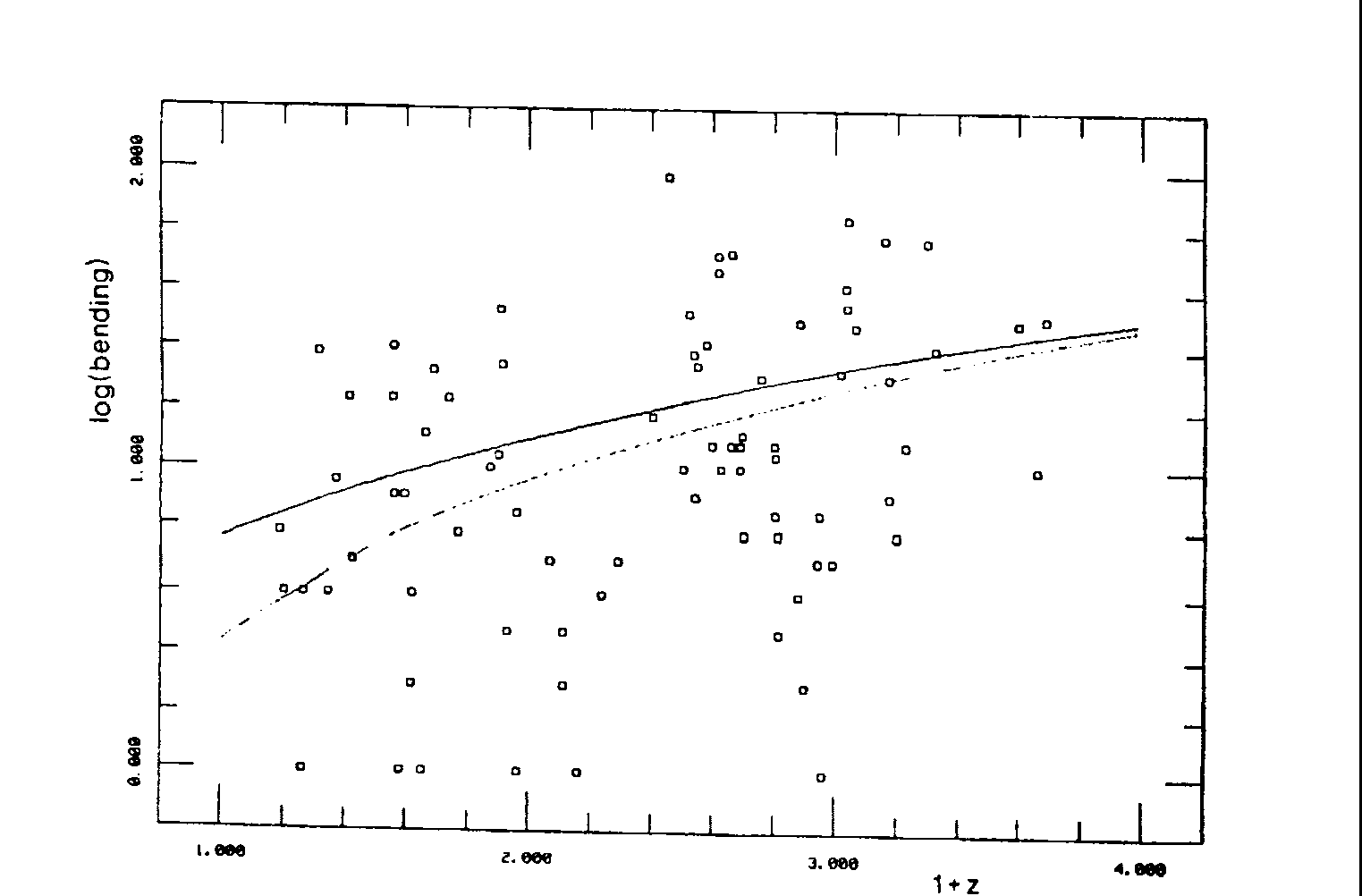
Poiché m » R, I » R³ e W » R⁻³/² W » 1/t » (1 + z)³/², in curiosa concordanza con l'adattamento a legge unidimensionale inferiore effettuato da BM sul campione ridotto (poiché la curvatura è definita solo in questo ultimo caso), vale a dire:
(20)
Fig 21: La curvatura (in gradi) su una scala logaritmica in funzione del redshift per le 83 sorgenti estese con morfologie "T" e "D1" solo, per le quali è definita. La curva continua corrisponde all'adattamento del modello di gauge, indicando che le velocità angolari erano più elevate nel passato, mentre la linea tratteggiata rappresenta l'adattamento in legge potenza di Barthel e Miley (BM).
...Ora proponiamo una spiegazione sommaria, riferendoci all'analisi recente di Greyber [5] sulla natura dei motori centrali nei QSO responsabili dei loro tassi di produzione energetica enormi: se accettiamo il fatto (i) che i pacchetti di plasma vengono espulsi a velocità elevate dal motore centrale, in modo continuo o no, lungo l'asse del dipolo magnetico dei QSO, e (ii) che quest'ultimo non è generalmente coincidente con l'asse del momento angolare, siamo di fronte a un modello simile a un irrigatore rotativo, in cui i getti si curveranno in una sorta di spirale di Archimede, finché l'interazione con il MIG rimane trascurabile. E anche se questa interazione diventa significativa a una certa distanza dal nucleo, i getti smetteranno di espandersi lì, causando un aumento della curvatura. Poiché non c'è motivo per cui la densità del MIG sia distribuita in modo sferico intorno ai QSO, tali interazioni potrebbero spiegare le asimmetrie frequenti osservate nei loro getti, così come gli effetti casuali sulla curvatura globale, come discusso da BM.
...Di conseguenza, più alto è il redshift del QSO, più alta è la sua velocità angolare a causa del processo di gauge cosmico, e quindi più grande è la curvatura dei suoi getti.
- CONCLUSIONE.
...Ci siamo concentrati su caratteristiche specifiche recentemente evidenziate nella distribuzione delle dimensioni angolari e della curvatura in funzione del redshift per un insieme omogeneo di 134 QSO radio. Abbiamo trovato interessantemente che il nostro modello di gauge con "costanti variabili" fornisce un migliore adattamento a queste distribuzioni rispetto al modello classico di Einstein-de-Sitter, a condizione che (i) le tendenze osservate (dimensioni angolari più piccole e curvature più grandi per i QSO lontani) siano confermate da osservazioni future, (ii) che queste tendenze non siano dominate da vari effetti o artefatti, e (iii) che le ipotesi sommarie fatte su alcuni meccanismi coinvolti siano reali. Inoltre, sono necessarie ulteriori indagini sulla potenza intrinseca di queste sorgenti per comprendere se il modello di gauge permette una migliore comprensione delle tendenze osservate, cioè se la luminosità dei QSO lontani è effettivamente molto maggiore di quella dei QSO vicini.
- RIFERIMENTI.
[1] J.P. PETIT : Interpretazione del modello cosmologico a velocità della luce variabile. Modern Physics Letters A, Vol. 3, n° 16, novembre 1988
[2] J.P. PETIT : Modello cosmologico a velocità della luce variabile. L'interpretazione degli spostamenti verso il rosso. Modern Physics Letters A, Vol. 3, n° 18, dicembre 1988.
[3] P.D. BARTHEL & G. K. MILEY. Evoluzione della struttura radio nei quasar: una nuova sonda delle proto-galassie? - Nature Vol 333, 26 maggio 1988.
[4] M.L. NORMAN, J.O. BURNS e M.E. SULKANEN : Perturbazione dei getti radio galattici da parte degli urti nel mezzo circostante, Nature 335 (1988) 146.
[5] H.D. GREYBER : L'importanza dei campi magnetici intensi nell'Universo, Comments Astrophys. 13 (1989) 201.









Versione originale (inglese)
cosmological model with variable light velocity
**Gauge cosmological model with variable light velocity. Comparizon with QSO observational data. **
Jean-Pierre Petit and Maurice Viton (Laboratoire d'Astronomie Spatiale. Traverse du Siphon.13012. Marseille)
Modern Physics Letters A Vol.4 , n°23 (1989) pp. 2201-2210
ABSTRACT :
...After a complement to previous papers on the gauge invariance of the Boltzmann collisional operator, we compare a recent homogeneous set of data on radio-QSOs, including angular sizes and bending of lobes, with what is expected from either our new cosmological gauge model or the most commonly accepted Friedman model with qo = 1/2 . It is shown that the new gauge model provides a much better fit to the angular size distribution vs. redshift and similarly to the bending, thanks to crude hypothesis on the mechanisms involved with the formation of jets.
- INTRODUCTION
...In references [1] and [2] , hereafter paper I and paper II respectively, we have previously developped a cosmological model in which all the so called constants of physics were made free, so that we had to introduce new physical laws, gauge laws, in order to link conveniently these constants :
c (velocity of light), G (gravitation), h (Planck's constant), me (electron mass), mp, mn (proton and neutron mass ). It was shown at first that the general relativity theory does not require the absolute constancy of G and c, but only the absolute constancy of the ratio G/c2 (Einstein's constant of the field equation). This brought the first linking relation. The other came from geometric considerations : we assumed that the characteristic lengths like Jeans length, Schwarzschild length and Compton length followed the variation of the scale parameter R(t).
Combining these new physical laws we got the following relations : (1)
(2)
mp = mn ( nucleon's mass ) » R
(3)
h » R3/2
(4)
G » 1/R
(5)
V ( velocity ) » R-1/2
(6)
r » 1/R2
In addition we found a single cosmic model, with negative curvature, indifferently filled by photons or matter or a mixture of the two, with non zero pressure, and obeying the single law : (7a)
...In the paper II we refound the Hubble's law, due to the secular variation of the Planck constant (which was found to vary like t) and not to the expansion process. In this constant energy model, geometrical considerations made some characteristic energies like the ionization energy to vary like R(t), and it was found to be consistent with additional gauge relations applying to electromagnetism. Then it appeared possible to derive the distances of light sources from the red shift data. They were found to be quite close, for moderate z values, to the classical values derived from a Friedman model with qo = 1/2 , since the ratio :
(7b)
remains close to unity within 5 percent for z £ 2 .
- A SHORT COMPLEMENT ABOUT THE GAUGE INVARIANCE
...In the paper I, section 5, we had shown that some fundamental equations (Vlasov, Schrödinger, Maxwell) were invariant under the suggested gauge relations. Let us show that the Boltzmann collision operator is invariant to.
Writing this equation. (8)
...f is the velocity distribution function, g is the relative velocity of two particles in an encounter, b is a length (impact parameter), e an angle. Introduce adimensional variables, through : (9)
t = t* t ; f = f* x ; V = V* w ; g = V* g ; r = R* z
Y = (Gm/R*) j ; b = R* b
The characteristic velocity distribution function is : (10)
...Following the gauge relations as defined in paper I , Gm/R* varies like 1/R*. V* varies like 1/R1/2. m varies like R* (mV2 is constant). The energy k T is constant. To sum up f * » R*-3/2, and hence : (11)
...Such a dimensional analysis gives terms varying respectively like 1/t*, V*/R* = 1/R3/2 , 1/R3/2 , which implies again : (12)
R* » t* 2/3
and hence the invariance of the Boltzmann operator.
- OBSERVATIONAL TESTS.
...After this short parenthesis, let us turn to a comparison of various models with the radio data on 134 QSOs recently published by Barthel and Miley [ 3, hereafter BM] , in which they show that distant DSOs have smaller angular sizes, larger bendings and higher luminosities than those nearby. Note however that we do not intend to discuss the given intrinsic powers here, since the physical mechanisms involved in the generation of relativistic jets are not yet clearly understood.
...The situation is appearently simpler concerning the angular size and bending of radiosources, since geometric properties are mainly concerned a priori in both cases, though we cannot ignore that important systematic effects might be at work and we adress the reader to the related comprehensive discussion of BM on the detailed mechanisms involved. In short :
-
interaction with the intergalactic medium (IGM) can disrupt very efficiently the initially collimated jets, resulting into the formation of large, turbulent lobes (4) of lesser extension : if it is clear that such effects can modify significantly the angular size distribution at a given redshift, more complicated mechanisms have been invoked by BM to explain the stronger bending of lobes observed at large redshifts.
-
possible evolutionary effects in all the elementary mechanisms implicated above, including gauge processes not yet identified.
-
observational bias such as the well-known Malmquist's, introducing an underestimate of angular sizes for distant QSOs.
...Now, let us suppose in this paper that such potential effects are not dominant in the data, i.e. that the distribution of angular size and bending vs. redshifts may be considered as good tests for discriminating between different cosmological models and show that the new gauge model provides better fits to these distributions than do the conventional models.
3a The angular size.
...The angular size of extragalactic objects has often be considered as a powerfull test for cosmological models. So, let the subscript 1 refer to the emission epoch and subscript 2 to the reception epoch : since the light emited by the edges of a source at time t1 follows radial pathes, the angular size f is conserved for a present observer, so that we can write classically, whatever the model :
(13)
where D(t1) is the linear diameter of the source and d(t1) its metric distance.
In the classical Friedman model with qO = 1/2 ( the so called Einstein-de-Sitter's )
D(t1) = D constant
R (t1) = R (t2) / ( 1 + z )
and d(t1) = R (t1) u where :
(14)
and hence some kind of a paradox arises since the angular size obeys :
(15)
This function has a minimum for z = 1.25 , and then it tends to grow linearly with z .
Now, with the new gauge model we have
D(t1) = D(t2)/(1+z) ,
R(t1) = R(t2) / ( 1 + z )
and d(t1) = R (t1) u also
but with :
(16)
and the angular size obeys :
(17)
When z tends to infinity, f tends to a constant, a readily different behaviour and in qualitative agreement with the data.
(18)
Fig 18 : The largest angular size (LAS, in arcsecond), on a logarithmic scale versus redshift for the 95 extended sources with "T", "D1" and "D2" morphologies (squares) and the 33 compact sources with "SSC" morphologiy (asterisks). The two curves represent the fits of the gauge model (continuous line) and the Einstein-De Sitter model (dotted line) derived for extended sources in this paper. Three additional radio-sources of very large extent are shown for comparison. 4C41.17 being the farthest galaxy presently known, 4C74.26 the largest radio-source associated with a quasar.
...In order to compare quantitatively how both models fit the data, let us write f = fof(z) where f(z) is a characteristic function as predicted above by each model. Linear regressions have been performed between f(z) and the "largest angular size" [ LAS after BM ) data, either for their complete sample of 134 QSOs, or for a reduced sample of 83 QSOs in which only two-sided lobes sources were selected, i.e. those with the "T" or "D1" morphologies defined by BM, thus excluding the steep spectrum core or "SSC" and the one-sided lobe or "D2" sources, so as to test for possibly different properties of compact and extended sources. The results of the regressions were as follows, all the given linear coefficients and their rms errors bars being in arc second units :
- with the Einstein-de-Sitter model :
F = ( 28.8 ± 2.9 ) f(z) - ( 89.3 ± 20.1 )
for the complete sample, and
F = ( 31.3 ± 3.3 ) f(z) - ( 90.5 ± 20.8 )
For the reduced sample.
- with the gauge model :
F = ( 21.5 ± 2.11 ) f(z) - ( 19.1 ± 19.6 )
for the complete sample, and :
F = ( 24.3 ± 2.3 ) f(z) - ( 17.3 ± 19.8 )
for the reduced sample.
...It is clear that the new gauge model provides a fairly better fit to the data since whatever the sample, the moderate constant term it implies is marginally significant from a statistical point of view and hence the (expected) zero value is highly probable. The situation is quite opposite with the conventional model, here also whatever the sample, since the constant term is highly significant from a statistical point of view and its large, negative value is unacceptable on theoretical grounds, unless one supposes that very strong systematic effects as those suspected above are at work in the data.
3b. The bending.
...Let us show also that the more bent, distorted appearence of distant QSOs pointed out by BM may be curiously explained by the new gauge model, providing here again that is not an artefact resulting from various systematic effects. Since in the new model it is assumed that all the energies are conserved during the cosmic gauge process, we can include the conservation of the rotational energy of the QSO core emitting the jets : (19)
As m » R , I » R3 and W» R-3/2 W » 1/t » ( 1 + z )3/2, in curious agreement with the one-dimensional lower law fit performed by BM on the reduced sample ( since the bending is only defined in this latter case ), that is :
(20)
Fig 21: The bending (in degree) on a logarithmic scale versus redshift for the 83 extended sources with "T" and "D1" morphologies only, for which it is defined. The continuous curve corresponds to the fit of the gauge model, indicating that angular speeds where higter in the past, while the dotted line represents the power law fit of Barthel and Miley (BM)
...Now let us suggest a crude explanation, refering to the recent analysis of Greyber [5) on the nature of the central engines in QSOs responsible for their tremendous energy production rates : if we accept the figure (i) that the plasma blobs are ejected at high velocities from the central engine, continuously or not, along the magnetic dipole axis of the QSOs and (ii) that this latter is not generally coincident with their angular momentum axis, then we are faced with a model similar to a rotating "garden sprinkler", in which the jets will bend into some kind of a spiral of Archimedes, as long as the interaction with the IGM remains neglectible. And even if this interaction becomes significant at some distance from the nucleus, the jets will stop to expand there, resulting into an increased bending. Since there is no reason why the IGM density would be spherically distributed around QSOs, such interactions could account for the frequently assymetries in their jets together with random effects on the overall bending, as it has been discussed by BM.
...As a consequence, the higher the redshift of the QSO, the higher its angular velocity because of the cosmic gauge process and hence the larger the bending of its jets.
- CONCLUSION.
...We have focussed on specific features recently evidenced in the distribution of angular sizes and bending vs. redshift for an homogeneous set of 134 radio-QSOs. We found interestingly that our gauge model with "variable constants" provides better fits to these distributions than the conventional Einstein-de-Sitter model, providing (i) that the observed trends (smaller angular size and larger bending of distant QSOs) will be confirmed by future observations, (ii) that these trends are not dominated by various effects or artefacts, and (iii) that the crude assumptions wa made on some of the mechanisms involved are real. Also, further investigations on the intrinsic power of these sources are needed to understand if the gauge model provides a better understanding of the observed trends, i.e. that the luminosity of distant QSOs is much greater than for those nearby.
- REFERENCES.
[ 1] J.P.PETIT : Interpretation of cosmological model with variable light velocity. Modern Physics Letters A, Vol.3 n° 16 November 1988
[ 2] J.P.PETIT : Cosmological model with variable light velocity. The interpretation of red shifts. Modern Physics Letters A, Vol.3 , n° 18, December 1988.
[ 3] P.D.BARTHEL & G.KMILEY. Evolution of radio structure in quasars : a new probe of protogalaxies? - Nature Vol 333, 26 may 1988.
[ 4] M.L.NORMAN, J.O. BURNS and M.E. SULKANEN : Disruption of the galactic radio jets by the shocks in the ambient medium, Nature 335 (1988) 146.
[ 5] H.D.GREYBER : The importance of strong magnetic fields in the Universe, Comments Astrophys. 13 ( 1989 ) 201.