質量の欠如の問題(p3)
4) 球対称解
…1916年にエディントンは、Vlasov方程式とPoisson方程式を組み合わせた球対称な定常解を導いた。彼は、速度の楕円体が球対称であり、システムの中心に向かっていると仮定した。
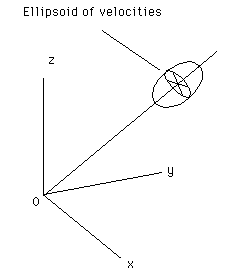
図1 (ga3114) : エディントン型の解に対応する速度の楕円体。
エディントンは、質量密度と重力ポテンシャルの間の次の関係を導いた:
(20)
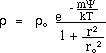
これは、重力ポテンシャルΨにおいて、重力が圧力と釣り合っている衝突のないガスにおける物質の定常分布を表す。対蹠的な領域に対して同じ種類の解を考えてみよう:
(21)
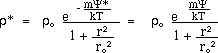
したがって、次の式を解く必要がある:
(22)

以下のように置く:
(23)
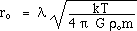
以下の無次元量を導入する:
(24)

これにより、
(24 bis)
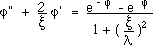
が得られる。これは数値計算によって解くことができる。次の初期条件を取ることができる:
φ'₀ = 0
φ"₀ = 10
λ = 10
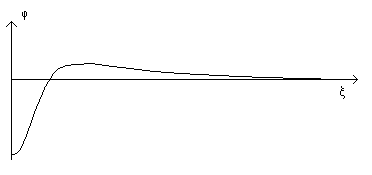
図2 : 球対称なエディントン型の解。重力ポテンシャル
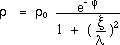
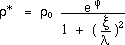
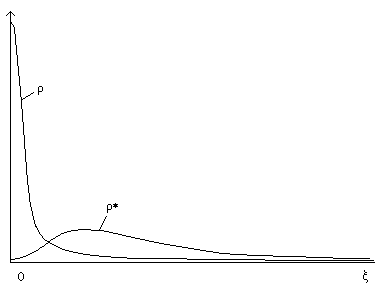
図3 : 球対称なエディントン型の解。質量密度。もしクラスターが一つの折れ線に存在するなら、第二の折れ線の共役領域にその関連する拡散的なハローが存在する。
オリジナルバージョン(英語)
The missing mass problem (p3)
4) Spherically symmetric solution
...In 1916 Eddington derived a spherically symmetric steady-state solution, combining the Vlasov and the Poisson equations. He assumed that the ellipsoid of the velocities was spherically symmetric and pointed towards the center of the system.
Figure 1 (ga3114): Ellipsoid of velocities corresponding to an Eddington-type solution.
Eddington derived the following relation between the mass density and the gravitational potential
(20)
which represents a steady-state distribution of matter in a collision-free gas, in a gravitational potential Ψ, in which the gravitational force balances the pressure force. Let us take the same kind of a solution for the antipodal region
(21)
So that we have to solve the following equation
(22)
Take
(23)
Introduce the following adimensional quantities :
(24)
We get
(24)
which can be solved by numerical computation. We can take the following initial conditions
φ'₀ = 0
φ"₀ = 10
λ = 10
Figure 2 : Spherically symmetric Eddington-type solution. The gravitational potential
Figure 3 : Spherically symmetric Eddington-type solution. Mass densities. If a cluster exists in one fold, an associated diffuse halo exists in the conjugated region of the second fold.