可変光速度を持つ宇宙論モデル
可変光速度を持つゲージ宇宙論モデル。QSOの観測データとの比較。
ジャン=ピエール・ピエティとモーリス・ヴィトン(宇宙天文実験室。スフィロン通り。13012。マルセイユ)
現代物理学の通信 A 巻 4 号 (1989) pp. 2201-2210
要約:
...以前の論文においてボルツマン衝突演算子のゲージ不変性に関する補足を行った後、我々は最近かつ一貫した放射性QSOデータセットを比較し、角度サイズとローブの曲率を含んで、我々の新しいゲージ宇宙論モデルまたは一般的に受け入れられているフリードマンモデル(q₀ = 1/2)から予測されるものと比較します。新しいゲージモデルが赤方偏移に応じた角度サイズの分布および曲率にはるかに良い適合を提供することが示されています。これは、ジェット形成に関与するメカニズムに関する単純な仮定によります。
- 導入
...参考文献[1]および[2](以下、論文Iおよび論文IIと呼ぶ)では、以前にすべての物理定数が自由にされた宇宙論モデルを開発しました。したがって、これらの定数を便利に結びつけるために新しい物理法則、つまりゲージ法則を導入する必要がありました:
c(光の速度)、G(重力)、h(プランク定数)、mₑ(電子の質量)、mₚ、mₙ(陽子および中性子の質量)。まず、一般相対性理論はGとcの絶対的な一定性を必要とせず、場の式のアインシュタイン定数であるG/c²の絶対的な一定性のみを必要とすることが示されました。これにより最初の結合関係が得られました。もう一つは幾何学的考察から得られました。我々は、ジーンズ長、シュワルツシルト長、コンプトン長などの特徴的な長さがスケールパラメータR(t)の変化に従うと仮定しました。
これらの新しい物理法則を組み合わせることで、以下の関係を得ました:(1)
(2)
mₚ = mₙ(核子の質量)» R
(3)
h » R³/²
(4)
G » 1/R
(5)
V(速度)» R⁻¹/²
(6)
ρ » 1/R²
さらに、負の曲率を持つ一貫した宇宙モデルを発見しました。このモデルは、光子または物質またはその混合で満たされており、圧力がゼロでないことを前提として、次の単一の法則に従います:(7a)
...論文IIでは、プランク定数の長期的な変化(これはtに比例することが判明)によってヒューブルの法則が再確認され、拡張プロセスではなく、それによって得られました。この定エネルギーモデルでは、幾何学的考察により、イオン化エネルギーなどの特徴的なエネルギーがR(t)に従って変化し、これは電磁気学に適用された追加のゲージ関係と一致することが判明しました。その後、赤方偏移データから光源の距離を導出することが可能となりました。それらは、中程度のz値では、q₀ = 1/2のフリードマンモデルから導かれた古典的な値と非常に近いことが判明しました。なぜなら、次の比:
(7b)
はz ≤ 2で1に近い値を示し、5%以内にとどまっています。
- ゲージ不変性に関する短い補足
...論文Iの第5節では、いくつかの基本方程式(Vlasov、Schrödinger、Maxwell)が提案されたゲージ関係に対して不変であることを示しました。ボルツマン衝突演算子も不変であることを示します。
この方程式を書きます。(8)
...fは速度分布関数、gは衝突時の2つの粒子の相対速度、bは長さ(衝突パラメータ)、eは角度です。無次元変数を導入します。(9)
t = t* t; f = f* x; V = V* w; g = V* g; r = R* z
Y = (Gm/R*) j; b = R* b
特徴的な速度分布関数は次の通りです。(10)
...論文Iで定義されたゲージ関係に従って、Gm/Rは1/Rに比例します。Vは1/R¹/²に比例します。mはRに比例します(mV²は一定)。エネルギーkTは一定です。まとめると、f * » R*⁻³/²であり、したがって:(11)
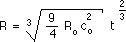
...このような次元分析により、それぞれ1/t*、V*/R* = 1/R³/²、1/R³/²に比例する項が得られ、これにより再び:(12)
R* » t*²/³
そしてボルツマン演算子の不変性が得られます。
- 観測的検証。
...この短い付記の後、バーセルとマイリー[3]によって最近公開された134のQSOのデータを用いて、いくつかのモデルと比較します。彼らは遠方のDSOが近接のものよりも角度サイズが小さく、曲率が大きく、明るさが高いことを示しています。ただし、ここではQSOの固有の出力について議論する意図はなく、相対的なジェット生成に関与する物理的メカニズムはまだ明確に理解されていません。
...放射性の対象の角度サイズと曲率に関しては、状況は明らかに単純です。これは、両方のケースで主に幾何学的性質が関与しているためです。ただし、重要な系統的効果が働いている可能性があるため、BMが詳細なメカニズムについて詳しく説明している議論に依拠する必要があります。要するに:
-
銀河間物質(IGM)との相互作用は、初期に整列したジェットを非常に効率的に乱し、広範囲で乱れたローブを形成します。もし、このような効果が特定の赤方偏移で角度サイズの分布を大幅に変化させるとすれば、BMは遠方の赤方偏移で観測されるローブのより強い曲率を説明するためにより複雑なメカニズムを提案しています。
-
上記のすべての基本的なメカニズムにおける進化効果、そしてまだ特定されていないゲージプロセスを含みます。
-
マルムクイストのよく知られたバイアスにより、遠方のQSOの角度サイズが過小評価される可能性があります。
...この記事では、これらの潜在的な効果がデータにおいて支配的ではないと仮定します。つまり、赤方偏移に応じた角度サイズと曲率の分布は、異なる宇宙論モデルを区別するための良いテストと見なすことができ、新しいゲージモデルがこれらの分布に従ってより良い適合を提供することを示します。
3a 角度サイズ。
...銀河外対象の角度サイズは、宇宙論モデルのテストとしてよく使われてきました。添字1は発生時、添字2は受信時とします。発生時t₁の対象の端から発せられた光は放射状の経路をたどるため、現在の観測者にとって角度サイズfは保存されます。したがって、モデルによらず次のように書けます:
(13)
ここでD(t₁)は対象の線形直径、d(t₁)はそのメトリック距離です。
一般的なフリードマンモデル(q₀ = 1/2)では(有名なアインシュタイン・デ・ジッターのモデル)
D(t₁) = D 定数
R(t₁) = R(t₂) / (1 + z)
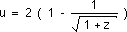
d(t₁) = R(t₁) u であり、ここで:
(14)
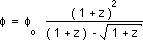
したがって、角度サイズが次のようになるというパラドックスが生じます:
(15)
この関数はz = 1.25で最小値を持ち、その後zに比例して増加します。
一方、新しいゲージモデルでは、次のようになります:
D(t₁) = D(t₂)/(1+z),
R(t₁) = R(t₂)/(1+z)
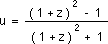
d(t₁) = R(t₁) u であり、ここで:
(16)
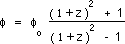
角度サイズは次のようになります:
(17)
zが無限大に近づくと、fは定数に近づき、これはデータと定性的に一致し、はっきりとした異なる挙動です。
(18)
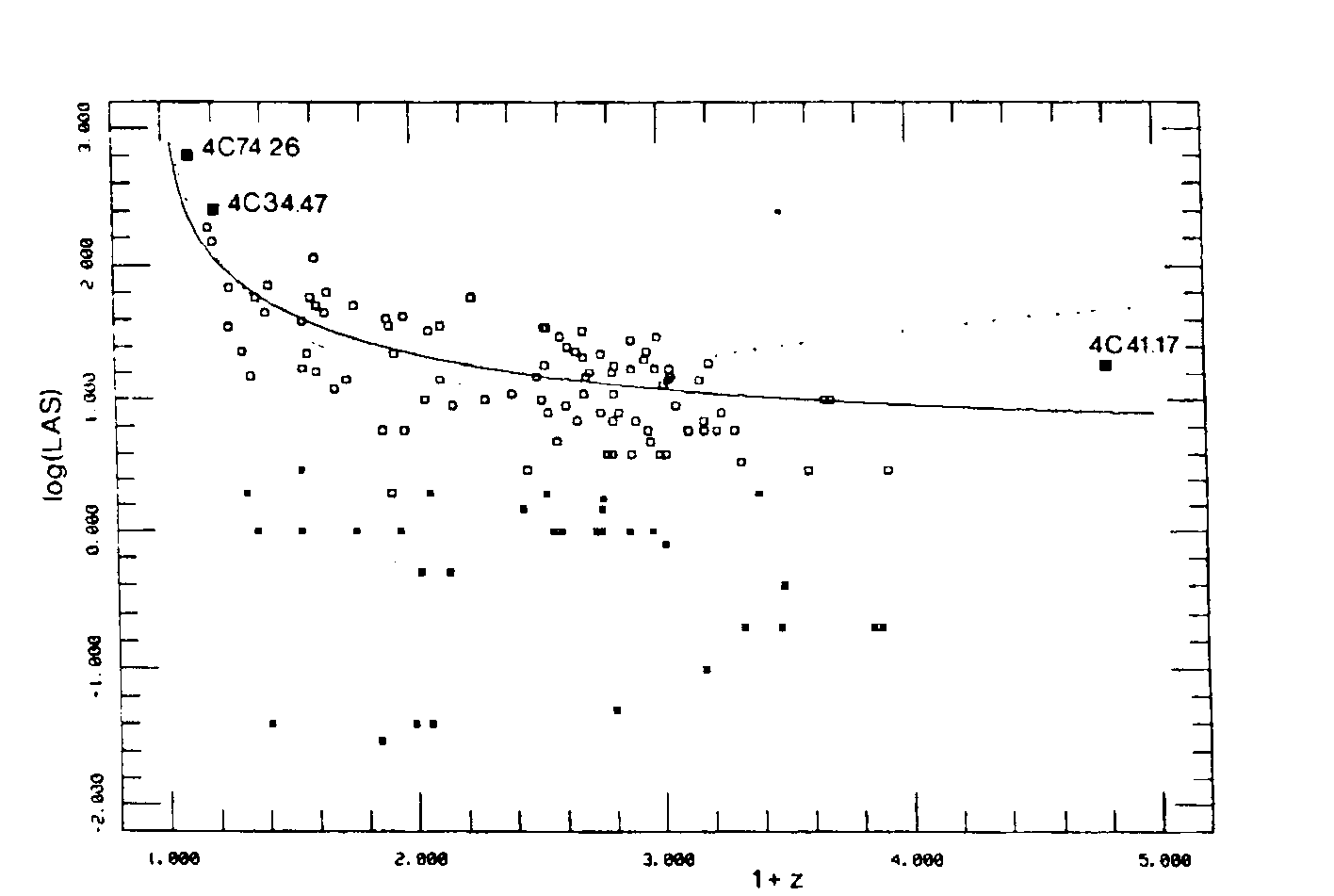
図18:95個の「T」、「D1」および「D2」形態の拡大対象(四角形)および33個の「SSC」形態のコンパクト対象(アスタリスク)の最大角度サイズ(LAS、秒単位)を、赤方偏移の対数スケールで示します。2本の曲線は、この論文で拡大対象に適合したゲージモデル(実線)とアインシュタイン・デ・ジッターモデル(点線)を示しています。比較のために、さらに3つの非常に広範な無線源を示します。4C41.17は現在知られている最も遠い銀河であり、4C74.26はクエーサーに関連する最大の無線源です。
...両モデルがデータにどの程度適合するかを定量的に比較するため、f = f₀f(z)と書きます。ここでf(z)は各モデルが上記のように予測する特徴的な関数です。線形回帰は、「最大角度サイズ」[BM後のLAS]データと行いました。これは、134のQSOの完全なサンプルまたは83のQSOの縮小されたサンプルの両方で行われました。後者は、双方向のローブを持つ対象のみを対象としており、BMが定義した「T」または「D1」形態を含み、スラストスペクトルコアまたは「SSC」および単方向ローブまたは「D2」を除外しています。これにより、コンパクト対象と拡大対象の性質の違いをテストします。回帰の結果は以下の通りです。すべての線形係数とそのRMSエラーバーは秒単位で示されています:
- アインシュタイン・デ・ジッターモデルでは:
F = (28.8 ± 2.9) f(z) - (89.3 ± 20.1)
完全なサンプルで、および
F = (31.3 ± 3.3) f(z) - (90.5 ± 20.8)
縮小されたサンプルで。
- ゲージモデルでは:
F = (21.5 ± 2.11) f(z) - (19.1 ± 19.6)
完全なサンプルで、および:
F = (24.3 ± 2.3) f(z) - (17.3 ± 19.8)
縮小されたサンプルで。
...新しいゲージモデルがデータにはるかに良い適合を提供していることは明らかです。なぜなら、どのサンプルでも、そのモデルが含む中程度の定数項は統計的にわずかに有意であり、したがって期待されるゼロ値は非常に確率が高いからです。一方、従来のモデルでは、どのサンプルでも定数項が統計的に非常に有意であり、その大きな負の値は理論的に受け入れられません。ただし、上記のように疑われているような非常に強い系統的効果がデータに働いていると仮定すれば可能です。
3b. 曲率。
...BMが遠方のQSOがより曲がって歪んでいると指摘した外観は、新しいゲージモデルによって奇妙に説明できることを示します。ただし、これはさまざまな系統的効果によるアーティファクトではないと仮定します。新しいモデルでは、宇宙的ゲージプロセス中にすべてのエネルギーが保存されると仮定されているため、QSOコアの回転エネルギーの保存を含めることができます:(19)
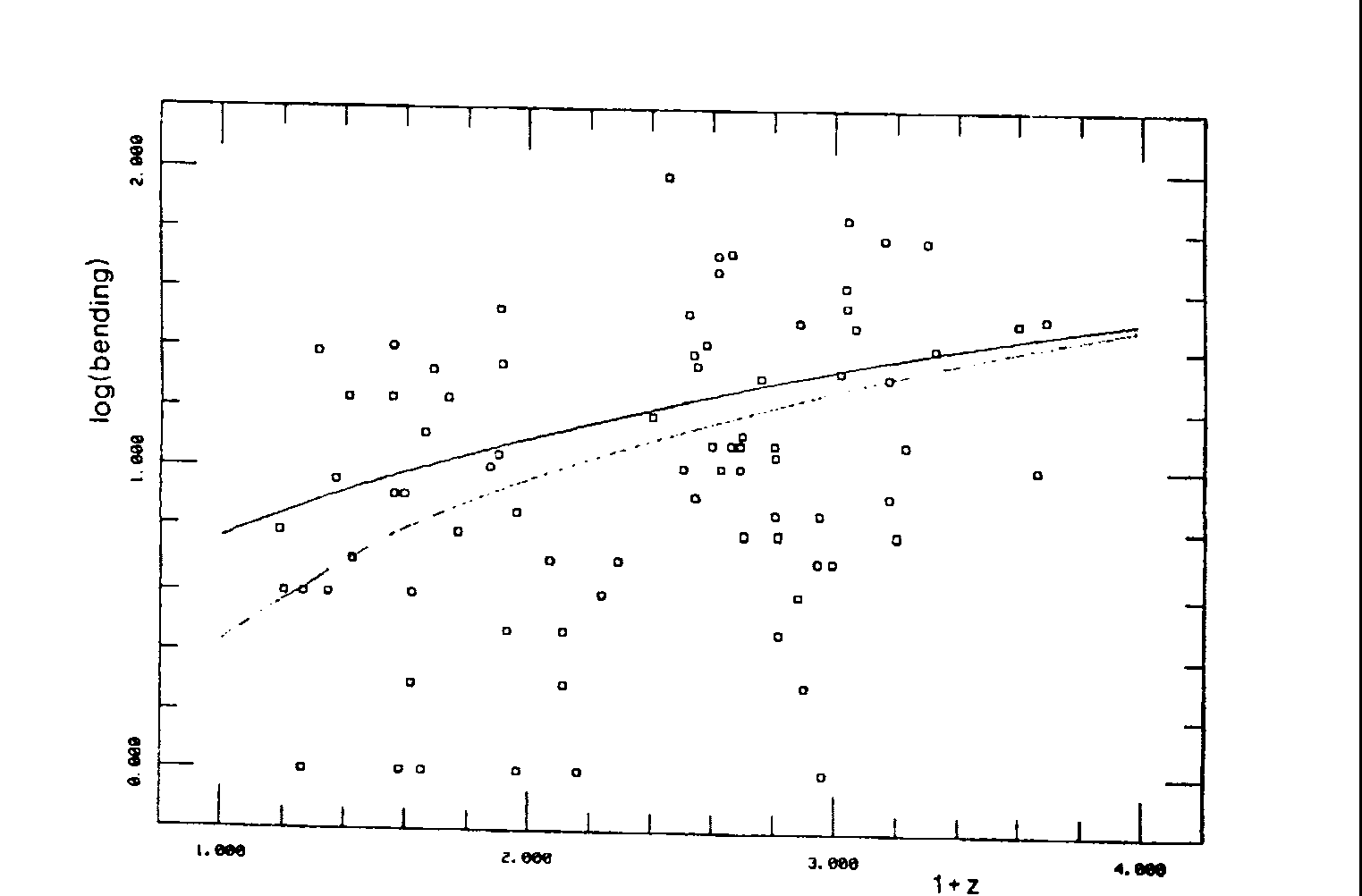
m » R、I » R³、W » R⁻³/² W » 1/t » (1 + z)³/²、これはBMが縮小されたサンプルで行った一次元下限の適合と奇妙に一致しています(曲率はこの後者のケースでのみ定義されるため)、つまり:
(20)
図21:83個の「T」と「D1」形態の拡大対象(曲率が定義されるもの)の曲率(度)を、赤方偏移の対数スケールで示します。実線はゲージモデルの適合を示し、過去の角速度がより高かったことを示しています。点線はバーセルとマイリー(BM)のべき乗則の適合を示します。
...最近のグレイバー[5]によるQSOの中心エンジンの性質に関する分析を参照して、簡単な説明を提案します。QSOがその膨大なエネルギー生成率を担っている中心エンジンの性質について、次のことを受け入れるとします:(i) プラズマの塊がQSOの磁気双極軸に沿って、連続的または非連続的に高い速度で放出され、(ii) その軸が一般的に角運動量軸と一致しないと仮定します。すると、回転する「庭のスプリンクラー」に似たモデルに直面することになります。この場合、ジェットはアキメデスの螺旋のように曲がります。IGMとの相互作用が無視できる限りです。そして、この相互作用が核からある程度の距離で重要になる場合でも、ジェットはそこで拡大を止めるため、曲率が増加します。QSOの周囲でIGMの密度が球対称に分布している理由がないため、このような相互作用は、ジェットの頻繁な非対称性および全体的な曲率にランダムな効果を説明できるかもしれません。BMが議論した通りです。
...結果として、QSOの赤方偏移が高いほど、宇宙的ゲージプロセスにより角速度が高くなり、したがってジェットの曲率も大きくなります。
- 結論。
...我々は、134の放射性QSOの均一なセットにおいて、角度サイズと赤方偏移に応じた曲率の分布に最近明らかにされた特定の特徴に焦点を当てました。我々は興味深く、我々の「変数定数」を持つゲージモデルが従来のアインシュタイン・デ・ジッターモデルよりもこれらの分布に良い適合を提供することを見出しました。これは、(i) 観測された傾向(遠方のQSOがより小さな角度サイズとより大きな曲率を持つこと)が将来的な観測によって確認される場合、(ii) これらの傾向がさまざまな効果やアーティファクトによって支配されていない場合、および(iii) 一部のメカニズムに関与する仮定が現実的である場合に限ります。さらに、このモデルが観測された傾向をよりよく理解できるかどうかを理解するために、これらの対象の固有出力に関するさらなる調査が必要です。つまり、遠方のQSOの明るさが近接のQSOよりもはるかに大きいということです。
- 参考文献。
[1] J.P. PETIT : 可変光速度を持つ宇宙論モデルの解釈。現代物理学の通信 A、Vol.3、n°16、1988年11月
[2] J.P. PETIT : 可変光速度を持つ宇宙論モデル。赤方偏移の解釈。現代物理学の通信 A、Vol.3、n°18、1988年12月。
[3] P.D. BARTHEL & G. K. MILEY. クエーサーにおける無線構造の進化:プロト銀河の新しい探査? - Nature Vol 333、1988年5月26日。
[4] M.L. NORMAN、J.O. BURNSおよびM.E. SULKANEN : 環境中の衝撃によって銀河の無線ジェットが乱される、Nature 335 (1988) 146。
[5] H.D. GREYBER : 宇宙における強力な磁場の重要性、Comments Astrophys. 13 (1989) 201。









オリジナル版(英語)
cosmological model with variable light velocity
**Gauge cosmological model with variable light velocity. Comparizon with QSO observational data. **
Jean-Pierre Petit and Maurice Viton (Laboratoire d'Astronomie Spatiale. Traverse du Siphon.13012. Marseille)
Modern Physics Letters A Vol.4 , n°23 (1989) pp. 2201-2210
ABSTRACT :
...After a complement to previous papers on the gauge invariance of the Boltzmann collisional operator, we compare a recent homogeneous set of data on radio-QSOs, including angular sizes and bending of lobes, with what is expected from either our new cosmological gauge model or the most commonly accepted Friedman model with qo = 1/2 . It is shown that the new gauge model provides a much better fit to the angular size distribution vs. redshift and similarly to the bending, thanks to crude hypothesis on the mechanisms involved with the formation of jets.
- INTRODUCTION
...In references [1] and [2] , hereafter paper I and paper II respectively, we have previously developped a cosmological model in which all the so called constants of physics were made free, so that we had to introduce new physical laws, gauge laws, in order to link conveniently these constants :
c (velocity of light), G (gravitation), h (Planck's constant), me (electron mass), mp, mn (proton and neutron mass ). It was shown at first that the general relativity theory does not require the absolute constancy of G and c, but only the absolute constancy of the ratio G/c2 (Einstein's constant of the field equation). This brought the first linking relation. The other came from geometric considerations : we assumed that the characteristic lengths like Jeans length, Schwarzschild length and Compton length followed the variation of the scale parameter R(t).
Combining these new physical laws we got the following relations : (1)
(2)
mp = mn ( nucleon's mass ) » R
(3)
h » R3/2
(4)
G » 1/R
(5)
V ( velocity ) » R-1/2
(6)
r » 1/R2
In addition we found a single cosmic model, with negative curvature, indifferently filled by photons or matter or a mixture of the two, with non zero pressure, and obeying the single law : (7a)
...In the paper II we refound the Hubble's law, due to the secular variation of the Planck constant (which was found to vary like t) and not to the expansion process. In this constant energy model, geometrical considerations made some characteristic energies like the ionization energy to vary like R(t), and it was found to be consistent with additional gauge relations applying to electromagnetism. Then it appeared possible to derive the distances of light sources from the red shift data. They were found to be quite close, for moderate z values, to the classical values derived from a Friedman model with qo = 1/2 , since the ratio :
(7b)
remains close to unity within 5 percent for z £ 2 .
- A SHORT COMPLEMENT ABOUT THE GAUGE INVARIANCE
...In the paper I, section 5, we had shown that some fundamental equations (Vlasov, Schrödinger, Maxwell) were invariant under the suggested gauge relations. Let us show that the Boltzmann collision operator is invariant to.
Writing this equation. (8)
...f is the velocity distribution function, g is the relative velocity of two particles in an encounter, b is a length (impact parameter), e an angle. Introduce adimensional variables, through : (9)
t = t* t ; f = f* x ; V = V* w ; g = V* g ; r = R* z
Y = (Gm/R*) j ; b = R* b
The characteristic velocity distribution function is : (10)
...Following the gauge relations as defined in paper I , Gm/R* varies like 1/R*. V* varies like 1/R1/2. m varies like R* (mV2 is constant). The energy k T is constant. To sum up f * » R*-3/2, and hence : (11)
...Such a dimensional analysis gives terms varying respectively like 1/t*, V*/R* = 1/R3/2 , 1/R3/2 , which implies again : (12)
R* » t* 2/3
and hence the invariance of the Boltzmann operator.
- OBSERVATIONAL TESTS.
...After this short parenthesis, let us turn to a comparison of various models with the radio data on 134 QSOs recently published by Barthel and Miley [ 3, hereafter BM] , in which they show that distant DSOs have smaller angular sizes, larger bendings and higher luminosities than those nearby. Note however that we do not intend to discuss the given intrinsic powers here, since the physical mechanisms involved in the generation of relativistic jets are not yet clearly understood.
...The situation is appearently simpler concerning the angular size and bending of radiosources, since geometric properties are mainly concerned a priori in both cases, though we cannot ignore that important systematic effects might be at work and we adress the reader to the related comprehensive discussion of BM on the detailed mechanisms involved. In short :
-
interaction with the intergalactic medium (IGM) can disrupt very efficiently the initially collimated jets, resulting into the formation of large, turbulent lobes (4) of lesser extension : if it is clear that such effects can modify significantly the angular size distribution at a given redshift, more complicated mechanisms have been invoked by BM to explain the stronger bending of lobes observed at large redshifts.
-
possible evolutionary effects in all the elementary mechanisms implicated above, including gauge processes not yet identified.
-
observational bias such as the well-known Malmquist's, introducing an underestimate of angular sizes for distant QSOs.
...Now, let us suppose in this paper that such potential effects are not dominant in the data, i.e. that the distribution of angular size and bending vs. redshifts may be considered as good tests for discriminating between different cosmological models and show that the new gauge model provides better fits to these distributions than do the conventional models.
3a The angular size.
...The angular size of extragalactic objects has often be considered as a powerfull test for cosmological models. So, let the subscript 1 refer to the emission epoch and subscript 2 to the reception epoch : since the light emited by the edges of a source at time t1 follows radial pathes, the angular size f is conserved for a present observer, so that we can write classically, whatever the model :
(13)
where D(t1) is the linear diameter of the source and d(t1) its metric distance.
In the classical Friedman model with qO = 1/2 ( the so called Einstein-de-Sitter's )
D(t1) = D constant
R (t1) = R (t2) / ( 1 + z )
and d(t1) = R (t1) u where :
(14)
and hence some kind of a paradox arises since the angular size obeys :
(15)
This function has a minimum for z = 1.25 , and then it tends to grow linearly with z .
Now, with the new gauge model we have
D(t1) = D(t2)/(1+z) ,
R(t1) = R(t2) / ( 1 + z )
and d(t1) = R (t1) u also
but with :
(16)
and the angular size obeys :
(17)
When z tends to infinity, f tends to a constant, a readily different behaviour and in qualitative agreement with the data.
(18)
Fig 18 : The largest angular size (LAS, in arcsecond), on a logarithmic scale versus redshift for the 95 extended sources with "T", "D1" and "D2" morphologies (squares) and the 33 compact sources with "SSC" morphologiy (asterisks). The two curves represent the fits of the gauge model (continuous line) and the Einstein-De Sitter model (dotted line) derived for extended sources in this paper. Three additional radio-sources of very large extent are shown for comparison. 4C41.17 being the farthest galaxy presently known, 4C74.26 the largest radio-source associated with a quasar.
...In order to compare quantitatively how both models fit the data, let us write f = fof(z) where f(z) is a characteristic function as predicted above by each model. Linear regressions have been performed between f(z) and the "largest angular size" [ LAS after BM ) data, either for their complete sample of 134 QSOs, or for a reduced sample of 83 QSOs in which only two-sided lobes sources were selected, i.e. those with the "T" or "D1" morphologies defined by BM, thus excluding the steep spectrum core or "SSC" and the one-sided lobe or "D2" sources, so as to test for possibly different properties of compact and extended sources. The results of the regressions were as follows, all the given linear coefficients and their rms errors bars being in arc second units :
- with the Einstein-de-Sitter model :
F = ( 28.8 ± 2.9 ) f(z) - ( 89.3 ± 20.1 )
for the complete sample, and
F = ( 31.3 ± 3.3 ) f(z) - ( 90.5 ± 20.8 )
For the reduced sample.
- with the gauge model :
F = ( 21.5 ± 2.11 ) f(z) - ( 19.1 ± 19.6 )
for the complete sample, and :
F = ( 24.3 ± 2.3 ) f(z) - ( 17.3 ± 19.8 )
for the reduced sample.
...It is clear that the new gauge model provides a fairly better fit to the data since whatever the sample, the moderate constant term it implies is marginally significant from a statistical point of view and hence the (expected) zero value is highly probable. The situation is quite opposite with the conventional model, here also whatever the sample, since the constant term is highly significant from a statistical point of view and its large, negative value is unacceptable on theoretical grounds, unless one supposes that very strong systematic effects as those suspected above are at work in the data.
3b. The bending.
...Let us show also that the more bent, distorted appearence of distant QSOs pointed out by BM may be curiously explained by the new gauge model, providing here again that is not an artefact resulting from various systematic effects. Since in the new model it is assumed that all the energies are conserved during the cosmic gauge process, we can include the conservation of the rotational energy of the QSO core emitting the jets : (19)
As m » R , I » R3 and W» R-3/2 W » 1/t » ( 1 + z )3/2, in curious agreement with the one-dimensional lower law fit performed by BM on the reduced sample ( since the bending is only defined in this latter case ), that is :
(20)
Fig 21: The bending (in degree) on a logarithmic scale versus redshift for the 83 extended sources with "T" and "D1" morphologies only, for which it is defined. The continuous curve corresponds to the fit of the gauge model, indicating that angular speeds where higter in the past, while the dotted line represents the power law fit of Barthel and Miley (BM)
...Now let us suggest a crude explanation, refering to the recent analysis of Greyber [5) on the nature of the central engines in QSOs responsible for their tremendous energy production rates : if we accept the figure (i) that the plasma blobs are ejected at high velocities from the central engine, continuously or not, along the magnetic dipole axis of the QSOs and (ii) that this latter is not generally coincident with their angular momentum axis, then we are faced with a model similar to a rotating "garden sprinkler", in which the jets will bend into some kind of a spiral of Archimedes, as long as the interaction with the IGM remains neglectible. And even if this interaction becomes significant at some distance from the nucleus, the jets will stop to expand there, resulting into an increased bending. Since there is no reason why the IGM density would be spherically distributed around QSOs, such interactions could account for the frequently assymetries in their jets together with random effects on the overall bending, as it has been discussed by BM.
...As a consequence, the higher the redshift of the QSO, the higher its angular velocity because of the cosmic gauge process and hence the larger the bending of its jets.
- CONCLUSION.
...We have focussed on specific features recently evidenced in the distribution of angular sizes and bending vs. redshift for an homogeneous set of 134 radio-QSOs. We found interestingly that our gauge model with "variable constants" provides better fits to these distributions than the conventional Einstein-de-Sitter model, providing (i) that the observed trends (smaller angular size and larger bending of distant QSOs) will be confirmed by future observations, (ii) that these trends are not dominated by various effects or artefacts, and (iii) that the crude assumptions wa made on some of the mechanisms involved are real. Also, further investigations on the intrinsic power of these sources are needed to understand if the gauge model provides a better understanding of the observed trends, i.e. that the luminosity of distant QSOs is much greater than for those nearby.
- REFERENCES.
[ 1] J.P.PETIT : Interpretation of cosmological model with variable light velocity. Modern Physics Letters A, Vol.3 n° 16 November 1988
[ 2] J.P.PETIT : Cosmological model with variable light velocity. The interpretation of red shifts. Modern Physics Letters A, Vol.3 , n° 18, December 1988.
[ 3] P.D.BARTHEL & G.KMILEY. Evolution of radio structure in quasars : a new probe of protogalaxies? - Nature Vol 333, 26 may 1988.
[ 4] M.L.NORMAN, J.O. BURNS and M.E. SULKANEN : Disruption of the galactic radio jets by the shocks in the ambient medium, Nature 335 (1988) 146.
[ 5] H.D.GREYBER : The importance of strong magnetic fields in the Universe, Comments Astrophys. 13 ( 1989 ) 201.