双子宇宙の宇宙論 双子宇宙の宇宙論(p 2) .
2) 大規模構造と「双子宇宙モデル」。
...前回の論文[1]では、宇宙がS3 x R1の幾何学を持つと仮定した。宇宙のどの領域も、式(1)を通じて、関連する反対点領域と反重力的に相互作用する。S3の球体を満たす正の物質mが一つだけ存在する。したがって、宇宙の全質量はゼロではない。参考文献[1]では、2つの隣接する折り目の相互作用のメカニズムを説明するために、いくつかの2次元の図(図10、11、12)が提示された。
...HPのブーストされたワークステーションと2×5000ポイントの相互作用セットを使用して、F. LansheatはPierre Midyの結果(参考文献[1]、図8)を確認した。その後、図3に示されたより小さな領域に焦点を当て、その領域では「隣接する折り目」における物質の密度が他の折り目に比べてはるかに高かった。図3. 点線の四角:非常に大規模な構造の一部に焦点を当て、最初の折り目(灰色、私たちのものと仮定)における物質の密度が隣接する折り目(白色)の密度よりも低いと仮定されている。
予想通り、重力不安定性が再び発生し、新たな共役構造を生じた。図4と図5を参照のこと。
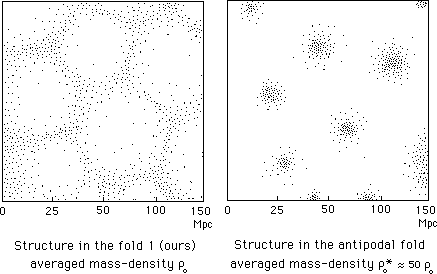
図4:F. Lansheatによるシミュレーションの結果。隣接する2つの折り目の相互作用によって生じた宇宙の大規模構造を示す。r*の平均値はrの平均値の50倍(左)。左:細胞構造。右:クラスタ構造。
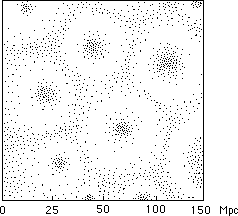
図5:同じもの、重ね合わせ
...双子の折り目の物質は大きな安定したクラスターを形成し、私たちの宇宙の折り目の物質を押しのける。この後者は残りの空間に配置される。パンケーキモデルの数値シミュレーションとは異なり、このパターンはかなり非線形である。高密度システムの Jeans 時間(2 × 10⁹ 年)に相当するその形成後、宇宙の年齢と同等の期間にわたって、全体的なパターンに顕著な進化は見られず、このモデルは私たちの宇宙の大きなスケールでの観測されたスポンジ状の外観を説明する良い候補となる可能性がある。
3) 2次元と3次元のシミュレーション。
...2次元シミュレーションの結果から、F. Lansheatは2点相関を計算し、ランダムな点の分布(ポアソン分布)から得られた2点相関と比較した。その結果は図6に示されている。曲線の左側は、ポイント間の距離がランダム分布の平均距離とほぼ同じになるため、関係性がない。右側の増加は、領域の境界(周期的境界条件)によるアーティファクトである。この結果は、観測データから導かれた経験則(傾き-1.8)と直接比較することはできない。Bahcall (1988) [31]、BahcallとSoneira (1983) [32]、BahcallとWest (1992) [33]、LuoとSchramm (1992) [34]の調査を参照のこと。より多くのポイントを用いた3次元シミュレーションを行う必要がある。可能であれば、観測データとのフィッティングにより、2つの宇宙の質量密度比が得られるだろう。
...このモデルで大規模な宇宙構造が形成されるシナリオをどのように描くことができるだろうか?質量と光の結合が強い間(t < 10⁵ 年)、宇宙は均一であり、重力不安定性に関連するすべてのプロセス(クラスター、銀河、星、スポンジ構造の形成)は凍結されている。宇宙が透過的になると、これらのプロセスがそれぞれの固有の形成と進化の特徴的な時間で起こると仮定できる。私たちが言えるのは、提示された非常に大規模な構造が2 × 10⁹ 年で形成されるということである。
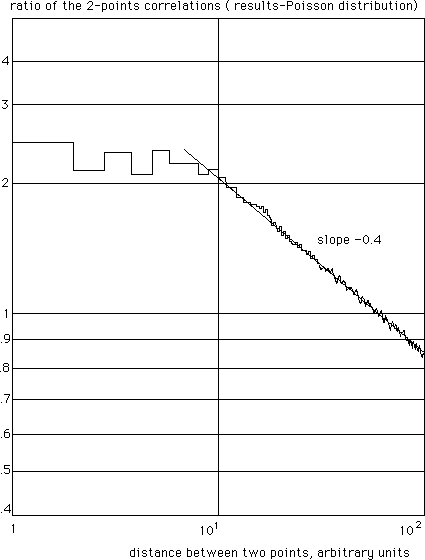
**** 図6:2点相関の曲線の傾き(数値シミュレーション対ポアソンのランダム分布)
** **
元の英語版
twin universe cosmology Twin Universes cosmology (p 2) .
2) Large scale structure and "twin universe model".
...We assumed in the previous paper [1] that the Universe had a S3 x R1 geometry. Any region of the universe interacts antigravitationnaly with its associated antipodal region, through equation (1). There is a single kind of positive matter m, filling the S3 sphere. Then the total mass of the Universe is non-zero. In the reference [1] several didactic 2d images (figures 10, 11 and 12) were given, in order to explain the mechanims of the interaction of the two adjacent folds.
...Using a boosted HP work-station and a set of 2 x 5000 interacting points, F.Lansheat confirmed the work of Pierre Midy (reference [1] , figure 8) . Then he focussed on a smaller region, indicated on the figure 3, in which the density of the matter in the "adjacent fold" was much higher that in the other fold. Fig 3 . Dotted square : focussing on some portion of the very large scale structure in wich the density of matter in the first fold (supposed to be ours, grey color) is supposed to be smaller that the density of matter in the adjacent fold (white color).
As expected the gravitational instability still occurs and provides new conjugated structures. See figure 4 and 5 .
Figure 4 : Results of simulations performed by F.Lansheat, showing the large structure of the Universe, due to the interaction of the two adjacent folds. Mean value of r = 50 times the mean value of r (left). Left : cellular structure. Right : cluster structure.*
Figure 5 : The same, superposed
...The matter of the twin fold forms big stable clumps, which repel the matter of our fold of the universe, this last taking place in the remnant space. By opposition to the pancake model numerical simulations, this pattern is fairly non-linear. After its formation, corresponding to the Jeans time of the high density system (2 109 years) , there is no significant evolution of the general pattern over a time comparable to the age of the Universe so that this model could be a good candidate to explain the observed spongy aspect of our fold of the Universe, at large scale.
3) 2d and 3d simulations.
...From the results of the 2d simulation, F. Lansheat performed a 2 point correlation and compared to the 2d correlation obtained from a grey distribution of points (Poisson distribution). The result is shown on the figure 6. The left hand of the curve is not relevant, for the distance between the points becomes comparable to the mean distance of the random distribution. The growth on the right hand is just an artefact due to the border of the field (periodic boudary). This result cannot be compared directly to the empirical law derived from observational data (slope -1.8), see the surveys of Bahcall (1988) [31], Bahcall and Soneira (1983) [32], Bahcall and West (1992) [33], Luo and Schramm (1992) [34]. Three-dimensional simulations have to be performed, with a larger number of points. If possible, the fitting with the observational data would provide the ratio of the mass densities of the two universes.
...How to outline a scenario for the formation of large-scale cosmological structure in this model ? As long as the coupling between mass and light remains strong (t < 105 years), the Universe remains homogeneous and all the processes linked to the gravitational instability (formation of clumps, galaxies, stars and spongy structure) are frozen. When the Universe becomes transparent we can assume that all these processes occur, with their proper charateristic times of formation and evolution. All that we can say is that the suggested very large structure forms in 2 109 years.
**** Figure 6 :The slope of the curve of the 2-points correlations ratio (numerical simulation versus Poisson random distribution)
** **