결측 질량 문제
(p3)
.
- 구대칭 해
1916년에 에딩턴은 볼라소프 방정식과 포아송 방정식을 결합하여 구대칭 정상 상태 해를 도출하였다. 그는 속도의 타원체가 구대칭이며 시스템의 중심을 향하고 있다고 가정하였다.
그림 1 (ga3114): 에딩턴형 해와 대응하는 속도 타원체.
에딩턴은 질량 밀도와 중력 포텐셜 사이의 다음 관계를 도출하였다.
(20)
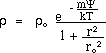
이는 중력 포텐셜 Y에서 충돌이 없는 기체에서 물질의 정상 분포를 나타내며, 중력력이 압력력과 균형을 이룬다. 반대편 영역에 같은 종류의 해를 취하자.
(21)
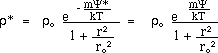
그러므로 다음 방정식을 풀어야 한다.
(22)

다음과 같이 두자.
(23)
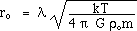
다음과 같은 무차원 양을 도입하자:
(24)

우리는 다음과 같은 결과를 얻는다.
(24)
이는 수치 계산을 통해 풀 수 있다. 다음 초기 조건을 취할 수 있다.
j
'o = 0
j
"o = 10
l = 10
그림 2: 구대칭 에딩턴형 해. 중력 포텐셜
그림 3: 구대칭 에딩턴형 해. 질량 밀도. 만약 한 접점에 군집이 존재한다면, 두 번째 접점의 공액 영역에 관련된 희박한 환경이 존재한다.
원래 버전(영어)
The missing mass problem
(p3)
.
- Spherically symmetric solution
In 1916 Eddington derived a spherically symmetric steady-state solution, combining the Vlasov and the Poisson equations. He assumed that the ellipsoid of the velocities was spherically symmetric and pointed towards the center of the system.
Figure 1 (ga3114): Ellipsoid of velocities corresponding
to an Eddington-type solution.
Eddington derived the following relation between the mass density and the gravitational potential
(20)
which represents a steady-state distribution of matter in a collision-free gas, in a gravitational potential
Y,
in which the gravitational force balances the pressure force. Let us take the same kind of a solution for the antipodal region
(21)
So that we have to solve the following equation
(22)
Take
(23)
Introduce the following adimensional quantities :
(24)
We get
(24)
which can be solved by numerical computation. We can take the following initial conditions
j
'o = 0
j
"o = 10
l = 10
Figure 2 : Spherically symmetric Eddington-type solution. The gravitational potential
Figure 3 : Spherically symmetric Eddington-type solution. Mass densities. If a cluster exists in one fold, an associated diffuse halo exists in the conjugated region of the second fold.