...The
problem of the gravitational lensing must be reconsidered. As suggested in
the previous paper [1], in the present model the confinement of the galaxies
is mainly due to the action of the surronding antipodal matter, located in
the twin fold, to be consistent to the strong missing mass effect. Numerical
simulations provided some description of a galaxy, surrounded by halos of
antipodal matter [1]. See figure 7.
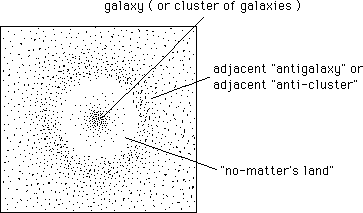
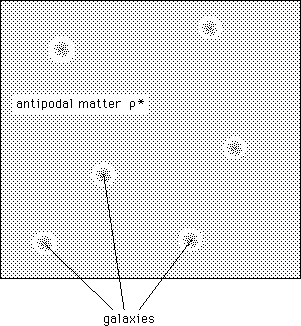
...As a confirmation of this confinement effect, if we remove the antipodal matter from the system, the central object dissipates immediatly. Although this figure concentrate on the surronding halo, all the surrounding antipodal matter contributes to this confinement effect, so that we can figure schematically the galaxies as nested in some sort of holes of the antipodal matter, as suggested in the figure 8. The intensity of the confinement effect depends obviously on the density r* of the antipodal matter distribution, which should be at least ten times larger than r.
...Classically, matter "attracts" photons and produces gravitational lensing. The trajectory of photons, bent by the presence of a positive point-mass can be computed from a Schwarzschild solution :
(3)

...Notice that m is an arbitrary constant of integration. For weak fields and slowly miving bodies we can link the goo term of the metric to the gravitational potential Y through :
(4)

The gravitational potential, due to a mass M is :
(5)

whatever this mass M would be positive or negative. If M is negative, it repels the test particle. Then
(6)
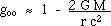
whence :
(7)

If M is positive the characteristic Schwarzschild length is
(8)

...As pointed out above, m is nothing but an arbitrary constant of integration is the Schwarzschild solution. If we take m < 0 then the associated mass M becomes negative. We can define a characteritic length, positive (the Schwarzschild radius Rs) from :
(9)

The trajectory, in polar
coordinates, corresponds to :
(10)
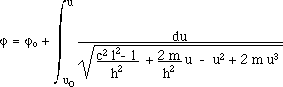
See reference [10] page 203. For the photon, following the null geodesics, we get
(11)
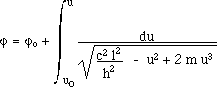
j is the polar angle for this plane trajectory. u = 1/r
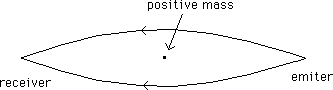
A positive mass (M > 0 ; m > 0) produces a positive gravitational lensing :
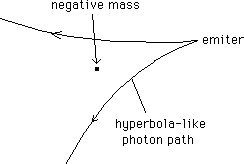
...For a test particle, located in one fold, a mass located in the adjacent fold behaves like a repulsive negative mass (M < 0 ; m < 0) and then produces a negative lensing effect :