10) The problem of the cosmological horizon.
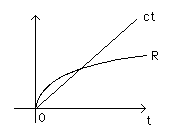
...Clasically this the cosmologic horizon is defined as is ct., which arises a paradox. The observed Universe is very homogeneous, at large scale. If we compare any characteristic distance R (t) (for an example the mean distance between particles), with the horizon, we get :
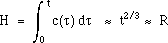
In the present model the cosmological horizon becomes the
following integral :
(87)
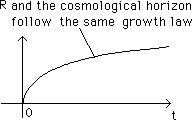
...If the Universe was homogeneous at the begining, the collisional process, always present, tends to maintain this homogeneity. It it was not, it tends to smooth it. This constitues an alternative to the theory of inflation.
...This
law between R »
t2/3
must not be considered as an expansion process but as a consequence of the
secular variation of the constants of physics, a gauge process, whose single
observable effect is the red shift..
11) The link with the Robertson-Walker geometry.
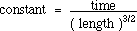
All this is compatible with the solution (34) if we give the following non-standard definition of the cosmic time :
(88)

The dimension of the constant is :
(88b)
In the standard definition of the cosmic time from
(88t)

12) Entropy as a better chronological marker.
...The detailed calculation of the entropy per baryon, as defined by :
(89)
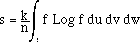
where f is the velocity distribution function, was given
in a former paper, with "variable constants". See [13] , section 2.
...As
a result, we found :
(90)

...If R(t) is an increasing function of t , the cosmic entropy grows like the cosmic time. In lab's experiments we usually relate entropy with time and consider that, according to the second principle, there is no possible strictly isentropic phenomenon. We consider that the time flux depends on the entropy change. In the classical model it is somewhat paradoxal to notice thet such enormous change in time would go with zero entropy variation. In the present model when the time t tends to zero, s tends to - ¥
...We have s = constant Log t . If we change the measure of the entropy (modifying the value of the constant) and write :
(91)

we get :
(92)
Let us return to the Robertson Walker metric.
(92b)

We get, with R = 3/2 ct :
(93)

In the representation { entropy, space variables } the metric becomes conformally flat and we have :
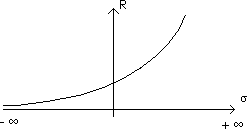
...In the classical description (t , s ) the physicist, when t tends to zero, has some difficulty to define any material clock, for the velocities of the particles tend to c. In a "variable constant cosmologic model" the entropy per baryon (99) is no longer constant and never fails to describe the events of the Universe. Notice that in a (s , s) description, the problem of the origin of the Universe falls down. In addition, if we describe the Universe in a phase space (position plus velocity) we found that the associate characteristic hypervolume R3c3 varies like t.
