...The derivation of the distance frome the red shift z, with "variable constants", has already been presented. See reference [13], sections 3 to 7 . The indix 1 refers to the emiter and the indix 2 to the receiver. For an example c2 is the today's value of the velocity of the light, as measured in the observatory. It is assumed that the Rydberg constant (ionization energy of the hydrogen) follows
(94)

Then we find :
(95)

The value g = 1 is chosen in order to fit the classical value.
Then, expanding the function 1/R(t) into a series with respect to
(96)

we get :
(97)
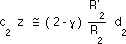
Which is nothing but the Hubble's red shift law, which still applies in this variable light velocity conditions. From mesurement of d2, c2 and z we can derive the so called Hubble's constant, i.e. the age of Universe.
(98)

identical to the standard value. Then the distance to the objet d2 is evaluated :
(99)
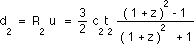
...When z tends to infinite we find the cosmological horizon 3/2 c2 t2 , which is twice smaller than the standard value 3 c2 t2. If we compare the present model to the EdS model, we get, for the distances, the ratio :
(100)
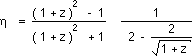
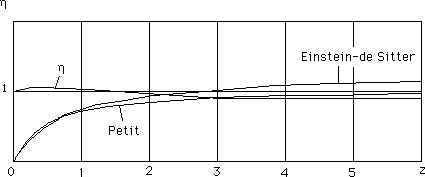
...They are similar for weak z values, as shown on the next figure. For weak z values, the distances, as derived from the present model, are a weakly larger. h is close to unity for z = 1.5. Then h tends to 0.5 when z tends to infinite. For z < 2.5 the difference of the two distance evaluation is less than 5% .
...If the reference [14] , section 3 the evolution of the angular size of a distant object, versus z, was computed. For the EdS model and constant size objects, the law is :
(101)
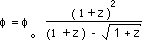
...This function of z has a minimum for z = 1.25 and then f tends to grow linearly versus z. The figure 21 explains why it provides an overestimation of f , for large z values.
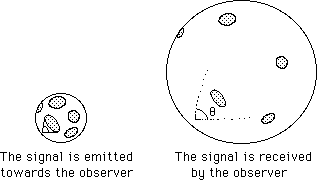
In the present model, the situation is basicly different for the objets are
supposed to expand with the Universe. See figure 22
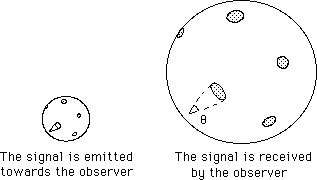
The corresponding formula is :
(102)
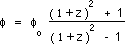
When z tends to infinite, f tends to be constant.
Notice that in our model :

...In the reference [14] this was used to compare the present model to the EdS model, applying to radio-QSO data (Barthel and Miley, 1988 [35]), giving a slight advantage to the first. Obviously, a single test, implying many assumptions about the nature of the observed objects, could not valid the model. See the discussion in reference [14].
