14) The light emission problem
...Assume
the energy production of light sources would proceed through collisions. The
collision frequency may be written as :
(103)

(104)

which gives :
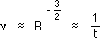
...Assume now that the characteristic amount of energy Ei , for this energy production reaction would vary like R(t). The energy emission rate varies like :
(105)
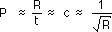
...Such as the emission rate would have been higher in the past. As, in this model, the energy is saved during the photon flight, the receiver would measure a higher luminosity, which would vary like (1+z)1/2.
...If we look at the data presented by Barthel and Miley when and plot Log (P) - 0.5 Log (1+z) when find something quite constant.
15) Some remarks about other possible comparizon to observational material.
15.1) Local relativistic effects.
...From the classical model of General Relativity have been imagined a large number of tests. The first were devoted to local tests, like the precession of the perihelia of Mercury or the time-delay of radar echos. There is no a priori incompatibility between these test and the present model. In effet, according to the results of the numerical simulations, the matter-density in the region of the twin fold corresponding to the vicinity of the sun is highly rarefied, for the antipodal mass is pushed away by the mass. Then then second term of the second member of the equation (1) can be neglected :
(106)
so that, locally, the Einstein equation would become an
approximate form of the equation (1). In such conditions, from the equation
(1) we refind the classical local observational features, like the advance
of the perihelia, etc..
15.2) About the strong field test from binary pulsars.
...A pulsar is supposed to be an object located in our galaxy. If we suppose again that the antipodal matter is very rarefied in the conjugated adjacent fold, the field equation becomes :
(107)
i.e. the Einstein equation. Then the observed effects [30] fit both the equation (1) and (2).
16) The problem of electromagnetism and other features of physics.
...We propose a new cosmological model. As said before, basicly, this model does not contain the electromagnetic nor strong or weak interaction phenomena and this is the same for the classical model. Only a fully unified field theory could deal with. In such conditions is it licit to try to apply the gauge analysis to the charged particle, i.e. to see how could vary the Bohr radius versus R ? This is questionable (whence this question was examined by the author if the formal paper [13], section 9) . Same thing for the strong and weak interactions and their associated characteristic lengths (in order to give a new an complete description of the cosmic evolution, including the nucleosynthesis, on should introduce, in this constant energy model, corresponding time-dependant "constants").
. Personnaly I would think that the cosmological model is far to be achieved. For an example the so-called cosmological constant L could be added, through (suggestion of J.M. Souriau):
(108)
or :
(109)
where T* and g* = A(g) are respactively the stress
tensor and the metric tensor associated to the conjugated antipodal region.
...This work just suggests that the geometry of the universe could be somewhat different from our standard vision. Perhaps an unified model (gravitation plus electromagnetism) could be built, by introducing complex tensors S , T and A(T) in the equation (1). On another hand, one can shif from a S3 x R1 geometry towards a twin geometry based on the cover of a projective P4 by a sphere S4. Then it could perhaps be possible to deal with CPT symmetry and then to take account of the matter-antimatter duality (the antipodal matter would behave like antimatter and become the lost "cosmological antimatter", as suggestd by Andréi Sakharov and Novikov in 1967 [36,37] and the authors [38,39 and 402]). But this we confess that is a hard mathematical task.
...In a Kaluza model we consider a 5 dimensional manifold. Then the electromagnetism can be introduced, whence nobody knows what this fifth dimension represents exactly. Notice that, locally, the model is equivalent to a Kaluza model with a fifth dimension limited to the values ± 1 .
In this model the statute of the Klein-Gordon equation is the same than in the classical General Relativity.
