 |
3
|
|
3
|
Consider 2d space (x,y).
In such space a translation is defined by translation vector ( Dx,Dy).
We use to write :
(27)
To get the new values x' and y' we use addition . Could we get the same results through a ..... multiplication ?
Consider the following
matrixes :
(28)

Notice they are defined by two independent parameters Dx and Dy. Then the dimension of the group is 2.
Form :
(29)
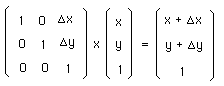
Notice this is basically
different from the simple matricial multiplication
(30)
It is a peculiar group's
action.
(31)

By the way, notice we
can consider translations in 3d or 4d spaces. The corresponding square matrixes,
forming groups, are
(32)
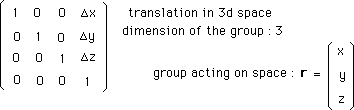
(33)
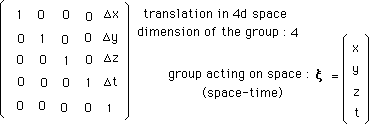
The corresponding action
is :
(34)

The group of translations is commutative. Its neutral element is the null-translation.
Groups of matrixes : why ?
...With
matrixes' groups we can combine several operations into a single one, into
a single action. Consider the following matrixes and the following action
:
(35-1)
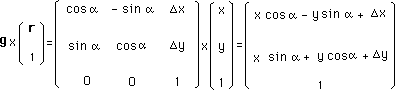
...We
combine two things : a rotation ( angle a ), plus a translation (Dx,Dy).
The element g of the group G acts on space r = (x,y), not "directly"
but through some more refined "action". This
group
(35-2)
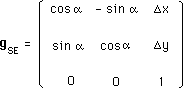
called "Special Euclid's group SE(2) ", acts on 2d space. This name will be explained further.
What is its dimension ? It depends on three free parameter : (a , Dx , Dy), so that its dimension is three. We may write :
Sub-groups.
For us, a group is a set of square matrixes. Among this set we can find sub-sets.
The above group carries points. These point own no peculiar characteristics. They are... points, nothing else.
...But, later, other groups, which describe physical world, will carry points which will have different characteristics, "attributes" : mass, energy, impulsion, spin....
With the above group only sets of points are interesting to carry. Here appears the fundamental concept of :
Species.
...Our
first group carries geometrical objects, which are sets of points, geometrical
("rigid") figures. The most simple set is composed by two points. Consider
couples of points in a 2d space :
(35-3)
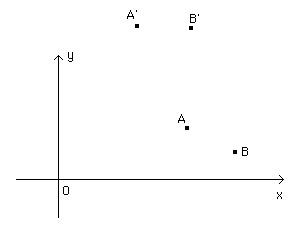
...On
figure (35-3) two couples of points (A,B) and (A',B') have been figured. I
can find an element of the group that transforms (A,B) into (A',B') : combining
a rotation around the point O and a translation. See figure (35-4).
(35-4)
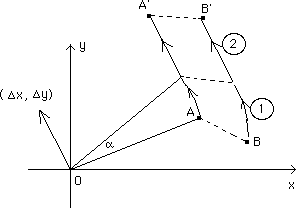
Now consider the two
couples :
(35-5)
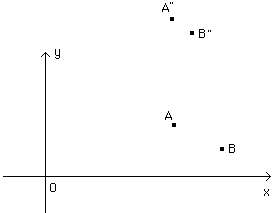
Impossible to find any element g ( square matrix ) of my group G which can carry (A,B) on (A",B"). I will say that:
(A,B) and (A',B') belong to a same species.
(A,B) and (A",B") belong to different species.
The characteristic of a species of couples of points is called length .
...How can you affirm that two segments have the same length ? Because you can compare them, putting one onto the other one.
...In
our group two segments, whose lengths, are different belong to different species,
because our group does not rule dilatations or contractions ( homothetic transforms
). The group which takes that in charge is a different one ("Special Descartes'
group" ):
(35-6)
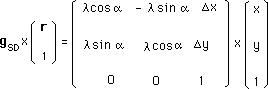
with respect to such
group all couples of points form the same species. The dimension of this group
is four.
Instead two points,
we could consider three or four, these last forming squares, for an example.
(36)

...With
respect to the group (35-1), squares whose sides have the same length belong
to the same species. But if the sides of two squares are basically different
:
(37)
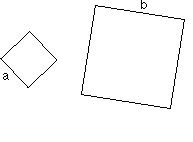
they belong to different species.
This group, ruling 2d
translation and rotations around a fixed point of a plane is the Special Euclid's
group : SE(2).
Now we imagine
easily a similar group acting on a 3d space. The group of 3d and 4d translations
were given in (32) , (33).
We can imagine
easily a group describing translations in a n-dimensional space. But what
about rotations ?
...We can imagine rotation in a 3d space. We can even write it with a matrix which contains three angles, the Euler angles : then its dimension is three.
