 |
4
|
|
4
|
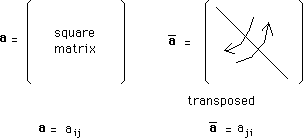
Take a square matrix
a. The transposed matrix corresponds to the commutation of the terms
which are symmetric with respect to the diagonal, as shown on the figure :
(38)
We write the inverse
matrix a-1
It obeys
:
Right now, we will no longer write the sign x and just write :
(38b)

One can show that :
(38c)

so that the determinant of an orthogonal matrix is ± 1 .
They are orthogonal matrixes of any rank ( n,n) . They form groups
Consider matrixes :
(39)

They are orthogonal matrixes, whose determinant is :
It is a sub-group of
the orthogonal group O(2), which is called "special orthogonal group"
SO(2).
We have an orthogonal group O(3), composed by (3,3) orthogonal matrixes, whose
determinant = ± 1 . It owns a sub-group SO(3) composed by orthogonal
matrixes whose determinant is + 1 .
In four dimensions : we have the orthogonal group O(4) and its sub-group : the special orthogonal group SO(4).
n dimensions : orthogonal group O(n), composed by (n,n) orthogonal matrixes, whose determinant is ± 1 . It owns a sub group, called Special orthogonal SO(n) limited to orthogonal matrixes whose determinant is + 1.
One can show that the
dimension of an orthogonal group is
(40)

Applying to two dimensional
space : the dimension of the group is 1.
Applying to three
dimensional space, the dimension of the group is three ( the three Euler's
angles ).
Applying to four
dimensional space, the dimension becomes six.
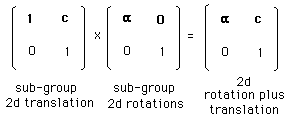
We have introduced the oriented Special Eulclid's group SE(2):
(41)
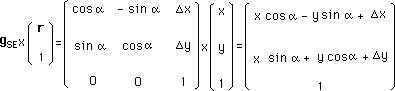
Which combined rotations
and translation.
Call :
(42)
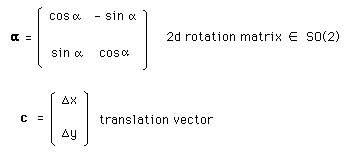
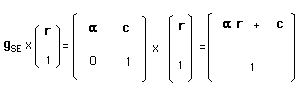
Then we can write the matrix and the action on space :
(43)
Remark :
(44)
In our 2d flat space,
in our plane, we find objects like :
(45)
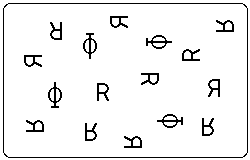
Considering these peculiar
objects :
(46)
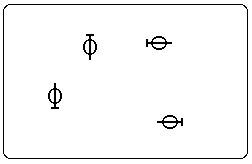
they belong to a species.
If I take any couple of those object, I can find and element of the group
which carries the first onto the second, and vice-versa.
The second sub-set
of object :
(47)
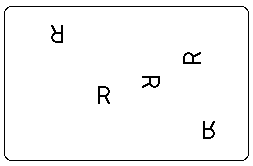
belongs to another species.
The third, too
:
(48)
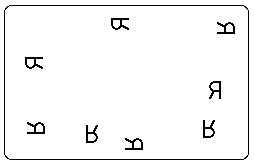
But :
(49)

I cannot fing any combination
rotation a plus translation c that put one on the other.
Can
we modify oriented Euclid's group in order to make this possible ?
