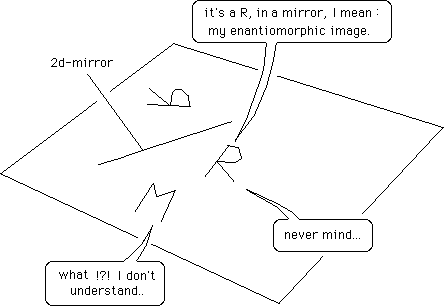
|
5
|
|
5
|

What does it mean ?
Consider a group
composed by four elements ( a "discrete group" ).
(50)
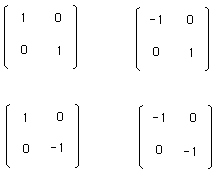
that I can write :
(51)
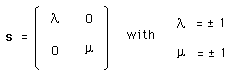
The corresponding action
is :
(52)
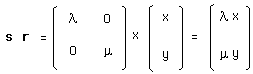
Clearly it may reverse
the x coordinate, the y coordinate, or the two.
Schematically :
(53)
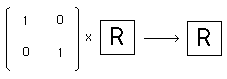
(54)
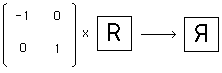
(55)
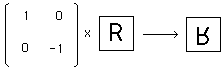
(56)
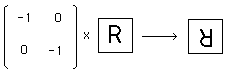
Now we may build the
matrix :
(57)
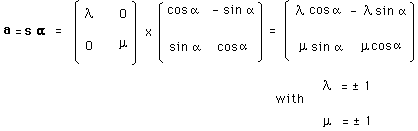
We can check such set
of matrixes form a group.
Their determinant
is :
(58)
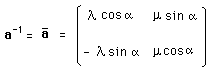
Check the inverse matrix
is :
(59)
(60)
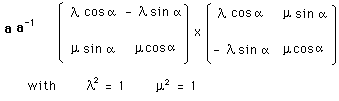
(61)
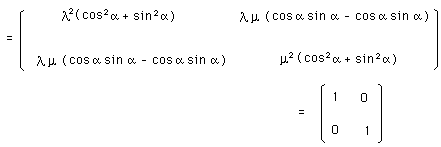
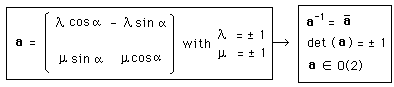
whence :
(63)
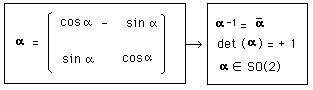
...SO(2)
(called special orthogonal group) is a sub-group of O(2) (called orthogonal
group) and we may form the matrixes a from the matrixes a through
:
(64)
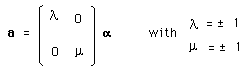
By the way, many are
redundant. For an example, if
(64b)

(65)
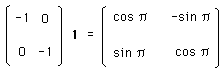
which means that changing
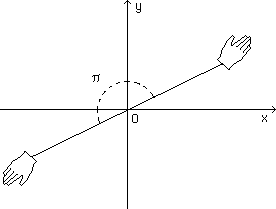
( x ---> - ; y ---> -y ) is equivalent to a rotation of p
. See next figure.
(66)
We know that matrixes
:
(67)
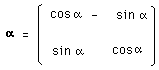
correspond to a simple
rotation around the center of coordinates O.
What is the meaning
of more general matrixes :
(68)
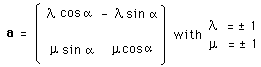
From :
(69)
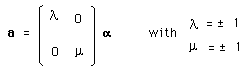
we know that a corresponds to two combined operations :
- A symmetry with respect
to axis OX , or OY , or both.
- A rotation a
around the center of coordinates.
(70)
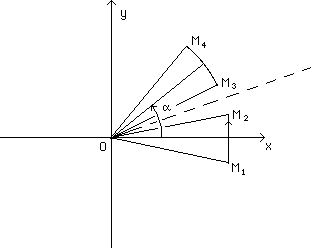
On the figure is shown the succession of the two operations
It is clear that it is
equivalent to a symmetry with respect to a straight line passing by O
(71)
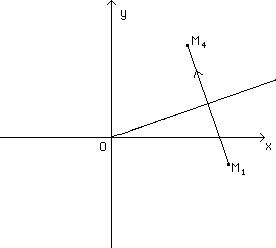
...We
have enriched the "special orthogonal group " SO(2) which began the "orthogonal
group" O(2). Then we discovers that this extended group contains mirror-symmetries
: all the symmetries with respect to straight lines passing by the origin
of coordinates O.
(72)