 |
6
|
|
6
|
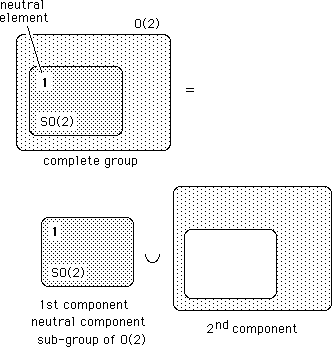
We have considered two groups : SO(2) and O(2). The second contains the first.
The first contains the
neutral element. We can figure the elements of the group as follows :
(73)
 .
.
The elements of the first
component form a group (a sub-group).
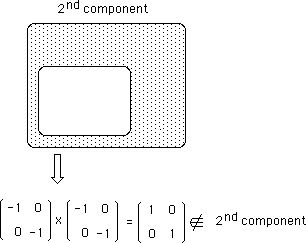
The elements of
the second group do not form a group, for many reasons :
- It does not contain
the neutral elements 1.
- we can pick
two matrices in this second component, whose product does not belong to this
second component. Example :
(74)
The component of the group which contains the neutral element 1 is called the
In the following we will consider groups with 2, 4, 8 components.
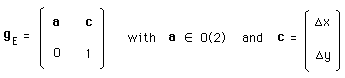
The Euclid's group.
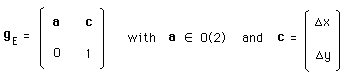
We can now integrate
this extended, enriched group, to 2d- translation, and we get :
(75)
and the corresponding
action of this Euclid's group :
(76)

Suppose we use our group to manipulate, to rule, to study alphabetic letters.
Limit the set to :
We have several sizes :
(77)
A B C D E F G J K L N P Q R S Z
for their sizes are different.
We decide to call their sizes masses so that G and G are similar to
particules, objects, atoms, who own different masses. Now,
depends on the group which acts on this set of objects. If I use :
(78)
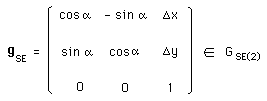
assume this "world" is
filled by :
(79)
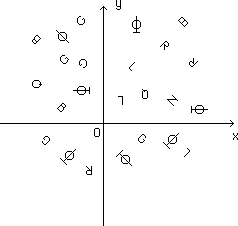
with a certain spectrum
of sizes (masses) and angles. If I operate group actions, whetever they are,
I will never find objects which belong to the russian alphabet :
(80)
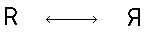
It will be possible if
I take the enriched group, the Euclid's group :
(80b)
Then my "world" will become :
(81)
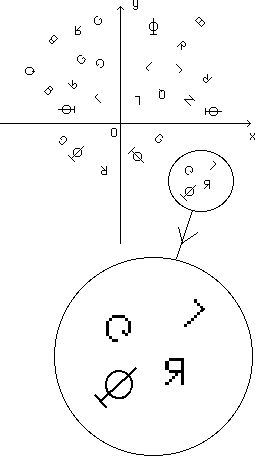
The group has enriched
the letters' "zoo". But in my zoo, one is invariant by symmetry, i.e :
(82)
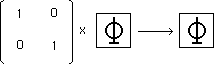
(83)
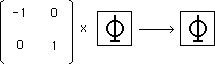
(84)
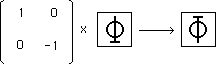
(85)
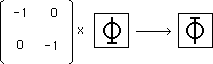
...In
general, any symetry with respect to any straight line of the plane, which
is a "2d mirror", does not change the "nature" of this character
(86)
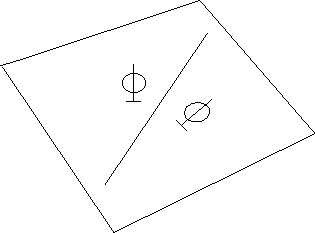
I will call this character
a "photon" and will assimilate the transform
(87)
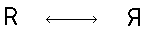
to the matter anti-matter
duality. Then I get a global zoo :
(88)
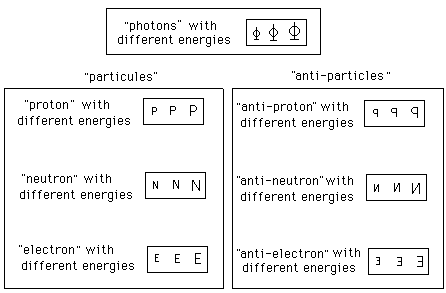
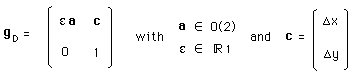
We could link letters
of same shape (nature) but different sizes (representing their energies),
using Descartes'group:
(89)
...But we are not going to build a complete analogical model of elementary particles, based on alphabetical characters. Anyway, you begin to see were we tend to go. Group have very simple aspects, but hidden properties. These properties depend on their sub-groups, which fathers species.
...Euclid's
group goes with an Euclid's world, with Euclid's zoo. The animals of euclidean
geometry are called sphere, cylinder, prisms, plane, straight line, triangles,
en so on. The are invariant under some sub-group action. Souriau calls the
sub-group linked to a an object, which belongs to a species, the regularity
of this object.
For an example spheres centered on a given point O are invariant through the
sub-group of rotations around this point.
- We can consider that the fact to be invariant is a property of the species called "spheres centered on a point O".
- Conversely we can consider that this property defines the species.
