 |
7
|
|
7
|
Two objects which belong to the same species have some common property.
1) Take a sphere, a peculiar
sphere.
2) Look at the
sub-group of the grand group ( Euclid's group ) which keeps this sphere invariant.
Souriau calls such sub-group the regularity of a sphere.
3) Search all the
objects which are invariant through the action of this sub-group. You find
all the spheres centered on a given point, Including the zero-radius shere
: the point.
Then the point belongs to the species of "spheres centered around the origin".
Conversely :
1) Take a point of a
three-dimensional space.
2) Look at the
sub-group of Euclid's group which keeps this point invariant. You find the
orthogonal group O(3).
3) Then search
all the objects which are invariant through the action of the elements of
this sub-groups, under rotation around this point. You find all the spheres
centered on this point and conclude that this point and all these spheres
belong to a same species.
Objects like a straight line, a plane, a cylinder, etc..... can be "built" as a species linked to some peculiar sub-group.
...In physics we want to classify elementary
particles. But you cannot take a particle between your thumb and index and
look at it through a magnifying glass. The just can observe its behaviour,
its movement .
...I have an old good friend, Jean-Louis Philoche, who is a fine chess player. He can play blind ( en français "jouer à l'aveugle", sans voir l'échiquier ). . You just have to indicate to him the movement of a piece ( une pièce de jeu ) :
For non-players :
(90)
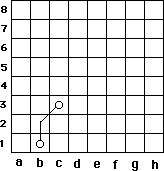
...Jean-Louis is able to memorize all that in his head. I don't know how he does, but it works. It proves that chess pieces are not necessary to play ( a computer does not use it ).
...Imagine you are in a room and you hear two neighbourings who play "some game". You don't see them but you hear when the announce their moves.
...You think : they move something. What's the game ? You take a boad, put small stones on it, and notice their successive moves on a sheet of paper. Call C the column indix and L the line indix. A move corresponds to :
( DC , DL )
If I DC I ? 1 and I DL I ? 1 : This refers to a king's move.
If I DC I = I DL I: this refers to a bishop's move ( along a diagonal
).
If I DC I x I DL I = 0 : This refers to a tower's move.
If I DC x DL I = 3 : this refers to a horse's move.
If DL is strictly positive, this refers to white pawn. If is strictlty negative, it refers to a black pawn.
An so on. We build a classification of "objects" based on their behaviour .
Another image. You have a box, with mixed bolts. You want to classify these
bolts. What to you need ? Different nuts.
(91)
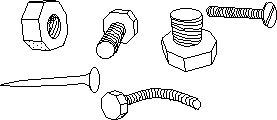
1) Take a bolt.
2) Search the nut that fits it.
3) Select all the bolts that fit this nut. You get a species of bolts.
Orthogonal group O(3).
...We
can extend what was said above in 2d to 3d context. We know how to make a
rotation in a 3d space, with respect to a fixed point, origine of coordinates.
It depends on three angles a , b , g , called Euler's angles. We won't write
such a matrix, just write it :
(92)
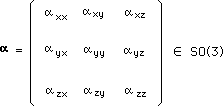
It is an orthogonal matrix
:
(92b)

...The
orthogonal group O(3) is composed by all orthogonal matrixes, including those
whose determinant is = - 1 . We call these matrixes
(93)

As in preceding section
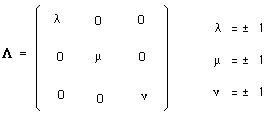
we can obtain all the orthogonal matrixes, from the SO(3), through :
(94)

L being the diagonal
matrix :
(95)
(96)
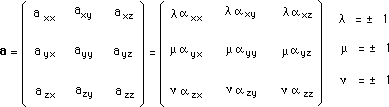
All this is redundant.
But it makes appear immediatly the basic symmetries.
(97)
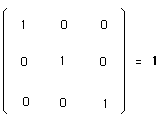
(98)
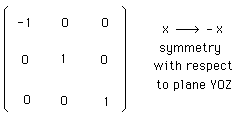
(98b)
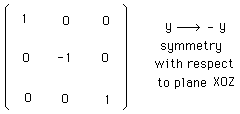
(99)
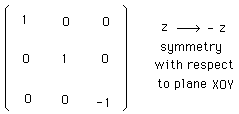
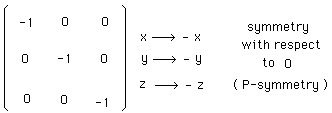
There are "mirror matrixes" which reverse the orientation of the objects, transform these objects into their image in a mirror :
(100)

Give an example of oriented objects, whose orientation is reversed through
this mirror symmetry :
(101)
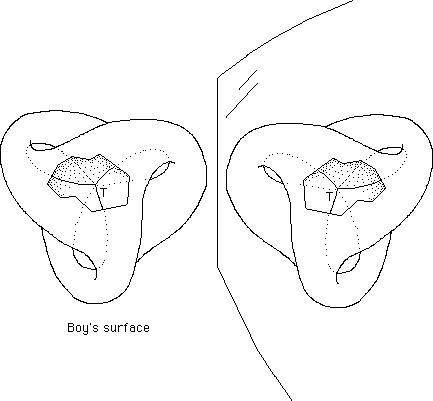
...This is the surface invented by Werner Boy, a student of Hilberth. Attention will be paid to this interesting object in the section of the site devoted to mathematics. We have removed a portion of the surface in order to show the triple point T.
...You
can call any of these object "right" or "left". Nobody has never indicated
what was the right rotation movement of of Boy's surface. Anyway : to make
a Boy's surface to turn : why ? Some pretend it can fly, but I am skeptical.
Next :
(102)
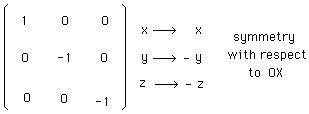
(103)
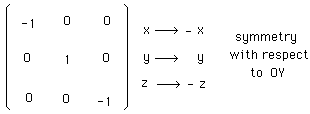
(104)
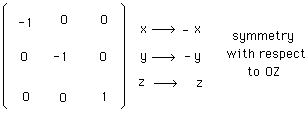
...As
in 2d geometry (symmetry with respect to the origin ) the symmetry with respect
to ax axis is equivalent to a rotation of p .
Finally
:
(105)
which change the orientation of objects.
