 |
9
|
|
9
|
O(2) is a group composed by two components :

this group owns two components.
Its neutral component is built with the SO(2) element.
(113)
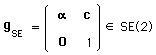
...We
call it Special Euclid's group : we cannot, with this group, reverse
the orientation of a "letter", like R. The
Euclid's group with its two components is called the complete group .
...With
respect to the special group, sub-group of the complete Euclid's group :
(114)
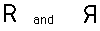
belong to two distinct
species, because we cannot find any element gEO of this
group GSE ( or SE(2) ) which can change the first letter into the second,
and vice-versa.
...With
respect to the complete group, these two letters belong to the same species,
for there is an element gE of the group GE (
symmetry, which belong to the second component ) which can change one of these
two letters into the other.
Similarly the 3d Euclid's
group ( the "complete" Euclid's group ) :
(115)
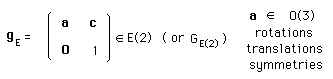
has two components. The first, the neutral one, is a sub-group formed
with the element of SO(3) :
(116)
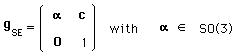
...We call this neutral component the Special Euclid's group SE(2). With respect to this group a right hand and a left hand belong to distinct species, for there is no element gSE of GSE which can transform a left hand into a right hand, and vice-versa.
With respect to the complete group they belong to the same species.
A short remark
:
When a man looks at his image in a mirror, he sees that his left hand and
raight hand are exchanged. But why his head and feet are not exchanged too
?
The answer is given by
the french mathematician J.M. Souriau :
(116b)

Another remark, more
technical. From the oriented Euclid's group it is possible to build the complete
Euclid's group, using a scalar l = ± 1
(116c)
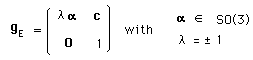
l = - 1 terms of the group belong to the second component and "reverse space", transform objects into their enantiomorphic image.
Extension to 4d PT-group.
Let us start from the
special orthogonal group :
(118)

and then build the PT-group
through (4,4) matrixes :
(119)
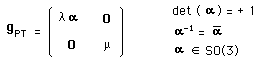
It is a four-components group ( l = ± 1 ; m = ± 1 ).
This group acts on space
time through the following action :
(120)
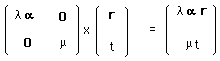
Notice we could write
it :
(121)
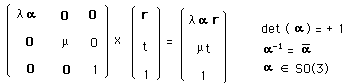
But it does not change anything, for the basic action is not changed.
Amont these four
components we have the neutral component, the ( Space oriented , time-oriented
group ).
(122)

We have :
(123)

Notice that :
(124)
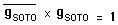
gSOTO
is also an orthogonal matrix. Orthogonal matrixes are defined through this
axiomatric property.
...Notice
that we are largely going to use the axiomatic properties of peculiar matrixes,
much more than the matrixes themselve. With teh SO(2) group we have written
the matrixes explicitely. But for SO(3) and O(3) we won't, for it will not
be not necessary and would make the calculations unecessarly complicated.
It is much more efficient and elegant to use the axiomatic properties of the
matrixes of the group.
Anticipating, consider
the matrixes defined by :
(125)

where :
(126)
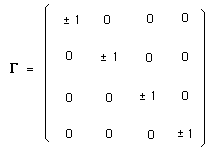
As a diagonal matrix
:
(127)

In addition :
(128)

Show that these matrixes
form a group.
Consider :
(129)

and form :
(130)

Then the product of such
generalized Lorentz matrixes obeys the axiom.
Show that the inverse
matrix belongs to the group :
(131)
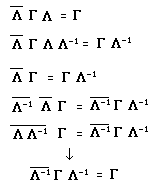
Compute the inverse matrix.
(132)
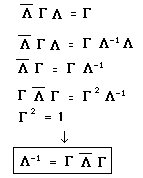
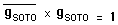
corresponds to peculiar
case :
(132c)

... The
form of this matrix corresponds to the metric of space-time (as will be considered
again, with Lorentz-matrixes, further, dealing with relativistic world).
(133)

being space-time vector
The link corresponds
to the elementary quadratic form :
(134)
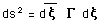
with :
(134b)

this gives :
(135)
x° = ct being a "chronological variable".
This corresponds to a euclidean space-time, where the velocity :
(136)
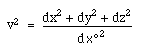
is unlimited.
