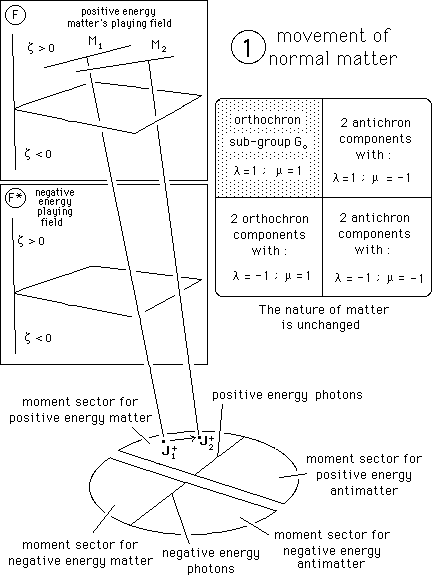
On the figure 5 the line M1 figures the
movement of normal, orthochron matter. We figures straight lines because
ou group does not take account of force field, like gravitational or electromagnétic
field. It only runs the behaviour of lonely particles, charged mass-points.
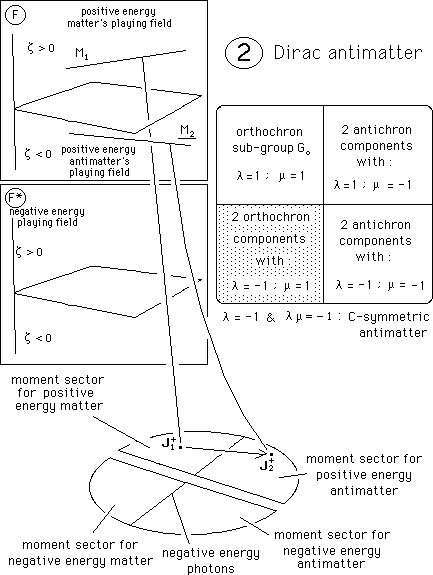
We choose an element in the grey area,
corresponding to a ( l
= -1 ; m = 1 ) matrix.
The ( l = - 1 ) value
changes the signs of all the z
i. They become negative. The new path is in the second sector,
corresponding to antimatter. As l
m = - 1 the charges
are reversed. But as time is not reversed, the energy and the mass of the
particle remains positive. This is a geometric description of ( orthochron
) antimatter after Dirac.
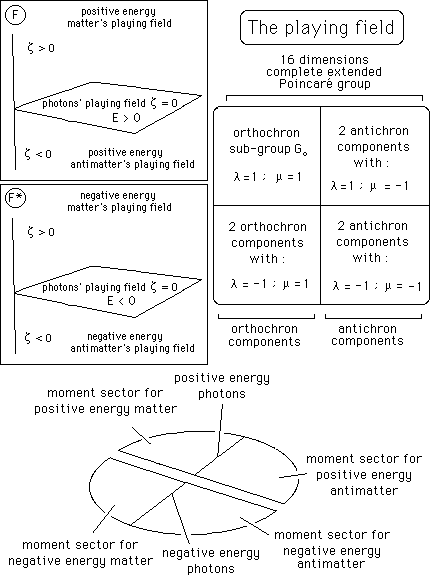
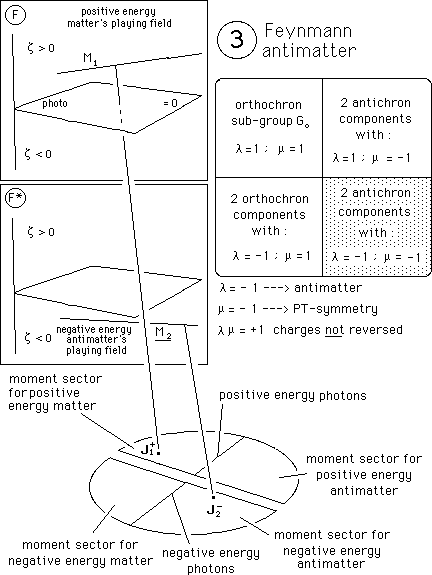
Two more sectors has to be explored. On the third we examine the impact of ( l = - 1 ; m = - 1 ) element on the momentum and movement.
( l = - 1 ) reverses the {z i}. According to our geometric definition this new movement corresponds to antimatter, for it takes place in the second sector of space { z 1 , z 2 , z 3 , z 4 , z 5 , z 6, x, y , z , t }.
( m = - 1 ) gives a PT-symmetry, reverses the signs of ( x, y , z , t )
But ( l m = + 1 ) keeps the charges unchanged. This is "PT-symmetric antimatter", so that it is a geometric description of antimatter after Feynmann.
The movement takes place in the second space sector,
in the fold F*.
The last elements correspond to the sector ( l=
1 ; m = -1 )
( l = 1 ) --- > the movement is still in the matter's sector : no z-Symmetry.
( m = -1 ) goes with a PT-symmetry. The particule runs backward in time.
( l
= -1 ) : C-Symmetry. The charges are reversed.
This is CPT-symmetrical matter, so that it corresponds to a geometrical interpretation of the so-called "CPT theorem", which asserts that the CPT-symmetric of a particle should be identical to that particle. That's not true. This movement corresponds to an antichron movement. The particle goes backward in time, si that (coadjoint action) its mass and energy become negative .