All the elements of the group are built from the elements of the complete Lorentz group, which obey :
(7) (4507)

with
(8) (4508)
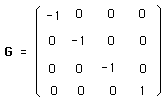
This last matrix is linked to the metric :
(9) (4509)

So that the two folds have same signature. If they are described as Minkiwski space times, their metrics are identical. But their arrows of time are opposite.
If one wants to describe the two folds, the two universes, one have to choose his own arrow of time and space orientation.
It is clear that the duality matter-antimatter occurs in both folds. If we call the second fold "twin fols" (A.Sakharov) or "shadow fold" (Green, Schwarz and Salam) or " ghost fold" (the author's choice) the arrow of time in this second fold is opposite (T-symmetry), as predicted by A.Sakharov, and space structures are enantiomorphic (P-symmetry).
In the second fold the matter is CPT-symmetric with
respect to ours. Whence, in that fold, a proton owns a negative charge
and an electron a positive charge.
Conversely, an anti-electron of that fold, PT-symmetric with respect to ours, owns a negative charge, whence an antiproton of the second fold has a positive charge.
To sum up, the second fold is CPT symmetric with respect to ours. As suggested by Andréi Sakharov, we can expect that the violation of the parity principle could be reversed in that fold.
If the absence of antimatter, in our fold, is a direct consequence of the violation of the parity principle, it is possible that such dissymmetry would be reversed in the other fold.
Interacting folds.
All our work in astrophysics and cosmology ( see Geometrical Physics A ) comes from a system of two coupled field equations :
(10)
(11)
The two minus signs were introduced as an a priori
hypothesis. At the end of this work, based on group theory, the explanation
arises. The two folds must have opposite arrows of time and must
be enantiomorphic in order to fit constrainsts coming from the group
structure.
So that the other matter, located in the other fold,
for an orbserver located in the first, bahaves as if it own a negative
mass, which comes from the coadjoint action and the T-symmetry.
Conclusion.
Starting from the work of reference [3] we have modified the model, in order to avoir encounters between positive and negative mass particles. The solution was to build a two-ten-dimensional folds (F,F*) as the quotient of the group by its orthochron sub-group.
Then we get two spaces with opposite arrows of time.
We study the impact of the different components of the group on momentum and movement spaces. One shows that the duality matter-antimatter occurs in boths folds, in both universes.
This work gives a new insight on antimatter, through geometrical tools.
For an example Dirac's antimatter is the antimatter of our own fold.
The matter of the second fold is CPT-symmetrical with respect to ours.
The PT-symmetrical of a matter particle that belongs to our fold is the antimatter of the other fold.
Matter and antimatter particles of our universe own positive mass and energie.
Matter and antimatter particles of the second fold own negative mass and energy.
Annex :
Extension of the group.
Consider a group  composed by matrixes :
(1) (4513)

A is a square matrix. B is a column matric and O a ligne matrix, composed by null terms.
Consider the extension :
(2) (4514)
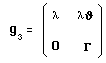
where J is the following ligne sub-matrix :
(3) (4515)

J being a scalar.
Check that (2) is a group :
(4) (4516)
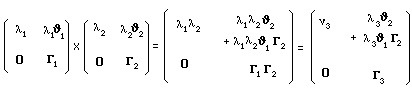
(5) (4517)

(6) (4518)

Then :
(7) (4519)
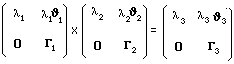
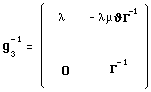
The inverse matrix is :
(8) (4520)
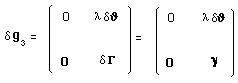
The element of the Lie algebra is :
(9) (4521)
Calculate the action of g3-1 on the element of the Lie algebra element dg3
(10) (4522)
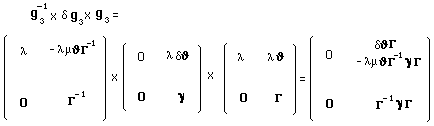
(11) (4523)

g is a matrix
:
(12) (4524)

so that :
(13) (4525)
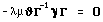
The identification :
(14) (4526)
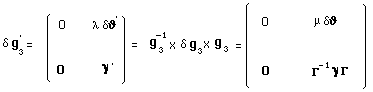
gives :
(15) (4527)

(16) (4528)