Het probleem van de ontbrekende massa (p3)
4) Oplossing met sferische symmetrie
… In 1916 leidde Eddington een stationaire oplossing met sferische symmetrie af, door de vergelijkingen van Vlasov en Poisson te combineren. Hij nam aan dat de snelheidsellipsoïde sferisch symmetrisch was en gericht naar het centrum van het systeem.
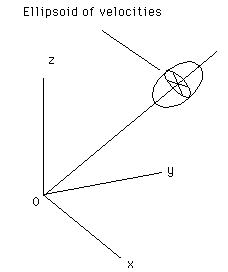
Figuur 1 (ga3114): Snelheidsellipsoïde die correspondeert met een oplossing van het Eddington-type.
Eddington leidde de volgende relatie af tussen de massadichtheid en het gravitationele potentiaal:
(20)
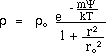
die een stationaire verdeling van materie in een botsingsvrij gas weergeeft, in een gravitationeel potentiaal Ψ, waarin de gravitationele kracht de drukkracht in evenwicht houdt. Beschouw dezelfde vorm van oplossing voor de antipodale regio:
(21)
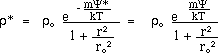
We moeten dus de volgende vergelijking oplossen:
(22)

Stel
(23)
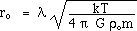
Introduceer de volgende dimensieloze grootheden:
(24)

We verkrijgen
(24 bis)
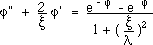
die numeriek kan worden opgelost. We kunnen de volgende beginvoorwaarden nemen:
φ'₀ = 0
φ"₀ = 10
λ = 10
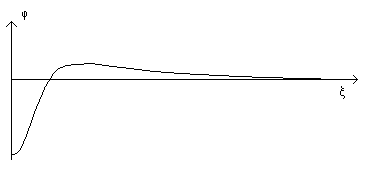
Figuur 2: Oplossing van het Eddington-type met sferische symmetrie. Het gravitationele potentiaal
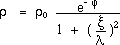
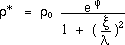
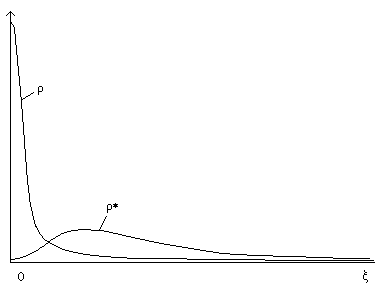
Figuur 3: Oplossing van het Eddington-type met sferische symmetrie. Massadichtheden. Als een cluster in een plooi bestaat, bestaat een bijbehorende diffuse halo in de geconjugeerde regio van de tweede plooi.
Originele versie (Engels)
The missing mass problem (p3)
4) Spherically symmetric solution
...In 1916 Eddington derived a spherically symmetric steady-state solution, combining the Vlasov and the Poisson equations. He assumed that the ellipsoid of the velocities was spherically symmetric and pointed towards the center of the system.
Figure 1 (ga3114): Ellipsoid of velocities corresponding to an Eddington-type solution.
Eddington derived the following relation between the mass density and the gravitational potential
(20)
which represents a steady-state distribution of matter in a collision-free gas, in a gravitational potential Ψ, in which the gravitational force balances the pressure force. Let us take the same kind of a solution for the antipodal region
(21)
So that we have to solve the following equation
(22)
Take
(23)
Introduce the following adimensional quantities :
(24)
We get
(24)
which can be solved by numerical computation. We can take the following initial conditions
φ'₀ = 0
φ"₀ = 10
λ = 10
Figure 2 : Spherically symmetric Eddington-type solution. The gravitational potential
Figure 3 : Spherically symmetric Eddington-type solution. Mass densities. If a cluster exists in one fold, an associated diffuse halo exists in the conjugated region of the second fold.