Geometrisering van materie en antimaterie door de coadjointe actie van een groep op zijn impulsruimte. 4 :
De Tweelinggroep. Geometrische beschrijving van Dirac's antimaterie.
Geometrische interpretaties van antimaterie na Feynman en het zogenaamde CPT-theorema. (p5)
Vergelijking (16) is de actie op het element van de Lie-algebra, corresponderend met de groep
. De coadjointe actie is de duale van deze actie en berust op de invariantie van een scalaire. Noem S deze scalaire, waaruit de coadjointe actie van de groep
op zijn impuls wordt berekend. We berekenen de coadjointe actie van de groep
g 3
vanuit de scalaire :
(17)
c dJ + S
De coadjointe actie van de groep
g 3
op zijn impuls is dan :
(18)
(4529)
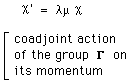
De impuls van de groep
g 3
is :
(19) J = {
c
, impuls van de groep
G }
De uitbreiding van de groep voegt een component
c
toe aan de impuls, die gehoorzaamt aan (20). In het bijzonder, als
, dat wil zeggen :
(20)
(4531)
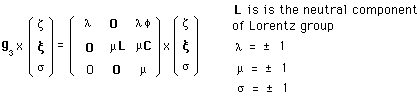
is zijn coadjointe actie :
(21)
c
'
= l m c
(22)
(4532)

(23)
(4533)

De vergelijkingen (22) + (23) komen overeen met de coadjointe actie van de Poincaré-groep wanneer
L de neutrale component van de Lorentz-groep is.
We weten dat we de impuls
J p
van de Poincaré-groep
g p
in de vorm van een antisymmetrische matrix kunnen schrijven :
(24)
(4534)
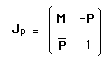
De actie op deze impuls is :
(25)
(4535)

We kunnen dan schrijven :
(26) J = {
c
,
J p }
en :
(27) (4536)
c
'
= l m c
De dimensie van de Poincaré-groep is tien. De dimensie van deze uitgebreide groep is elf, vanwege de toevoeging van de nieuwe variabele
f
. (
l
= ± 1 ) en (
m
= ± 1 ) vertegenwoordigen geen nieuwe dimensies van de groep.
Deze methode kan zo vaak als gewenst worden uitgebreid. Beschouw de volgende matrix :
(28)
(4537)
De Poincaré-groep heeft tien dimensies. De verzameling
( f 1
,
f 2
,
f 3
,
f 4
,
f 5
,
f 5 )
voegt zes extra dimensies toe. De scalairen (
l 1
,
l 2
,
l 3
,
l 4
,
l 5
,
l 5
) zijn vast en corresponderen niet met nieuwe dimensies.
De coadjointe actie van de groep op zijn impuls
(29) J = {
c 1
,
c 2
,
c 3
,
c 4
,
c 5
,
c 6
,
J p }
is :
(30)
(4538)
c
'
i = l i m c i
met
i = { 1 , 2 , 3 , 4 , 5 , 6 }
Referenties .
[1] J.P.Petit & P.Midy : Geometrisering van materie en antimaterie door de coadjointe actie van een groep op zijn impulsruimte. 1 : Ladingscomponenten als extra scalaire componenten van de impuls van een groep die werkt op een 10D-ruimte. Geometrische definitie van antimaterie. Geometrische Natuurkunde B ,
1
, maart 1998.
[2] J.P.Petit & P.Midy : Geometrisering van materie en antimaterie door de coadjointe actie van een groep op zijn impulsruimte. 2 : Geometrische beschrijving van Dirac's antimaterie. Geometrische Natuurkunde B,
2
, maart 1998.
[3] J.P.Petit en P.Midy : Geometrisering van materie en antimaterie door de coadjointe actie van een groep op zijn impulsruimte. 3 : Geometrische beschrijving van Dirac's antimaterie. Een eerste geometrische interpretatie van antimaterie na Feynman en het zogenaamde CPT-theorema. Geometrische Natuurkunde B ,
3
, maart 1998.
[4] J.M.Souriau : Structuur van dynamische systemen, Dunod-France Ed. 1972 en Birkhauser Ed. 1997.
[5] J.M.Souriau : Geometrie en relativiteit. Ed. Hermann-France, 1964.
[6] P.M.Dirac : "Een theorie van protonen en elektronen", 6 december 1929, gepubliceerd in de verslagen van de Royal Society (Londen), 1930 : A
126
, pp. 360-365
[7] R.Feynman : "De reden voor antipartikelen" in "Elementaire deeltjes en de wetten van de natuurkunde". Cambridge University Press, 1987.
Dankbetuigingen .
Dit werk werd ondersteund door het Franse CNRS en door het bedrijf Brevets et Développements Dreyer, Frankrijk.
Deposited in a sealed envelope at the Paris Academy of Sciences, 1998.
Copyright Franse Academie van Wetenschappen, Parijs, 1998.
Original version (English)
Geometrization of matter and antimatter through
coadjoint action of a group on its momentum space. 4 :
The Twin group. Geometrical description of Dirac's antimatter.
Geometrical interpretations of antimatter after Feynmann and so-called CPT-theorem. (p5)
The equation (16) is the action on the Lie algebra element , corresponding to the group
.The coadjoint action is the dual of this action and is based on the invariance of a scalar. Call S this scalar from which one computes the coadjoint action of the group
on its momentum. We compute the coadjoint action of the group
g 3
from the scalar :
(17)
c dJ + S
Then the coadjoint action of the group
g 3
on its momentum is :
(18)
(4529)
The moment of the group
g 3
is :
(19) J = {
c
, momentum of the group
G }
The extension of the group adds a component
c
to the moment, which obeys (20). In particular, if
, i.e :
(20)
(4531)
its coadjoint action is :
(21)
c
'
= l m c
(22)
(4532)
(23)
(4533)
The equations (22) + (23) identifies to the coadjoint action of the Poincaré group when
Lis the neutral component of the Lorentz group.
We know that we can put the momentum
J p
of the Poincaré group
g p
into an antisymmetric matrix :
(24)
(4534)
The its action on this momentum is :
(25)
(4535)
Then we can write :
(26) J = {
c
,
J p }
and :
(27) (4536)
c
'
= l m c
The Dimension of the Poincaré group is ten. The dimension of this extended group is eleven, due to adding the new variable
f
. (
l
= ± 1 ) and (
m
= ± 1 ) are not new dimensions of the group.
This method can be extended as many times as one wants. Consider the following matrix :
(28)
(4537)
The Poincaré group depends owns ten dimensions. The set
( f 1
,
f 2
,
f 3
,
f 4
,
f 5
,
f 5 )
adds si more dimensions. The scalar (
l 1
,
l 2
,
l 3
,
l 4
,
l 5
,
l 5
) are fixed and do not correspond to new dimensions.
The coadjoint action of the group on its momentum
(29) J = {
c 1
,
c 2
,
c 3
,
c 4
,
c 5
,
c 6
,
J p }
is :
(30)
(4538)
c
'
i = l i m c i
with
i = { 1 , 2 , 3 , 4 , 5 , 6 }
References .
[1] J.P.Petit & P.Midy : Geometrization of matter and antimatter through coadjoint action of a group on its momentum space. 1 : Charges as additional scalar components of the momentum of a group acting on a 10d-space. Geometrical definition of antimatter. Geometrical Physics B ,
1
, march 1998.
[2] J.P.Petit & P.Midy : Geometrization of matter and antimatter through coadjoint action of a group on its momentum space. 2 : Geometrical description of Dirac's antimatter. Geometrical Physics B,
2
, march 1998.
[3] J.P.Petit and P.Midy : Geometrization of matter and antimatter through coadjoint action of a group on its momentum space. 3 : Geometrical description of Dirac's antimatter. A first geometrical interpretation of antimatter after Feynmann and so-called CPT-theorem. Geometrical Physics B ,
3
, march 1998.
[4] J.M.Souriau : Structure des Systèmes Dynamiques, Dunod-France Ed. 1972 and Birkhauser Ed. 1997.
[5] J.M.Souriau : Géométrie et relativité. Ed. Hermann-France, 1964.
[6] P.M.Dirac : "A theory of protons and electrons", Dec. 6th 1929, published in proceedings of Royal Society ( London), 1930 : A
126
, pp. 360-365
[7] R.Feynman : "The reason for antiparticles" in "Elementary particles and the laws of physics". Cambridge University Press 1987.
Acknowledgements .
This work was supported by french CNRS and Brevets et Développements Dreyer company, France.
Déposé sous pli cacheté à l'Académie des Sciences de Paris, 1998.
Copyright french Academy of Science, Paris, 1998.