univers gêmeos contra matéria escura matéria escura e constante cosmológica
- **Buracos negros não existem. **
De onde vem o modelo dos buracos negros? Da equação do campo com segundo membro nulo. Paradoxalmente, um objeto tão denso surge de uma equação inicialmente concebida para descrever regiões vazias do Universo. O tensor de Kerr não traz muito mais: o objeto se torna simplesmente mais complexo. A rotação causa um fenômeno de arrasto de quadro azimutal, o que significa que a velocidade da luz é diferente conforme se olha para frente ou para trás em relação ao movimento de rotação. Qualquer que seja a técnica escolhida, as coisas tornam-se francamente patológicas após passar pelo horizonte e entrar. No centro encontra-se "a singularidade". Vamos começar com um exercício. Considere a métrica 2D (a). Se considerarmos r como uma distância radial e j como um ângulo polar, enfrentamos problemas para r < Rs. Mas se introduzirmos a mudança (b), a expressão da métrica se torna (c). Todas as patologias desaparecem. Além disso, essa superfície pode ser imersa em R3: a equação do meridiano é (d). Veja a figura 25 onde representamos uma geodésica. Isso ilustra o fato de que uma patologia pode depender de uma escolha errada de coordenadas e de uma escolha errada de topologia.
No exemplo 3D, calculamos geodésicas planas (veja a figura 26) que são projetadas no espaço de representação inicial (r, q, j). Obtemos uma "esfera de garganta" ligando dois espaços euclidianos 3D. Não há nada dentro. O espaço para r < Rs não tem significado físico. Se tentássemos calcular geodésicas nesse local, obteríamos uma solução imaginária.

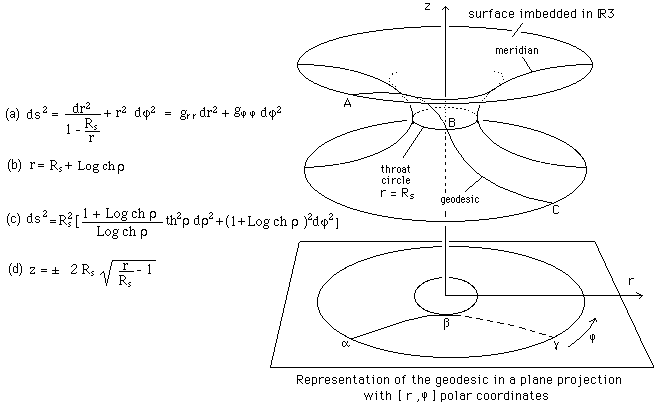
Fig. 25 : métrica 2D de uma superfície com um "ponte" ligando dois dobras.
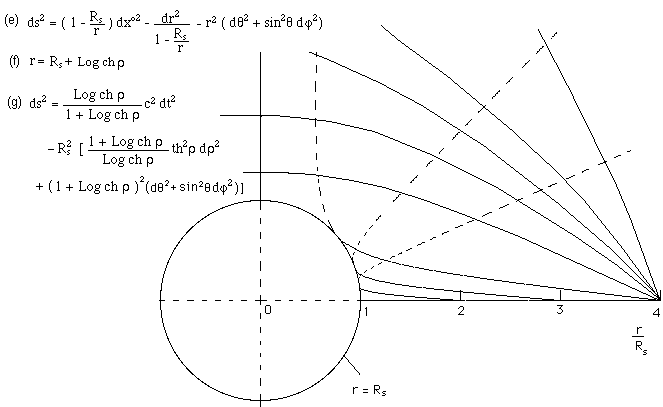
Fig. 26 : hipersuperfície métrica 3D com um "ponte espacial". Geodésicas.

Classicamente, introduzimos um tempo próprio s (j) e uma "coordenada de tempo" t (i). O estudo das geodésicas radiais dá duas equações diferenciais (k) e (l), cujas soluções correspondem às curvas (m), figura 6.2, referência [52].
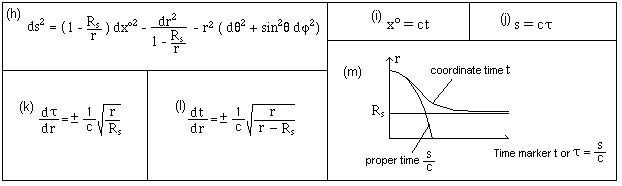
As curvas representadas na figura (m) são a base do modelo dos buracos negros. Identificamos a coordenada t ao tempo próprio de um "observador distante", de modo que o tempo de queda livre de uma partícula-teste em direção à esfera de Schwarzschild se torna infinito para ele. Mostremos que isso é totalmente devido a essa escolha particular de coordenada de tempo. Em 1925, Eddington sugeriu um novo marcador de tempo (p).

Em seguida, o estudo das geodésicas radiais correspondentes.
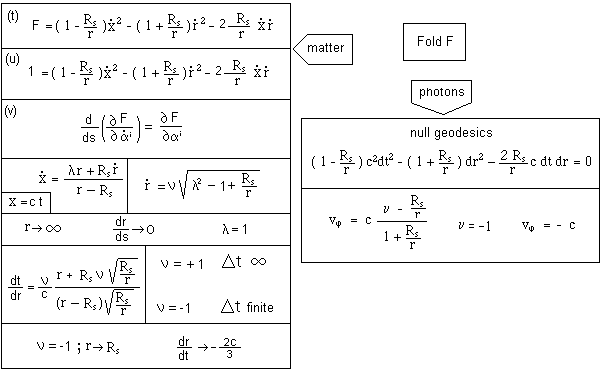
Usamos as equações de Lagrange. À direita, vemos que a velocidade da luz seguindo caminhos radiais tem duas valores. (nu = -1) corresponde aos caminhos centrípetos: a velocidade tem um valor constante – c. Da mesma forma (à esquerda), o tempo de transito desde um ponto distante até a esfera de Schwarzschild depende da orientação dos caminhos. O tempo de queda livre centrípeta (nu = -1) termina em um intervalo de tempo finito Dt. Ao contrário, um caminho centrífugo (nu = +1), partindo da esfera de Schwarzschild, dá um intervalo de tempo infinito, de modo que a esfera de Schwarzschild atua como uma membrana de sentido único. Isso corresponde a um efeito de arrasto radial. Isso não é uma razão para rejeitar essa interpretação da geometria de Schwarzschild. De fato, encontramos um fenômeno semelhante no tensor de Kerr (tração azimutal). Em seguida, a expressão clássica do tensor de Kerr. Vemos que obtemos dois valores distintos para a velocidade azimutal da luz. Dependendo de considerarmos a luz seguindo a rotação ou indo ao contrário.
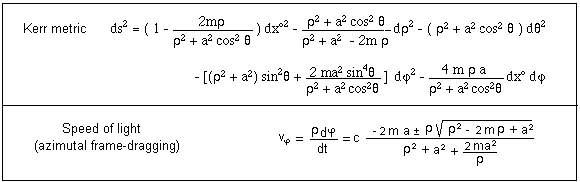
Podemos dar uma nova interpretação da geometria de Schwarzschild, através de um puente espacial ligando duas dobras F e F. Se a dobra F corresponde à dobra gêmea, a coordenada de tempo t = - t (simetria T). De acordo com a seção 19, sabemos que essa simetria T vai junto com uma inversão de massa, de modo que ao atravessar a esfera de Schwarzschild, considerada como uma superfície de garganta, a massa positiva torna-se negativa. A geometria conjugada, tal como apresentada na seção 13, corresponde a substituir Rs por – Rs. Em seguida, introduzimos a seguinte mudança de marcador de tempo, análoga à de Eddington:

Ainda usando as equações de Lagrange, estudamos o sistema de geodésicas radiais e estabelecemos uma ligação entre as duas dobras.

Mas os caminhos inversos exigem um tempo infinito, de modo que é um passeio de sentido único de um universo para outro. Aqui também encontramos um efeito de arrasto, mas no sentido oposto.
Durante a transição, o fluxo do tempo próprio permanece inalterado: ds > O. Isso torna o modelo dos buracos negros problemático. De fato, de acordo com essa nova interpretação da geometria de Schwarzschild, tal puente espacial pode engolir grandes quantidades de matéria em muito pouco tempo (» 10-4 s). Para comparação, uma análise baseada no tensor de Kerr, embora ligeiramente mais complexa, dá resultados semelhantes.
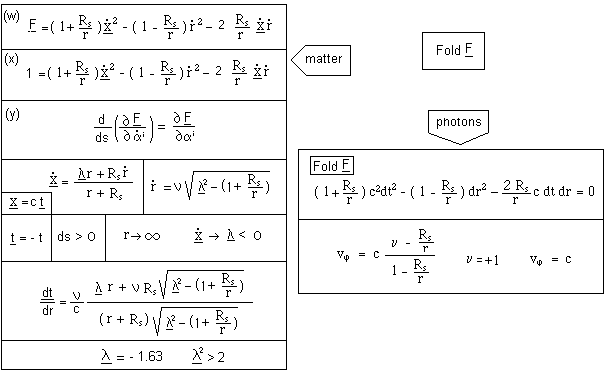
Em seguida, a solução dos sistemas de geodésicas.
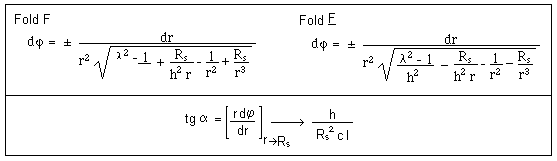
Como representar tais caminhos? Podemos usar o espaço de representação inicial (r, q, j). Obtemos então o sistema de equações diferenciais acima e o esquema da figura 27.
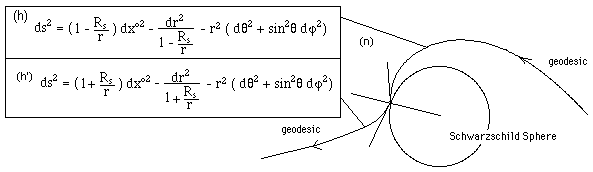
Fig. 27 : Geodésicas de entrada e saída.
A geodésica parece "rebater" na esfera de Schwarzschild, como também mostra a figura 28.
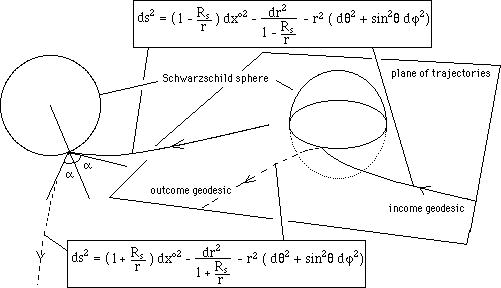
**  **
**
Mas tudo isso vem de uma representação euclidiana ingênua do caminho. Usando a seguinte mudança de marcador de espaço :
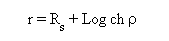
A expressão da métrica conjunta se torna :
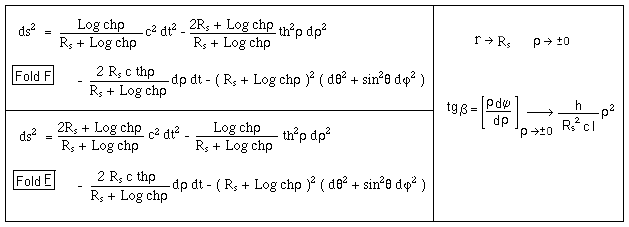
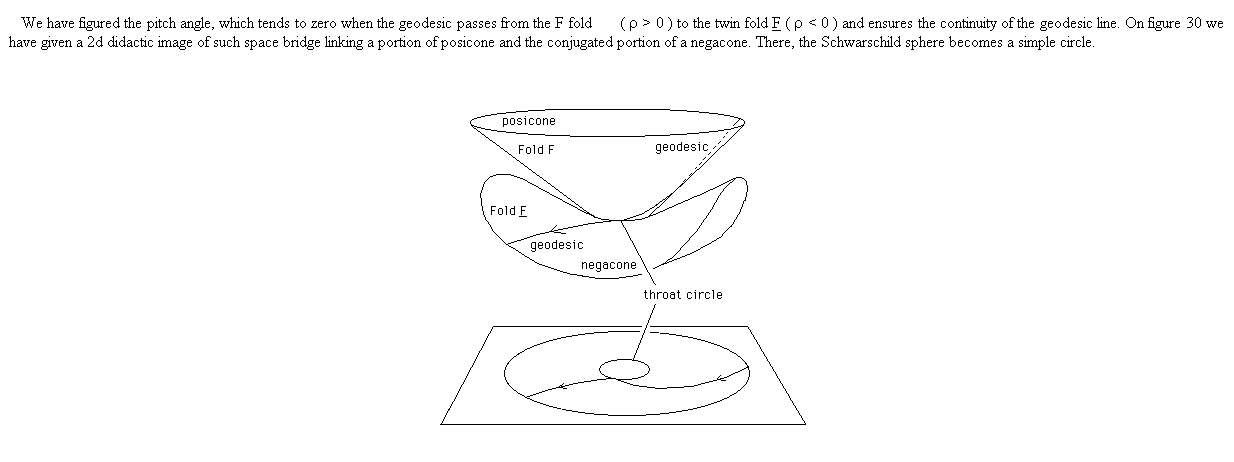
Fig. 29 : Imagem didática de um puente espacial com fluxo rápido.
Referências.
[1] J.F.Augereau : « Se a matéria escura desvia os raios luminosos, então ela existe » (Se a matéria escura desvia os raios luminosos, então ela existe). Le Monde, 17 de março de 2000.
[2] Entrevista de B.Fort em Ciel et Espace, junho de 2000.
[3] J.P.Petit : O efeito da massa faltante. Il Nuovo Cimento, B, vol. 109, julho de 1994, pp. 697-710
[4] J.P.Petit, Cosmologia dos universos gêmeos. Astrophysics and Space Science. Astr. And Sp. Sc. 226 : 273-307, 1995
[5] Zel'dovich Ya.B., Astrophysica 6. 319 MNRAS 192, 192 (1970)
[6] Doroskhevich A.G. MNRAS 192, 32 (1980)
[7] Klypin A.A & Shandarin S.F. MNRAS 204, 891 (1983)
[8] Centrella J.M. & Mellot A.L. Nature 305, 196 (1983)
[9] Mellot J.M. & Shandarin S.F. Nature 346, 633 (1990)
[10] Shandarin S.F. Em Grandes Estruturas do Universo, ed. J.Audouze, M.C. Peleton e A.Szalay, 273. Dordrecht : Kulwer (1988).
[11] Kofman.L.A., Pogosyan D. e Shandarin S. MNRAS 242, 200 (1990)
[12] Peebles P.J.E. Princípios de Cosmologia Física, Princeton University Press (1993).
[13] M.Myamoto e R.Nagai Publ. Astrom. Soc. Japan 27, 583, 1975
[14] J.Binney e S.Tremaine, "Galactic Dynamics", Princeton University Press, Princeton, 1987. [16] Bahcall J.N & Soneira R.M. APJ. S** 44** p. 73 1980
[17] Bahcall J.N., Flynn A e Gould A. APJ 389 p.234 1992
[18] B.Lindblad, Handbuch der Physik 53, (1959) 21
[19] C.C. Lin e F.H.Shu : Astrophysics and Gen. Relat. Vol.2 Gordon and Breach Sc. Publ. 1971, p. 235
[20] Toomree A. (1981) A estrutura e dinâmica de galáxias normais. Cambridge University Press, p.111
[21] Toomree A. e Toomree J. (1972) Astrophys. J. 178, 623
[22] A.Toomree, Ann. Rev. Astronom. Astrophys. 15 (1977) 437
[23] E.Athanassoula : Espirais e barras conduzidas por companheiros. International Astronomic Union. Symposium n° 146 (1991)
[24] A.Toomree Astrophys. J. 158 (1969) 89
[25] R.H.Miller e B.F. Smith, Astrophys. J. 277 (1979) 785
[26] F. Hohl, Astrophys. Sp. Sc. 14 (1971) 91
[27] Holmberg E. (1941) Astrophys. J. 94, 385
[28] B. Sundelius e K.J. Donner : Galáxias em interação, Dinâmica de galáxias em disco (1991) Sundelius ed. p. 195
[29] S. Engström : Velocidades características em simulações numéricas. , Dinâmica de galáxias em disco (1991) Sundelius ed. p. 332
[30] A.Toomree Ann. Rev. Astron. Astrophys. 15 (1977) 437.
[31] F.Bouchet e L.Hernquist : Simulações cosmológicas usando métodos teóricos arborescentes. Astr. Jr Suppl. Series 68 , pp. 521, 538, 1988.
[32] F.Bouchet, L.Hernquist e Y.Suto : Aplicação do método de Ewald às simulações N-corpos cosmológicas. Apj. Suppl. Series 75 , pp. 231-240, 1991
[33] A.Sakharov : "Violação de CP e assimetria bariônica do Universo". ZhETF Pis'ma 5 : 32-35 (1967) : Tradução JETP Lett. 5 : 24-27 (1967)
[34] A.Sakharov : "Um modelo cosmológico de múltiplas folhas". Pré-print Instituto de Matemática Aplicada, Moscou 1970
[35] A.Sakharov : "Modelo cosmológico do Universo com inversão do vetor tempo". ZhETF 79 : 689-693 (1980) : Tradução em Sov. Phys. JETP 52 : 349-351 (1980)
[36] A.Sakharov : "Estrutura topológica das partículas elementares e assimetria CPT" em "Problemas de física teórica", dedicado à memória de I.E.Tamm, Nauka, Moscou 1972 pp. 243-247
[37] Green M.B. & Schwarz J.H. Nucl. Phys. B181 , 502-530 (1981) ; B198 , 225-268 (1982) ; Phys. Lett. B , 444-448 (1982)
[38] Green M.B. Surv. High Energy Phys. 3 , 127 (1982)
[39] Gross D.J. , Harvey J.A. , Martinec E. & Rohm R. , Phys. Rev. Lett. 54, pp 503-505 (1985)
[40] Kolb E.W. , Seckel D , Turner M.S. : O mundo invisível das teorias das supercordas, Nature Vol. 314, abril 1984 pp. 415-419
[41] P.C.W.Davies & J.B.Brown : Supercordas, Cambridge University Press 1988
[42] Abdus Salam, Nuovo Cimento 5 , 299 (1957)
[43] Nima-Arkani Ahmed, Savas Dimopoulos e Georgi Dvali : "As dimensões ocultas do universo", PLS out 2000 n° 276 pp. 56-64
[44] J.P.Petit : Uma interpretação do modelo cosmológico com velocidade da luz variável. Modern Physics Letters A, Vol. 3, n°16, nov 1988, p.1527
[45] ** **J.P.Petit : Modelo cosmológico com velocidade da luz variável: a interpretação dos desvios para o vermelho. Modern Physics Letters A, Vol.3 , n° 18, dez. 1988, p.1733
[46] J.P.Petit & Maurice Viton : Modelo cosmológico com velocidade da luz variável. Comparação com os dados observacionais de QSO. Modern Physics Letters A Vol.4 , n°23 (1989) pp. 2201-2210
[47] P.Midy & J.P.Petit : Cosmologia invariante de escala. The international Journal of Modern Physics D, Vol.8 junho 1999 pp.271-280
[48] E.A.Milne : Relatividade cinemática Oxford 1948.
[49] J.D.Anderson, P.A.Laing, E.L.Lau, A.S.Liu, M.M. Nieto e S. Turchev : Indicação para os dados Pioneer 10/11, Galileo e Ulysse, uma aceleração anormal, fraca, de longo alcance. Phys. Rev. Letters : 81 31 agosto 1998.
[50] G.J.Stephenson Jr. , T.Goldman, Phys. Rep. 205, 211 (1992) ; 216, 343 (1992).
[51] M.N. Nieto e T.Goldman, Phys. Re. 205, 221, 1991; 216, 343.
[52] R.Adler, M.Bazin & M.Schiffer : Introdução à relatividade geral, Mac Graw Hill book, 1975, capítulo 10, seção 10.5 : Limite clássico das equações gravitacionais, p. 345.
[53] J.M.Souriau, Estrutura dos Sistemas Dinâmicos, Ed. Dunod 1970, França & Estrutura dos Sistemas Dinâmicos. Birkhauser Ed. Boston-Zurich 1997.
[53] J.P.Petit : Universos enantiomórficos com setas de tempo opostas (Universos enantiomórficos com setas de tempo opostas). Comptes rendus de l'Académie des Sciences de Paris, t. pp. 1977
[54] Eddington S.A : : Uma comparação das fórmulas de Withead e de Einstein. Nature 113 : 192 (1924).
****Resumo do artigo
Versão original (inglês)
univers gêmeos contra matéria escura matéria escura e constante cosmológica
- **Black holes do not exist. **
Where the black hole model does come from ? From the null second member field equation. Paradoxically such very dense object rises from an equation which was initially built to describe empty regions of the Universe. The Kerr metric does not bring so much : the object becomes more complex, thats all. Rotation brings an azimutal frame-dragging phenomenon, which means that the speed of light is different if one looks forward or backward with respect to the spinning movement. Whatever is the technique you choose, the things become frankly pathological when you pass the horizon and get in. At the centre lies the singularity. Let us start with an exercise. Consider the 2d metric (a). If we consider r as a radial distance and j as a polar angle, we get problems for r < Rs. But if we introduce the change (b) the expression of the metric becomes (c). All pathologies disappear. Moreover this surface can be imbedded in R3 : the meridian equation is (d). See figure 25 where we have figured a geodesic. This illustrates the fact that a pathology can depend on a wrong choice of coordinates and on a wrong choice of topology.
In the 3d example we have computed (plane) geodesics ( see figure 26 ) which are projected on the initial (r,q,j) representation space. We get a throat sphere linking two Euclidean 3d spaces. There is nothing inside. Space for r < Rs has no physical meaning. If we would try to compute geodesics in that place, we would find an imaginary solution.
Fig. 25 : 2d metric of a surface with a bridge linking two folds.
Fig. 26 : 3d metric hypersurface with a space bridge. Geodesics.
Classically, one introduce a proper time s (j) and a time-coordinate t (i). Then the study of radial geodesics gives two differential equations (k) and (l), whose solutions correspond to curves (m), fig. 6.2, reference [52].
The curves shown on figure (m) are the basis of the black hole model. One identifies the coordinate t to the proper time of a distant observer so that the free fall time of a test particle, towards the Schwarzshild Sphere become infinite for him. Let us show that this is completely due to this peculiar choice of time coordinate. In [54] 1925 Eddington suggested a new time-marker (p).
Following, the study of corresponding radial geodesics.
We use Lagrange equations. On the right we see that the speed of light, following radial paths has two values. ( nu = - 1 ) corresponds to centripetal paths : the speed has a constant value c. Similarly (left) the transit time from a distant point to the Schwarzschild sphere depends on the orientation of the paths. Centripetal ( nu = - 1 ) free fall time is achieved in finite time interval Dt . Oppositely a centrifugal path ( nu = + 1 ), starting from the Schwarzschild sphere gives an infinite time interval, so that the Schwarzschild sphere works like a one-way membrane. This corresponds to a radial frame-dragging effect. This is not a reason to reject this interpretation of the Schwarzschild geometry. In effect we find a similar phenomenon in the Kerr metric ( azimutal frame-dragging). Next, the classical expression of the Kerr metric. We see that we get two distinct values for azimutal speed of light. Depends if we consider light following the rotation or going backwards.
We can give a new interpretation of the Schwarzschild geometry, through a space-bridge linking two folds F and F. If the fold F corresponds to the twin fold, the time coordinate t = - t ( T-symmetry). From section 19 we know that this T-symmetry goes with a mass-inversion, so that when a positive mass passes through the Schwarzschild sphere, considered as a throat surface, the sign of it becomes negative. The conjugated geometry, as presented in section 13 corresponds to change Rs into Rs. Then we introduce the following Eddington-like time marker change :
Still using Lagranges equation we study the radial geodesics system and build a link between the two folds.
But the inverse paths requires an infinite time, so that it is a one-way passage from a Universe to the other. Here again we find a frame-dragging effect, in the opposite direction.
During the transit the proper time flow is unchanged : ds > O . This makes the black hole model questionable. In effect, according to this new interpretation of the Schwarzschild geometry such space bridge can swallow in a very short time ( » 10-4 sec) unlimited amounts of matter. By the way, an analysis based on the Kerr metric, although a little bit more complicated gives similar results.
Following, the solution of the geodesic systems.
How to figure such paths ? We can use the initial ( r , q , j ) representation space. Then we get the above system of differential equations and the schema of figure 27 .
Fig.27 : Income and outcome geodesics.
The geodesic seems to bounce on the Schwarzschild sphere, as shown of figure 28 too.
** **
But all that comes from such naïve Euclidean representation of the path. Using the following change of space marker :
The expression of joint metrics become :
Fig. 29 : Didactic image of a fast flow space bridge.
References.
[1] J.F.Augereau : « Si la matière sombre dévie les rayons lumineux, cest donc quelle existe (If dark matter bends light rays it shows it does exist). Le Monde, March 17 th 2000.
[2] Interview of B.Fort in Ciel et Espace, june 2000.
[3] J.P.Petit : The missing mass effect. Il Nuovo Cimento, B , vol. 109, july 1994, pp. 697-710
[4] J.P.Petit, Twin Universe Cosmology. Astrophysics and Space Science. Astr. And Sp. Sc. 226 : 273-307, 1995
[5] Zel'dovich Ya.B., Astrophysica 6. 319 MNRAS 192, 192(1970)
[6] Doroskhevich A.G. MNRAS 192, 32 (1980)
[7] Klypin A.A & Shandarin S.F. MNRAS 204, 891 (1983)
[8] Centrella J.M. & Mellot A.L. Nature 305, 196 (1983)
[9] Mellot J.M. & Shandarin S.F. Nature 346 , 633 (1990)
[10] Shandarin S.F. In Large Structures of the Universe, ed. J.Audouze, M.C. Peleton and A.Szalay, 273. Dordrecht : Kulwer (1988).
[11] Kofman.L.A., Pogosyan D. and Shandarin S. MNRAS 242, 200 (1990)
[12] Peebles P.J.E. Principles of Physical Cosmology, Princeton University Press (1993).
[13] M.Myamoto and R.Nagai Publ. Astrom. Soc. Japan 27, 583, 1975
[14] J.Binney and S.Tremaine, "Galactic Dynamics", Princeton University Press, Princeton, 1987. [16] Bahcall J.N & Soneira R.M. APJ. S** 44** p. 73 1980
[17] Bahcall J.N. , Flynn A and Gould A. APJ 389 p.234 1992
[18] B.Lindblad, Handbuch der Physik 53, (1959) 21
[19] C.C. Lin and F.H.Shu : Astrophysics and Gen. Relat. Vol.2 Gordon and Breach Sc. Publ. 1971, p. 235
[20] Toomree A. (1981) The structure and dynamics of normal galaxies. Cambridge University Press, p.111
[21] Toomree A. and Toomree J. (1972) Astrophys. J. 178, 623
[22] A.Toomree, Ann. Rev. Astronom. Astrophys. 15 (1977) 437
[23] E.Athanassoula : Companion driven spirals and bars. International Astronomic Union. Symposium n° 146 (1991)
[24] A.Toomree Astrophys. J. 158 (1969) 89
[25] R.H.Miller and B.F. Smith, Astrophys. J. 277 (1979) 785
[26] F. Hohl, Astrophys. Sp. Sc. 14 (1971) 91
[27] Holmberg E. (1941) Astrophys. J. 94, 385
[28] B. Sundelius and K.J. Donner : Interaction galaxies, Dynamics of Disk Galaxies (1991) Sundelius ed. p. 195
[29] S. Engström : Feature velocitys in numerical simulations. , Dynamics of Disk Galaxies (1991) Sundelius ed.p. 332
[30] A.Toomree Ann. Rev. Astron. Astrophys. 15 (1977) 437.
[31] F.Bouchet and L.Hernquist : Cosmological simulations using theoretical tree methods. Astr. Jr Suppl. Series 68 , pp. 521, 538, 1988.
[32] F.Bouchet, L.Hernquist and Y.Suto : Application of the Ewald method to cosmological N-body simulation. Apj. Suppl. Series 75 , pp. 231-240, 1991
[33] A.Sakharov : "CP violation and baryonic asymmetry of the Universe". ZhETF Pis'ma 5 : 32-35 (1967) : Traduction JETP Lett. 5 : 24-27 (1967)
[34] A.Sakharov : "A multisheet Cosmological Model" Preprint Institute of Applied Mathematics, Moscow 1970
[35] A.Sakharov : "Cosmological Model of the Universe with a time-vector inversion". ZhETF 79 : 689-693 (1980) : Traduction in Sov. Phys. JETP 52 : 349-351 (1980)
[36] A.Sakharov : "Topological structure of elementary particles and CPT asymmetry" in "problems in theoretical physics", dedicated to the memory of I.E.Tamm, Nauka, Moscxow 1972 pp. 243-247
[37] Green M.B. & Schwarz J.H. Nucl. Phys. B181 , 502-530 (1981) ; B198 , 225-268 (1982) ; Phys. Lett. B , 444-448 (1982)
[38] Green M.B. Surv. High Energy Phys. 3 , 127 (1982)
[39] Gross D.J. , Harvey J.A. , Martinec E. & Rohm R. , Phys. Rev. Lett. 54, pp 503-505 (1985)
[40] Kolb E.W. , Seckel D , Turner M.S. : The shadow world of superstring theories, Nature Vol. 314, april 1984 pp. 415-419
[41] P.C.W.Davies & J.B.Brown : Superstrings, Cambridge University Press 1988
[42] Abdus Salam, Nuovo Cimento 5 , 299 (1957)
[43] Nima-Arkani Ahmed, Savas Dimopoulos and Georgi Dvali : "Les dimensions cachées de l'univers", PLS oct 2000 n° 276 pp. 56-64
[44] J.P.Petit : An interpretation of cosmological model with variable light velocity. Modern Physics Letters A, Vol. 3, n°16, nov 1988, p.1527
[45] ** **J.P.Petit : Cosmological model with variable light velocity: the interpretation of red shifts. Modern Physics Letters A, Vol.3 , n° 18, dec. 1988, p.1733
[46] J.P.Petit & Maurice Viton : Gauge cosmological model with variable light velocity. Comparizon with QSO observational data. Modern Physics Letters A Vol.4 , n°23 (1989) pp. 2201-2210
[47] P.Midy & J.P.Petit : Scale Invariant Cosmology. The international Journal of Modern Physics D, Vol.8 June 1999 pp.271-280
[48] E.A.Milne : Kinematic Relativity Oxford 1948.
[49] J.D.Anderson, P.A.Laing, E.L.Lau, A.S.Liu, M.M. Nieto and S. Turchev : Indication for Pioneer 10/11, Galileo and Ulysse Data, an an Apparent Anomalous, Weak, Long-Range Acceleration. Phys. Rev. Letters : 81 31 August 1998.
[50] G.J.Stephenson Jr. , T.Goldman, Phys. Rep. 205, 211 (1992) ; 216, 343 (1992).
[51] M.N. Nieto and T.Goldman, Phys. Re. 205, 221, 1991; 216, 343.
[52] R.Adler, M.Bazin & M.Schiffer : Introduction to general relativity, Mac Graw Hill book, 1975, chapter 10, section 10.5 : Classical limit of gravitational equations, p. 345.
[53] J.M.Souriau, Structure des Systèmes Dynamiques, Ed. Dunod 1970, France & Structure of Dynamical Systems. Birkhauser Ed. Boston-Zurich 1997.
[53] J.P.Petit : Univers énantiomorphes à flèches du temps opposeés (Enantiomorphic universes with opposite time arrows). Comptes rendus de lAcadémie des Sciences de Paris, t. pp. 1977
[54] Eddington S.A : : A comparizon of Witheads and Einsteins formulæ. Nature 113 : 192 (1924).
****Resumo do artigo