O problema da massa faltante
(p3)
.
- Solução com simetria esférica
Em 1916, Eddington derivou uma solução estacionária com simetria esférica, combinando as equações de Vlasov e de Poisson. Ele supôs que o elipsóide das velocidades era esféricamente simétrico e orientado para o centro do sistema.
Figura 1 (ga3114): Elipsóide das velocidades correspondente a uma solução do tipo Eddington.
Eddington derivou a seguinte relação entre a densidade de massa e o potencial gravitacional
(20)
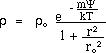
que representa uma distribuição estacionária de matéria em um gás sem colisão, em um potencial gravitacional
Y,
no qual a força gravitacional é equilibrada pela força de pressão. Vamos tomar uma solução do mesmo tipo para a região antípoda
(21)
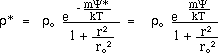
Assim, devemos resolver a seguinte equação
(22)

Vamos definir
(23)
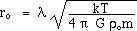
Introduzimos as seguintes grandezas adimensionais:
(24)

Obtemos
(24)
que pode ser resolvida por cálculo numérico. Podemos tomar as seguintes condições iniciais
j
'o = 0
j
"o = 10
l = 10
Figura 2: Solução do tipo Eddington com simetria esférica. O potencial gravitacional
Figura 3: Solução do tipo Eddington com simetria esférica. Densidades de massa. Se um aglomerado existe em uma dobra, um halo difuso associado existe na região conjugada da segunda dobra.
Versão original (inglês)
The missing mass problem
(p3)
.
- Spherically symmetric solution
In 1916 Eddington derived a spherically symmetric steady-state solution, combining the Vlasov and the Poisson equations. He assumed that the ellipsoid of the velocities was spherically symmetric and pointed towards the center of the system.
Figure 1 (ga3114): Ellipsoid of velocities corresponding
to an Eddington-type solution.
Eddington derived the following relation between the mass density and the gravitational potential
(20)
which represents a steady-state distribution of matter in a collision-free gas, in a gravitational potential
Y,
in which the gravitational force balances the pressure force. Let us take the same kind of a solution for the antipodal region
(21)
So that we have to solve the following equation
(22)
Take
(23)
Introduce the following adimensional quantities :
(24)
We get
(24)
which can be solved by numerical computation. We can take the following initial conditions
j
'o = 0
j
"o = 10
l = 10
Figure 2 : Spherically symmetric Eddington-type solution. The gravitational potential
Figure 3 : Spherically symmetric Eddington-type solution. Mass densities. If a cluster exists in one fold, an associated diffuse halo exists in the conjugated region of the second fold.