Nuclear Gardanne seismic experiments
Gardanne
- page 1 -
In indifference
April 19, 2003 - addition of May 25, 2004
May 25, 2004:
This morning I received an email, reproduced below. The Gardanne affair has been buried in general indifference. No journalist moved. Jean-Yves Casgha, the one who had raised the Gardanne issue, did not even attend the two trials, nor did he make any effort to mobilize his colleagues in the press. This is why I was condemned. In the first instance there were two journalists and two articles in major newspapers; in the second instance there were none. I will no longer attend the "Sciences Frontière" festival in Cavaillon, nor will I speak on the radio station "Ici et Maintenant" in Plage.
The Gardanne mine is now flooded. The surface installations have been dynamited. The farce is over. A few days ago I dined at a friend's house with an engineer working at the CEA. Wealthy, very comfortable, he dedicates his leisure time to buying artworks to furnish his magnificent home. He sleeps the sleep of the just.
-
In terms of superconductivity, we achieve 8 teslas... MHD? We can't be on all fronts... Hypervelocity torpedoes? Never heard of them... Don't tell me our nuclear submarines are just wheelbarrows... In France, we still know how to do things... Our nuclear warheads are completely stealthy, I can assure you, that's my area... Giudicelli? Yes, I've heard of those things. But he's a man who says anything...
-
Do you think he was drunk? Yes, I think he was simply drunk when he made those confessions to you. But he didn't seem to be. I've also heard about these supposed underground nuclear experiments in mines. But no, it's completely false. Then how can you ensure the reliability of nuclear warheads after eight years of interruption? We conduct what are called "cold tests." It's the same thing, but with uranium insufficiently enriched to cause a nuclear explosion. We verify that the device works properly... Besides, a nuclear test underground, believe me, you can hear it. We even captured in 1996 the signal from the Kursk accident. But you know that an explosion of a one-kiloton charge in a twenty-meter cavity produces a seismic signal of magnitude 3 equivalent to the explosion of 450 kilograms of TNT, common in the exploitation of mining fronts. Yes, but these holes need to be dug... No, I don't believe it.
-
Have you heard about electromagnetic weapons? Yes, I know. The electromagnetic effects of explosions—No, not that. I'm thinking of electromagnetic cannons powered by small nuclear charges via a flux compression system. This is being done in Saint Louis. It's a Franco-German cooperation (see the information below). Ah, but Saint Louis isn't the CEA...
Close the session. I am no longer involved in this matter. I've made a brief foray into the world of Egyptology. I'm now trying to hasten the completion of a book to prevent a potential scientific pillaging. Indeed, in this field, it's not better than elsewhere. There may be something worth fighting against: trying to protect the freedom of the Internet, seriously threatened.
Here is the email I received this morning:
Dear Mr. Petit,
I feel compelled to recount my experience regarding earthquakes in the Gardanne area. I've lived my entire life in Bouc Bel Air, on the border of Gardanne, except for a five-year interruption in the Paris region. I returned to the area a few years ago, in 2000. I lived on the first and top floor of a small residence with four apartments. Working exclusively at night, I am therefore awakened every night, which I invariably spend in front of my computer. In my family, we are particularly sensitive to seismic vibrations. But to describe these vibrations, you don't need to be a mobile seismograph.
Every week, I noticed vibrations in the ground, invariably at night between 1 and 3 a.m.
The vibrations were clearly noticeable, the strongest causing my computer screen to oscillate without triggering car alarms or waking up sleeping people. Not being a scientist, I can't quantify their intensity on the Richter scale. The duration is very short, about 1 to 2 seconds, and of rapid frequency, which I estimate at 5 back-and-forth cycles per second.
Nevertheless, after a few months, intrigued by these vibrations despite knowing we are located on a seismic fault, I questioned my surroundings. The responses I received were: "We're on the old Gardanne mines that often collapse."
Note from JPP: It's curious that collapses occur always at night, between 1 and 3 a.m.
However, it seems to me that mine tunnels, which aren't extremely high, couldn't produce such strong and frequent vibrations (about once a week). I had come to believe I was experiencing particularly active geological activity in our region until I read your website.
If you find any interest in this testimony, I obviously authorize you to publish all or part of this email.
Bertrand P., Police Officer.
There are situations where it's better to take certain precautions, hoping they will be effective. The reader may know that during the summer of 2000, I was alerted by revelations that led me to the conviction (three witnesses) that France had continued underground nuclear tests on its own soil since 1993, these experiments taking over from those halted in 1996 at Mururoa.
We also know that our current President of the Republic, Jacques Chirac (nominated as a possible Nobel Peace Prize recipient), announced that year that France "would continue developing its nuclear weapons, massive destruction, through simulations carried out at the Barp Center near Bordeaux, within the framework of a laser fusion experiment called 'Mégajoule.'" However, we know that laser fusion has never worked in any country, and furthermore, this fusion of two isotopes of hydrogen—deuterium and tritium—would have no relation to the fusion occurring in "hydrogen bombs," which function using lithium hydride (a mixture of lithium and hydrogen). This project Mégajoule, which in 2010 will involve a thousand engineer and technician salaries, is therefore a cover project designed to conceal other activities: the continuation of underground nuclear experiments within the hexagon itself. (Incidentally, note that these thousand salaries will be paid to people assigned to a project that is not designed to yield results, given that this type of enterprise has never produced anything since 1975 anywhere in the world, including in the United States (Livermore). But on one hand, scientific journalists are too cowardly to dare challenge such a waste of such importance, of a "political" nature, and on the other hand, CNRS personnel remain silent or praise the benefits of creating such an "artificial sun" in exchange for a few positions for astrophysicists.)
We also know that France continues developing an electromagnetic weapon, whose low-power prototype, developed at the Franco-German Institute in Saint-Louis, is already operational. This small weapon (10 cm in diameter, 40 cm in length) is intended to equip a "combat drone."
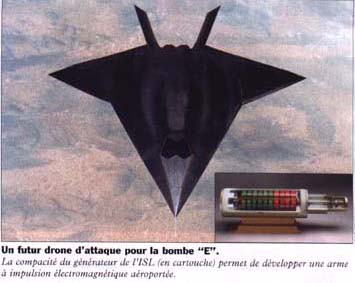
These operational weapons in "full scale" must be powered by low-power A-bombs (less than one kiloton TNT equivalent). The electromagnetic pulse they deliver could disable technico-industrial installations deployed over large areas (e.g., the Nuclear Center of Cadarache, a missile base, a combat fleet, etc.). Therefore, a country wishing to develop such weapons cannot be content with "calculations" or even "simulations." Genuine experiments must be conducted, and we believe hundreds of clandestine tests have been carried out by French military forces within the hexagon.
Tests: How? Where? — A U.S. report titled:
Geological and Engineering Constraints on the Feasibility of Clandestine Nuclear Testing by Decoupling in Large Underground Cavities
Translation:
Feasibility and constraints of clandestine nuclear testing in large underground cavities.
http://geology.er.usgs.gov/eespteam/pdf/USGSOFR0128.pdf
written by Dr. William Leith, U.S. Geological Survey, Reston, Virginia, 20192, USA, emanating from the U.S. Department of the Interior, U.S. Geological Survey, OPEN FILE REPORT 01-28, provides all the steps. Issued by the most serious authorities on the matter, it focuses on detecting clandestine nuclear tests worldwide. It explains that by detonating charges of one kiloton (we know today it's possible to go down to powers three times lower) in cavities of 25 meters in diameter, the seismic signal emitted has a magnitude equal to or less than 3, depending on the terrain. It is then specified that the best way to proceed is to blend these tests among the signals corresponding to the "normal" activity of a mine. Indeed, a magnitude 3 signal is produced by creating, for example, mining fronts by detonating 450 kilograms of TNT.
-
The Laboratory of Geophysics and Geodynamics in Saint Jérôme (CNRS), part of Aix Marseille III University, records regional seismic signals to study plate tectonics. This laboratory has recorded a hundred signals emanating from a region located south of the city of Gardanne, with the following characteristics:
-
All are located at a depth of around one thousand meters. The epicenters are quite clustered.
-
All are approximately the same magnitude: 3
-
These signals originate from a mine area no longer exploited and should not, according to specialists, produce any signal of this magnitude.
-
A lignite mine is located in a sedimentary region, which appears as a "layer cake," with alternating marls and limestones. The lignite layer itself is thin (one to a few meters). But this material, intermediate between peat (beginning of carbonification) and coal (end of carbonification, hard as stone), constitutes a good sound damper for high frequencies. Therefore, sound and seismic signals are dispersed over a vast area through a complex system of reflections between layers. Only low frequencies pass through. We have linked this to a thick file concerning "mysterious vibrations" (low rumbles lasting several seconds) affecting a large area of the PACA region, the last such incident dating back to November 14, 2002. The explanations provided post hoc by official services (a Rafale aircraft conducting a low-altitude transonic test under "very particular meteorological conditions") are hardly convincing on multiple counts. A first report specified that no aircraft was in flight at that time. Later, when this hypothesis of a "long-duration bang" (without precedent in fluid mechanics) was proposed, the flight plan did not match either the location or the observation time of the phenomenon.
-
In short, there is a presumption that the military may have carried out clandestine underground nuclear tests, taking advantage of the continued activity of the Gardanne mine and the vast area covered by the mine.
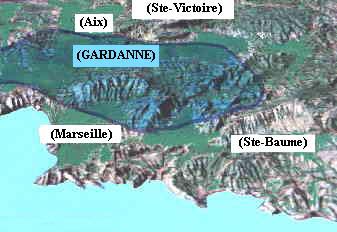
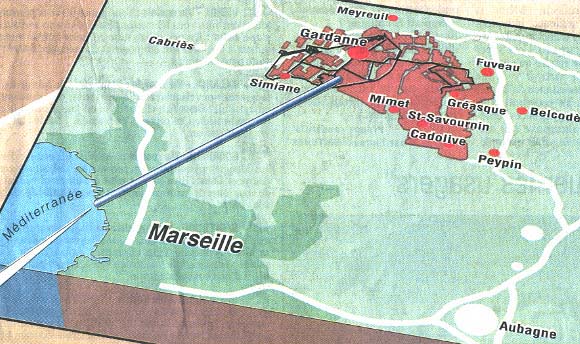
Investigation and questioning of specialists have shown that this was entirely possible, provided one was willing to pay the price, either by using abandoned "descenderies" located away from the test zone, or by digging access points from a location such as a military base. Here are some images that give an idea of the mine's structure. Brown areas indicate zones already exploited. There is a tunnel whose entrance is 18 meters above sea level and which allows water evacuation toward Estaque, right in Marseille:
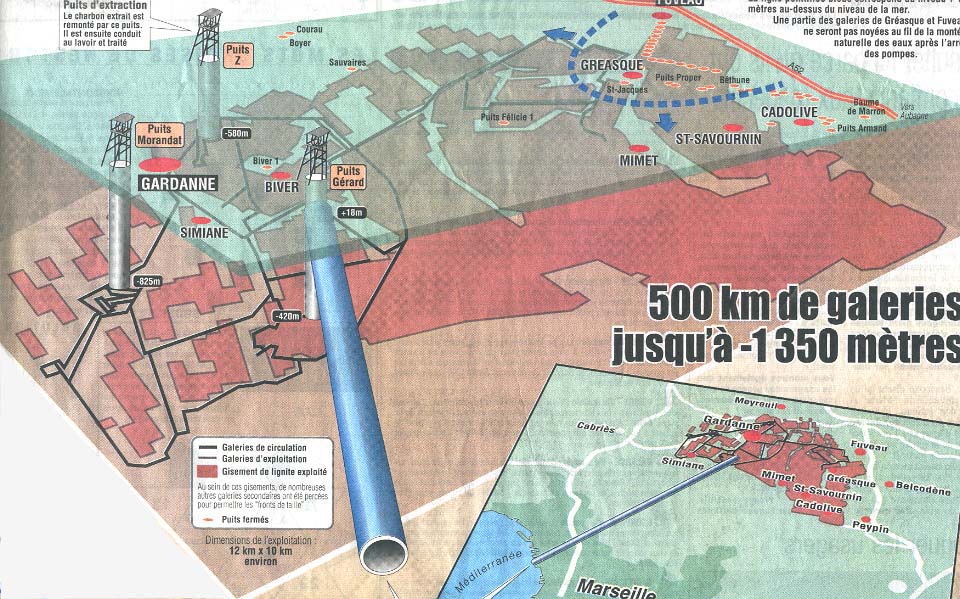
In these views, we have a 3D image of the mine with its three shafts still active. The suspected epicenters linked to clandestine underground nuclear tests are grouped south of the Gérard shaft.
For information, substantial galleries can be dug using machines with the following dimensions:
| length: six meters | width: three meters | height: two meters |
|---|
Ventilation can be ensured by long flexible ducts, with a blower every 400 meters, relayed by discreet surface returns, disguised or with simple air return through the gallery itself. Specialized excavation machines are designed to be transported to the site in disassembled parts and reassembled on-site (conventional machines are designed to be lowered through mine shafts). The excavation of galleries and test cavities could have been carried out by a team (obviously not mine personnel) not exceeding twenty people. As for the test installations, they remain modest in size. The nuclear device itself (which, by converting part of the explosive energy into electricity, contributes to its own stealth through its operation) is small, since it must be transportable by a Tomahawk cruise missile. Say one meter long and fifty centimeters in diameter. As fantastic as this may seem, it is entirely possible to conduct clandestine nuclear tests in any region of France without being detected, operating from any hangar, civilian or military. We believe hundreds of clandestine nuclear tests could have been conducted at a thousand meters depth in the Gardanne mine, unknown to the personnel working there, as well as in various locations across the French territory.
(Simple aside: take a look at another file that shows how little the military care about civilian concerns when their activities seem to fall under national security secrets).
This is where we move to recent facts that reinforce this presumption. — On January 9, 2003, my book "UFOs and American Secret Weapons" was published by Albin Michel. In a drawing, I included a chapter, pages 139 to 147, where I managed to touch on this presumption, further strengthened by abnormal radiation measurements conducted by the DRIRE (Regional Directorate for Industry, Research, and Environment) at the Esla Triolet elementary school (which led to the closure of the school until the problem was "resolved," i.e., through "appropriate ventilation of the premises" so that the radioactive emissions, impossible to control, would fall "below accepted norms"). A minor detail: the Gardanne area is a secondary sedimentary basin where, a priori, there should be no type of radioactivity.
-
On January 14, 2003, the government decided to accelerate the closure of the mine by three years.
-
On January 31, 2003 (a Friday!), a commando of hooded men (sources: mine personnel and union leaders) entered the mine and carried out significant destruction of mining equipment at the bottom (800 meters). Sixty machines were destroyed by fire.
-
On February 1, 2003 (the following Saturday), the mine's management sent a gendarmerie brigade, a bailiff, and "four men in combat gear wearing no name, rank, or any distinguishing insignia" to conduct on-site investigations. The personnel normally responsible for the mine's security were barred from access.
-
According to management, the Prosecutor immediately decreed a formal ban on entering the mine, and no personnel member has been able to enter since Sunday, February 2, 2003. Union leaders state that no miner could have committed such acts of destruction of the work tools. At most, a mine occupation could have been declared, as has happened in the past. From the standpoint of job preservation, these destructions are contrary to the employees' interests.
-
The closure decision must be followed by the flooding. If only precipitation is used, the deep parts (one thousand meters) should be submerged within six months to a year. This period could be shortened if water supply (Berre lake) can be utilized (by modifying existing pipelines or activating planned water intakes, long in the making).
-
This flooding will be irreversible. Once the limestone is underwater, dissolution will occur, causing mechanical stresses, fissures, and eventually collapses. If underground nuclear explosions have been conducted at depth, this flooding will cause the dispersion of radioactive debris, themselves dispersed by the intense natural underground flow present in the mine and emerging... into the Mediterranean through countless underwater outlets. In this case, the phenomenon could create an ecological catastrophe affecting the entire Mediterranean basin. We can suppose that when the first signs of radioactivity are detected in the Mediterranean, they will be blamed on a "Russian submarine sinking at great depth," for example, in one of the trenches near Toulon, a phenomenon impossible for the average person to verify. Adding that the management of the Russian fleet is subject to such fluctuations that the matter could seem perfectly plausible. Another hypothesis: involvement of the Al Quaïda network. Thus, we see that there is no shortage of explanations to choose from.
-
The regional press, which echoed the defamation trial related to this affair in July 2002, of which I was the victim, did not attend the appeal trial on January 20, 2003. Currently, any attempt to give this affair media coverage meets the strongest resistance, with editorial offices under very strong pressure.
-
The precautionary measure to take would be to suspend the flooding while a commission of inquiry can inspect the entire mine. But "locking out" a mine does not simply mean prohibiting access. Besides pumping, ventilation must be maintained to avoid rapid risks of methane cloud formation. Even without personnel, operational costs of a mine remain significant. Beyond that, it should be noted that the exploitation of the Gardanne mine, after reaching the lowest point of the ore body, now concerns its ascending portion, where extraction is then facilitated. This lignite represents an important natural energy reserve for France, which should consider its long-term future. Closing this mine (one thousand employees) will increase the country's dependence on external fossil fuel supplies. Additionally, Gardanne lignite does not pose a risk of silicosis (it is the only mine in the world offering this advantage). The closure of the mine is driven by short-term profitability imperatives and allows getting rid of personnel with significant social benefits (retirement at age 50 for underground miners). It is possible that the acceleration of this closure date and its sudden, suspicious nature are linked to reasons unrelated to France's energy policy.
****Documents from the mine in support
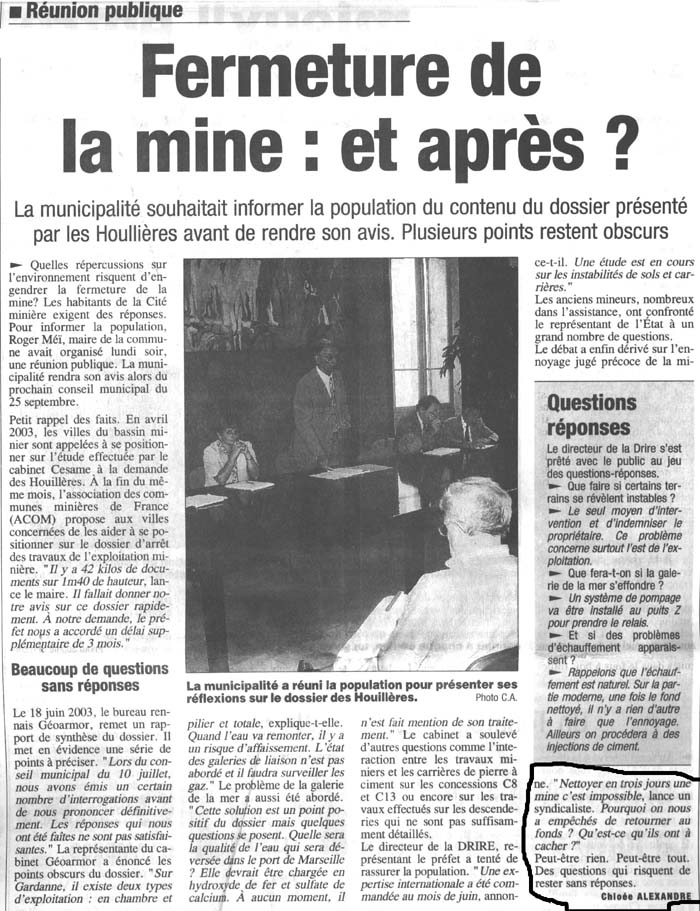
July 17, 2003: Message from one of the investigators:
The mine was flooded starting from the weekend of May 1. It had previously been "dismantled in three days" by a team of 20 people (engineers, assistant engineers, and others), while the site was "protected by mobile guards" (under the Ministry of Defense). Notably, the dismantling project of January 13, 2003, had planned for work lasting 2 to 6 months. Contrary to what the Minister of Industry had promised, no "independent or foreign expert," appointed by the municipalities concerned, was allowed to descend to verify that the mine had been properly cleaned. "They will work on paper," explained the management.
The decision was not made by the Prefect, as the law requires, but by "the Coal Directorate." Reason: a heating of the lignite deposit was detected at the end of April (just after (!) the mine had been dismantled in three days by 20 people during the Easter weekend, see La Provence article of April 24). To create "hydraulic buffers," the management stopped the pumps evacuating water. The bottom is now under dozens of meters of water.
Since this date, Gardanne has experienced an earthquake between 2.5 and 3.3 on the Richter scale per week.
An earthquake of 3.0 Richter in this type of terrain and at this depth corresponds to the explosion of 450 kg of TNT.
Two possible explanations:
-
Earthquakes induced by flooding causing gallery collapses (see page 7 of this thread). But that's enormous!
-
Explosions of very high power to "help water" flood the mine, and possibly "near the mine": the more southern area where 102 tremors above 2.9 Richter have occurred since 1989.
The mayor of Gardanne has made démarches to the Prefect to stop the flooding. These démarches have remained unanswered.
Ground subsidence will likely worsen in the coming years. The mine's gas emissions, with the rising water table, will increase, including radon emissions, since, strangely, there is radon in this mine! When the water reaches the level of the sea gallery, it will emerge in some neighborhoods located very low relative to the Gérard shaft.
If anyone knows a journalist interested in ecological and human disasters, now is the time.
Because on my side, I am unfortunately out of arguments.
If no one finds within the next two weeks a way to "alert the public widely," there will be nothing left but to wait... for the consequences.
September 27, 2003: Practically the epilogue.
In spring 2003, I was convicted of defamation in the trial brought by Antoine Giudicelli, former director of the Marcoule Center and former deputy director of military applications at the CEA, who told me during the summer of 2000 that "France had conducted underground nuclear tests on its own territory." There was a trial in the first instance in 2002. See press reports from the time. The court then applied the statute of limitations. The opponent appealed. The judge then invoked a subtle procedural clause. When accused of defamation, one has two ways to defend oneself. One can choose only one.
-
Either one pleads the exception of truth. One is then required to provide evidence that the alleged facts are true. This amounts to saying, "I heard Mr. Antoine Giudicelli tell me that there had been underground nuclear tests in France, and I can provide proof that this actually occurred." When choosing this option, all evidence must be submitted to the court within ten days after notification.
-
Or one pleads the exception of good faith. One then does not stand on the ground of proving that the alleged facts actually occurred but can provide elements showing that these allegations are not absurd and especially provide testimonies in support. This amounts to saying, "I cannot prove that France actually conducted underground nuclear tests on its own territory, but I can provide two testimonies from people who confirm that Mr. Giudicelli indeed told me such things."
Of course, in the second framework, we had situated ourselves during both trials, in the first instance and on appeal. The documents, the two testimonies confirming my statements word for word, were thus communicated to the court